Biden administration is reversing recognition of Jerusalem,’ says former Israeli ambassador to the US and former lawmaker Michael Oren.

Arutz Sheva Staff , Oct 25 , 2021 10:37 AM


Joe Biden

Joe Biden

Official White House Photo by Adam Schultz

A former Israeli diplomat and lawmaker has accused the Biden administration of pursuing an ‘anti-Semitic’ policy, and urged the Israeli government to challenge the planned reopening of the American consulate in eastern Jerusalem.

Speaking with Radio 103FM Monday morning, former Israeli Ambassador to the US and former MK Michael Oren excoriated the Biden White House over its plans to reopen a consulate in eastern Jerusalem which in the past served as a de facto mission to the Palestinian Authority.

Israel lauded the Trump administration for closing the consulate in 2019, arguing that the presence of such a consulate for the PA in Jerusalem negated Israeli sovereignty over its capital city.

The move came after the Trump White House relocated the US embassy in Israel from Tel Aviv to Jerusalem, and officially recognized Jerusalem as Israel’s capital.

Now, Oren argued Monday, the Biden administration is working to undermine that recognition, effectively reversing US policy vis-à-vis Jerusalem.

“This is a pivotal reversal on American recognition of Jerusalem as our capital,” Oren said. “It effectively makes American policy similar to that of Russia, which recognizes the western part of the city as our capital, but not all of it.”

Noting the use of the consulate prior to 2019 to offer services to Palestinian Arabs, Oren said the situation before the consulate closure was “absurd”.

“It was a totally absurd situation. Not only are these American policies impractical, they’re anti-Semitic,” Oren continued, slamming US opposition to Israeli residential neighborhoods in eastern Jerusalem.

“This is the only place in the world where Jews are prohibited from living in certain neighborhoods. Would anyone dare pass such a law in New York?”

“Basically what the Americans did is to recognize the eastern part of the city as not being part of Israel, then went on to ban Israeli Jews from living there. If you ever visited the eastern Jerusalem consulate’s website, you’d think there aren’t any Jews living in the city. There wasn’t any Hebrew there at all.”

Israel, Oren said, should challenge the plans to reopen the consulate, but avoid a serious break with the US.

“We need to take the cost of a diplomatic break with the US into account. Everything has a cost, and we need to be mindful of the fact that the US is an important ally that helps us military, and there will be a cost politically. I don’t say we should oppose them at any cost, I’m saying that we need to strongly oppose this.”


Syria vows to oppose Israel in new relations with Jordan

The Prime Minister of Jordan was quoted as saying that the Jordan-Syria ties are “in the interests of the Arab world.”

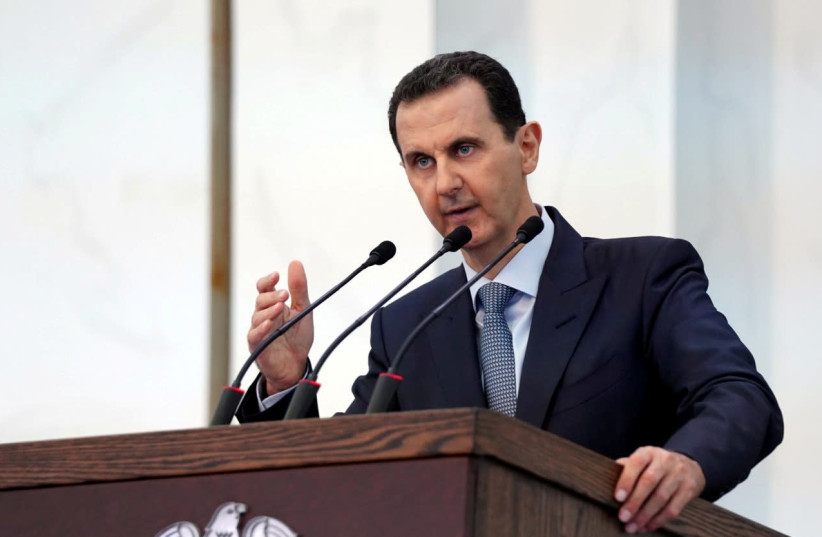
Syria's President Bashar al-Assad addresses the new members of parliament in Damascus, Syria in this handout released by SANA on August 12, 2020 (photo credit: SANA/HANDOUT VIA REUTERS)
Syria’s President Bashar al-Assad addresses the new members of parliament in Damascus, Syria in this handout released by SANA on August 12, 2020
(photo credit: SANA/HANDOUT VIA REUTERS)
Syria has vowed to continue fighting Israel as it does outreach to Jordan. It is widely known that the Syrian regime has been doing more outreach across the region. In recent years it held high-level calls with Egypt and then in more recent months with Iraq, then Jordan, and now Gulf countries. What this means is that Syria wants to come in from the cold after years of civil war. Many Arab states are signaling they also want new normalization.
According to Iranian media, this could be a concern for Iran. Although they don’t state this openly, the inference is that Iran is concerned that Syria might return to the ranks of the Arab states and that this could reduce Iran’s flow of arms via Iraq and Syria to Hezbollah in Lebanon. Stability and normalization could be bad for Iran. A drone attack on the US base at Tanf over the weekend is an example of how Iran wants destabilization. Russia supports Damascus and may also prefer Syria reoriented toward the Arab region. Tensions with Turkey are also continuing.
In this context, Iran’s Tasnim news says that a senior Syrian official spoke to Al-Mayadeen news, which is pro-Iran. He says Arab countries are turning to Syria. “Consultations between Jordan and Syria started a year ago.”
The source added that the “relationship between Syrian President Bashar al-Assad and Jordan’s King Abdullah II was not the first meeting this year. Several Jordanian envoys have visited the Syrian presidential palace this year.”
This is important for Syria. “A year ago was not a good time for Jordan to make public contact with Damascus, but now is a good time,” he said. Damascus wants Iran to know that it will continue to oppose Israel even as it does outreach to countries that have peace with Israel, such as Jordan and the UAE.

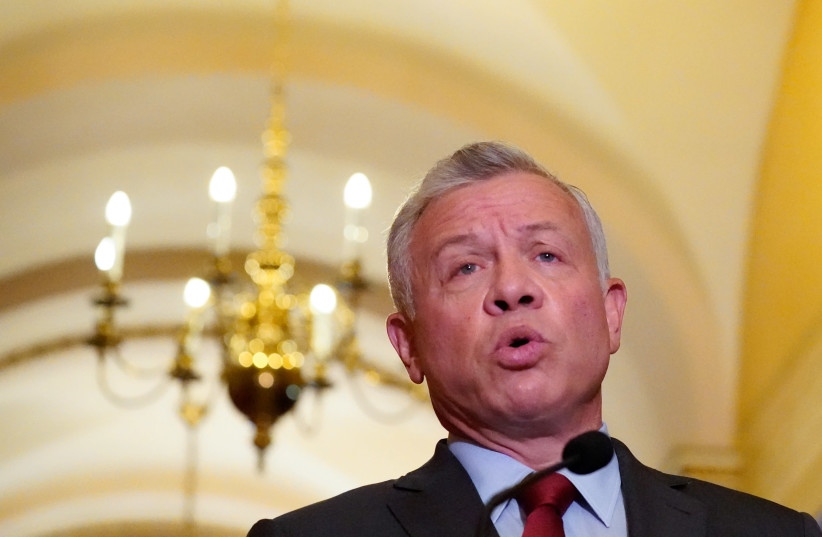
Jordan's King Abdullah II speaks after being welcomed by US House Speaker Nancy Pelosi (D-CA) to the US Capitol in Washington, US, July 22, 2021. (credit: REUTERS/ELIZABETH FRANTZ)Jordan’s King Abdullah II speaks after being welcomed by US House Speaker Nancy Pelosi (D-CA) to the US Capitol in Washington, US, July 22, 2021. (credit: REUTERS/ELIZABETH FRANTZ)

“The source said that Syria has not and will not change its position on the normalization of relations with the Zionist regime. Damascus considers normalization to be wrong and detrimental to Arab and Palestinian interests.” The official said that “any change in Syria’s position towards Israel is a waiver of rights, and this is not an issue.”
What Iran wants us to know is that “Iran has not been mentioned in talks with any Arab country. Previously, relations with Tehran were a problem for Arab countries in their relations and consultations with Syria,” Tasnim says. “The official said that Syria will not give up the fight with Israel. Syria will not resort to alliances that are not in line with its interests and principles,” Tasnim says. Jordan recently opened a border crossing with Syria. There is even talk of supplying Lebanon with energy via Jordan and Syria. “Jordan has entered a new path to normalize relations with Syria,” the report says.
“Jordan is aware of the advantages and specifics of its relationship with Syria. If the situation in Syria is stable, it can support Jordan in the field of food, and Jordan is a gateway between Syria and the GCC countries,” said political analyst Ghassan Youssef.
Regarding Jordan’s statement that “Jordan is working with the Arab countries and the international community to find a solution to the Syrian crisis,” the source said, “this makes Jordan not think that it is moving against the current and causes the reduction of pressure on this country is due to its interaction with Syria.” It was not clear what that statement meant.
However, another part of the report notes that Jordan has close relations with the US and that the US is aware of the opening to Syria and that this means the US may be supporting the outreach. “The problem [for the US] is because of the support of big countries like China for Syria.”
The report notes that high-level government ministers of Syria traveled to Jordan recently to talk energy deals. “Syrian Minister of Oil and Mines Bassam Ta’meh and Minister of Electricity Ghassan al-Zamil met with Jordanian Minister of Energy Haleh Zawati during a visit to Jordan.”
According to the statement, the meeting focused on the expansion of relations between the two countries in the field of oil and electricity. “Jordanian and Syrian officials discussed the connection of the two countries’ electricity grids, as well as the construction of a joint gas network between the two countries, known as the Arab Gas Grid, as well as cooperation in the field of renewable energy,” the report said.
What might this mean for Jordan’s role in regional issues and stance on Palestinian issues? The Prime Minister of Jordan was quoted as saying that the Jordan-Syria ties are “in the interests of the Arab world and, most importantly, Palestine.” The Syrian ambassador to Amman, Essam Niall, also praised Jordan’s firm stance on the Palestinian issue, despite all the pressure, and stressed that Damascus is working hard to expand relations with Jordan, the report said.
The talk of Israel may be lip service but it shows how Iran wants to keep the Israel issue on the radar as any new relations with Syria emerge. Iran wants Syria to be part of the “axis of resistance” and host Iranian forces, Hezbollah and others. It wants to expand the Iranian “road to the sea” via Jordan and traffic in drones and precision-guided missiles. Syria is also a center of the illicit drug trade in the region, likely part of the worldwide Hezbollah role in drug trading.
This is why we hear about captagon shipments from Syria. Syria has become a “narco-state” the Economist said in July 2021. Syria is under sanctions and wants a way out. It uses Lebanon as well. This has spread economic chaos across Syria and the region. The question for Iran is how to continue to base forces around southern Syria.
If Syria works with Jordan then Jordan and others will want a stable Syria. Iran wants to use Syria as a base to strike at Israel. This means that there are no common interests involved. That is why Iran wants to pressure Syria to at least pay lip service to the Israel issue in talks with Jordan.


Sudan PM, ministers detained in apparent military coup

Sudan has been on edge since a failed coup plot last month.

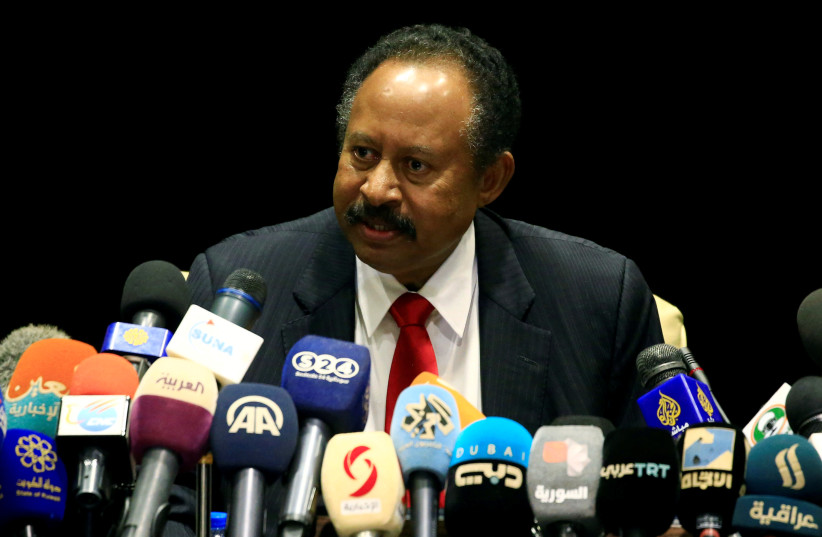
Sudan Prime Minister Abdalla Hamdok speaks during joint press conference with German Foreign Minister Heiko Maas in Khartoum, Sudan September 3, 2019 (photo credit: REUTERS/ MOHAMED NURELDIN ABDALLAH)
Sudan Prime Minister Abdalla Hamdok speaks during joint press conference with German Foreign Minister Heiko Maas in Khartoum, Sudan September 3, 2019
(photo credit: REUTERS/ MOHAMED NURELDIN ABDALLAH)
Soldiers arrested most of the members of Sudan’s cabinet and a large number of pro-government party leaders on Monday in an apparent military coup, three political sources said, throwing a fragile transition towards democracy into disarray.
Prime Minister Abdalla Hamdok was detained and moved to an undisclosed location after refusing to issue a statement in support of the coup, the information ministry said.
Joint military forces holding Hamdok under house arrest were pressuring him to issue a supportive statement, it said.
There was no immediate comment from the military.
Several people were injured on Monday in clashes between Sudanese soldiers and anti-coup protesters who tried to get close to buildings housing military headquarters in Khartoum, Al-Arabiya TV reported, citing witnesses.
Sudan has been on edge since a failed coup plot last month unleashed bitter recriminations between military and civilian groups meant to be sharing power following the 2019 ouster of former leader Omar al-Bashir.

French President Emmanuel Macron welcomes Sudan's Prime Minister Abdalla Hamdok as he arrives for a meeting at the Elysee Palace in Paris (credit: REUTERS)French President Emmanuel Macron welcomes Sudan’s Prime Minister Abdalla Hamdok as he arrives for a meeting at the Elysee Palace in Paris (credit: REUTERS)

Bashir was toppled and jailed after months of street protests. A political transition agreed after his ouster has seen Sudan emerge from its isolation under three decades of rule by Bashir and was meant to lead to elections by the end of 2023.
The military had stirred unrest in eastern Sudan and used the crisis to implement a coup against the government of Hamdok, the director of his office told al-Arabiya TV channel.
The takeover happened in spite of an agreement Hamdok had reached with the head of a ruling council, Abdel Fattah al-Burhan, in the presence of US special envoy Jeffrey Feltman, he added, according to the Dubai-based channel.
Sudan’s state television said Burhan would deliver a statement shortly.
Protesters had moved past barricades and entered the street surrounding military headquarters in the capital, Khartoum, footage on the Qatar-based Al-Jazeera Mubasher television channel showed.
The footage also showed soldiers standing by as protesters passed them and marched down the street.
Citing witnesses, Al-Arabiya television said there were injuries in clashes in front of army headquarters.
The information ministry said military forces had also arrested civilian members of the Sovereign Council and members of the government.
In a statement sent to Reuters, the ministry asked Sudanese “to block the military’s movements to block the democratic transition”. “We raise our voices loudly to reject this coup attempt,” it said.
A Reuters witness saw joint forces from the military and from the powerful, paramilitary Rapid Support Forces stationed in the streets of Khartoum.
The military was meant to pass leadership of the joint Sovereign Council to a civilian figure in the coming months.
But the timing of the handover had been left unclear, as transitional authorities struggled to move forward on key issues including whether to hand Bashir over to the International Criminal Court.
In recent weeks, civilian officials had claimed credit for some tentative signs of economic stabilization after a sharp devaluation of the currency and the lifting of fuel subsidies.
Feltman, who was visiting Sudan on Saturday and Sunday, said the United States was deeply alarmed at reports of a military takeover of the transitional government in Sudan.
On the official Twitter of the State Department’s Bureau of African Affairs, Feltman warned that a military takeover would contravene Sudan’s Constitutional Declaration and puts at risk US assistance.
The United Nations was deeply concerned about reports of a coup and attempts to undermine Sudan’s political transition, said Volker Perthes, special representative of the UN secretary-general for the country.
Military forces stormed Sudanese Radio and Television headquarters in Omdurman, the twin city of Khartoum, and arrested employees, the information ministry said on its Facebook page.
Two major political parties, the Umma and the Sudanese Congress, condemned what they said was a coup and the campaign of arrests.
The Reuters witness said military and paramilitary forces deployed across Khartoum, restricting civilians’ movements, as protesters carrying the national flag burnt tires in different parts of the city.
Khartoum airport was shut and international flights were suspended, according to Dubai-based al-Arabiya TV channel.
POPULAR TECHNOCRAT
Hamdok is an economist and former senior UN official who was appointed as a technocratic prime minister in 2019 and is well respected internationally.
Though popular with pro-democracy civilian groups, he has struggled to keep the transition going due to political splits between the military and civilians and the pressures of an economic crisis.
Family sources told Reuters that military forces had stormed the house of Hamdok’s media adviser and arrested him.
Many of the ministers and officials who had been arrested had been intensifying their rhetoric towards the military in the past few weeks.
Reuters witnesses said internet services appeared to be down in Khartoum.
The Sudanese Professionals Association, a main activist coalition in the uprising against Bashir, called on supporters to mobilize after what it called the arrest of cabinet members.
“We urge the masses to go out on the streets and occupy them, close all roads with barricades, stage a general labor strike, and not to cooperate with the putschists and use civil disobedience to confront them,” the group said in a statement on Facebook.
As tensions built this month, a coalition of rebel groups and political parties aligned themselves with the military and called on it to dissolve the civilian government, staging a sit-in outside the presidential palace.
Last week, several cabinet ministers took part in big protests in several parts of Khartoum and other cities against the prospect of military rule.
The military head of the Sovereign Council has previously asserted his commitment to the transition.
Aside from the political tension, Sudan is in the midst of a deep economic crisis, marked by record-high inflation and shortages of basic goods, that was beginning to show signs of easing amid flows of international aid.