Military chief Aviv Kohavi reportedly orders air force to ‘intensely’ drill for possible attack on Iran, after 2-year pause in training

By TOI STAFF
21 October 2021, 9:32 pm

An Israeli Air Force Boeing KC-135 Stratotanker and F-16 fighter jets perform during an air show over Tel Aviv, on May 9, 2019, as Israel marks its 71st Independence Day. (Jack Guez/AFP)

The Israeli Air Force has resumed training for a possible strike on Iranian nuclear facilities, Israeli television reported Thursday.

According to Channel 12 news, Israel Defense Forces Chief of Staff Aviv Kohavi ordered that budgetary funds be set aside for drilling such a scenario, after a two-year hiatus.

The network said Kohavi had also ordered that the air force train “intensely” in simulating a strike on Iran’s nuclear program.

The orders were reportedly given during a meeting Kohavi held at his office in recent days.

The report did not cite a source and there was no comment from military officials.

On Monday, Channel 12 reported that the government planned to allocate NIS 5 billion ($1.5 billion) for an attack on Iran, with NIS 2 billion ($620 million) coming from the 2022 defense budget and the rest coming from the current budget.

A day later, Defense Minister Benny Gantz defended the government’s requested budget increase for the military, warning that the additional funds are necessary in order to prepare for a potential strike on Iranian nuclear sites.


IDF Chief of Staff Aviv Kochavi (left) and Defense Minister Benny Gantz attend a Knesset Foreign Affairs and Defese Committee meeting, on October 19, 2021. (Yonatan Sindel/Flash90)

Kohavi publicly declared in January that the IDF was preparing fresh “operational plans” for a potent military strike, and in August that Iran’s nuclear progress has prompted the IDF “to speed up its operational plans,” with a fresh budget to do so.

In his speech to the United Nations General Assembly last month, Prime Minister Naftali Bennett declared that “Iran’s nuclear program has hit a watershed moment, and so has our tolerance. Words do not stop centrifuges from spinning… We will not allow Iran to acquire a nuclear weapon.”

United States President Joe Biden’s administration has said it is still seeking a joint US-Iranian return to compliance with the 2015 nuclear deal, while acknowledging that it will not wait indefinitely for Tehran to return to the negotiation table.

If it fails to do so, US Secretary of State Antony Blinken told his Israeli counterpart Yair Lapid this month that “every option” will be on the table — an apparent uptick in rhetoric after Biden told Bennett in August that Washington was willing to consider “other options” if the nuclear deal cannot be revived.


Prime minister touts importance of relationship with Moscow before taking off for hours-long trip, though Kremlin says forging close ties between leaders will take time


Israeli Prime Minister Naftali Bennett speaks at the Muni Expo 2021 conference in Tel Aviv, on October 20, 2021. (Avshalom Sassoni/Flash90)

Israeli Prime Minister Naftali Bennett speaks at the Muni Expo 2021 conference in Tel Aviv, on October 20, 2021. (Avshalom Sassoni/Flash90)

Prime Minister Naftali Bennett arrived Friday for a lightning visit to Sochi to meet with Russian President Vladimir Putin for talks expected to focus on Iran and Syria.

Bennett will only be in the Russian resort city for about five hours, during which he’ll hold his first meeting with the Russian leader since entering office before jetting back to Israel Friday afternoon before the start of Shabbat at sundown. The leaders also spoke two weeks ago when Bennett congratulated Putin on his 69th birthday.

“The two will discuss a series of diplomatic, security and economic issues involving both countries, as well as important regional matters, primarily Iran’s nuclear program,” the Prime Minister’s Office said when the visit was announced several days ago. His spokesperson said the trip came at Putin’s invitation.

Speaking from the tarmac before taking off, Bennett touted the importance of ties with Moscow, which Israel sees as a major regional player due to its support for Syrian President Bashar Assad and the influence it wields over Tehran.

“The ties between Russia and Israel are a significant pillar of Israel’s foreign policy, both because of Russia’s special position in the region and its international status, and also because there are a million Russian speakers in Israel who are a bridge between the two countries,” he said in a video distributed by his office.

“In general, the foreign policy and international status of Israel are significantly strengthening. There is considerable energy and the direction is very good,” he added.

Bennett’s predecessor Benjamin Netanyahu boasted of a close relationship with Putin, which he claimed created the space for Israel to wage a years-long air campaign against Iran-backed fighters in Syria. That campaign has continued under Bennett, though recent reports have pointed toward tensions in the Israel-Russia relationship over policies toward Syria.

Russia is also a member of the P5+1 group of countries that negotiated the Iran nuclear deal, with talks on the US rejoining the moribund pact possibly set to resume sometime soon, according to officials.

Israel has lobbied against the resumption of the deal and pushed for a concerted international effort to keep Iran from developing nuclear weapons. On Thursday, Finance Minister Avigdor Liberman, whose political base is largely made up of Russian speakers from the former Soviet Union, said a military clash with Iran was “only a matter of time.”

The Kremlin has acknowledged that Bennett will likely not have the same rapport with Putin that Netanyahu did.

Israeli Prime Minister Benjamin Netanyahu (R) and Russian President Vladimir Putin cut the ribbon to unveil the Memorial Candle monument in Jerusalem on January 23, 2020, to commemorate the people of Leningrad during the Second World War Nazi siege on the city. (Amit Shabi/Pool/AFP)

“We try not to compare Mr. Netanyahu to the current Prime Minister because Netanyahu worked with President Putin for lots of years and they knew each other very well and it takes time to develop new personal relationships,” Kremlin spokesman Dmitry Peskov told i24News.

While Bennett will be hoping to get Putin to use his influence to curb Iran, the challenge was highlighted by Moscow hosting Iran’s military chief of staff just days before Bennett’s visit.

After meetings with his Russian counterpart, Major General Mohammad Hossein Baqeri hailed the close military ties between Tehran and Moscow.

“The military and defense relations have grown remarkably in recent years, and we hope that the growing course of cooperation would continue,” Iran’s Tasnim news agency quoted him as saying.

Bennett’s visit follows a trip by his foreign minister Yair Lapid to Moscow last month, where he met with his Russian counterpart Sergei Lavrov.

The Walla news site later reported that during that meeting, Lavrov asked for Israel to push the United States to agree to hold trilateral talks on the ongoing conflict in Syria.

Foreign Minister Yair Lapid (left) makes comments to the press alongside his Russian counterpart, Sergey Lavrov, in Moscow, on September 9, 2021. (Shlomi Amsalem/GPO)

Israel’s freedom of action in Syria was seriously curtailed after Russia provided advanced S-300 air defense batteries to Syrian President Bashar Assad’s forces following a 2018 incident in which the Syrian army, aiming at Israeli jets, knocked a Russian plane out of the sky instead, killing all 15 people on board.

Israel has carried out hundreds of airstrikes inside Syria in the course of the country’s civil war, targeting what it says are suspected arms shipments believed to be bound for Lebanon’s Iran-backed Hezbollah terror group, which is fighting alongside Syrian government forces. Israel rarely acknowledges or discusses such operations.


Liberman: Conflict with Iran a matter of time, not far off

Finance Minister Avigdor Liberman said “a confrontation with Iran is only a matter of time, and not a long time.”

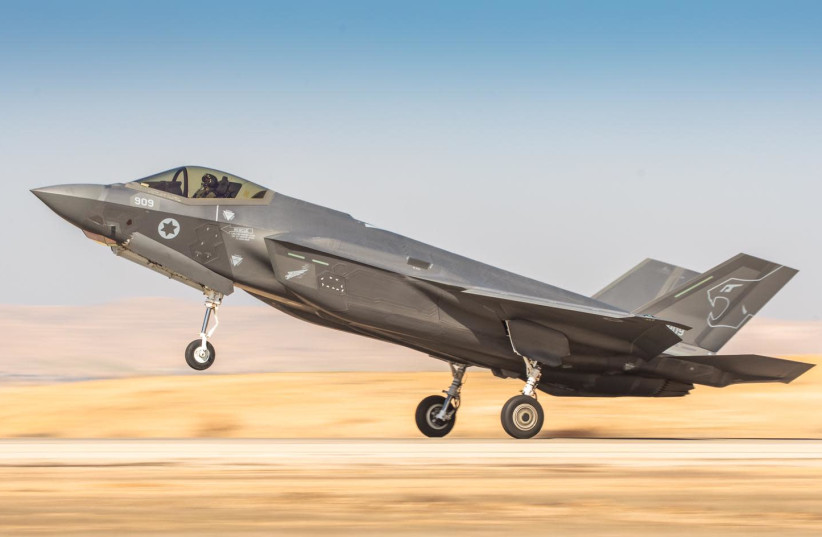
An IAF fighter jet is seen taking off amid the Vered Hagalil drill in Israel's North. (photo credit: IDF SPOKESPERSON'S UNIT)
An IAF fighter jet is seen taking off amid the Vered Hagalil drill in Israel’s North.
(photo credit: IDF SPOKESPERSON’S UNIT)
Finance Minister Avigdor Liberman said Thursday that “a confrontation with Iran is only a matter of time, and not a long time.”
In an interview at Walla studios with Tal Shalev and Yaki Adamkar, Liberman stressed that “no diplomatic move or agreement will stop the Iranian nuclear program. They see North Korea, despite the diplomatic moves, they see its unprecedented intensification. The Jewish people must not live in illusions. Hitler wrote his book in 1923 and then seized power. This is a problem of the international community but first of all ours because they have stated that their policy is the destruction of Israel, and they do mean it.”
The Finance Minister referred to the defense budget approved by the government. “They were surprised why such a large budget was approved for the IDF. The money is going to become stronger and the purchase of advanced systems. There is also money for the northern protection program after it took three years.”
Liberman discussed the outline for shortening shifts and the agreement reached by Health Minister Nitzan Horowitz with the protest organizers. “I talked to Horowitz, he’s a decent man. This arrangement for interns was determined in 2011. The intern’s shift is 26 hours, and the average intern’s salary is NIS 24,000 per month. For ten years it did not bother anyone. We are in the government for three months and we are being attacked to fix the whole situation, it is not fair. We will examine this in the framework of the agreement with the medical union.”
According to him, “Horowitz did not finalize anything” on his own with the interns. “We proposed an outline called ‘Periphery First’ with Orna Barbivai and Horowitz, and it is important to emphasize that there is no shortage of interns at Tel Hashomer or Ichilov, there is a great shortage in the periphery, Eilat, Nahariya and Safed, and we need to take care of them. That is why we have built an outline that is acceptable to everyone. I assume that after Pesach we will enter into negotiations on a new collective arrangement and until then nothing. Everything else is really stories.”

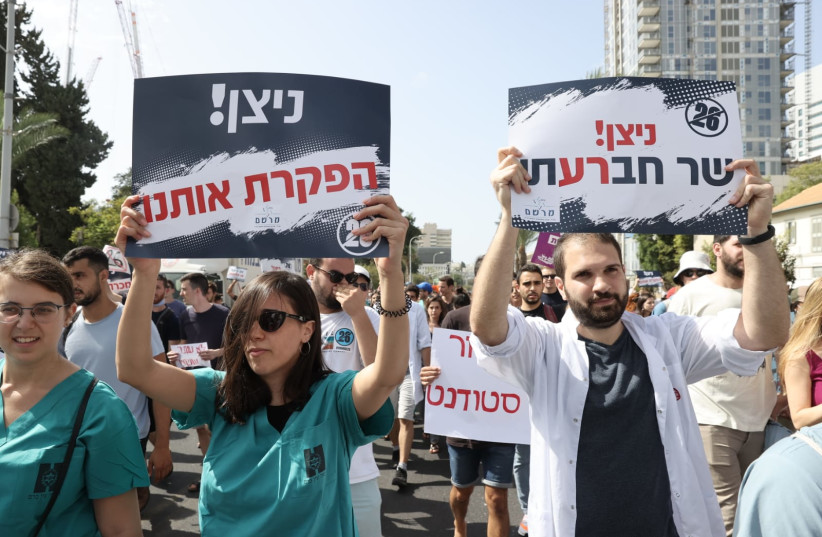
 MED STUDENTS demonstrate in Tel Aviv in support of doctors, interns and residents who resigned in protest of 26-hour-shifts and heavy workload in hospitals, October 17, 2021 (credit: MIRSHAM)MED STUDENTS demonstrate in Tel Aviv in support of doctors, interns and residents who resigned in protest of 26-hour-shifts and heavy workload in hospitals, October 17, 2021 (credit: MIRSHAM)

He went on to attack protest leader Ray Bitton and said: “You can log on to her Facebook and see that five days a week she runs a private clinic from morning to night, with all the services. So it is impossible to say that everyone is exhausted and works for a meager wage. Working conditions are not optimal, but reasonable. This is what is accepted in the United States and around the world, not just here.”
The finance minister was asked about the climate crisis, and the decision to raise taxation on disposable products. “I have not used disposable utensils for a long time. I do not understand the madness that consumption here is over four times as much as the European Union, it harms the environment and the climate.”
He referred to the harm to the ultra-Orthodox public as a result of the reform. “I do not understand who sees this as harmful to him. 40 years ago there were no single-use utensils and no dishwashers, these stories are plots of Shas and United Torah Judaism. These are not taxes, in the end, the consumer will not buy single-use utensils, and it is meant to change the behavioral patterns of the citizens of Israel.”
Liberman was also asked about the salaries of IDF NOCs and the supplement to the pension. “This arrangement was set in the 1960s by Ben-Gurion. We made orders and reduced the amount, took off the regular service years for calculating the pension and saved several hundred million [shekel]. The attempt to present NOCs as pirates of the Caribbean is invalid.”
On the salary for soldiers in regular service, the finance minister said: “There is no salary for regular soldiers, there is a subsistence allowance. We do not have a mercenary or professional army. I promised before the election to increase the subsistence allowance for regular soldiers by 50%, what do you want? It’s been four months, check me after a year.”
Liberman accused the Likud and opposition leader Benjamin Netanyahu of the cynical use of IDF soldiers. “This is the most cynical and dangerous thing I have ever seen. This is the first time that a big party is manipulating young people, aged 18, 19 and 20. Netanyahu makes political use of soldiers to incite against another party. Netanyahu said at the Likud faction meeting that ‘this is the strongest point in public opinion at the moment, talk about it as much as possible.’ Who prevented him from doing that? You were in power until 2021, why did Netanyahu not do that? This is utter cynicism and manipulation. He does not really care about IDF soldiers, it is a political use.”