
In first UN address, Biden defended the chaotic withdrawal from Afghanistan and expressed support for the two-state solution
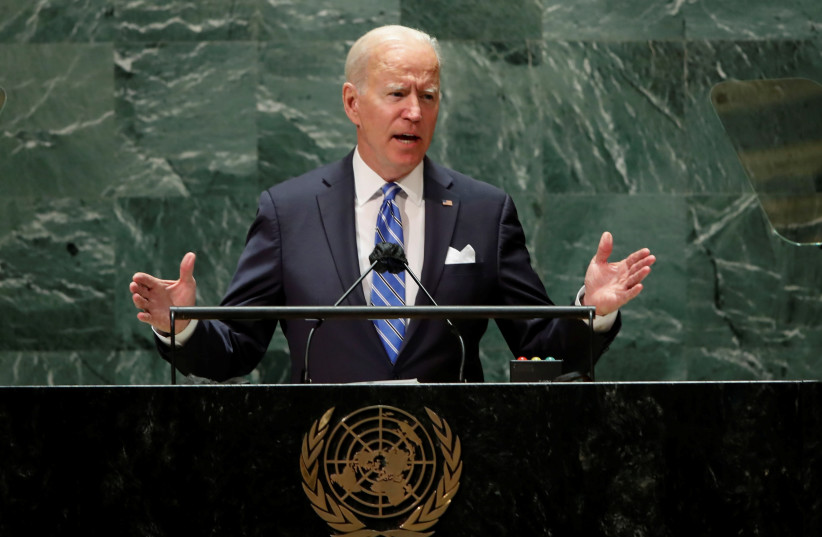
  1.  US President Joe Biden addresses the 76th Session of the UN General Assembly in New York City (photo credit: REUTERS/EDUARDO MUNOZ/POOL)
US President Joe Biden addresses the 76th Session of the UN General Assembly in New York City
(photo credit: REUTERS/EDUARDO MUNOZ/POOL)
WASHINGTON – US President Joe Biden addressed the UN General Assembly in New York for the first time since taking office on Tuesday. He called on world leaders to join forces “to build a better future” and to address joint challenges such as climate change and COVID-19.
He also dedicated parts of his speech to defend the US’s chaotic withdrawal from Afghanistan. “I stand here today for the first time in 20 years with the United States not at war. We’ve turned the page,” Biden said. “All the unmatched strength, energy, commitment, will, and resources, our nation are now fully and squarely focused on what’s ahead of us, not what was behind.”
“We’ve ended 20 years of conflict in Afghanistan, and as we close this period of relentless war, we’re opening a new era of relentless diplomacy,” said Biden.
He said that the US is ready to return to the 2015 nuclear agreement with Iran if the Islamic Republic would do the same. “The United States remains committed to preventing Iran from getting a nuclear weapon,” Biden said. “We are working with the P5+1 to engage Iran diplomatically, to seek a return to the JCPOA. We are prepared to return to full compliance if Iran does the same.”
He also voiced support for the two-state solution but recognized that we are “a long way from that goal at the moment.”
“The commitment of United States to Israel’s security is without question and our support for an independent Jewish state is unequivocal, but I continue to believe that the two-state solution is the best way to ensure Israel’s future as a Jewish democratic state, living in peace, alongside a viable, sovereign and democratic Palestinian state,” said Biden. “We’re a long way from that goal at this moment, but we must never allow ourselves to give up on the possibility of progress.”
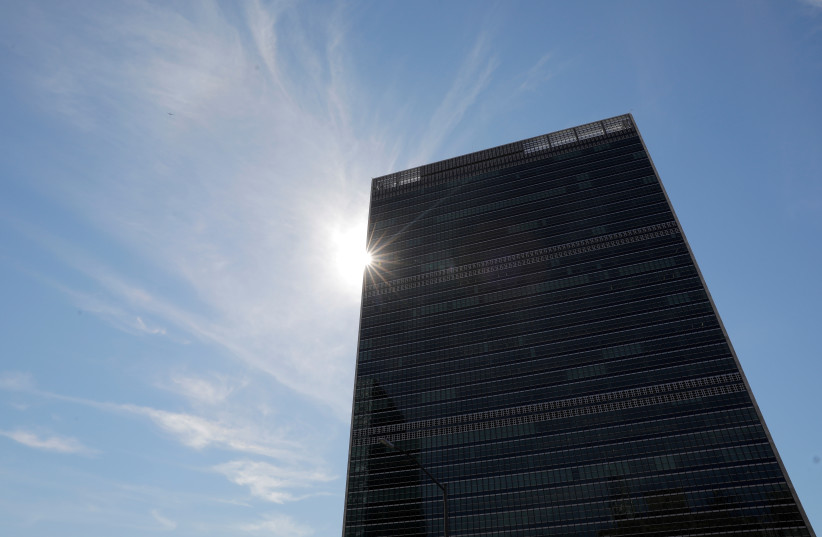
 The sun shines behind the United Nations Secretariat Building at the United Nations Headquarters. New York City, New York, U.S., June 18, 2021.  (credit: REUTERS/ANDREW KELLY/FILE PHOTO)The sun shines behind the United Nations Secretariat Building at the United Nations Headquarters. New York City, New York, U.S., June 18, 2021. (credit: REUTERS/ANDREW KELLY/FILE PHOTO)

Speaking about the aftermath of the withdrawal from Afghanistan, Biden said that “those who commit acts of terrorism against us will continue to find a determined enemy in the United States.”
“The world today is not the world of 2001, though,” Biden noted. “And the United States is not the same country we were when we were attacked on 9/11, 20 years ago. Today, we’re better equipped to detect and prevent terrorist threats and we are more resilient in our ability to repel them and to respond,” he said.
“We’ll meet terrorist threats that arise today and in the future with a full range of tools available to us, including working in cooperation with local partners, so that we need not be so reliant on large-scale military deployments,” he continued.
He went on to say that US military power “must be our tool of last resort not our first and should not be used as an answer to every problem we see around the world.”
Speaking about the COVID-19 pandemic, Biden said that many of the world’s greatest concerns “cannot be solved or even addressed through the force of arms.”
“Bombs and bullets cannot defend against Covid-19 or its future variants,” he said. “To fight this pandemic, we need a collective act of science and political will. We need to get shots in arms as fast as possible and expand access to oxygen, tests, treatments to save lives around the world.”
He called on world leaders to work together to address climate challenges. “To keep within our reach the vital goal of limiting global warming to 1.5 degrees celsius, every nation needs to bring their highest possible ambitions to the table when we meet in Glasgow for COP26,” he said.


House Dems vote to remove Iron Dome funding from upcoming budget

The decision stemmed from a fear that progressives would not vote for the budget should the $1 billion in funding for the Iron Dome remain in the bill.

THE IRON Dome anti-missile system intercepts a rocket launched from the Gaza Strip toward Israel, as seen from Ashkelon last month. (photo credit: REUTERS/AMMAR AWAD)
THE IRON Dome anti-missile system intercepts a rocket launched from the Gaza Strip toward Israel, as seen from Ashkelon last month.
(photo credit: REUTERS/AMMAR AWAD)
US House Democrats have voted to remove funding for Israel’s Iron Dome on Tuesday, following increased pushback from progressives on the issue, Politico’s co-Congressional Bureau Chief reported.
The decision stemmed from a fear that progressives would not vote for the budget should the $1 billion in funding for the Iron Dome remain in the bill.
Earlier last week, Rep. Alexandria Ocasio-Cortez also introduced an amendment to the defense budget bill which would suspend the transfer of $735 million worth of Boeing Joint Direct Attack Munitions (JDAM) to Israel. JDAMs are kits that convert unguided bombs into precision-guided munitions.


Saudi Arabia blasts push by Iran for nuclear bomb

SauThe Kingdom’s Energy Minister, Prince Abdulaziz bin Salman, also called for the nuclear threat from Israel be dealt with. (AFP/File Photo)di Arabia blasts push by Iran for nuclear bomb

  • Prince Abdulaziz was speaking at annual general conference of International Atomic Energy Agency in Vienna
  • Minister said the region needs to be free of weapons of mass destruction

DUBAI: Saudi Arabia on Monday condemned Iran’s drive to obtain a nuclear bomb and Tehran’s failure to cooperate with the UN watchdog inspecting its nuclear program.

The Kingdom’s Energy Minister, Prince Abdulaziz bin Salman, also called for the nuclear threat from Israel be dealt with, and for the Middle East to be free of nuclear weapons.

Prince Abdulaziz told the annual general conference of the International Atomic Energy Agency in Vienna: “The Kingdom expresses its concern with regards to Iran’s noncompliance with its commitments to the safeguards agreement, and its non-transparency with the agency, which poses a threat to the non-proliferation ecosystem.

“The Kingdom also supports all international efforts aimed at preventing Iran from possessing nuclear weapons, and developing the non-proliferation system in the region and the world.”

Last week Iran allowed IAEA inspectors to install memory cards into cameras the watchdog uses to monitor its nuclear facilities, after a visit to Tehran by IAEA secretary general Rafael Grossi.

The deal allowed the continuation of the inspection process, which is vital for any potential deal between Iran and world powers, and avoided an embarrassing rebuke for Tehran at this week’s IAEA meeting. But critics say this is just another stage in the “cat and mouse” game Tehran is playing with the international community as it pursues a nuclear bomb.

Prince Abdulaziz also addressed the issue of Israel, the only country in the Middle East known to have a military nuclear capability, though it has never officially admitted it.

“The Kingdom also reaffirms the importance of confronting nuclear proliferation in the Middle East, which requires dealing with Israel’s nuclear threat, which not only threatens the security and stability of the Middle East, but also the entire world,” he said.

“In this regard, we reaffirm the importance of implementing the decision of 1995 completely in creating a nuclear weapons free zone in the Middle East.

“The Kingdom is committed to its national policy, which ensures the highest standards of transparency andreliability, and the highest levels of safety. The Kingdom works, in this regard, to develop peaceful uses of nuclear technology in various fields, including its national nuclear energy project.”

The Saudi delegation is due to hold talks with several other countries at the Vienna meeting, including the US delegation under Energy Secretary Jennifer Granholm.

Prince Abdulaziz also revealed that Saudi Arabia had made a contribution of $10 million toward the construction of a nuclear security center in the Austrian town of Seibersdorf.