
With eye on Iran, Israeli navy steps up Red Sea presence

Vice Adm Eli Sharvit stopped short of confirming a series of attacks and mishaps on Iranian ships that have been attributed to Israel.

By: AP | Israel |
September 16, 2021 11:37:19 pm

An oil platform in Israel’s offshore Leviathan gas field is seen from on board the Israeli Navy Ship Atzmaut as a submarine patrols, in the Mediterranean Sea, Wednesday, Sept. 1, 2021. (AP)

Israel’s navy has stepped up its activities in the Red Sea “exponentially” in the face of growing Iranian threats to Israeli shipping, the country’s just-retired navy commander said in an interview.

Vice Adm Eli Sharvit stopped short of confirming a series of attacks and mishaps on Iranian ships that have been attributed to Israel. But he described Iranian activities on the high seas as a top Israeli concern and said the navy is able to strike wherever necessary to protect the country’s economic and security interests.

“The state of Israel will protect its freedom of navigation across the globe,” Sharvit told The Associated Press, days after completing his five-year term. “That’s not related to distance from the country.”

Sharvit was a busy man during his tenure overseeing a small but well-equipped force responsible for safeguarding Israel’s Mediterranean coast as well as the Red Sea, a vital gateway for imports from Asia.

While the Israeli navy has an overwhelming advantage over its enemies in the region, it nonetheless faces an array of threats. They include the Lebanese militant group Hezbollah, which possesses an arsenal of guided surface-to-sea missiles, and Gaza’s Hamas militant group, which has developed a small squad of naval commandos, as well as the challenges posed by Iran’s military activity across the region.

One of the navy’s most important responsibilities is protecting Israel’s natural gas platforms in the Mediterranean Sea, which now provide some 75% of the country’s electricity.

To the north, Hezbollah has made no secret of its intentions to target those platforms if war breaks out. The Iranian-backed militant group successfully struck an Israeli naval vessel during a 2006 war, killing four soldiers, and is believed to have vastly upgraded its missile stockpile since then. Israel says Iran continues to try to smuggle sophisticated weapons to Hezbollah.

Sharvit confirmed that Israel has intercepted many arms shipments to Hezbollah. “We are very vigilant concerning seaborne arms shipments, and every time that a shipment is one of arms, and not something else, we act,” he said.

With Lebanon’s economy in disarray, however, he said Israel has “no interest” in stopping fuel deliveries meant for civilian use.

Along Israel’s southern flank, Sharvit said Hamas has a small but formidable unit of well-trained naval commandos.

Hamas frogmen managed to infiltrate an Israeli beach during a 2014 war before they were killed. Since then, the unit has been equipped with state-of-the-art equipment allowing them to travel underwater well up Israel’s coastline and making them much harder to detect, Sharvit said.

During a recent war in May, Israel says it thwarted an attempt by Hamas to launch a torpedo-like underwater drone at Israeli targets.

Israel has faced criticism over its naval blockade and heavy restrictions on Gaza. Israel says the blockade is needed to prevent a Hamas military buildup. But critics, including human rights groups and U.N. officials, say the policy amounts to collective punishment.
???? The Indian Express is now on Telegram. Click here to join our channel (@indianexpress) and stay updated with the latest headlines


Iran has reportedly not been this close to nuclear capability since before the nuclear accord in 2015.

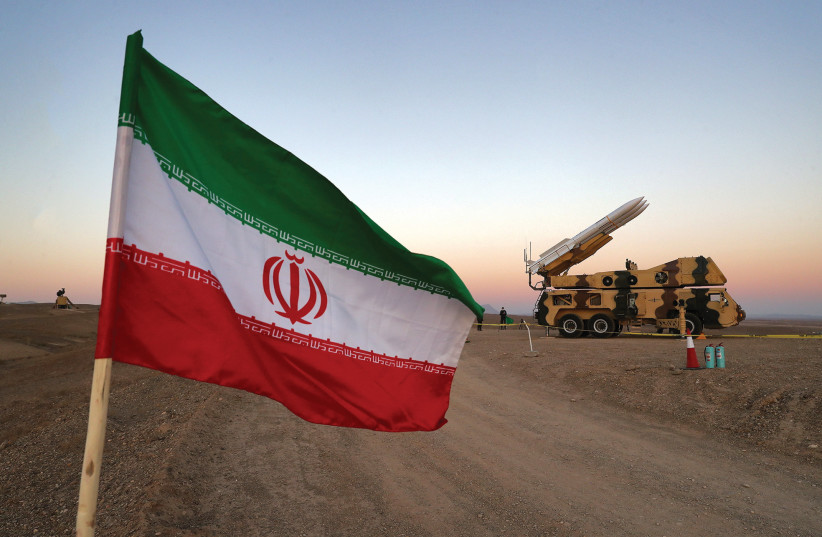
AN IRANIAN FLAG is pictured near in a missile during a military drill, with the participation of Iran’s air defense units in October.  (West Asia News Agency/Reuters) (photo credit: WEST ASIA NEWS AGENCY/REUTERS)
AN IRANIAN FLAG is pictured near in a missile during a military drill, with the participation of Iran’s air defense units in October. (West Asia News Agency/Reuters)
(photo credit: WEST ASIA NEWS AGENCY/REUTERS)
Iran is on track to obtaining enough enriched uranium for a nuclear bomb within one month, according to a report published on Monday by the Institute for Science and International Security, a US-based think tank.
The institute estimated, in a worst-case scenario, that in as little as a month Iran could produce enough weapons-grade uranium for one nuclear weapon. In three months it could produce enough weapons-grade uranium for a second weapon and in five months a third.
Iran already has 200 grams of enriched uranium metal, which is an integral element for the production of nuclear weapons.
The late Wednesday report by ISIS – also known as the “good ISIS” – would not mean the Islamic Republic could fire a nuclear weapon, as this requires additional tasks relating to detonation and delivery, but if correct, it would mean Tehran is at a new nuclear threshold where all that is needed is the political decision.
This dire prediction by the think tank came with criticism of the IAEA’S latest deal with Iran on Sunday in which a new dialogue was opened with Iran’s new government over nuclear issues, but without Tehran stopping its 60% enrichment violation of the 2015 JCPOA nuclear deal.
Since April, the Islamic Republic jumped its enrichment from 5% and 20% to the 60% level, which is considered only one level down from the 90% weaponized level.
At lower levels, Iran has in fact had sufficient quantity for multiple nuclear bombs for several months.
However, what was most significant about the report was that it was laid out in quantitative scientific terms based on IAEA reports itself, as opposed to the sometimes more vague statements by Israeli or other politicians.

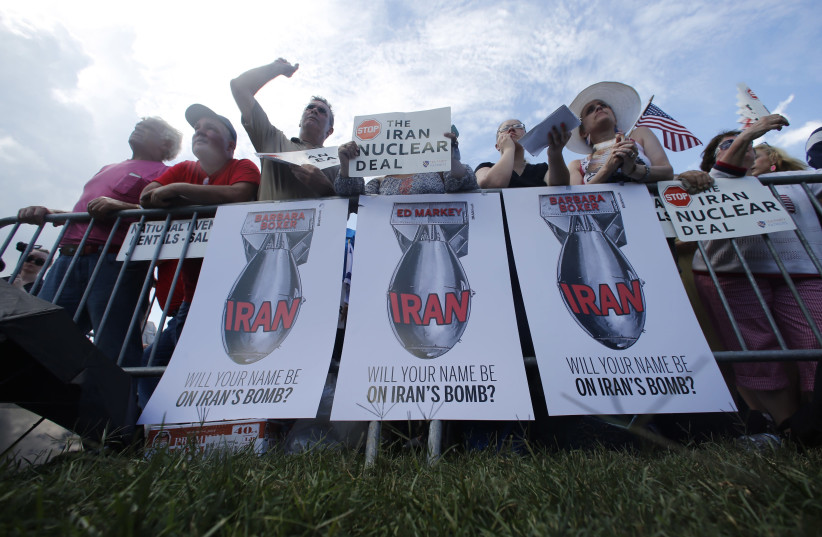
RALLYING AGAINST the Iran nuclear deal on Capitol Hill in Washington, 2015. (credit: JONATHAN ERNST / REUTERS)RALLYING AGAINST the Iran nuclear deal on Capitol Hill in Washington, 2015. (credit: JONATHAN ERNST / REUTERS)

Critics will note that the think tank’s founder David Albright is a hawk on Iran issues, but the report is based on IAEA data.
The report concluded that all Iranian moves are designed to pressure the US into concessions in the nuclear negotiations which broke down between May-June and have been totally frozen since new Iranian President Ebrahim Raisi was elected.
The current and former Israeli governments both oppose a return to the JCPOA without massive changes to fill holes whereas the Biden administration has moved aggressively to return to the deal.
To date, Biden administration officials have vaguely threatened that their patience for Iran to return to the negotiating table was not limitless, but have avoided any actual deadline.
Defense Minister Benny Gantz stated back in August that Iran was two months away from acquiring a nuclear weapon.


Bennett, Sissi discuss Iran, Hamas during first meeting in Egypt

By Lauren Marcus, World Israel News

Prime Minister Naftali Bennett met with Egyptian President Abdel-Fattah el-Sissi at the Red Sea resort city of Sharm El-Sheikh in southern Egypt, with the two leaders discussing regional security issues and economic cooperation.

The meeting comes after a statement last month from Bennett, who said that Sissi had invited him to meet in Egypt “to strengthen and expand relations between the countries in the region.”

“Prime Minister Bennett thanked Egyptian President El-Sisi for Egypt’s important role in the region and noted that in the over 40 years since it was signed, the peace agreement between the two countries continues to serve as a foundation for security and stability in the Middle East,” read a statement from the Israeli premier’s office.

“Prime Minister Bennett emphasized Egypt’s significant role in maintaining the security stability in the Gaza Strip and in finding a solution to the issue of the [Israeli] captives and missing [held in the Strip.]”

The two men also discussed the Iranian nuclear threat, Turkey’s role in Libya, and expanding trade and tourism agreements between Israel and Egypt.

“The meeting was very important and very good. During the meeting, first and foremost, we created a foundation for deep ties in the future,” said Bennett in a post-meeting statement.

“Israel is increasingly opening up to the countries of the region, and the basis of this longstanding recognition is the peace between Israel and Egypt. Therefore, on both sides we must invest in strengthening this link, and we have done so today.”

Egyptian media reported that during the meeting, Sissi offered to host Bennett and Palestinian leaders for peace talks in the near future.

The meeting comes on the heels of rising tensions between Israel and various Palestinian groups, including Gaza-based terror group Hamas and the Palestinain Authority.

Just two weeks ago, Defense Minister Benny Gantz met with PA President Mahmoud Abbas in Ramallah, in what many believed was a signal that the Jewish State was interested in resuming peace talks with the Palestinians.

Egypt has long served as a critical interlocutor between the Jewish State and Hamas, with the African nation recently pressuring the terror group to temporarily pause arson balloon launches from the Strip.

At a trilateral summit in Cairo in early September, Abbas, Sissi, and Jordan’s King Abdullah ii discussed the importance of resuming negotiations for a two-state solution to end the Israeli-Palestinian conflict, as well as supporting Abbas’ resistance to “dangerous repercussions” stemming from Jewish building in Judea and Samaria.

At the time, a statement from Palestinian news agency Wafa confirmed that Abbas was ready to embrace “confidence-building steps” with Israel aimed at “achieving comprehensive calm in Palestinian lands.”

But a jail break last week, which saw 6 Palestinian prisoners held on serious security offenses escape from a prison in northern Israel, triggered a breakdown in calm.

As Israeli authorities searched for the escapees, Gaza-based terror groups resumed launching rockets at southern Israeli communities from the Strip – the first rocket attacks since the ceasefire that ended May 2021’s Operation Guardian of the Walls clash.

In July, Foreign Minister Yair Lapid met with his Egyptian counterpart, Sameh Shoukry, in Brussels, discussing a wide range of topics including freeing Israeli hostages that are currently held by terror groups in the Gaza Strip.
