IDF strikes Hamas targets in Gaza after rocket fired at Israel

Riots and attacks broke out across the West Bank following the recapture of two escaped Gilboa prisoners.

Footage of IDF striking a Hamas position used for shooting, a storage facility next to a school and mosques, and a military facility that creates cement for tunnels (IDF SPOKESPERSON’S UNIT)
The IDF carried out an airstrike in Gaza on Friday night after Hamas shot a rocket towards the Eshkol Regional Council in the south of Israel. The rocket was intercepted by the Iron Dome.
The IDF made a statement that they struck a Hamas position used for shooting, a storage facility next to a school and mosques, and a military facility that creates cement for tunnels.
“Once again, Hamas proved that they purposely place their assets at the heart of the civilian population in Gaza,” they wrote in a tweet. “The IDF will continue to strike against terror attempts and sees Hamas as responsible for all that is done in the Gaza Strip.”
Meanwhile, attacks and riots broke out all across the West Bank on Friday afternoon and into the night.
An attempted stabbing attack took place at Lion’s Gate in the Old City of Jerusalem on Friday afternoon.

 Knife used in attempted stabbing attack in the Old City. (credit: POLICE SPOKESPERSON'S UNIT)Knife used in attempted stabbing attack in the Old City. (credit: POLICE SPOKESPERSON’S UNIT)

The suspect, a 50-year-old resident of east Jerusalem, came to the gate where he attempted to stab Israel Police officers in the area. He was immediately stopped and arrested, a police spokesperson stated.
According to police, one of the officers was slightly injured by a firing squad during efforts to stop the terrorist at the scene.
Magen David Adom medics and paramedics arrived at the scene to provide medical care to a 19-year-old Border Police officer who was slightly injured in the leg. He was evacuated to Shaare Zedek Medical Center.
The Jerusalem District Commander, Superintendent Doron Turgeman, visited the officer at the center, praising the police and their quick response.
The alleged attacker, Dr. Hazem al-Julani, was transferred to Hadassah-University Medical Center on Jerusalem’s Mount Scopus, where he died of his wounds shortly after.
Julani was a medical doctor who worked at the Shamir Medical Center. Security forces raided his home in Shuafat and arrested some members of his family, Army Radio reported. He was a director at the Rian College of Complementary Medicine.
A Palestinian source told Ynet that Julani has been in a difficult mental state recently due to heavy financial debts. The source said that Giulani had even tried to commit suicide earlier this week.
Hamas welcomed the attempted attack: “The Palestinian people will not stand by in the face of enemy aggression against our prisoners. In the coming days, there will be more resistance operations, for the freedom of the prisoners,” they said, according to Army Radio.
The entrances to the Temple Mount were closed after the attempted stabbing attempt, Walla reported.
There were reported clashes between Palestinian youth and Israeli forces in the town of Shuafat, where Julani is from on Friday night, according to Palestinian news outlet Al-Aqsa Radio.
There were also violent clashes that broke out between Palestinians and IDF forces in a number of areas in the West Bank, including Hebron, Beit Umar, Kalkilya, and Beita on Friday afternoon and Friday night, Army Radio reported.
The disturbances, which included throwing stones and burning tires, took place as a sign of solidarity with the fleeing prisoners and in protest of the Israel Prisons Service’s measures against security prisoners.
The IDF reportedly fired live bullets in response.
There were also reported confrontations between Palestinian rioters and IDF soldiers at the Al-Aqsa Mosque, also in solidarity with the escaped prisoners, according to the Palestinian media outlet Safa Press Agency.
Dozens demonstrated in Haifa as a sign of solidarity with the terrorists who escaped from Gilboa Prison. The protesters waved flags and chanted nationalist chants, under police supervision, Walla reported.
These events come shortly after riots that occurred overnight Wednesday, where Palestinians numbering in the hundreds clashed with Israeli troops in the West Bank and east Jerusalem, firing at IDF troops in Ramallah.


Lapid departs for Moscow for talks with Russian FM

Foreign minister’s first meeting with Sergey Lavrov follows reports of tensions in Israel-Russia relationship over Syria policies


Foreign Minister Yair Lapid heads a Yesh Atid faction meeting at the Knesset in Jerusalem, on August 2, 2021. (Yonatan Sindel/Flash90)

Foreign Minister Yair Lapid heads a Yesh Atid faction meeting at the Knesset in Jerusalem, on August 2, 2021. (Yonatan Sindel/Flash90)

Foreign Minister Yair Lapid departed for Moscow on Wednesday night for a snap visit, his office said.

He will meet Thursday with his Russian counterpart Sergey Lavrov. The two will also hold a joint press conference, according to a Foreign Ministry statement, which did not say what the two were set to discuss. Lapid will also meet with Israeli diplomatic staff at the embassy.

The meeting will be Lapid’s first with Lavrov since becoming foreign minister in June.

The trip comes following recent reports of tensions in the Israel-Russia relationship over policies toward Syria.

Israel’s freedom of action in Syria was seriously curtailed after Russia provided advanced S-300 air defense batteries to President Bashar Assad’s forces following a 2018 incident in which the Syrian army, aiming at Israeli jets, knocked a Russian plane out of the sky instead, killing all 15 people on board.

Israel has carried out hundreds of airstrikes inside Syria in the course of the country’s civil war, targeting what it says are suspected arms shipments believed to be bound for Lebanon’s Iran-backed Hezbollah terror group, which is fighting alongside Syrian government forces. It rarely acknowledges or discusses such operations.

Russian Foreign Minister Sergey Lavrov speaks during a meeting in Moscow, Russia, Wednesday, Feb. 10, 2021 (Russian Foreign Ministry Press Service via AP)

Russia has waged a military campaign in Syria since 2015, helping Assad’s government reclaim control over most of the country after a devastating civil war. Moscow also has helped modernize Syria’s military arsenals and train its personnel.

Early Friday, the Israeli Air Force struck and destroyed a Syrian missile battery that had launched a missile that exploded near central Israel.


Aviv Kohavi also defends top brass amid anger over border cop’s death: ‘If we don’t back them up we’ll end up without commanders’


IDF Chief of Staff Lt. Gen. Aviv Kohavi during a graduation ceremony at the National Security College in Glilot, central Israel, July 14, 2021 (Tomer Neuberg/Flash90)

IDF Chief of Staff Lt. Gen. Aviv Kohavi during a graduation ceremony at the National Security College in Glilot, central Israel, July 14, 2021 (Tomer Neuberg/Flash90)

Israel has “greatly accelerated” preparations for action against Iran’s nuclear program, army chief Aviv Kohavi said in an interview published Monday.

Kohav told Walla news that “a significant chunk of the boost to the defense budget, as was recently agreed, was intended for this purpose. It’s a very complicated job, with much more intelligence, much more operational capabilities, much more armaments. We’re working on all these things.”

The head of the Israel Defense Forces said the military’s current main objective is “minimizing Iranian presence in the Middle East, with an emphasis on Syria…but these operations take place throughout the Middle East. They’re also against Hamas, against Hezbollah.”

Kohavi said Israeli strikes and other operations had “greatly diminished Iran’s presence and weaponry in the northern arena, certainly in comparison to what they sought.” He said the army was “very active in disrupting the smuggling routes of Hezbollah, of Hamas, of Iran, in all regions.”

The IDF “is operating at much greater depths, at 360 degrees throughout all the Middle East. It doesn’t wait for the threat to come. It prepares, it meets [the threat] head-on, neutralizes it, roots it out.”

Defense Minister Benny Gantz also issued threats against Iran last month, telling foreign diplomats that Israel may have to take military action against Iran.

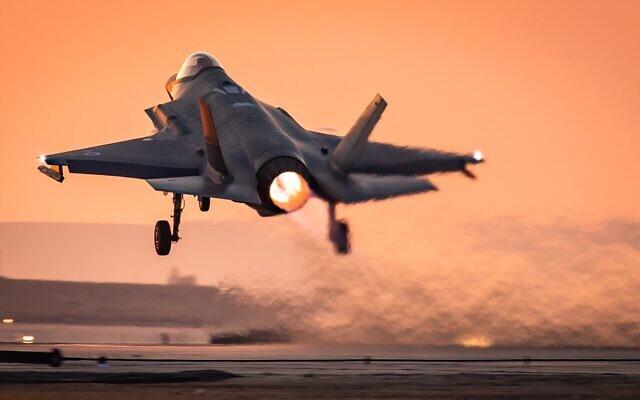
An F-35 fighter jet takes off during a surprise exercise, ‘Galilee Rose,’ in February 2021. (Israel Defense Forces)

“The State of Israel has the means to act and will not hesitate to do so. I do not rule out the possibility that Israel will have to take action in the future in order to prevent a nuclear Iran,” Gantz said.

“Iran is only two months away from acquiring the materials necessary for a nuclear weapon. We do not know if the Iranian regime will be willing to sign an agreement and come back to the negotiation table and the international community must build a viable ‘Plan B’ in order to stop Iran in its tracks towards a nuclear weapon,” he added.

Though Iran is believed to be two months away from obtaining the fissile material needed for a bomb, the IDF has assessed that it would take at least several more months from then before Tehran would be capable of producing a deliverable weapon, needing that time to construct a core, perform tests and install the device inside a missile.

On Sunday Kohavi visited the home of a Border Police sniper fatally wounded during a riot along the Gaza border last month to express his condolences to the fuming family.

Barel Hadaria Shmueli was shot in the head at point-blank range by a Palestinian gunman on August 21 and succumbed to his wounds just over a week later. On Friday, the IDF released the initial findings of its investigation into Shmueli’s death, blaming it principally on the way in which troops were deployed along the Gaza border barrier during the riot.

IDF Chief of Staff Aviv Kohavi pays a condolence call on September 5, 2021, to the home of Barel Hadaria Shmueli, a Border Police officer who was shot dead by a Gaza gunman at the border last month (Via Facebook: צועדים בדרך בראל)

His family, along with right-wing activists and opposition lawmakers, accused the military of issuing overly restrictive rules of engagement that they claim prevented troops from keeping the rioters away from the border fence. Shmueli’s father has suggested Prime Minister Naftali Bennett and top military commanders should resign over the incident, his mother has said she does not trust the government or the army, and the family has rejected the IDF’s investigation, demanding an independent inquiry.

The IDF has denied that the open-fire regulations were to blame — noting that Shmueli himself fired at the rioters when they rushed the border — and said that at issue was the way in which troops were deployed.

In Monday’s interview, Kohavi said that while mistakes “will happen” in combat, the military must back its officers or it will remain without any.

“There was a mistake in the way we prepared from the moment the rioting began,” Kohavi told Walla of the Gaza riot. “The initial preparation was very good. There was a mistake there, a mistake that occurred as a result of decision-making in real-time, under pressure, in conditions of uncertainty. This has happened, does happen and will happen in any war.”

But, he said, “We remember that [commanders] also make a great many good decisions that protect Israeli citizens… Mistakes can happen but we need to remember to back them up. If we don’t back them up we’ll end up without commanders. Without anyone to guard the borders.”

His comments were similar to ones he made in a letter to commanders Sunday.

“A society that does not back its soldiers and commanders, including when they make mistakes, will discover that it has nobody to fight for it,” Kohavi wrote in his missive.

It was the IDF’s obligation to thoroughly investigate, “to get to the truth and learn the lessons, but mistakes of judgment on the battlefield are not matters for blame and punishment,” he declared.