by Steven Emerson

Palestinian group Hamas’ top leader, Ismail Haniyeh speaks during a protest to express solidarity with the Palestinian people amid a flare-up of Israeli-Palestinian violence, in Doha, Qatar May 15, 2021. REUTERS/Hussein Sayed
Since the May war between Israel and Gaza-based terrorist organizations, international attention has shifted elsewhere and is now primarily focused on the rapid Taliban takeover of Afghanistan.
But August has been a particularly volatile month for Israel’s national security. Despite Israel’s efforts to maintain relative calm, the Jewish State faces considerable terrorist threats on each of its borders, from powerful Iranian-backed insurgent organizations to unaffiliated terrorists.
On Monday, Palestinian terrorists sparked several fires in southern Israel after launching incendiary balloons across the border amid rising tensions in the area. Israel responded with airstrikes targeting Hamas terrorist infrastructure, including a weapons factory and offensive tunnel.
Hamas and other Palestinian terrorist groups have increased the volume of airborne explosives sent since June, and have previously encouraged arson terrorism to provoke Israeli retaliation and increase pressure on Israel to offer more concessions. A similar logic appears at play this week, as Israel and Hamas negotiate a longer term ceasefire through Egyptian mediation.
On Tuesday, Israel’s military said that it is reinforcing its presence near Gaza ahead of Hamas-led border protests planned for Wednesday.
These measures follow recent arson attacks and violent Palestinian riots on the Israel-Gaza border, where one assailant shot and critically wounded an Israeli border guard. More than 41 Palestinian rioters were wounded during clashes on Saturday.
Egypt closed its main border crossing with Gaza on Monday, amid rising regional tensions with Hamas. Egyptian officials, speaking with the Associated Press, said that the measure is aimed to pressure Hamas over “differences” between Egypt and the terrorist organization concerning ongoing discussions with Israel.
Volatility on Israel’s southern border comes as the country faces a variety of threats elsewhere, including instability in the West Bank and an emboldened Hezbollah in Lebanon.
For example, Israeli forces were met with major gunfire in the West Bank city of Jenin during an August 15 operation to detain a terrorist operative, Muhammad Samir Saleh Abu Zina.
Abu Zina allegedly was in contact with Hamas and planning a terrorist attack, reports the Meir Amit Intelligence and Terrorism Information Center. During the operation, Palestinians shot at Israeli forces at close range, who returned fire and killed four Palestinians.
Palestinian Islamic Jihad claimed one of the fatalities as a member of its terrorist organization.
The attack marked the second time West Bank-based Palestinians fired at Israeli security personnel this month. Click here to read the full Meir Amit report, which details specific attacks including Palestinians throwing stones and Molotov cocktails at Israeli vehicles. For example, on August 12, Palestinians threw rocks at a vehicle near Ramallah, injuring an Israeli man.
Earlier this month, a Palestinian woman tried to stab Israeli troops based in the northern West Bank. IDF forces shot her in the leg in response.
The West Bank witnessed a major increase in Palestinian attacks, both completed and foiled, during the summer conflict between Israel and terrorist organizations in Gaza. While near-daily violence in the West Bank has largely subsided since the war ended, recent terrorist incidents show that Palestinians — both affiliated and unaffiliated with terrorist organizations — remain emboldened to carry out attacks.
According to a report from Israel’s Kan news earlier this month, Hamas operatives in Gaza have increased efforts to plan and coordinate terrorist attacks in the West Bank. The report outlined how Hamas recruits Palestinians, via social media or by phone, and offers instructions on building explosives and identifying targets for attacks.
Many of these terrorist incidents are under-reported in the West for various reasons. First, some attacks — like incendiary balloons from Gaza — generally do not cause physical injuries to people, despite spreading fear or inflicting widespread economic and environmental damage. In other cases, Israeli security authorities foil many terrorist attacks before they materialize.
However, dismissing foiled plots, and attacks that do not inflict casualties, misrepresents the overall terrorist threat Israel actually faces.
Israel also faces a large threat from Hezbollah, Lebanon’s most dominant political and military force.
Lebanon faces one of the gravest economic depressions in modern history and is on the brink of collapse. But instead of trying to alleviate the country’s woes, Hezbollah has been looking for ways to deflect responsibility.
One of the easiest ways for Israel’s enemies to divert attention from internal problems is to attack the Jewish state.
On August 6, Hezbollah fired about 20 rockets toward the Israeli-controlled Sheba’a Farms region in response to targeted Israeli airstrikes in south Lebanon the previous day. The airstrikes were retaliation for three rockets launched against Israel on August 4. The initial rocket fire remains unclaimed, though it is highly unlikely that Hezbollah — which controls southern Lebanon — did not at least tacitly approve the barrage.
The organization has consolidated an arsenal of more than 130,000 rockets and missiles that directly threaten Israeli national security. The IDF anticipates that Hezbollah could launch between 1,000-3,000 missiles daily for over a week in the first week of a future war with Israel.
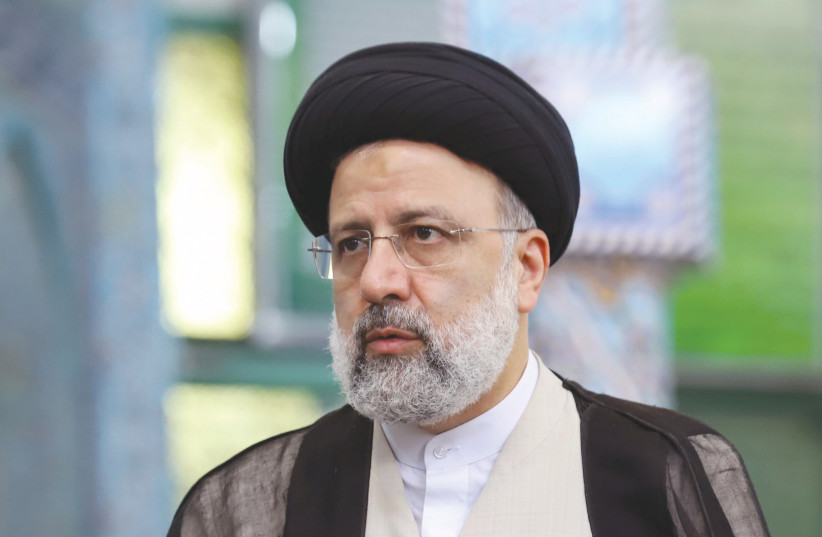
Hezbollah’s latest missile attack also came a day after Iran, the group’s main backer, inaugurated its new president, Ebrahim Raisi, a hard-liner who seeks to strengthen ties to its terrorist partners across the region.
Following the swearing-in ceremony, President Raisi met with Hamas leader Ismail Haniyeh and Palestinian Islamic Jihad Secretary General, Ziad al-Nakhleh. During the meeting, Raisi highlighted the Islamic Republic’s long-standing support for Palestinian terrorist groups and said that “resistance” (i.e. terrorism and violence) is the only way to destroy the “Zionist regime.”
From north to south, Israel has had to tackle a variety of terrorist challenges. Facing a multi-faceted terrorist threat, Israel continues to carefully engage in targeted coercive measures, and sometimes concessions, to manage conflict with a wide range of armed actors.
Steven Emerson is executive director of the Investigative Project on Terrorism (where this article first appeared), the author of eight books on national security and terrorism, the producer of two documentaries, and the author of hundreds of articles in national and international publications.