
Russia hosts Jordan’s king, hints at UAE deal

Russia’s interest in rapidly expanding its role from China to Afghanistan, across the Middle East to the Mediterranean, has major ramifications for Israel.
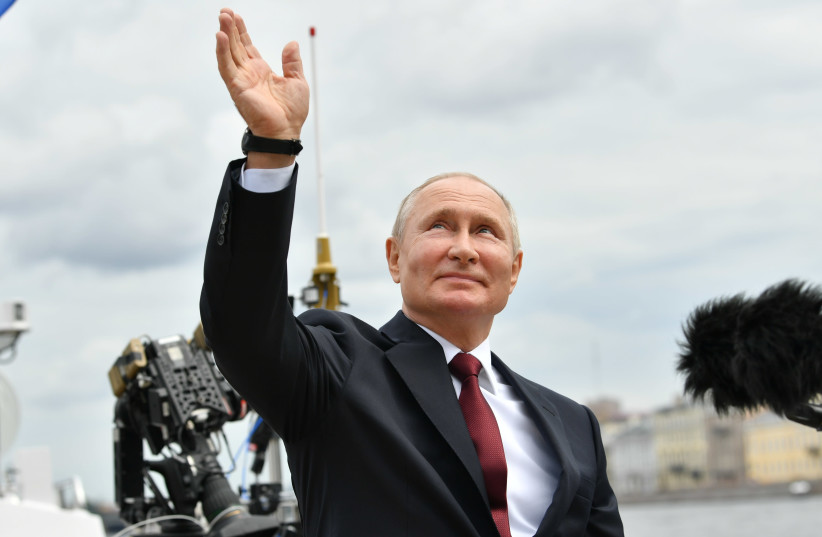
Russia's President Vladimir Putin attends the Navy Day parade in Saint Petersburg, Russia July 25, 2021.  (photo credit: SPUTNIK/ALEXEI NIKOLSKY/KREMLIN)
Russia’s President Vladimir Putin attends the Navy Day parade in Saint Petersburg, Russia July 25, 2021.
(photo credit: SPUTNIK/ALEXEI NIKOLSKY/KREMLIN)
King Abdullah II of Jordan met Russian President Vladimir Putin on Monday. They discussed the situation in Syria and Afghanistan, according to Russian media reports. “Of course, we hope for an exchange of views on the most pressing matters…They are the normalization of the situation in Syria and the current escalation in Afghanistan,” Putin said. These comments come during an important military event in Russia and Russian outreach to the UAE, as well as S-400 deliveries to India and Russian-Iran ties which are growing.
It is part of Russia’s interest in expanding its role in the Middle East and in Afghanistan. Russia has been talking to Turkey about coordinating relations with the Taliban and Russia may hold a joint military drill with China and Iran later this year or in 2022, Iran’s Tasnim media said. The Russian ambassador announced that the exercises of the three countries will focus on maritime security and the fight against piracy, Iran’s media reported. “Apart from Russia, Iran and China, countries such as India, Syria and Venezuela will also participate in this exercise.” Russia will also support Iran’s application to join the Shanghai Cooperation Organization. This organization increasingly is seen as a Russian and Chinese balance to declining US global hegemony. “Moscow and Tehran have similar and similar positions on some international and regional issues,” the report says.
The Russian ambassador in Tehran also noted that Russia and Iran are negotiating on weapons, Tasnim media reports. “He said that after the lifting of the UN arms embargo against Iran, Tehran and Moscow are holding talks on a wide range of weapons. The Russian ambassador to Iran added: ‘Military-technical cooperation with Iran has a long history and is more than 50 years.’”
After the Iran discussions, Russia wants to increase its relations with Jordan. The meeting with the King is part of that work. “Putin stressed that despite the coronavirus pandemic relations between Russia and Jordan are developing in all areas, including trade and economic ties and political dialogue. He noted that the intergovernmental commission, chaired by Russian Agriculture Minister Dmitry Patrushev, is working actively,” Tass media said in Moscow. “We are also working jointly to combat the pandemic and overcome its impacts,” Putin said.
The Russian leader and King of Jordan examined military hardware during a walk after the meeting. “The Russian president explained that these weapons are both supplied to the Russian army and exported. In his words, direct contacts with colleagues from the armed forces of foreign countries help build up trust.” The Russian delegation to the talks included Foreign Minister Sergey Lavrov, Defense Minister Sergei Shoigu, Agriculture Minister Dmitry Patrushev, and presidential aide Yuri Ushakov, Tass media noted.
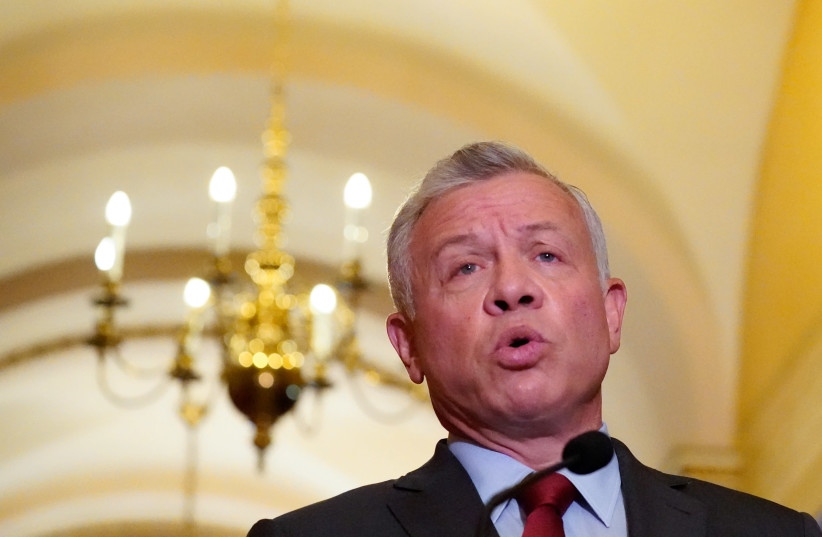
Jordan's King Abdullah II speaks after being welcomed by US House Speaker Nancy Pelosi (D-CA) to the US Capitol in Washington, US, July 22, 2021. (credit: REUTERS/ELIZABETH FRANTZ)Jordan’s King Abdullah II speaks after being welcomed by US House Speaker Nancy Pelosi (D-CA) to the US Capitol in Washington, US, July 22, 2021. (credit: REUTERS/ELIZABETH FRANTZ)
The context for the meeting is the Army 2021 international military-technical forum which opened on Monday in Russia. Russian President Vladimir Putin gave a command via a video conference to lay down six combat ships for the Russian Navy at three shipyards on Monday, Tass also reported. Russia and China want to increase their navies to present a peer-to-peer challenge to the US. Russia’s navy, while an important historic arm of the Russian military, has had many setbacks and needs modernization.
“We will continue ramping up Russia’s navy potential, perfect the basing system and navy infrastructure, fit the most advanced weaponry and equipment on ships, train difficult tasks at drills and in long-distance voyages as well as display the Russian flag in strategically important regions of the world’s oceans,” Putin said. The navy is important because Russia uses it to project power in the Black Sea and Mediterranean.
Russia is selling the S-400 air defense system to Turkey and Russia plays an important role in Syrian air defense. Recently Moscow has critiqued what it alleges are Israeli airstrikes in Syria. Russia also says the S-400 will be provided to India this year. The deputy CEO of the air and space defense company Almaz-Antey, Vyacheslav Dzirkaln, told media at the International Military-Technical Forum Army-2021 on Monday that the Indian deliveries are on schedule.
Russia is also seeking more work with the UAE, Russian Deputy Defense Minister Alexander Fomin said during talks with his UAE counterpart Al Jaberi Mubarak Saeed on Monday. Tass reported these talks as well, noting that “we, Russia, are ready not only to supply equipment and armaments but also share technologies and arrange local production on the territory of your country,” a Russian defense official said.
Russia wants to enter the UAE market. The UAE has new relations with Israel since last year’s Abraham Accords. Fomin praised the UAE for “developing its own industry, the high-tech industry.” He said Russia and the UAE should develop relations in “directions, primarily political.” Tass media said that the UAE deputy minister for defense and defense industry was at the event. “First of all, I would like to convey my best greetings on behalf of the defense minister of the United Arab Emirates to you personally. He wishes this exhibition, this forum to develop further and grow in its dimensions,” the UAE defense official said, according to Tass media. It didn’t name the UAE official.
The articles clearly indicate Russia’s interest in rapidly expanding its role from China to Afghanistan, across the Middle East to the Mediterranean via arms deals, new ships and international cooperation. This has major ramifications for Israel. Israel and Russia have amicable ties, but the US looks with concern on Russia and China moving into the Middle East, even as the US has been indicating it wants to draw down and focus on Asia. The US Vice-President Kamal Harris is in Southeast Asia but she has faced tough questions about the US role in the world after Afghanistan.

Turkey sees Afghanistan as lever for global agenda – analysis

Ankara is pursuing both its Islamic and pragmatic geopolitical agendas in Kabul. Despite its concerns, it sees the Taliban win as a boost for its global aspirations.

Iranian Foreign Minister Javad Zarif attends a news conference with his Turkish counterpart Mevlut Cavusoglu in Istanbul, Turkey, January 29, 2021 (photo credit: TURKISH FOREIGN MINISTRY /HANDOUT VIA REUTERS)
Iranian Foreign Minister Javad Zarif attends a news conference with his Turkish counterpart Mevlut Cavusoglu in Istanbul, Turkey, January 29, 2021
(photo credit: TURKISH FOREIGN MINISTRY /HANDOUT VIA REUTERS)
Turkey is desperate to find a way to work with the Taliban and get control of Kabul’s Hamid Karzai International Airport.
It has several agendas. It wants to control Afghanistan as a key route to China and Iran and also to sit astride global jihadist moments from Idlib to Kabul so that it can use them for its own agenda to become an Islamic world leader.
Turkey’s ruling AKP party is linked to the Muslim Brotherhood and Hamas, and it wants to work with Malaysia, Pakistan and other countries on what it sees as “Islamic” causes, such as pressuring India over Kashmir. But it has pragmatic reasons for cooperation with the Taliban as well: Kabul can be the key to influence over Iran, Pakistan, China and Russia.
Turkey’s military presence in Afghanistan is to strengthen the new Kabul administration’s hand in the international arena, President Recep Tayyip Erdogan said last week. Erdogan means he wants to help the Taliban, much as Turkey’s ally Qatar has helped them.
Ankara will also position itself as a faucet controlling the flow of Afghan refugees into Europe. It will use the refugee pressure to get funding from Germany in exchange for stemming the tide of Afghans.
Turkey is building a wall on the border with Iran to keep Afghans out and wants control of the airport to ship them back. Germany, a key ally of Turkey, and other European states will likely pay it to crush the hopes of refugees, as European Union states have done since 2015.
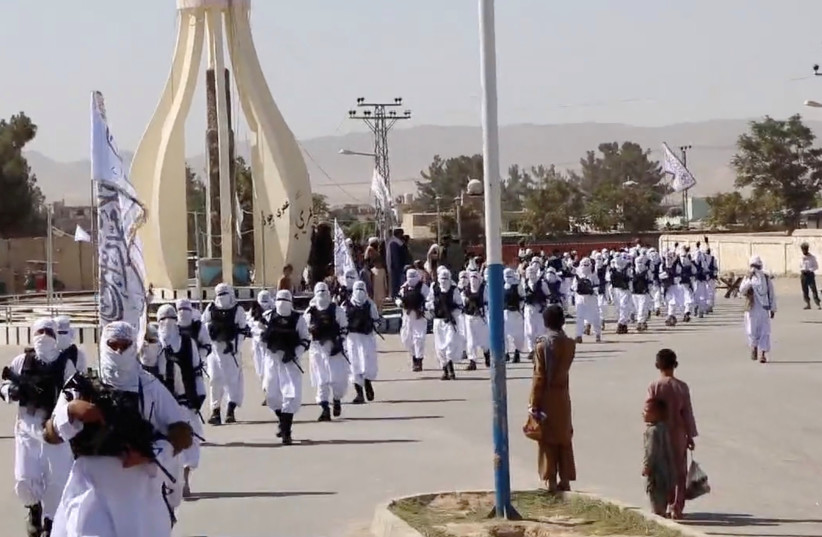
 Taliban fighters march in uniforms on the street in Qalat, Zabul Province, Afghanistan, in this still image taken from social media video uploaded August 19, 2021  (credit: REUTERS) Taliban fighters march in uniforms on the street in Qalat, Zabul Province, Afghanistan, in this still image taken from social media video uploaded August 19, 2021 (credit: REUTERS)
But what is Turkey saying about its role in Afghanistan?
Almost all Turkish media is controlled by the government or is linked to far-right groups that support the governing AKP Party, so Turkish headlines can be construed as mimicking the government narrative.
“Turkey will exert all efforts for stability in Afghanistan,” Daily Sabah reported last week.
Meanwhile, an article at government-run TRT World’s website was titled: “How international actors laid the groundwork for Taliban rule.”
“Despite the Taliban insurgency’s strength and its powerful local connections across the country, many experts think that some regional players and international actors, primarily the US, have played a crucial role in facilitating Taliban rule across Afghanistan,” the article said.
Turkey, which is working with Russia to buy S-400s and has new deals with China, is also interested in what they think.
Russia and China want the Taliban to keep ISIS and al-Qaeda weak in Afghanistan and not be a platform for terrorism, according to the article.
A more interesting article on the pro-government Anadolu news site said last week: “Turkey seeks to position itself according to realities of [a] emerging new world order… As the axis of history moves from [the] Atlantic to [the] Pacific, Turkey aptly consolidates [the] multilateral dimension of its foreign policy.”
This article encapsulates the worldview of Ankara in its move to push some of its chess pieces into Afghanistan with the hopes of working with China, Russia and Iran to control Kabul.
Much like the US and Soviet Union moved into Berlin in 1945, Turkey sees this as a key moment. As the US declines, the new global leaders will move into the proverbial Berlin of 2021, which is Kabul.
The post-American world that came in the wake of the US Global War on Terrorism is one where Turkey, Russia, China and Iran will work in concert and not against each other to weaken the US.


Bennett and Biden will most likely discuss Washington’s controversial proposal to open a separate Palestinian Consulate in Jerusalem.

By Donna Rachel Edmunds, World Israel News

As Israeli Prime Minister Naftali Bennett prepares to fly to Washington to meet U.S. President Joe Biden, members of his government and the Knesset are already warning that discussion of the two-state solution must not be on the table.

Two key topics are likely to be foremost on the premiers’ agenda in their meeting this Thursday: Iran’s nuclear ambitions, and Washington’s controversial proposal to open a separate Palestinian Consulate on Agron Street in Jerusalem, which has been within sovereign Israeli territory since 1949.

The move reverses the merger under the Trump administration of the U.S. consulate for Palestinians into the U.S. Embassy to Israel, which took place when the Embassy was moved from Tel Aviv to Jerusalem.

However, the proposed is being viewed as a signal that the Biden administration ultimately envisions a divided Jerusalem serving as the capital to both Israel and Palestine within a two-state solution.

Bennett is already coming under fire by opposition MKs for his willingness to discuss the matter with Biden. As Israeli permission would be required for such a move, he is expected to come under pressure to agree to the measure.

But Likud Knesset member Nir Barkat told JNS that it was clear Washington’s goal with the policy is to establish facts on the ground” and “to promote the establishment of Palestine with Jerusalem as its capital.”

“This is a goal Israel cannot agree to,” Barkat warned. “There is no other capital city in the world where the Americans have opened two embassies. After all, there is an American embassy in Jerusalem, and it can provide consular services to anyone who needs it.”

Interior Minister Ayelet Shaked denied that a two-state solution was on the table while Bennett was at the helm of the Israeli government, according to Arutz Sheva.

When asked Sunday morning what Bennett would say to Biden if the issue arose during the meeting, she responded: “He will answer that he is against a two-state solution. Our position is known, it was decided when this government was formed not to deal with this issue. Biden is also aware of the prime minister’s views.”

Her comments came in response to those made by Foreign Minister Yair Lapid on Friday during an interview with Israel’s Channel 11. While reiterating that movement toward a two-state solution under Bennett was not a possibility, when asked whether it might be when he took the reins as Prime Minister under the rotation agreement in 2023, he responded “it might be”.

Shaked warned: “If it happens, he will not have a government,” noting that the Yamina party would not be part of Lapid’s future government if he advances the issue of Palestinian statehood.
