
Defense Ministry in a statement says missiles are ‘solely for defense purposes,’ adding that Tehran’s military plan includes constant updates to deal with threats
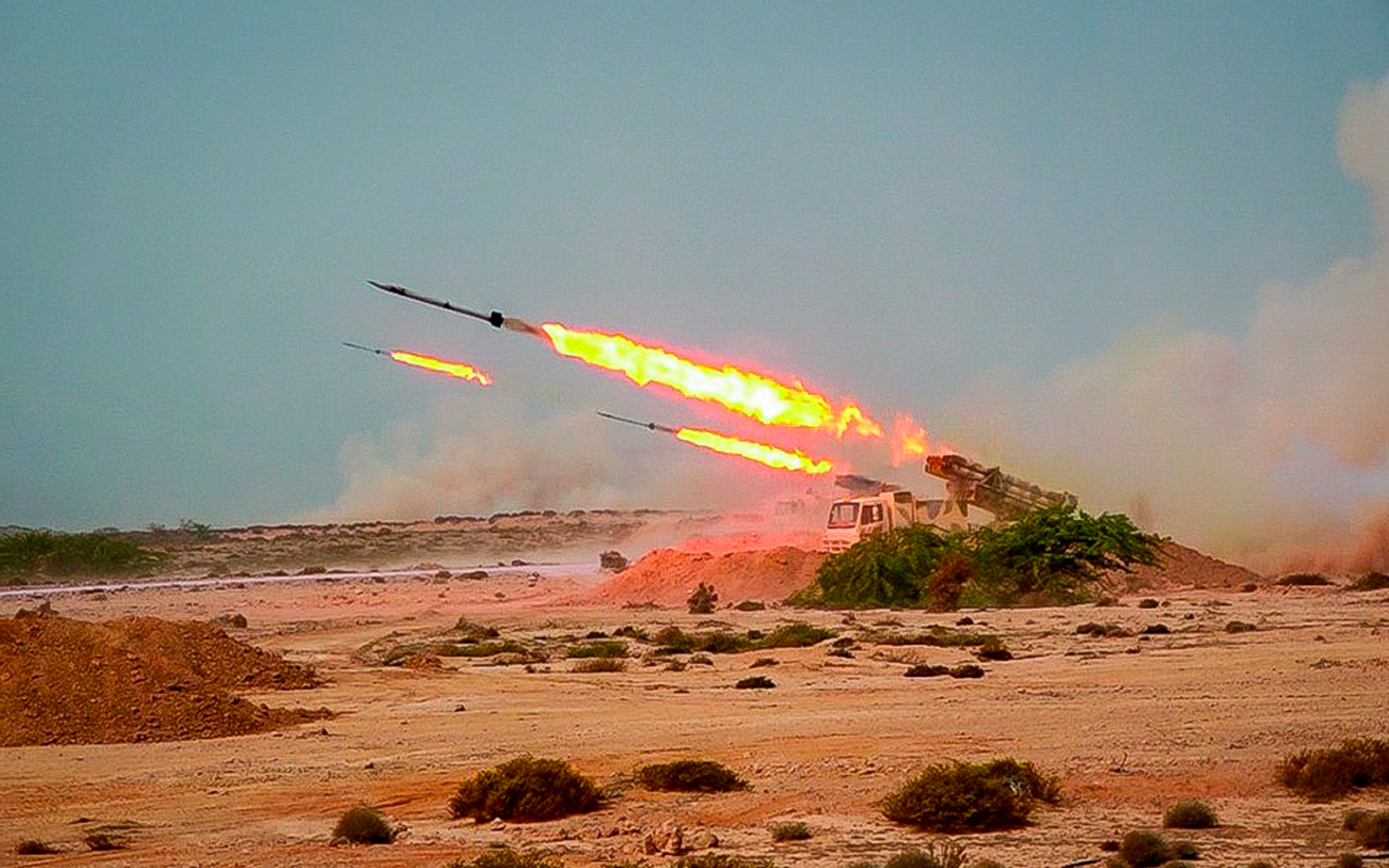
 

Missiles are fired in an Iranian military exercise by the Islamic Revolutionary Guards Corps, on July 28, 2020. (Sepahnews via AP)

File: Missiles are fired in an Iranian military exercise by the Islamic Revolutionary Guards Corps, July 28, 2020. (Sepahnews via AP)

The Iranian Defense Ministry said on Saturday that it was expanding its defense efforts beyond the borders of the country, in an apparent message of deterrence to Israel and the West, as hopes for a return to the 2015 nuclear deal continue to fade.

“Our country has an important role to play in strengthening the resistance front and expanding the radius of defense of national security beyond the borders of the country,” the ministry said in a message for Defense Industries Day, the Moj News Agency reported.

The ministry stated that Iran’s military plan includes “strengthening the defensive force and constantly updating the ability to deal with the threats of our enemies.”

“We will not hesitate to strengthen our military capabilities, including the missile program designed solely for defense purposes,” it added.

The statement came as the foreign ministries of Germany, France, and Britain expressed “grave concern” over Iran’s growing violations of the moribund 2015 nuclear accord.

The International Atomic Energy Agency (IAEA) in Vienna confirmed last week that Iran has produced uranium metal enriched up to 20 percent for the first time, and has significantly increased its production capacity of uranium enriched up to 60%.
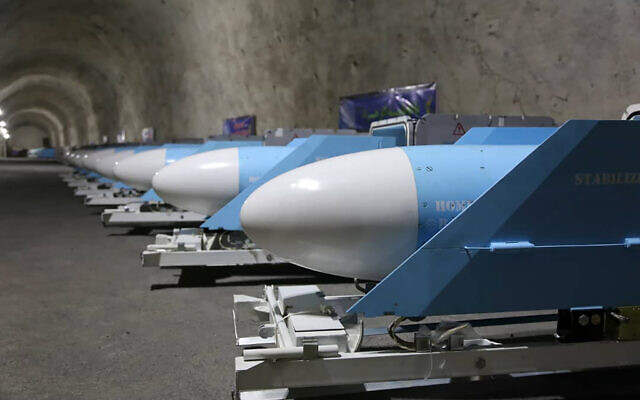
In this photo released January 8, 2021 by Sepahnews, the website of the Iranian Revolutionary Guard, missiles are displayed during an inauguration of a new military base in an undisclosed location in Persian Gulf in Iran. (Sepahnews via AP)

The production of uranium metal is prohibited by the 2015 nuclear deal, known as the Joint Comprehensive Plan of Action, or JCPOA, which promised Iran economic incentives in exchange for limits on its nuclear program, and is meant to prevent Tehran from developing a nuclear bomb.

On Thursday, Germany, France and Britain — the western European members of the JCPOA — called the moves by Iran “serious violations” of its commitment under the JCPOA. They said that “both are key steps in the development of a nuclear weapon and Iran has no credible civilian need for either measure.”

Iran insists that it is not interested in developing a bomb, and that the uranium metal is for its civilian nuclear program.

The United States unilaterally pulled out of the nuclear deal in 2018, with then-US president Donald Trump saying it needed to be renegotiated.
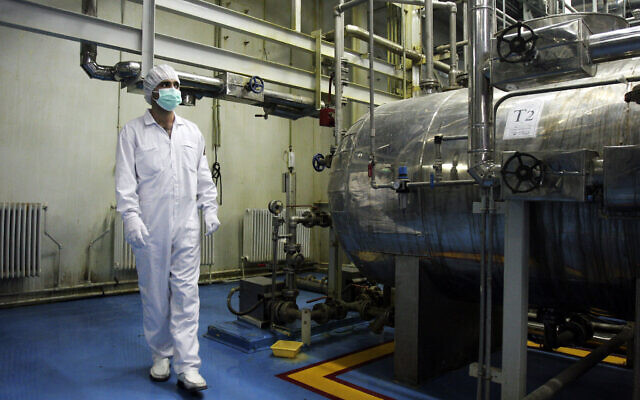
An Iranian technician walks through the Uranium Conversion Facility just outside the city of Isfahan, 255 miles (410 kilometers) south of the capital Tehran, Iran, on February 3, 2007. (Vahid Salemi/ AP/ File)

Since then, Tehran has been steadily increasing its violations of the deal to put pressure on the other signatories to provide more incentives to Iran to offset crippling American sanctions reimposed after the US pullout.

The western Europeans, as well as Russia and China, have been working to try to preserve the accord.

US President Joe Biden has said that he is open to rejoining the pact, but that Iran needs to return to its restrictions, while Iran has insisted that the US must drop all sanctions.

Months of talks have been held in Vienna with the remaining parties of the JCPOA shuttling between delegations from Iran and the US.

The last round of talks ended in June with no date set for their resumption.

Hopes for an Iranian return to the accord have dwindled significantly following the ascension of Iran’s new president, hardliner Ebrahim Raisi.



Reports say alleged Israeli strikes on Thursday killed four pro-Iranian fighters; no comment from IDF


Illustrative: Anti-aircraft fire rises into the sky as Israeli missiles hit air defense positions and other military bases around Damascus, Syria, on May 10, 2018, following what the Israeli military said was an Iranian barrage of rockets against Israeli bases on the Golan Heights. (Syrian Central Military Media, via AP)

Illustrative: Anti-aircraft fire rises into the sky as Israeli missiles hit air defense positions and other military bases around Damascus, Syria, on May 10, 2018, following what the Israeli military said was an Iranian barrage of rockets against Israeli bases on the Golan Heights. (Syrian Central Military Media, via AP)

MOSCOW (AP) — Syria’s air defense forces shot down 22 missiles launched by Israeli warplanes during an airstrike against targets in Syria, the Russian military said Friday.

Rear Adm. Vadim Kulit, head of the Russian military’s Reconciliation Center in Syria, said six Israeli fighter jets targeted facilities in the provinces of Damascus and Homs from Lebanon’s airspace late Thursday.

Kulit said Syrian air defense units downed 22 of the 24 missiles launched by the Israeli warplanes with Russia-supplied air defense systems Pantsyr-S and Buk-M2.

There was no immediate reaction from Israel, which rarely comments on its military operations in Syria.

Syria routinely claims to shoot down Israeli missiles. Syrian war analysts generally believe that such claims — heard after nearly every Israeli airstrike — are false, empty boasts.

Russia, which supplies Syria with its air defenses, also has an interest in showing that they are not ineffective.

Kulit’s statement followed a report by the Syrian state news agency SANA that Syrian air defense units responded to an Israeli airstrike targeting the Damascus countryside and the central province of Homs.

There were no official reports of any casualties, however, a Britain-based war monitor said on Friday that the strikes killed four pro-Iranian fighters allied to the Damascus regime.

The Syrian Observatory for Human Rights said that the Israeli missiles targeted “arms depots and military positions” belonging to Lebanese Shiite terror group Hezbollah, in the Qarah area in the northwest of Damascus province, near Homs province and the Lebanese border.

An air defense missile, bottom center, streaks toward what appears to be a missile shot into Syria, in a video distributed by Syrian state news. (Screen capture: YouTube/SANA)

The strikes killed four members of the Iran-backed group, but it was not immediately clear whether they were Syrian or Lebanese, according to the war monitor, a pro-Syrian opposition organization of uncertain funding based in the UK.

Lebanese media also reported that two missiles fell in the Qalamoun region on the rugged border between Lebanon and Syria, though it was unclear if the projectiles were from the alleged airstrikes or errant interceptors.

Israel has carried out hundreds of airstrikes inside Syria in the course of the country’s civil war, targeting what it says are suspected arms shipments believed to be bound for Lebanon’s Iran-backed Hezbollah militant group, which is fighting alongside Syrian government forces. It rarely acknowledges or discusses such operations.

Russia has waged a military campaign in Syria since 2015, helping President Bashar Assad’s government reclaim control over most of the country after a devastating civil war. Moscow also has helped modernize Syria’s military arsenals and train its personnel.


Damascus claims most missiles shot down by air defense systems in attack on sites near capital and city of Homs, days after twin strikes near Golan; loud blasts heard in videos


Syrian air defenses were activated against Israeli missile attacks on sites near Damascus and Homs, Syrian state media reported late Thursday, citing a military source.

Loud explosions shook the Syrian capital during the reported air strikes, two days after the Israeli military reportedly conducted twin missile strikes on a Syrian army base and an outpost controlled by the Lebanese terror group Hezbollah.

A military source told Syria’s official SANA news agency that most missiles fired by Israel had been intercepted by its air defense systems. The source said the missiles had come from the direction of Beirut in neighboring Lebanon just after 11 p.m.

There were no immediate reports of any casualties.

“The results of the aggression are being looked into,” the source told SANA.

There was no immediate comment from Israel, which general refrains from confirming individual strikes in Syria.

The Syrian Observatory for Human Rights, a UK-based war monitor linked to the Syrian opposition, claimed the strikes had targeted weapons depots and military sites belonging to Hezbollah.

Damascus has been accused in the past of inflating the success of its air defense systems, while the Observatory has been accused of inflating the damage caused by alleged Israeli attacks.

Damascus residents reported hearing at least five loud explosions that shook apartment buildings over a 15 minute time span. The missiles appeared to have been fired from over Lebanon, jolting residents who heard them streak across the sky before striking targets in Syria.

Blasts could be heard in videos distributed by SANA, which showed what appeared to be missiles streaking across the sky.

Israel has launched hundreds of strikes against Iran-linked targets in Syria over the years and against Syrian military installations in cases where they were being used to attack Israel or Israeli forces.

Israel fears Iranian entrenchment on its northern frontier, and it has repeatedly struck Iran-linked facilities and weapons convoys destined for Hezbollah.

Leaflets dropped on southern Syria early Wednesday, apparently by the Israel Defense Forces, warned Syrian soldiers against cooperating with Hezbollah, hours after twin missile attacks on military positions near the Golan Heights.

According to a pro-opposition Syrian source in the Golan Heights, the office of the 90th Brigade commander, Brig. Gen. Hussein Hamoush, near the city of Khader, was one of the targets of the Tuesday night strike, which Syria blamed on Israel. The second target was said to be a Hezbollah outpost in the area.

“Be careful with your actions, you are being watched through a microscope. Hasham’s help has brought you destruction and his bad intentions are coming out. You are responsible for your actions, and Hezbollah is responsible for your suffering,” it said.

Judah Ari Gross and Emmanuel Fabian contributed to this report.