
Iran’s pre-emption doctrine against Israel, UK, US – analysis

Heat up northern Israel, to show it can strike anywhere it wants if it is pressed about the tanker attack.
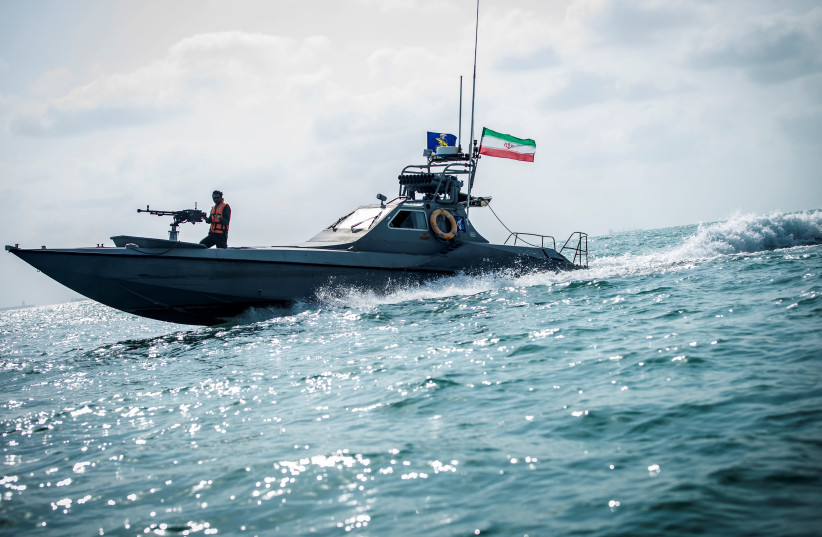
A boat of the Iranian Revolutionary Guard (IRGC) sails, at undisclosed place off the coast of Bandar Abbas, Iran August 22, 2019. (photo credit: NAZANIN TABATABAEE/WANA VIA REUTERS)
A boat of the Iranian Revolutionary Guard (IRGC) sails, at undisclosed place off the coast of Bandar Abbas, Iran August 22, 2019.
(photo credit: NAZANIN TABATABAEE/WANA VIA REUTERS)
Iran is putting in place a new doctrine designed to preempt any response to its attack on a ship off the coast of Oman. In the week and a half since the Mercer Street tanker was first attacked on July 29, and two of its crew members were killed on July 30, Iran has been singled out as a culprit.
The US and UK have accused Iran, and there has been tough talk. Then, suddenly, rockets were fired at Israel last week. This was Iran’s preemption. Heat up northern Israel to show it can strike anywhere it wants if it is pressed about the tanker attack.
It’s important to listen to Iran’s logic and narrative here. Iran has laid that out through media messaging and speeches by its proxies, as well as in meetings with key Hamas, Hezbollah and other terrorist leaders during the inauguration of President Ebrahim Raisi. IRGC head Hossein Salami and key official Ali Shamkhani attended various meetings, and it appears the messaging was put out at the same time.
What was the message? The strike off the coast of Oman was retaliation for previous Israeli attacks, Iran said via Al-Alam TV and Press TV. That means Iran felt it had evened the score. Tough talk from the US, UK and Israel had put Iran on edge. It has warned the UK and Israel. It may have warned the US via other channels.
It appears that the US pressured Israel not to alter the rules of engagement against Hezbollah ahead of another round of Iran nuclear talks next month” the London-based Asharq Al-Awsat newspaper reported, citing a senior diplomatic source.
This is important because it means Iran was able to put Hamas and Hezbollah in play, and possibly units based in Iraq, as well as Iraqi-based militias and the Iranian-backed Houthis in Yemen as part of a concerted regional effort. If Iran feels pressured in the Gulf, then it may strike elsewhere.
But this is not just about striking. They are pushing Hezbollah and Hamas and other frontline actors to create complexity, deterrence and unpredictable results for Israel in the wake of the tanker attack.
French President Emmanuel Macron spoke with Raisi, according to reports on Monday. “The Islamic Republic is very serious about providing security and maintaining deterrence in the Persian Gulf and Sea of Oman Region,” Raisi told the French.
What does this mean? We heard that also in Hezbollah leader Hassan Nasrallah’s recent speech. Hezbollah had responded to Israeli artillery and airstrikes, he said on August 7, adding: “This was to reinforce the old equation of deterrence and not to create a new one, as some have said.”
But what about the fact that Hezbollah had enabled areas it controls to be used for rocket fire on Israel on August 4? Hezbollah had started this round, in a sense. But it also openly said it would continue it, rocket for rocket, against Israel.
On August 1, IDF Chief of Staff Lt.-Gen. Aviv Kohavi concluded a conversation with his British counterpart, Chief of the Defense Staff Gen. Sir Nick Carter. “The two discussed recent events in the region and common challenges faced by both countries,” a press release said.
It appears Iran put in place a preemption doctrine over the next 48 hours after that. Then on August 6, Hezbollah fired a salvo of rockets into an uninhabited border area of Israel.
Nasrallah gave his speech the next day. This is clear, coordinated messaging. Iran has been seeking to deter, to be unpredictable and to put its frontline units, which are its proxies and allies and partners in Lebanon, Syria and Gaza, into play. This is a new preemption doctrine in a sense. Iran wants to present Israel with a multiplicity of threats and frontlines.
It also unveiled this in May during the lead-up to the Gaza conflict. It threatened Israel and had its proxies give speeches in the hours before Quds Day and after, all directed at challenging Israel.
Then Hamas launched some 4,000 rockets in 10 days. Iran openly supported this, and its media celebrated what it thought was an attempt to test Israel. Iran also launched a drone into Israeli airspace on May 18, likely guiding it from Syria.
“Six failed launch attempts were identified from Lebanon that did not cross into Israeli territory,” the IDF said on May 17. More rockets were fired from Lebanon toward Israel on May 19 as the Israel-Hamas conflict winded down.
What this shows is a more complex Iranian response and likely an illustration of more to come. Iran wants to put in play this preemption doctrine. It wants to distract the US, UK and Israel from the incident off Oman and the emerging reports that Washington and London back a response and that London may respond somewhere.


Lebanon is in Hezbollah’s clutches – opinion

Given the likely composition of the new administration, there seems no chance of Lebanon freeing itself any time soon from the dominance of Hezbollah and, in consequence, Iran.

LEBANESE PRESIDENT Michel Aoun addresses the media on the eve of the anniversary of Beirut port explosion last week. (photo credit: DALATI NOHRA / REUTERS)
LEBANESE PRESIDENT Michel Aoun addresses the media on the eve of the anniversary of Beirut port explosion last week.
(photo credit: DALATI NOHRA / REUTERS)
Lebanon has been without a government since the massive explosion of August 4, 2020, blew Beirut’s port apart and, with it, Lebanon’s administrative machine. In the aftermath of the blast, Lebanese President Michel Aoun promised a swift and transparent investigation. A year later no one has been held responsible, while the inquiry itself has been subject to continuous obstruction, evasion, and delay.

Judge Fadi Sawan was appointed to conduct the investigation. On December 10 he formally charged caretaker prime minister Hassan Diab and three former ministers with negligence in connection with the blast. But Diab, who had been supported by the Hezbollah parliamentary bloc in his bid to become the designated prime minister, refused to appear for questioning. So did two of the other former ministers. They were supported by the caretaker interior minister, Mohammed Fahmi, described by the Abu Dhabi-based The National as “staunchly pro-Hezbollah.” Fahmi declared publicly that even if the judiciary issued arrest warrants, he would not ask the security forces to detain them.
Aoun, a strong supporter of Hezbollah – which reciprocates the favor – made no comment at the time, but in February, Sawan was removed from the inquiry.
He was replaced by Judge Tarek Bitar, who is known to have no strong political affiliations. On July 9, Bitar applied to question Major-General Abbas Ibrahim, head of the powerful Lebanese General Security Directorate. Fahmi refused the request.
It seems clear that the caretaker government is deliberately thwarting the investigation, and the suspicion must arise that leading figures were involved in the circumstances leading to the explosion and are being shielded. Indeed, in a report issued on August 3, Human Rights Watch declares: “The very design of the port’s management structure was developed to share power between political elites. It maximized opacity, and allowed corruption and mismanagement to flourish.”
Questions waiting to be answered include who authorized the detention of the Moldovan-flagged cargo ship, the Rhosus, in November 2013; under whose authority was its load of 2,754 tons of ammonium nitrate – which no party has subsequently claimed – off-loaded and stored in unsafe conditions on October 23 and 24; and what has since happened to some 2,200 tons of that shipment – according to a report by the FBI – the blast, massive as it was, involved only around 550 tons.
Amnesty International criticized Lebanon’s judicial process from the start. “Every step, measure or statement taken thus far,” it declared in September, “particularly by the highest-ranking officials in the country, have made it clear that the authorities have no intention whatsoever of fulfilling their responsibilities of conducting an effective, transparent and impartial investigation… An international fact-finding mechanism is the only way to guarantee the rights of victims to truth, justice and remedy.” HRW concurred. Taking into account the undue influence exercised by Hezbollah, the “state within a state”, as well as the widespread graft and venality within ruling circles, HRW believes that Lebanon‘s domestic investigation is incapable of credibly delivering justice, and has called for an international, independent probe. It believes that the blast – which killed more than 200 people, wounded thousands and inflicted billions of dollars in damage – was the starkest example yet of the chronic corruption and mismanagement that have left the Lebanese with a dysfunctional state and a collapsing economy.
In October, Saad Hariri was named by the Lebanese parliament as prime minister-designate and charged with forming a new government. For nine long months he was at loggerheads with Aoun, who wanted to pack any new government with Hezbollah-supporting ministers. Hariri flatly refused to give way; he wanted to assemble a technocrat cabinet dedicated to enacting the reforms long demanded by the World Bank, the International Monetary Fund and donor countries, such as the US and France. Finally, on July 15, Hariri resigned.
Shortly afterwards a compromise candidate as prime minister-designate emerged in the shape of one of the richest men in Lebanon, Najib Mikati. Mikati, who has served twice before as prime minister, found himself endorsed by most of Lebanon’s political parties, including Hezbollah and the other major Shi’ite party, Amal, and also by former Sunni prime ministers, including Hariri. Nevertheless, critics have called Mikati “a Hezbollah puppet,” while objecting to once again having a prime minister drawn from what they term the “corrupt political elite.” International media have cited corruption charges brought against Mikati by a judge in 2019 in a case involving accusations of illicit gains related to subsidized housing loans – charges that he terms politically motivated. The case has not yet come to trial. On July 28, Mikati announced that he had submitted to the president his list of candidates for government posts. “President Aoun approved most of them,” he announced, “and he made some remarks which are acceptable. God willing… we will be able to form a government soon.” In light of the Hariri-Aoun standoff, few guesses are needed as to the general shape of a future Mikati cabinet.
DOUBTS MUST persist as to whether it will have the ability, let alone the will, to undertake the root and branch reforms essential to restoring Lebanon‘s economic health. The World Bank pulls no punches in its criticism of Lebanon’s political elite, in which Hezbollah features so strongly. It accuses them of deliberately failing to tackle the country’s many problems, which include the economic and financial crisis, the COVID pandemic and the Beirut port explosion. In a recent report it identifies the inaction as due to a continuing political consensus that defends “a bankrupt economic system, which benefited a few for so long.”
Given the likely composition of the new administration, there seems no chance of Lebanon freeing itself any time soon from the dominance that Hezbollah has managed to acquire in the nation’s political life and the consequent malign influence on Lebanese affairs that Iran is able to exercise through its puppet. For example, Hezbollah directly claimed responsibility for a barrage of rockets fired on August 6 toward Israel – an action coinciding with Iranian aggression off the Gulf of Hormuz and the accession of Iran’s new hardline president, Ebrahim Raisi. It is no wonder that some commentators, like the UK’s policy institute Chatham House, are coming to regard Lebanon as a state controlled by Hezbollah.
The writer is Middle East correspondent for Eurasia Review. His latest book is Trump and the Holy Land: 2016-2020. Follow him at www.a-mid-east-journal.blogspot.com.


Iran’s pre-emption doctrine against Israel, UK, US – analysis

Heat up northern Israel, to show it can strike anywhere it wants if it is pressed about the tanker attack.

A boat of the Iranian Revolutionary Guard (IRGC) sails, at undisclosed place off the coast of Bandar Abbas, Iran August 22, 2019. (photo credit: NAZANIN TABATABAEE/WANA VIA REUTERS)
A boat of the Iranian Revolutionary Guard (IRGC) sails, at undisclosed place off the coast of Bandar Abbas, Iran August 22, 2019.
(photo credit: NAZANIN TABATABAEE/WANA VIA REUTERS)
Iran is putting in place a new doctrine designed to pre-empt any response to its attack on a ship off the coast of Oman.

In the last week and a half, after a tanker named the Mercer Street was first attacked on July 29, before two of its crew were killed on July 30, Iran has been singled out as a culprit. The US and UK have accused Iran and there has been tough talk. Then, suddenly, rockets were fired at Israel last week.

This was Iran’s pre-emption. Heat up northern Israel, to show it can strike anywhere it wants if it is pressed about the tanker attack.

It’s important to listen to Iran’s logic and narrative here. Iran has laid that out through media messaging and speeches by its proxies, as well as in meetings with key Hamas, Hezbollah and other terror leaders during the inauguration of its new president Ebrahim Raisi. The IRGC head Hossein Salami and key official Ali Shamkhani attended various meetings and it appears the messaging was put out at the same time.
What was the message? Iran said via Al-Alam TV and Press TV that the strike off the coast of Oman was retaliation. It claimed it was retaliating for previous Israeli attacks. That means Iran felt it had evened the score. Tough talk from the US, UK and Israel thus put Iran on edge. It has warned the UK and Israel. It may have warned the US via other channels. It appears, according to a report that the US pressured Israel not to alter the rules of engagement against Hezbollah ahead of another round of Iran nuclear talks next month” the London-based Asharq Al-Awsat newspaper reported, citing a senior diplomatic source.
This is important because it means Iran was able to put Hamas and Hezbollah in play, and possibly units based in Iraq, as well as Iraqi-based militias and the Iranian-backed Houthis in Yemen, as part of a concerted regional effort. If Iran feels pressured in the Gulf, then it may strike elsewhere. But this is not just about striking. They are pushing Hezbollah and Hamas and other frontline actors to create complexity, deterrence and unpredictable results for Israel in the wake of the tanker attack.
French President Emmanuel Macron spoke with Iran’s President Raisi, according to reports on Monday. “The Islamic Republic is very serious about providing security and maintaining deterrence in the Persian Gulf and Sea of Oman Region,” Raisi told the French. What does this mean? We heard that also in Hezbollah leader Hassan Nasrallah’s recent speech. On August 7 he said that Hezbollah responded to Israeli artillery and airstrikes. “This was to reinforce the old equation of deterrence, and not create a new one as some have said.” But what about the fact that Hezbollah had enabled areas it controls to be used for rocket fire on Israel on Wednesday, August 4. Hezbollah had started this round, in a sense. But it also openly said it would continue it, rocket for rocket, against Israel.
On August 1, IDF Chief of Staff Aviv Kohavi concluded a conversation with his British counterpart, Chief of the Defence Staff Gen. Sir Nick Carter. “The two discussed recent events in the region and common challenges faced by both countries,” a statement read. It appears Iran put in place a pre-emption doctrine over the next 48 hours after that. Then on Friday the 6 of August, Hezbollah fired a salvo of rockets into an uninhabited border area of Israel.
Nasrallah gave his speech the next day. This is clear, coordinated messaging. Iran has been seeking to deter, to be unpredictable and to put its frontline units, which are its proxies and allies and partners in Lebanon, Syria and Gaza, into play. This is a new pre-emption doctrine in a sense. Iran wants to present Israel with a multiplicity of threats and frontlines.
It also unveiled this in May during the leadup to the Gaza conflict. It threatened Israel and had its proxies give speeches in hours before Quds Day and after, all directed at challenging Israel. Then Hamas launched some 4,000 rockets in 10 days and Iran openly supported this and its media celebrated what it thought was an attempt to test Israel. Iran also launched a drone into Israeli airspace on May 18, likely guiding it from Syria. On May 17, the IDF said it detected “six failed launches attempts were identified from Lebanon that did not cross into Israeli territory.” On May 19, more rockets were fired from Lebanon toward Israel as the Israel-Hamas conflict winded down.
What this shows is a more complex Iranian response and likely an illustration of more to come. Iran wants to put in play this pre-emption doctrine. It wants to distract the US, UK and Israel from the incident off Oman and the emerging reports that Washington and London back a response and that London may respond somewhere.