
DF withdrawals from both Lebanon and Gaza sent a message to terror groups that Israel can be beaten by wearing them down. That’s exactly what Taliban has done to the US.
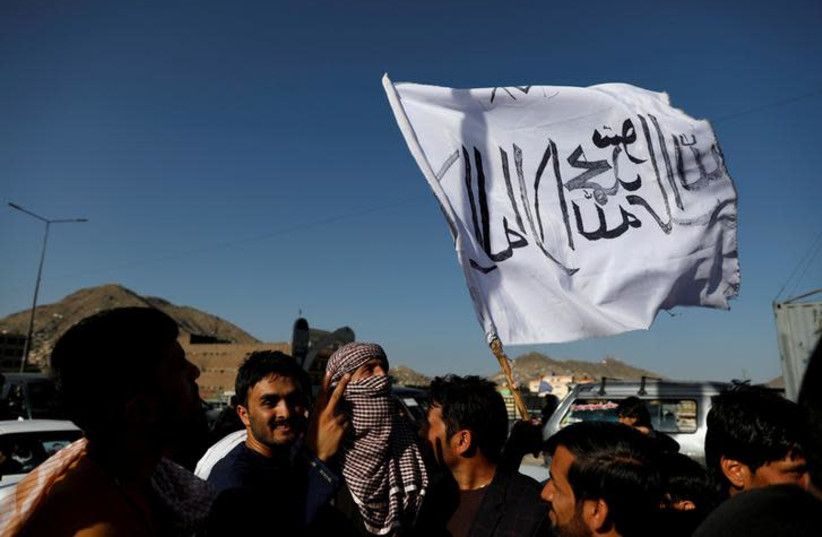
A member of the Taliban holds a flag in Kabul, Afghanistan June 16, 2018. The writing on the flag reads: ‘There is no god but Allah, Muhammad is the messenger of Allah’
(photo credit: REUTERS/MOHAMMAD ISMAIL)
Afghanistan has fallen.
Almost 20 years after September 11th, Taliban has blitzkrieged through Afghanistan taking province after province after the United States withdrew their remaining troops.
The US and NATO invaded the impoverished mountainous country in 2001 to root out the extremist jihadist group that had sheltered al-Qaida.
President Joe Biden announced in April that he planned to withdraw all 3,000 US service members in Afghanistan by August 1rst.
Numbering some 350,000 Afghanistan’s army and police forces were supposed to be powerful enough to take on and stop Taliban. Biden himself had expressed his confidence in the military and told reporters that “there’s going to be no circumstance where you are going to see people being lifted off the roof of the US Embassy in Afghanistan.”
Though the Afghan military had years of training and millions of dollars and weaponry injected into it, more than $83 billion since 2002 according to The Washington Post, the Afghani troops didn’t even put up a fight.
In less than a week, Taliban fighters conquered one province after another and took control of tons of US weaponry including drones and even helicopters.
Taliban of 2001 is not Taliban of 2021.
And though 3,000 American troops have left the central Asian country, some 5,000 troops were sent to help evacuate US personnel as the jihadist group conquered their way to Kabul.
It’s not the first time that a military has left a country after occupying it, and not the first time for the US that just needs to remember the fall of Saigon in 1975. Even the pictures of the evacuation of the embassies are frighteningly similar.
Half a world away, Israel has had similar experiences in withdrawing from occupied territory.
Though it hasn’t invaded and occupied a country thousands of kilometers away, Israel has two military withdrawals from lands it occupied-Lebanon and the Gaza Strip.
In both instances, the vacuum left allowed terror groups to cement their presence and balloon into what the IDF now calls terror armies.
Israel occupied the coastal enclave in 1967 following the Six-Day War and in the years until Israel disengaged countless civilians and troops were killed in terror attacks by Palestinian terrorists.
Ordered by then-Prime Minister Ariel Sharon and carried out by Maj.-Gen. (res.) Gershon HaCohen, the Gaza disengagement saw the evacuation of 8,500 Israeli civilians and soldiers and the evacuation of 21 Jewish communities in the Gaza Strip in August 2005.
Less than six months later elections were held across Gaza and the West Bank. They were won by Hamas, elevating the movement’s leader, Ismail Haniyeh, to the Palestinian Authority’s premiership.
The elections caused a rift between Hamas and Fatah which led to an eventual split between the two the following year and the consolidation of power in the Gaza Strip by Hamas and the imposition of a naval and land blockade by Israel and Egypt that remains in place until today.
The disengagement not only bolstered support for Hamas, but it gave the terror group free rein to increase its rocket arsenal to threaten deep into Israel-not only the settlements around the enclave.
Though Hamas fired its first rocket as early as 2001, the near free flow of weapons like rocket-propelled grenades and sniper rifles from the Sinai and their newfound freedom to locally produce the rockets accelerated to a rate not seen before the disengagement.
Israel has gone to war with Hamas and the various terror groups numerous times since the disengagement and has had countless rounds of violence which have led to the deaths of both soldiers and civilians.
The latest round in May saw over 4,000 rockets and mortars fired into Israel and killed 11 civilians and one soldier.
That’s only Gaza.
Five years earlier, the IDF withdrew from south Lebanon 15 years after Israeli troops first crossed into the country in 1978 to root out Palestinian terrorists.
While the Israeli military withdrew from most of the country in 1985, it kept control of a 1,000 sq. km. security buffer zone 20 km. deep, in order to prevent terror attacks that had plagued the civilians of the North in the 70s and 80s.
But under intense public pressure, then Prime Minister and Defense Minister Ehud Barak made the decision that Israel would withdraw from the security belt. Current Defense Minister Benny Gantz was the one who shut the gate after all troops crossed back into Israel.
Twenty-one years later, Hezbollah has grown into one of the most powerful terror armies in the world with an arsenal of between 130,000-150,000 rockets and missiles aimed towards Israel. Its militants have fought in Syria and have trained militias in Iraq and Yemen. The group is also a central part of the Lebanese social and political frameworks, making it almost impossible to dislodge the group from Lebanon’s civilian infrastructure.
It is because of these two withdrawals that Israel is cautious about withdrawing from the West Bank where IDF troops continue to have a strong presence in order to prevent terror attacks and safeguard the Israeli settlers who have made it their home.
Israel is well aware that should it leave, the Palestinian Authority would disintegrate and that Hamas would take over power in the West Bank. The PA, though corrupt like the Afghan government, is still able to hold Hamas at bay. For now.
The IDF withdrawals from both Lebanon and Gaza sent a message to terror groups that there was a way to beat the Israeli army-not through military operations or by diplomacy, but by wearing them down until they withdrew.
And that’s exactly what Taliban has done. It has worn out the great and powerful US military. Just like it did to the British and the Russians.
A version of this analysis appeared on the Hebrew website N12 on Aug. 5, 2021.
The radical Islamic regime in Iran is carefully pushing an escalation with Israel to deter the new government from continuing to carry out attacks on Iranian targets in Syria. At the same time, Iran is pursuing a similar policy with the United States to persuade the U.S. administration to be more flexible in its positions on the nuclear deal.
There are three factors behind Iran’s aggressiveness. First, Iran’s growing sense of distress which comes from several sources: continued U.S. sanctions; the American refusal to accept the Iranian outline for the United States’ return to the nuclear deal; the unrelenting attacks attributed to Israel that undermine Iran’s nuclear infrastructure and its strategic efforts to entrench in Syria and use its territory to strengthen Hizbullah; and the persistent unrest within Iran and in countries it seeks to control or influence (Syria, Lebanon, Yemen, and Iraq).
Second, Iran assumes – with good reason – that the responses to its escalation will be limited. Iran’s rivals have no interest in escalation and are even afraid and repulsed by it. Proof of this is amassing in Tehran all the time. The suspension of international oversight of nuclear facilities, while Iran continues to develop components needed to produce nuclear weapons and accumulates high-enriched uranium, has elicited no response. Nor did the attempt to kidnap an opposition activist from New York, the attacks on Iranian domestic protesters, or the rocket fire from Lebanon into Israeli territory. The response to the ongoing attacks on American targets in Iraq actually led to a U.S. decision to reduce military activity in Iraq while withdrawing international forces from Afghanistan.
All of these occurrences, coupled with the Biden administration’s adamant refusal to say in the Iranian nuclear context that all options (including military options) are on the table and that the United States will not allow Iran to achieve the capability to produce nuclear weapons (and not only prevent Iran from acquiring nuclear weapons) are seen in Iran as an expression of American weakness, limiting the boundaries of Israeli activity. The weak international response to hardliner Ebrahim Raisi’s inauguration as president, especially on the part of Europeans, who sent a representative to attend Raisi’s inauguration ceremony, and Russia’s mobilization of forces to defend Iran, including its willingness to intercept missiles that Israel launches at Iranian targets in Syria, all reinforce this sentiment.
Finally, Iran is confident in its high state readiness for low-intensity, asymmetric warfare against the United States and Israel. For many years, the Iranians have been building up their military might for this type of warfare. They recognize their difficulty in dealing with such conventional powers on the same level, so they do not attempt to develop and secure expensive weapons like planes and battle tanks. Instead, they invest in missiles and rockets, including ballistic missiles and cruise missiles, and in drones of the type used to attack Saudi oil facilities in Al Abqaiq and the Mercer Street ship.
Damage at a Saudi oil facility at Abqaiq in 2019, caused by an Iranian drone attack.Damage to the Mercer Street ship in 2021 by Iranian drones documented by U.S. Central Command.2
Iran is also investing in high-speed explosive sea drones and the development of advanced cyber capabilities. They market these means to the compliant militia organizations throughout the region who use them to advance their common goals, while Iran preserves the ability to deny their direct responsibility for the actions taken by these organizations.
A recent war game in Washington concluded that there is a significant kernel of truth in the Iranian assumptions, forcing Americans to recalculate their path.
Israel’s commitment not to act against Iran without coordination with the United States, especially under the risk-averse Biden administration, could further strengthen Iranian security.
It is likely, in light of all this, that if nothing changes, Iranian audacity will intensify and perhaps even lead Iran very close to securing the capability to produce its first nuclear weapon, by accumulating a sufficient quantity of highly enriched uranium. At the same time, this is not the desired path for Iran, which prefers the nuclear deal that guarantees it a safe and carefree path to achieving the ability to produce a large arsenal of nuclear weapons within ten years. However, walking on the brink, on the basis of readiness for a low-intensity confrontation, is Iran’s preferred option as long as the United States does not accept the Iranian outline for a return to the nuclear deal. Iran hopes that eventually, Washington will fold.
So, What Should Be Done?
First, do not blink. Israel must continue to act resolutely to thwart the Iranian nuclear project and to undermine the Iranian effort to establish itself in Syria and provide Hizbullah with advanced weapons. The United States, for its part, must at least stand by its claims against Iran.
Second, and more importantly, it should be made clear to Iran that the policy of measured escalation involves a high and unexpected cost. This is what the previous administration in the United States did when it hit Qasem Soleimani, and now, after the Iranians killed a British citizen and a Romanian citizen, there must be a sharp reaction. Israel can contribute to this with its intelligence assets, which already played a role in proving Iranian responsibility for the tanker attack – proof that can motivate a disproportionate joint American-British operation, which can include, in addition to additional sanctions, kinetic activity in naval or land theaters or cyber action. The United States must make it clear to the rulers of Iran, especially with Raisi’s entry into office, that the United States will not act according to Iranian logic.
Beyond this response, Israel needs to convince the Americans that the latest incident reveals Iran’s true face. The Iranian attack created the opportunity for the United States to renew pressure on Iran on the nuclear issue – to declare that all options are on the table to prevent Iran from acquiring nuclear weapons capability and to demand a long-term nuclear deal from Iran that will guarantee robust inspections over its nuclear program. Returning to the nuclear deal during the Iranian escalation is very dangerous for Israel and the entire world. Israel must act in this matter in full cooperation with the Emirates, Bahrain, and Saudi Arabia.
At the same time, readiness and vigilance must be increased to thwart further Iranian efforts on all fronts. The impressive ability to detect the launch of the Iranian UAV that attacked the ship is not enough; a joint mechanism must be activated with the Americans that will allow the Fifth Fleet to intercept Iranian UAVs in flight. In Operation Guardian of the Walls in Gaza, Israel thwarted eight attack drones, thanks to a quick examination and operational reaction to the situation. It is essential to develop such a capability with the United States. Cooperation with the United States is especially essential because the Iranians have chosen to act in arenas in which they have a relative advantage. Such cooperation with the United States is demanded to protect targets related to it or its citizens.
Finally, it is vital to preserve Israel’s ability to act against Iran independently. This is an essential element in both deterrence and the ability to prevent Iran from achieving the ability to produce nuclear weapons. Former U.S. diplomat Dennis Ross recently suggested that the United States, on its own initiative, build an independent Israeli capability to damage Iranian nuclear infrastructure by selling it the MOAB – a bomb designed to damage the underground nuclear infrastructure – and leasing it heavy B-2 attack aircraft, which is required to carry the bomb. This is a tempting offer at first glance, but it is worth thinking twice before adopting it for fear that it will be construed as a waiver by the United States of an independent American attack option. The Iranian nuclear program is a strategic problem that could become existential for Israel, but it is among the highest strategic threats to the United States and the international system. Israel must continue to develop its own independent plan to undermine the Iranian nuclear program.
The flags of Israel and Bahrain flutter along a road, in Netanya, Israel, Sept. 14, 2020. Photo: Reuters / Nir Elias.
As heightened tensions with Tehran continued on Tuesday, Israel’s point man on Iran met with Bahraini Undersecretary for International Affairs Abdullah bin Ahmed Al Khalifa in an effort to deepen security ties between the two countries.
IDF Major General Tal Kalman — who heads the military’s Third Circle Directorate, which is focused on Iran — spoke with Khalifa about joint security opportunities and the nations’ common threats in the maritime theater and elsewhere.
Khalifa, who is responsible for relations with Israel at the Bahraini Ministry of Foreign Affairs, arrived on Sunday for a four-day working visit to the country. It was the Bahraini diplomat’s third trip since the two countries normalized ties in September 2020, as part of the US-brokered Abraham Accords.
Earlier on Tuesday, Khalifa met with the Chairman of the Peres Center for Peace and Innovation, Chemi Peres, and the Director General of the Center, Efrat Duvdevani. Along with alumni of the Center’s programs, they discussed issues of coexistence, future challenges, innovation, and entrepreneurship.
“We have been building this peace for 11 months and this is only the beginning. We have much in common and there is plenty of potential for further close cooperation,” said Khalifa of his meeting with Peres.
He praised the contributions of the late Israeli statesman Shimon Peres to the furthering of peace, noting that “this is why the Peres Center … is an integral part of the strategy for peace between Bahrain and Israel.”
As part of the visit, the Bahraini diplomat also met with Israel’s Foreign Minister Yair Lapid and President Isaac Herzog, and went diving with Israel’s Foreign Ministry Director General Alon Ushpiz.
“We took advantage of the rare chance for underwater diplomatic etiquette. One knows it is a true friendship when your partner in peace is your diving buddy,” Ushpiz commented.
As chairman of the Derasat — the Bahrain Center for Strategic, International and Energy Studies — Khalifa also signed a “historic agreement” with the Jerusalem Center for Public Affairs to enhance cooperation against threats posed by Iran’s regional policies.
