Senior Palestinian Authority and Egyptian officials are discussing implementation of the second phase of the ceasefire agreement and reopening the Rafah crossing in both directions.
Dalit Halevi
Published:
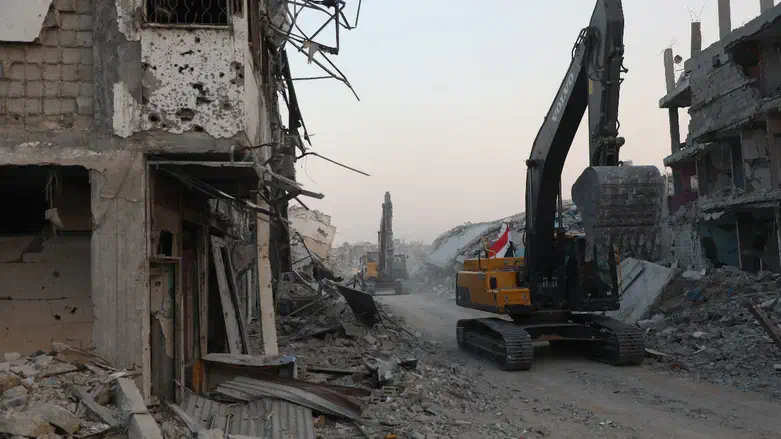
Rebuilding Gaza, illustrationTPS
Deputy Palestinian Authority chairman Hussein al-Sheikh and head of the General Intelligence, Majed Faraj, arrived in Cairo today (Sunday) and met with senior Egyptian officials, as part of efforts to advance the “second phase” of the ceasefire agreement in the Gaza Strip.
According to reports, the Egyptian side presented Palestinian officials with a list of candidates for a committee of technocrats that is supposed to administer the Strip, at least temporarily, after the end of Hamas rule. Sources involved in the talks said Israel and the United States had already given their approval to the names.
However, a senior Palestinian official who spoke to the newspaper Al-Arabi Al-Jadeed stressed, “Any committee that is established and operates without Palestinian national legitimacy will not succeed,” and clarified that this stance was conveyed to Arab parties and the U.S.
Among the issues discussed in the talks were reopening the Rafah crossing in both directions, deploying a Palestinian and a European force in the crossing area, and a return to the 2005 arrangements, under which Palestinian forces operated in civilian clothing alongside a European presence.
Another issue on the table is the deployment of Palestinian Authority security forces inside the Strip.
PA security sources said that hundreds of police and Palestinian security personnel underwent training in Egypt over the past year, in preparation for the possibility of PA forces entering Gaza when the war ends.
Moscow endorses Latin American statement calling for urgent UN Security Council meeting; leftist Latin American regimes warn of regional instability, as right-wing ones celebrate
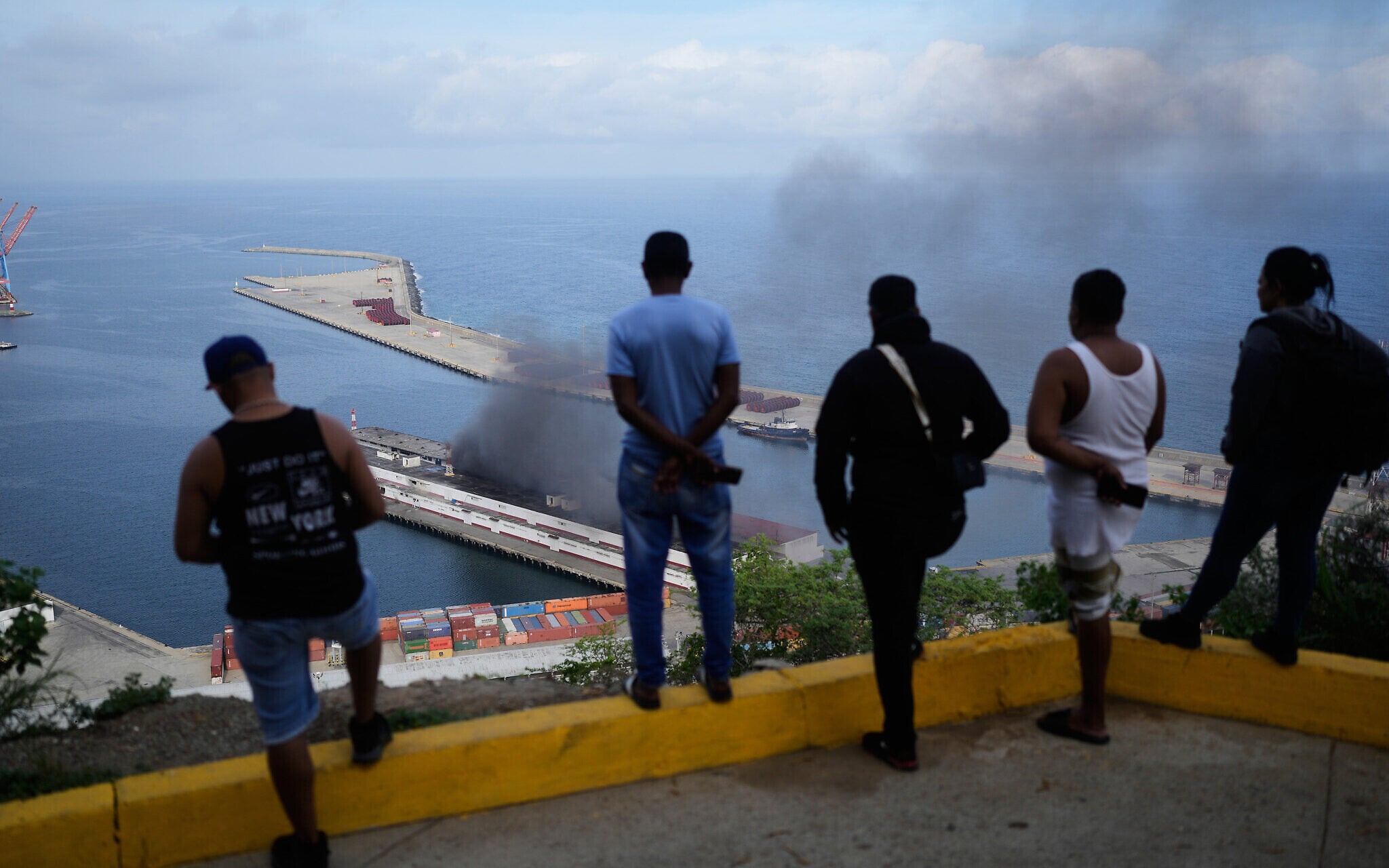
People watch smoke rising from a dock after a series of US strikes at La Guaira port, Venezuela, January 3, 2026. (AP/Matias Delacroix)
Britain and the European Union urged respect for international law on Saturday after the US launched a large-scale assault on Venezuela and announced the capture of its leader Nicolas Maduro, drawing condemnation from his allies in Latin America, Russia and Iran, as well as from Lebanon’s Hezbollah.
“The EU has repeatedly stated that Mr. Maduro lacks legitimacy and has defended a peaceful transition” in Venezuela, the 27-nation bloc’s top diplomat Kaja Kallas wrote on X after speaking with her US counterpart Marco Rubio. “Under all circumstances, the principles of international law and the UN Charter must be respected. We call for restraint.”
Kallas said the EU was closely monitoring the fast-moving situation and that she had spoken to the bloc’s envoy to Venezuela, with the safety of EU citizens “our top priority.”
EU Council President Ursula von der Leyen said she was following developments “very closely.”
“We stand by the people of Venezuela and support a peaceful and democratic transition. Any solution must respect international law and the UN Charter,” she said on X.
British Prime Minister Keir Starmer said the UK had no part in the assault ordered by US President Donald Trump on Venezuelan capital Caracas.
“I want to establish the facts first, I want to speak to President Trump, I want to speak to allies,” the UK leader said in brief comments aired on British television hours after the US attack. “I can be absolutely clear that we were not involved in that. And as you know, I always say and believe we should all uphold international law.”
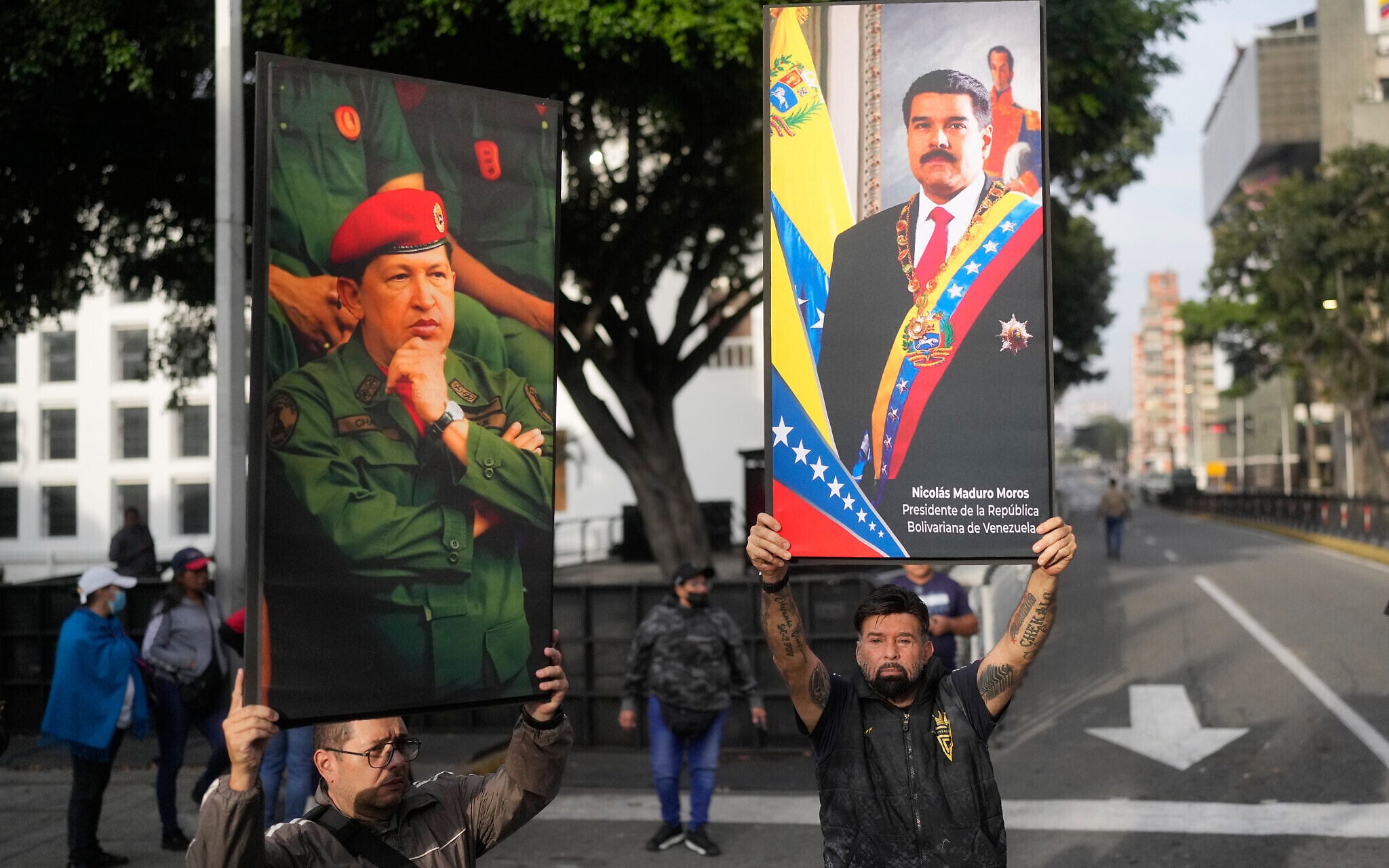
Government supporters display posters of Venezuelan President Nicolás Maduro, right, and former President Hugo Chávez in downtown Caracas, Venezuela, January 3, 2026, after US President Donald Trump announced that Maduro had been captured and flown out of the country. (AP Photo/Matias Delacroix)
Neither the EU nor the UK has recognized the results of the disputed 2024 election that handed Maduro a third term in power. Both have slapped sanctions on dozens of Venezuelan officials for undermining democracy in the country.
But they have stopped short of formally recognizing 2024 opposition candidate Edmundo Gonzalez Urrutia as Venezuela’s rightful leader, as the United States has done.
Gonzalez Urrutia ran as a last-minute stand-in for opposition figurehead Maria Corina Machado, who was barred from contesting last year’s election. After the vote, Gonzalez Urrutia fled Venezuela for Madrid — which offered to act as mediator after Maduro’s capture on Saturday.
“Spain calls for de-escalation and moderation, and for action to always be taken in accordance with international law and the principles of the UN Charter,” the Spanish government said. “In this regard, Spain is willing to offer its good offices to achieve a peaceful and negotiated solution to the current crisis.”
Venezuela’s allies cry foul
The US assault on Venezuela came after the Trump administration spent months escalating pressure on Maduro. The CIA was behind a drone strike last week at a docking area believed to have been used by Venezuelan drug cartels — the first known direct operation on Venezuelan soil since the US began strikes at sea in September. The US accuses Maduro of running a drug cartel.
Russia, a Venezuelan ally, accused the US of unprovoked aggression and expressed support for a statement by Venezuelan authorities and Latin American leaders calling for an immediate meeting of the UN Security Council.
“This morning, the United States committed an act of armed aggression against Venezuela. This is deeply concerning and condemnable,” Moscow’s foreign ministry said. “The pretexts used to justify such actions are unfounded. Ideological animosity has prevailed over business pragmatism and the willingness to build relationships based on trust and predictability.”
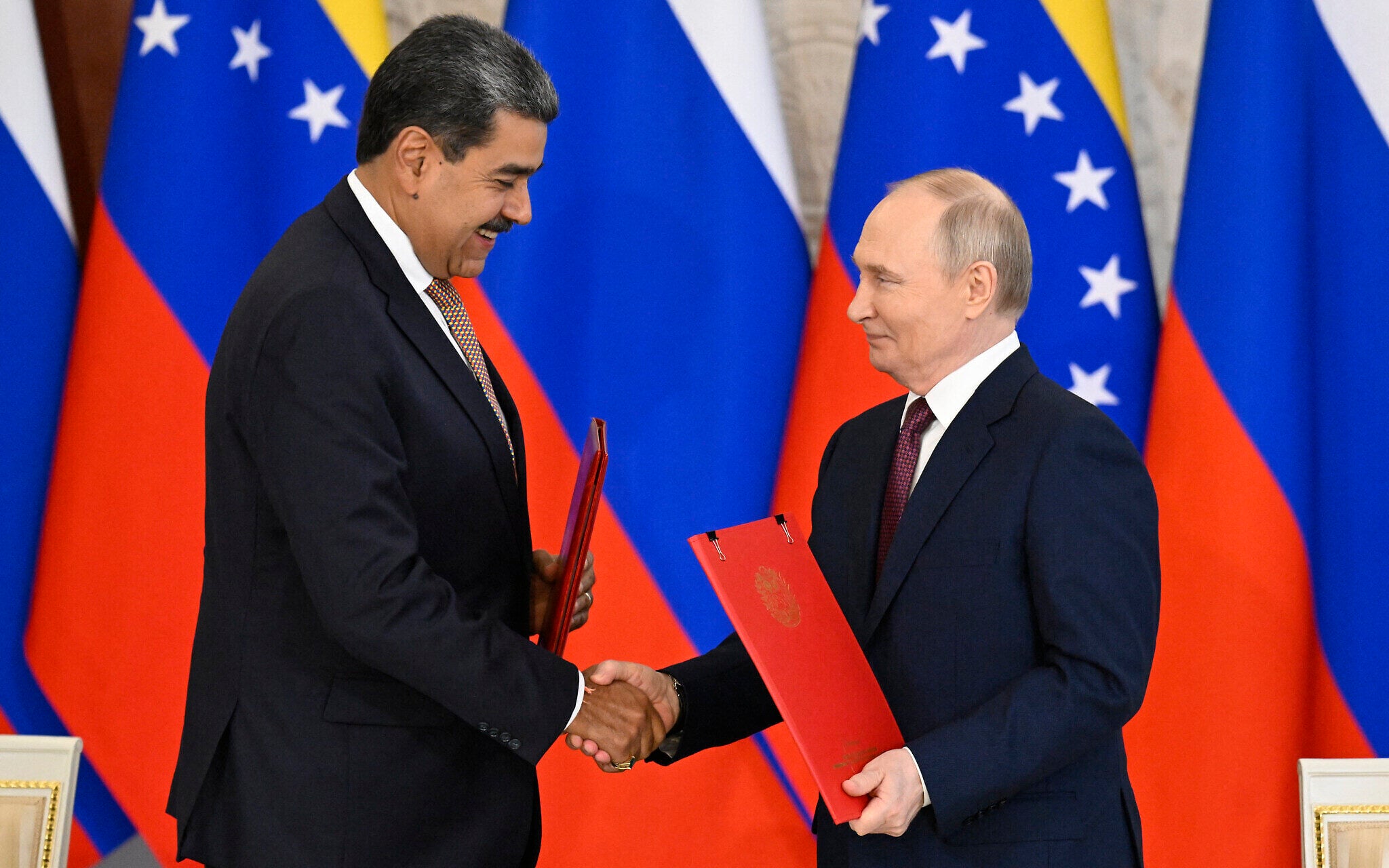
Russian President Vladimir Putin, right, and Venezuelan leader Nicolas Maduro shake hands as they exchange documents during a signing ceremony following their talks at the Kremlin in Moscow on May 7, 2025. (Alexander NEMENOV / AFP)
“In the current situation, it is important, first and foremost, to prevent further escalation and to focus on finding a way out of the situation through dialogue.”
“Latin America must remain a zone of peace,” said the statement. “Venezuela must be guaranteed the right to determine its own destiny without any destructive, let alone military, interference from outside.”
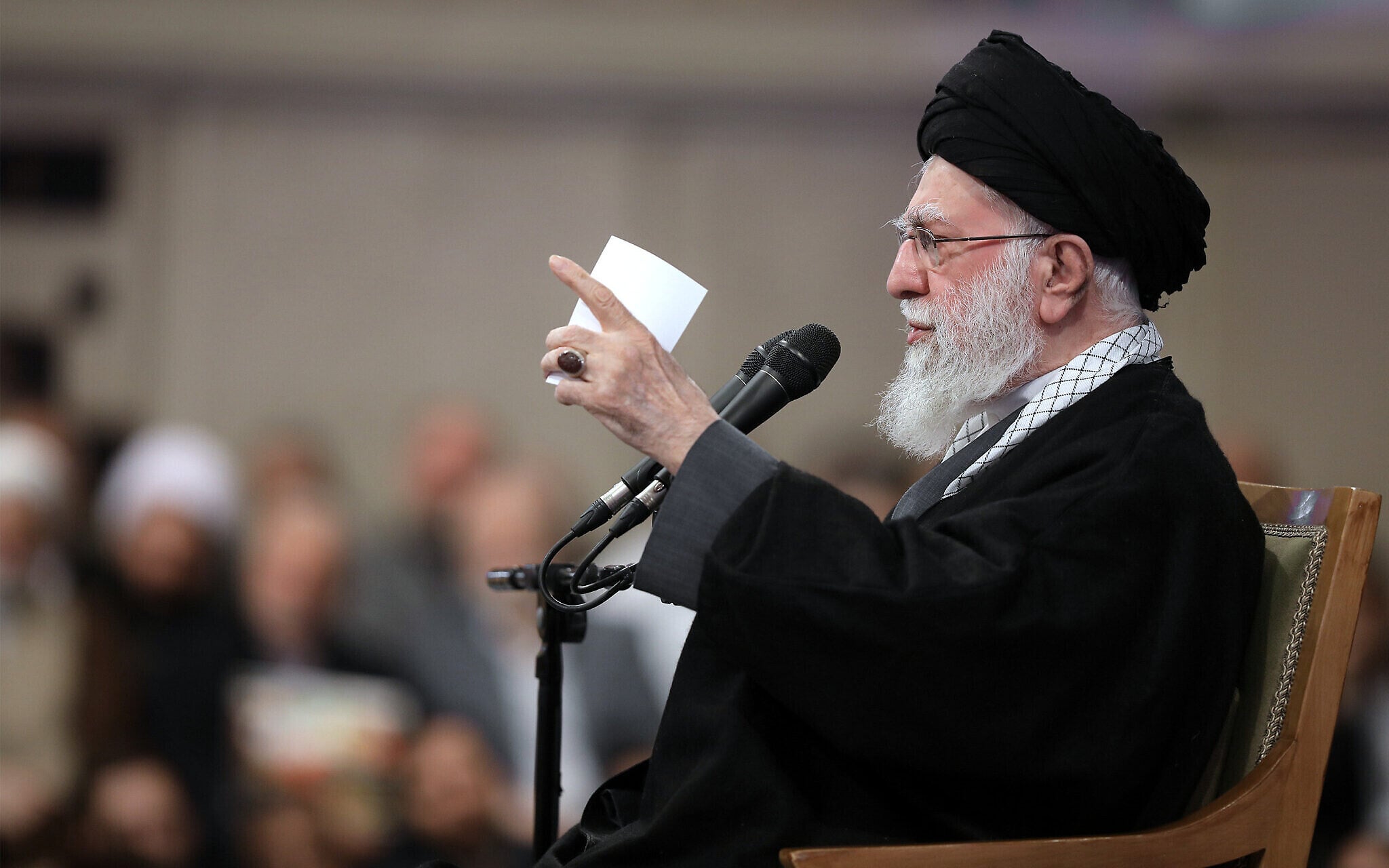
Iran’s Supreme Leader Ayatollah Ali Khamenei called for “resistance” against the US assault in Venezuela, a day after Trump said the US was “locked and loaded” to strike Iran if it kills peaceful protesters.
“What matters is that when a person realizes the enemy is arrogantly trying to impose something on the country, on the officials, on the government, and on the nation, one must stand firmly against the enemy and bare one’s chest in resistance. We will not yield to the enemy,” said Khamenei. “Relying on Almighty God, trusting in God, and with confidence in the support of the people, God willing and by divine grace, we will bring the enemy to its knees.”
The Hezbollah terror group, a member of Iran’s so-called Axis of Resistance network of regional anti-Israel proxies, said it “condemns the terrorist aggression and American thuggery against the Bolivarian Republic of Venezuela.
“Hezbollah further affirms its full solidarity with Venezuela — its people, presidency, and government — in confronting this American aggression and arrogance,” it said.
In this photo released by an official website of the office of the Iranian supreme leader, Supreme Leader Ayatollah Ali Khamenei speaks in a meeting, in Tehran, Iran, January 3, 2026. (Office of the Iranian Supreme Leader via AP)
Left-wing Latin American governments also assailed the US strikes.
Mexico said any form of military action “seriously jeopardizes regional stability.”
Mexico “strongly condemns and rejects the military actions carried out unilaterally in recent hours by the armed forces of the United States of America against targets on the territory of the Bolivarian Republic of Venezuela,” the foreign ministry said in a statement.
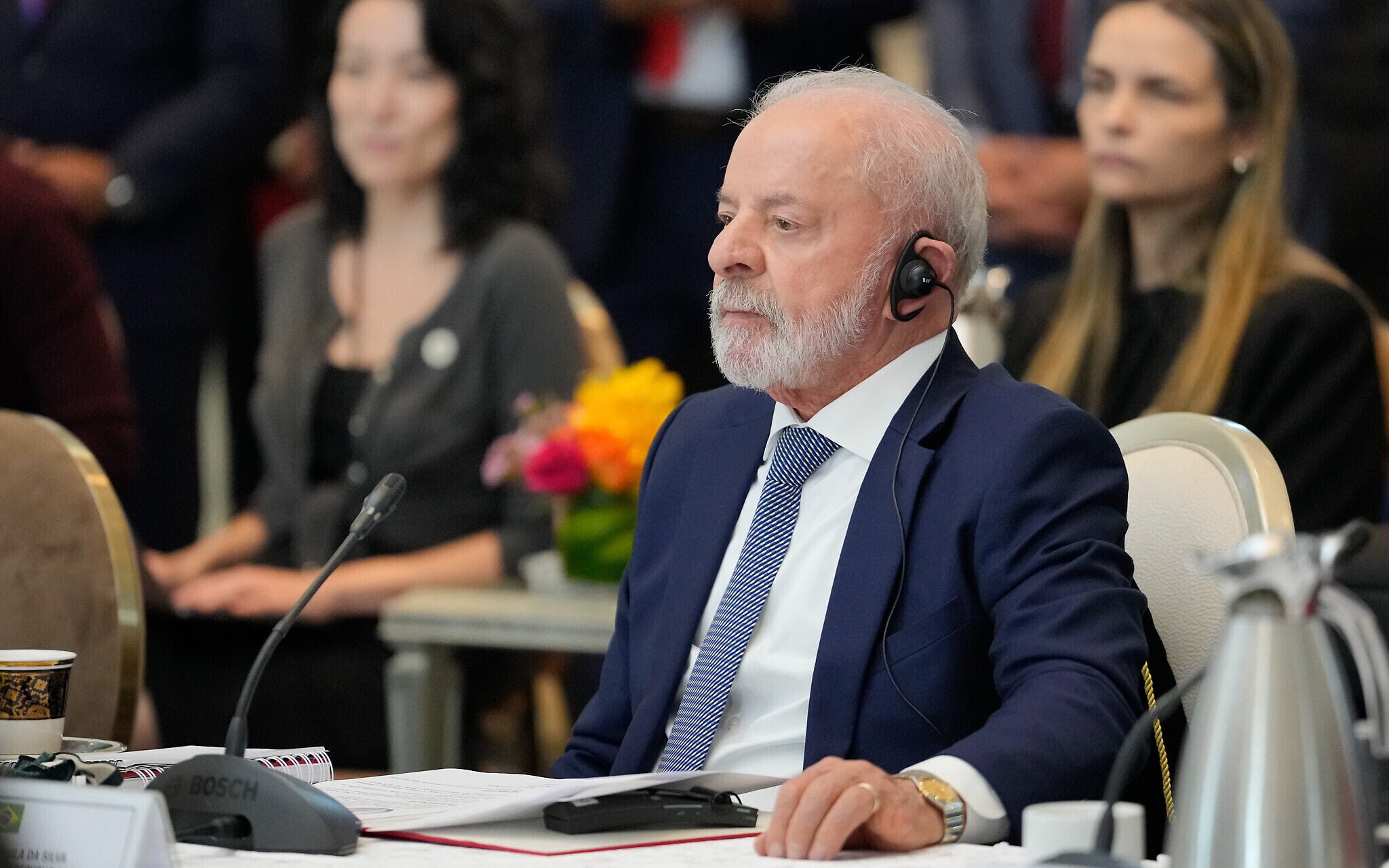
Brazil’s veteran leftist president Luiz Inacio Lula da Silva said the US strike crossed “an unacceptable line.”
“These acts represent a grave affront to Venezuela’s sovereignty and yet another extremely dangerous precedent for the entire international community,” Lula said in a post on X.
Lula had previously said that an armed intervention in Venezuela would be a “humanitarian catastrophe,” and has offered to mediate disputes between the countries.
Brazilian President Luiz Inácio Lula da Silva listens to a speech by Malaysian Prime Minister Anwar Ibrahim, unseen, during a meeting in Putrajaya, Malaysia, October 25, 2025. (AP Photo/Vincent Thian, Pool)
Colombian President Gustavo Petro warned of “escalation of tension in the region.”
Colombia “views with deep concern the reports of explosions and unusual air activity in recent hours in the Bolivarian Republic of Venezuela, as well as the resulting escalation of tension in the region,” he said. “The Colombian government rejects any unilateral military action that could aggravate the situation or put the civilian population at risk.
Meanwhile, Trump’s right-wing allies in South America celebrated.
“FREEDOM MOVES FORWARD. LONG LIVE FREEDOM DAMN IT,” Argentina’s Javier Milei wrote on X.
In an appended video, Miliei could be seen previously talking at a summit and describing Maduro as a threat to the region and backing the pressure Trump was putting on Caracas.
“The time to have a timid approach on this subject has passed,” Milei said there.
Ecuador’s President Gabriel Noboa said “the time is coming for all the narco-Chavista criminals,” referring to Maduro’s patron and predecessor, Hugo Chavez, who took power in Venezuela in 1999 and declared the country a socialist “Bolivarian Republic.”
“Their structure will finally collapse across the entire continent,” wrote Noboa on X. “To Corina Machado, Edmundo Gonzalez, and the Venezuelan people: it is time to reclaim your country. You have an ally in Ecuador.”
Iran’s Supreme Leader Ayatollah Ali Khamenei vowed not to yield after US President Donald Trump threatened to come to the aid of protesters, as rights groups reported a sharp rise in arrests following days of unrest sparked by soaring inflation.
Speaking in a recorded appearance on Saturday, Khamenei said the Islamic Republic “will not yield to the enemy” and that rioters should be “put in their place.”
State-affiliated media reported three deaths on Saturday, with rights groups saying more than 10 had already died in demonstrations across Iran since Sunday as the collapsing rial currency hits an economy already undermined by sanctions.
ECONOMIC CRISIS
Videos circulating on social media, which Reuters could not immediately verify, purported to show protests in southern and western Iran. In one, marchers called on other Iranians to come onto the streets, chanting “We don’t want spectators: join us”.
Mehr and Fars news agencies, both state affiliated, reported that a security forces member and two demonstrators were killed in Malekshahi, a western town, when what they called armed protesters tried to enter a police station.
Authorities have attempted to maintain a dual approach to the unrest, saying protests over the economy are legitimate and will be met by dialogue, while meeting some demonstrations with tear gas amid violent street confrontations.
“The bazaaris were right. They are right to say they cannot do business in these conditions,” said Khamenei, referring to market traders’ concerns over the currency slide.
“We will speak with the protesters but talking to rioters is useless. Rioters should be put in their place,” he added.
Reports of violence have centered on small cities in Iran’s western provinces, where several people have been killed, according to state media and rights groups. Authorities have said two members of the security services had died and more than a dozen were injured in the unrest.
Hengaw, a Kurdish rights group, said late on Friday that it had identified 133 people arrested, an increase of 77 from the previous day.
Trump on Friday said the US was “locked and loaded and ready to go” but did not specify what action it might take against Iran, where it carried out airstrikes last summer, joining an Israeli campaign targeting Iran’s nuclear sites and military leaders.
The threat of action adds to the pressure on Iran’s leaders as they navigate one of the most difficult periods in decades, with the sanctions-hit economy shrinking and the government struggling to provide water and electricity in some regions.
Iran has suffered a succession of major strategic blows to its regional position since the start of the war in Gaza in 2023 between its ally Hamas and Israel.
Israeli strikes hammered Iran’s strongest regional partner Hezbollah. Tehran’s close ally Bashar al-Assad was ousted in Syria. The Israeli and US assault strikes on Iran set back the expensive atomic program and killed senior military leaders, revealing extensive penetration of Tehran’s upper echelons.
FLARING VIOLENCE
The protests are the biggest since mass nationwide demonstrations in late 2022 over the death in custody of Kurdish woman Mahsa Amini. This week’s demonstrations have not matched those in scale, but still represent the toughest domestic test for authorities in three years.
Rights groups such as Hengaw and activists posting on social media reported continued protests and violence by security forces across Iran, while state-affiliated media reported what it called attacks on property by infiltrators “in the name of protest.”
State television reported arrests in western and central Iran and near the capital Tehran, including of people accused of manufacturing petrol bombs and home-made pistols.
Numerous social media posts overnight said there had been unrest in a number of cities and towns, as well as three districts of Tehran.
Reuters could not immediately verify the reports by rights groups, state media or social media accounts.