Qatar condemned on Monday an attack on an oil tanker off the coast of Oman on Friday and called for resorting to the international law to ensure that such attacks would not be repeated in the future, the foreign ministry said.

The ministry said in a statement that Qatar totally rejects “actions that would disrupt the safety and security of international maritime transport and impede the movement of ships and tankers.”
The United States, Israel and Britain blamed Iran for the attack on an Israeli-managed tanker off the coast of Oman. Tehran has denied any involvement in the suspected drone attack on Thursday that killed two crew members, a Briton and a Romanian.


IRANIAN CYBERATTACKS THREATEN OUR DAILY OPERATIONS – OPINION

According to a Sky News report based on classified documents allegedly from Iran, a cyber attack could sink a cargo ship or blow up a fuel pump at a gas station.

UNTIL NOW, building owners did not add nation-states into the reference threat options, a mistake that needs to be addressed. (photo credit: KACPER PEMPEL / REUTERS)
UNTIL NOW, building owners did not add nation-states into the reference threat options, a mistake that needs to be addressed.
(photo credit: KACPER PEMPEL / REUTERS)
According to a Sky News report based on classified documents allegedly from Iran, a cyber attack could sink a cargo ship or blow up a fuel pump at a gas station.
The Sky News report also details how satellite devices are used by the shipping industry globally and how a computer-based system controls lighting, heating, and ventilation in smart buildings worldwide.
According to a security source with knowledge of five research documents, the 57-page collection was gathered by an offensive cyber unit called Shahid Kaveh, part of Iran’s terrorist-linked Islamic Revolutionary Guard Corps (IRGC).
 “They are creating a target bank to be used whenever they see fit,” said the source, who requested to remain anonymous for the documents to be discussed directly.
 Almost all of the files include a quote that appears to be from Iran’s Supreme Leader Ali Khamenei: “The Islamic Republic of Iran must become among the world’s most powerful in the area of cyber.” Sources describe this quote as something like a “commander’s intent statement.”
The front pages of only two of the reports mention the date of completion.
The first examines what is known as a building management system – the computer technology that controls things like lights, heating, and ventilation in smart buildings – from November 19, 2020.
Companies that provide these services are listed in the documents. Several manufacturers were involved, including Honeywell in the United States; Schneider Electric, a French electrical equipment company; Siemens, a German company; and KMC Controls, another US company.
Another report, which deals with a German company called WAGO, which makes electrical components for the industrial automation market, is dated April 19, 2020 and is the most comprehensive.
The file examined vulnerabilities in a programmable logic controller or PLC – a computer control system.
“Continuing the investigation, to use these processes, we noticed the vulnerabilities within these systems are irreparable. If there is an attack, the damage will not be easy to fix,” the report said.
“Therefore, compared to other PLC brands, this brand is impenetrable once connected online. When online, the infrastructure and intelligence on engineering cannot be reached and cannot be lost.
“For our benefit, the best situation is for the PLC not to work as intended, and for that to happen, a project must be written in ‘ladder’ language and have multiple exits, as many as possible. But the problem with this project is that we wouldn’t be able to assess the damage caused. The other option is to assess the PLC’s and software’s weak points and dangerous points to attack our target. This option needs separate investigation and research before we can find the weak points.”
The Iranian attack Unit 13 is not working in a vacuum. There are many attack groups for nations, companies, and criminals, with the last two seeking money as an incentive. Governments do not follow those rules, and their agenda might not be as clear.
This is why documents describing such targets with attack openness, as those documents describe, are rarely published or exposed in such a manner.
The document provides a glimpse into the attackers’ way of thinking regarding the targets’ owners and the possible attack vectors and destruction capabilities required to harm the target.
Until now, smart building owners did not add nation-states into the reference threat options, and by closely examining the reports, it’s clear that this was a mistake that needs to be addressed.
WAGO, a German manufacturer of industrial automation, was one of the attack vectors described in the report. Many types of automation equipment are used in the industrial automation market and with Cloud-PLC service.
Many of the devices used in industrial automation and building automation are not updated. Vulnerability issues are not addressed, allowing the Iranians and other attackers to continue and hold ground on the victims’ systems for many years.
Industrial and building management systems are a key to ensuring safety. With millions of systems globally, those attack groups pose a significant risk to the modern life that we get used to in our daily lives.
The writer is a senior ICS/OT Division manager, BDO Israel.

How could the Iran ship attack affect the Vienna talks?

“Historically, when faced with real pushback, the Iranians become more cautious. Will they seek an external crisis to try to promote a nationalist coalescence? Or will they look to defuse tension?”

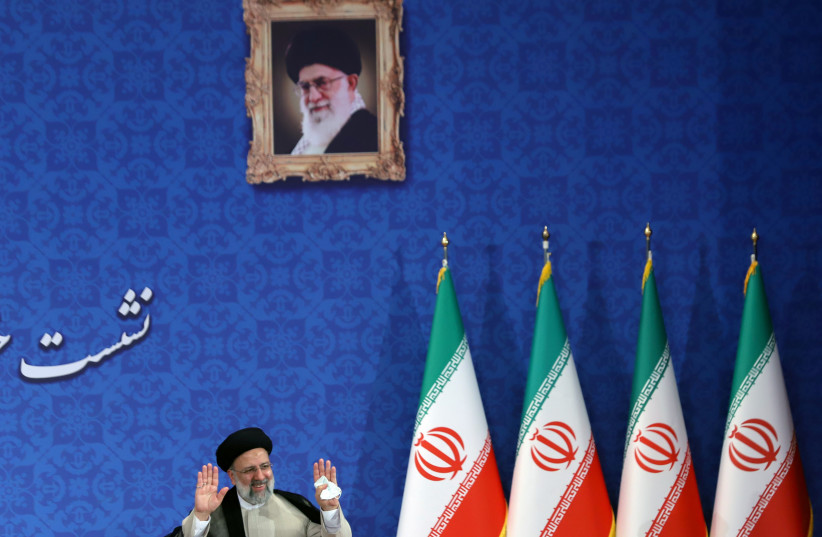
Iran's President-elect Ebrahim Raisi gestures at a news conference in Tehran, Iran June 21, 2021.  (photo credit: MAJID ASGARIPOUR/WANA (WEST ASIA NEWS AGENCY) VIA REUTERS)
Iran’s President-elect Ebrahim Raisi gestures at a news conference in Tehran, Iran June 21, 2021.
(photo credit: MAJID ASGARIPOUR/WANA (WEST ASIA NEWS AGENCY) VIA REUTERS)
WASHINGTON – The United States and Britain said on Sunday they would work with their allies to respond to the attack on the Mercer Street, a Liberian-flagged, Japanese-owned petroleum product tanker managed by Israeli-owned Zodiac Maritime.

Secretary of State Antony Blinken said on Sunday that the US is “consulting with governments inside the region and beyond on an appropriate response, which will be forthcoming.”
As tension rises between the US and Iran, could that affect the dynamic of the Iran nuclear talks? The last round of talks took place almost six weeks ago, on June 20, and since then the sides have yet to reschedule the next one.

“It’s possible that if Iran is looking for a convenient excuse to end the negotiations, it will use any US retaliation for the Mercer Street attack to do so,” James Acton, co-director of the Nuclear Policy Program at the Carnegie Endowment for International Peace, told The Jerusalem Post. “If, however, Iran wants to revive the JCPOA – as I think it probably does – then I don’t think US retaliation will alter its calculations,” he added. “I doubt that US policy toward the nuclear negotiations with Iran has changed.”

Ambassador Dennis Ross, a distinguished fellow at The Washington Institute for Near East Policy, told the Post that Iran’s approach is to build pressure on the US. “Responses on other issues may sober the Iranians,” he said, “but there is a risk that the Iranians can also miscalculate and overplay their hand.”

“Historically, when faced with real pushback, the Iranians become more cautious,” Ross noted. “Now, they are also facing protests domestically. Will they seek an external crisis to try to promote a nationalist coalescence? Or will they look to defuse tension? My bet is they will continue to build tension to test our response, and that means in Vienna, probably coming in with new demands, at least initially.”

“Raisi has not rejected the JCPOA, but in keeping with the supreme leader’s strategy, the regime will continue to engage in hard bargaining; they will continue to build the pressure on us by advancing their nuclear program, while denying the IAEA (International Atomic Energy Agency) its access for monitoring,” said Ross.

“Simultaneously, to return to the JCPOA, they will press for more expansive sanctions relief and assurances against the re-imposition of sanctions. I say hard bargaining because the Iranians are trying to see what they can get and will try to coerce more concessions; they must become convinced that no more concessions will be forthcoming and they will jeopardize getting sanctions relief at all if they persist on this path. They must also see that this path creates real risks that at some point, we may conclude that we no longer have a diplomatic path to limit their nuclear program. I think Iran aims to become a threshold nuclear weapons state and will test the limits of what is possible in this regard,” Ross said.

Mark Dubowitz, CEO of the Foundations for Defense of Democracies in Washington, told the Post that he was skeptical that any response will be meaningful. “This administration fears escalation with Iran which is why the clerical regime continues to have negotiation dominance,” he said.
“The supreme leader is the supreme decider. But now he has a president in Raisi who, unlike Rouhani, is not enthusiastic about a return to the JCPOA, who believes in a resistance economy that doesn’t depend on Western investment and who has seen that nuclear escalation only leads to more Biden administration concessions,” said Dubowitz. “The clerical regime is moving closer to a nuclear threshold state as it strings along American negotiators. It may decide to return to the nuclear deal but only after it has squeezed every last concession out of Washington and firmly put itself on a pathway to nuclear weapons as JCPOA restrictions expire.”

Reuters contributed to this report.
