UK diplomat: Israel has its own considerations on Iran response

An Iranian report claimed the US and UK have “greenlit” an Israeli response to the attack on a tanker off the coast of Oman.
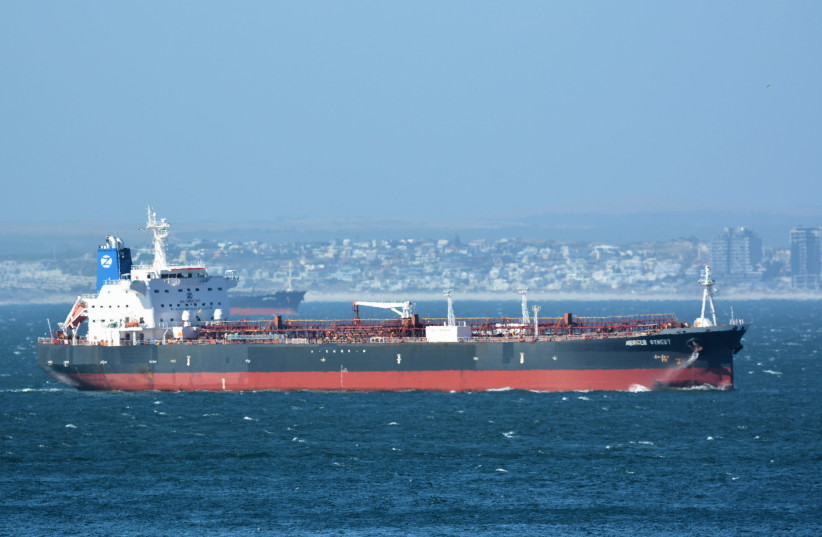
The Mercer Street, a Japanese-owned Liberian-flagged tanker managed by Israeli-owned Zodiac Maritime that was attacked off Oman coast as seen in Cape Town, South Africa, December 31, 2015 in this picture obtained from ship tracker website, MarineTraffic.com.  (photo credit: JOHAN VICTOR/HANDOUT VIA REUTERS)
The Mercer Street, a Japanese-owned Liberian-flagged tanker managed by Israeli-owned Zodiac Maritime that was attacked off Oman coast as seen in Cape Town, South Africa, December 31, 2015 in this picture obtained from ship tracker website, MarineTraffic.com.
(photo credit: JOHAN VICTOR/HANDOUT VIA REUTERS)
Israel will make its own decisions on whether to strike back at Iran after the attack on the Mercer Street ship, UK Deputy Ambassador to Israel Mark Power said on Monday, amid reports that the US and UK greenlit Israeli targets in Iran.
“Israel, like many countries in the region is threatened and must make its own considerations,” Power said, in response to KAN’s Amichai Stein question if Israel has a right to respond.
Israel, the UK and US said Iran is undoubtedly behind the bombing of the vessel off the coast of Oman on Friday, and that they would work with partners on a response.
The UAV attack which took the lives of a British and Romanian national who were aboard the Mercer Street. The ship is managed by Israeli-owned Zodiac Maritime, but is Liberian-flagged and Japanese-owned.
Power said “there is clear proof” of Iran’s culpability and the UK is working with international partners on a response, echoing remarks by UK Foreign Secretary Dominic Raab the day before.
“The question for Iranians who deny – If you did not do it, then who did it and who has the motivation to attack the ship?” he asked.
Power’s remark that Israel must make its own considerations came after Kuwaiti newspaper Al-Jarida reported that “the Israeli army has drawn up a list of Iranian targets to respond to the attack on a tanker off the coast of Oman.”
The article is headlined with claims the US and UK have “greenlit” an Israeli response to the attack.
The paper, which in the past has also claimed to have sources revealing Iranian attacks and Israeli responses, says that there are accelerated contacts between Israel the US. The paper says that the attack on the ship off Oman will not go unnoticed and that Israel will “deal a painful blow” in response. The article “stresses that Britain, whose nationals were killed in the attack, and the United States gave a green light to respond.”
The paper claims that the retaliation could be against several key targets such as the port of Bandar Abbas, or “destruction of ships near Iranian shores, and the last of which is the targeting of an Iranian warship, from which it is believed that the ‘drones’ launched the attack.”
Other sources quoted in the article claimed that the Iranian attack was aimed at the Vienna nuclear talks. Iran is about to have a new President and this could be linked to his coming to office.


The plot was audacious: Agents of the Islamic Republic of Iran would kidnap an American citizen on American soil. Masih Alinejad, an Iranian-born journalist and human rights activist, was to be grabbed, spirited out of Brooklyn to Venezuela, and then on to Tehran where she would have been imprisoned, tortured, and, almost certainly, executed.

Earlier this month, the FBI, to its enormous credit, foiled the plot. “Not on our watch,” FBI Assistant Director William Sweeney told reporters.

Spokesmen for the Islamic Republic dismissed the charges as “ridiculous and baseless.” If you believe that, Ms. Alinejad can get you a good price on a bridge not far from her home.

How dare Iran’s leaders commit such a crime? Let’s connect a few dots. Ten years ago, Iran’s rulers planned to assassinate the Saudi ambassador to America on American soil. A bomb was to explode in Café Milano, an elegant Georgetown eatery, while Adel al-Jubeir was enjoying his antipasto. Other diners, restaurant employees and passersby on the street would have been collateral damage.

This act of terrorism was foiled only because the plotters made the mistake of involving an undercover informant working with the DEA.

The question I suspect is not being asked in the White House: Did Washington’s failure to impose serious penalties on Iran’s rulers in response to the 2011 plot lead them to believe they risked little with the 2021 plot? And if no serious penalties are imposed on Iran’s rulers now, what might they try next?

In “Call Sign Chaos,” published two years ago, Jim Mattis, who headed U.S. Central Command in 2011, termed the bombing plot “an act of war.” There was no doubt about responsibility.  “I saw the intelligence,” General Mattis wrote. “We had recorded Tehran’s approval of the operation.”

He added that “only Iran’s impression of America’s impotence could have led” Iran’s rulers “to risk such an act within a couple of miles of the White House.” It was therefore essential, he believed, that the theocrats feel more than a slap on the wrist.

President Donald Trump withdrew from the Joint Comprehensive Plan of Action (which was neither comprehensive nor a plan of action) and imposed economic sanctions that, over the less than two years they were in place, enfeebled Iran’s economy. President Biden has prioritized reviving the JCPOA, offering Tehran a range of economic incentives, so far without result.

How will he respond to the abduction attempt? After meeting with Alinejad last week, Secretary of State Antony Blinken “affirmed that the U.S. will always support the indispensable work of independent journalists around the world. We won’t tolerate efforts to intimidate them or silence their voices.” Note: No mention of Tehran. And no mention of penalties.

Iran’s rulers have committed many other crimes and provocations, including a string of attacks by militias they support—the most recent last week—on U.S. forces deployed in Iraq and Syria.

I’ll discuss just one more outrage today. Wang Xiyue is a naturalized American citizen and doctoral candidate at Princeton. A few years ago, he embraced the “prevailing academic view” that “allegations of the regime’s malign behavior” were “American propaganda.” In 2016, he felt confident about traveling to Iran to work on his dissertation so long as he “remained apolitical and focused on historical research.”

He arrived not long after the implementation of the JCPOA and during what appeared to be a period of rapprochement between Washington and Tehran. Nevertheless, he was soon arrested, thrown into solitary confinement, forced to make a false confession and sentenced to 10 years in prison on espionage charges for which not a shred of evidence was produced.

His interrogator “made clear that my sole ‘crime’ was being an American. He told me I was to be used as a pawn in exchange for U.S.-held Iranian prisoners and the release of frozen Iranian assets.”

After 40 months behind bars, Iran’s rulers released him in exchange for Masoud Soleimani, an Iranian accused of attempting to export biological materials from the United States to Iran in violation of sanctions laws. The message sent to Tehran: By taking Americans hostage, you have nothing to lose and much to gain.

“Haybat” is a word I’ve learned from my Farsi-speaking friends. It implies the awe, majesty and fear that power inspires. Leaders who have it can stun and deter their enemies. Leaders who lack it are regarded as coyotes regard Cockapoos.

There was a time when American leaders had haybat, a time when Americans could cite what I call the Marilyn Monroe Doctrine. In the 1957 film, The Prince and the Showgirl, the character portrayed by the great star of the silver screen tells a foreign plotter who has threatened her: “I’m an American citizen. Nobody can do anything to me!”

Do Iran’s rulers think President Biden possesses haybat? Do the Taliban, Vladimir Putin and Xi Jinping? If you answered in the affirmative, I want to mention again that you can be the proud owner of a marvelous bridge in Brooklyn for a very reasonable price.


New president is a JCPOA opponent who may deal a death blow to the deal while advancing nuclear program.

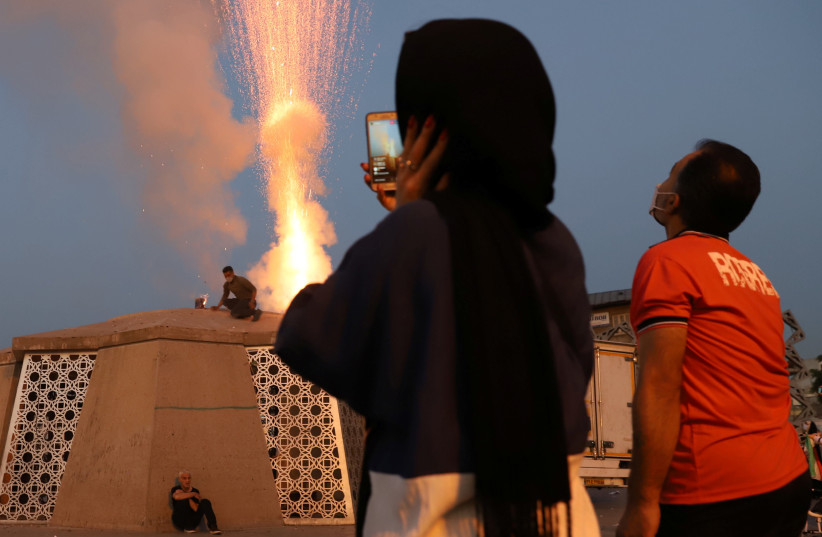
Supporters of Ebrahim Raisi light fireworks as they celebrate his presidential election victory in Tehran, Iran June 19, 2021.  (photo credit: MAJID ASGARIPOUR/WANA (WEST ASIA NEWS AGENCY) VIA REUTERS)
Supporters of Ebrahim Raisi light fireworks as they celebrate his presidential election victory in Tehran, Iran June 19, 2021.
(photo credit: MAJID ASGARIPOUR/WANA (WEST ASIA NEWS AGENCY) VIA REUTERS)
The changing of presidents in Iran shouldn’t make much of a difference for Israel. Whether it’s Hassan Rouhani, who has been president since 2013, or Ebrahim Raisi, who will enter office on Thursday, they’re not really making the decisions that matter to Israel.
When it comes to the things that matter to Israel – Iran’s nuclear program, its development of other advanced weaponry, its proxies around the Middle East and more – the person calling the shots is Supreme Leader Ayatollah Ali Khamenei. “Hardliner” or “reformer,” as many commentators call the different sides of the narrow political field Khamenei permits, no president truly has a say in the Supreme Leader’s calls for genocide against Israel and steps toward the bomb.
However, with the Iranian attack on an Israeli-managed ship near Oman on Friday, killing the vessel’s Romanian captain and a British crew member, Raisi is entering office with a bang – literally – and Israel is using its full diplomatic weight, and more, in response.
Plus, Khamenei is using Raisi’s presidency as a reason to delay, and perhaps even withdraw entirely from, negotiations with the US to rejoin the 2015 nuclear deal.
Raisi, known as the “Butcher of Tehran,” is Iran’s former chief justice responsible for thousands of executions in 1988 and the violent suppression of demonstrations in 2009. As a result, the US put him under sanctions for human rights violations in 2019, and Sweden has a pending war crimes trial against him. Raisi was elected president in a vote in which Khamenei pruned and approved the candidates, and in which turnout was under 50%.
A top Israeli official pointed fingers at Raisi in the immediate aftermath of the Mercer Street bombing by a UAV: “The Iranian attack took place days before the swearing-in of the new president Raisi, a confidant of Iran’s Supreme Leader, who was responsible for the mass executions of dissidents. The masks are coming off, and no one can pretend that they don’t know the nature of the Iranian regime.”
Prime Minister Naftali Bennett and Foreign Minister Yair Lapid publicly said Iran is behind the attack, and Bennett said Israel has the intelligence to prove it.
Bennett said he expects the world to put a stop to Iran’s aggression, but that Israel knows “how to send a message to Iran in our own way,” hinting at covert Israeli action against the Islamic Republic.
Israel views Iran killing British and European nationals in the attack as a costly mistake by the regime that could bring other countries to Israel’s side, at least when it comes to responding to this specific incident.
Lapid has been pulling out all the stops, telling his counterparts in the US, UK and Romania that Israel has assessed the attack to be from Iran. Ambassadors in London, Washington and New York have already begun relaying to relevant leaders in the capitals and the UN that Iran is threatening international trade with its repeated attacks on ships.
Israel has also begun to push for a UN Security Council condemnation of Iran’s attack. The UNSC, like the rest of the UN, is not a very friendly forum for Israel, and while it is possible that such a resolution could happen, its chances are not great. Still, Raisi could begin his time in office with drama in Turtle Bay, requiring Iranian Ambassador to the UN Majid Takht-Ravanchi to try to fend off international pressure.
Even before this weekend, Raisi’s impending presidency already had an impact on nuclear talks.
He has long been a skeptic about the Joint Comprehensive Plan of Action, the 2015 nuclear deal between Iran and world powers that the US left in 2018 and to which it now seeks to return. Raisi was Khamenei’s favored candidate, which already told us something about how the supreme leader sees the agreement.
The incoming Iranian president tempered his former total opposition to the JCPOA ahead of the election, but called for far greater concessions from the US, including a guarantee that future US administrations will not leave the deal. This is something the US cannot legally offer Iran.
In July, nearly a month after Raisi was elected president and a month after the end of the sixth round of indirect negotiations between the US and Iran to return to the JCPOA, his reservations about the deal were turned into action from Iran. Tehran’s chief nuclear negotiator and Deputy Foreign Minister Seyed Abbas Araghchi announced that the month-long pause in the talks would continue until Raisi entered office. Abbas Araghchi cynically said the break would allow for a “democratic transfer of power.”
In recent weeks, Israel has expressed alarm to its allies in the JCPOA process – the US, UK, France and Germany – that Iran was using its time away from the negotiating table to advance its nuclear program dangerously close to producing weapon-grade uranium.
Diplomatic sources have said Iran could use the “state of limbo” to reduce its breakout time for a weapon from about seven to two or three months, while the International Atomic Energy Agency is in an “uncomfortable position,” as Director-General Rafael Grossi called it, of being unable to properly inspect the situation.
And what we do know is not reassuring: Iran told the IAEA in July that it has taken steps to produce uranium metal enriched to 20% for use as reactor fuel, bringing it to a more advanced state than any country without nuclear weapons.
US Secretary of State Antony Blinken said the JCPOA negotiations “cannot go on indefinitely,” and a return to the deal will be impossible if Iran’s nuclear advances continue. But Israel is urging the US to draw a firm line on the matter of when it will be willing to go back to talks.
Meanwhile, it looks like Iran is leaning toward letting US patience run out. Last week Khamenei publicly advised Raisi to learn from Rouhani, during whose tenure “it became clear that trusting the West is not helpful… Administrations should utterly avoid tying their plans for negotiations with the West, for they’ll certainly fail.” The Americans have taken an “obstinate stance” in recent talks, the Supreme Leader added.
Israel continues to oppose the JCPOA, as it did when Benjamin Netanyahu was prime minister, pointing out that the constraints on Iran’s nuclear program – which it is currently violating – expire in 2030, and that the deal does not address Iranian malign behavior, like proxy warfare and sponsoring terrorist groups across the region, or its ballistic missile program.
Unlike Netanyahu, the “change government” has chosen to work with the US to mitigate the deal’s damage as long as Washington insists on trying to return to it.
However, if Khamenei and Raisi get their way and kill the JCPOA for good, US-Israel talks on Iran will have to shift from how to make the Iran deal “longer and stronger” to more dramatic ways to try to stop the Islamic Republic’s nuclear program.