
Assessment: Iran within months of nuclear weapons

Institute for National Security Studies submits annual report to the President: Iran has crossed lines that have not been crossed in the past.

Ben Ariel , Jul 28 , 2021 3:04 AM


Natanz nuclear facility in Iran

Natanz nuclear facility in Iran

Reuters

The Institute for National Security Studies (INSS) on Tuesday submitted its annual report to President Isaac Herzog.

The document first and foremost stressed the need to stop the Iranian nuclear race, which is defined as “the most serious threat to Israel.”

The report also discusses Lebanon and the fear that the collapse of Lebanon due to the political and economic crisis there could lead to an escalation with Hezbollah.

The document shows that Iran is gaining the knowledge and experience required for nuclear weapons and is advanced in uranium enrichment and “technological nuclear capabilities in the operation of advanced centrifuges. It has crossed previously unseen lines, such as uranium enrichment to 60 percent. Iran is based on a ‘near nuclear threshold’ with a ‘nuclear bomb’ capability over a period of a few months.”

INSS researchers recommend that Israel prepare for the possibility of the need to use military force to stop the Iranian program.

Regarding Lebanon, it was written, “Although there is mutual deterrence between Israel and Hezbollah, the potential for deterioration increases as a result of activities that could lead to dynamics of escalation.”

“Hezbollah is maintaining its strength and continues to establish its hold on the Lebanese system, in a way that places it as a real and serious threat to Israel. The IDF should be preparing for scenarios of escalation, including a confrontation with Hezbollah that could develop into a war in the north. Israel must advance an international and regional effort to prevent Lebanon from deteriorating into scenarios of anarchy, civil war, or Hezbollah takeover of the country,” the report says.


Reportedly Revolutionary Guard documents from last year name Israel, US, UK and others as potential targets; also say attacks could be used to blow up fuel pump at gas station


Cargo ships idle in the Gulf of Suez, March 26, 2021. (AP Photo/Mohamed Elshahed)

Cargo ships idle in the Gulf of Suez, March 26, 2021. (AP Photo/Mohamed Elshahed)

A cache of top-secret documents, allegedly written by Iranian intelligence, show Tehran is building a bank of potential targets for cyberattacks, Sky News reported on Monday.

The files, screenshots of which were published by the UK news outlet, show plans for attacks that could sink a cargo ship or blow up a fuel pump at a gas station.

They also include researched details about satellite communication devices used by the international shipping industry, as well as computer-based systems controlling the lights, heating and ventilation in smart homes.

The five documents, spanning 57 pages in total, of which at least four appear to have been written last year, show an interest in cyberattacks against Western countries, including Israel, the United States, Britain and France.

They were written by a secret offensive unit of the Islamic Revolutionary Guard Corps’ cyber command called Shahid Kaveh, the report said, citing an unnamed security source who said he was “very confident” they were authentic. Other knowledgeable sources said the documents “looked credible and interesting.”

The documents were said to have been written by “Intelligence Team 13,” and each begins with a quote by Iranian Supreme Leader Ayatollah Ali Khamenei: “The Islamic Republic of Iran must become among the world’s most powerful in the area of cyber.”

“They are creating a target bank to be used whenever they see fit,” the source was quoted as saying.

Intelligence Team 13, he added, “are supposed to be rather clandestine. They work on offensive cyber operations globally.”

However, the documents appeared to be based on open sources and internet searches rather than privileged information, according to Sky.

Iran’s embassy in London declined to comment on the report.

One document showed diagrams of systems designed to keep cargo ships balanced even when they tilt.

“These pumps are used to bring water into the tanks through centrifuges and in order to operate correctly, the task must be completed with precision. Any problems could result in the sinking of the ship,” the document said.

It added: “Any kind of disruptive influence can cause disorder within these systems and can cause significant and irreparable damage to the vessel.”

Another file detailed information and photos of automatic tank gauges that track fuel flow at gas stations.

“[An] explosion of these fueling pumps is possible if these systems are hacked and controlled remotely,” it said, adding that an attack could also cut the fuel supply.

Another document examined satellite communications devices use at sea, called Seagull 5000i and Sealink CIR.

The file featured internet searches along with key phrases that included Israel, the US, the UK, France and other countries.

Commenting on the report, British Defense Secretary Ben Wallace told Sky that unless steps are taken to counter the threat of cyberattacks, “our critical national infrastructure, our way of life could be threatened quite easily.”

Britain’s military cyber chief Patrick Sanders said Iran was “among the most advanced cyber actors. We take their capabilities seriously. We don’t overstate it. They are a serious actor and they have behaved really irresponsibly in the past.”


Iran has made significant progress in high levels of uranium enrichment, uranium metal production and in operating advanced centrifuges.

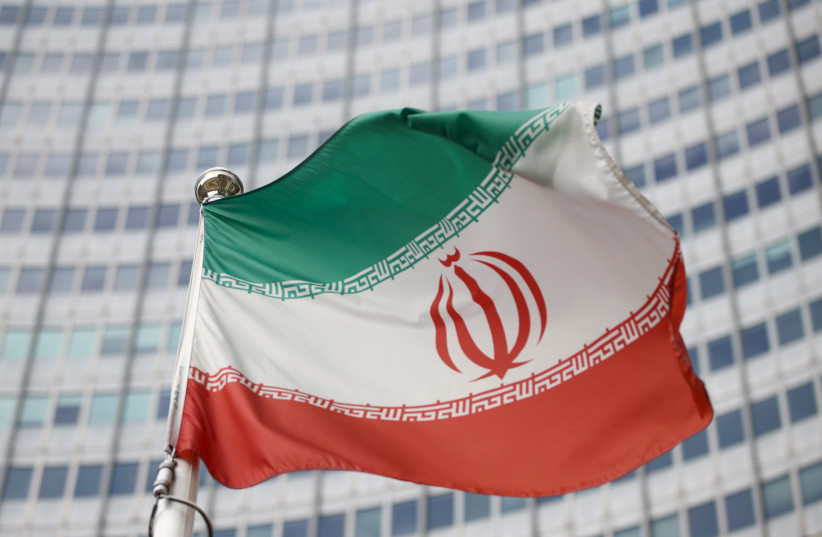
The Iranian flag waves in front of the International Atomic Energy Agency (IAEA) headquarters, before the beginning of a board of governors meeting, amid the coronavirus disease (COVID-19) outbreak in Vienna, Austria, March 1, 2021. (photo credit: REUTERS/LISI NIESNER/FILE PHOTO)
The Iranian flag waves in front of the International Atomic Energy Agency (IAEA) headquarters, before the beginning of a board of governors meeting, amid the coronavirus disease (COVID-19) outbreak in Vienna, Austria, March 1, 2021.
(photo credit: REUTERS/LISI NIESNER/FILE PHOTO)
Iran’s nuclear program poses a very serious threat to Israel, Prof. Manuel Trajtenberg, the head of the Institute for National Security Studies (INSS), told President Isaac Herzog on Tuesday.

Trajtenberg, accompanied by a team of researchers, was presenting the annual INSS report on the main challenges confronting Israel, along with recommendations for strategic positions that Israel should take in relation to these challenges.
There is a sense that nuclear talks conducted with Iran in Vienna by American and European representatives will not lead to anything, because Tehran is accumulating more vital knowledge and experience in order to produce nuclear armaments, according to the INSS assessment.
Iran has made significant progress in high levels of uranium enrichment, uranium metal production and in operating advanced centrifuges.
The political, economic and social collapse of Lebanon, and the ongoing divisions in Syria have enabled Iran to penetrate deeper into the area with the capability to strike directly into the heart of Israel.
Despite the difficult straits in which it finds itself, and the massive criticism to which it is subjected, Hezbollah is conserving its strength for possible conflict with Israel.
There is an additional problem of Russia and Iran competing for influence in Syria.
Israel must understand that so long as President Bashar Assad remains in power in Syria, there is no hope of Iran leaving this part of the region, Herzog was informed.
The Palestinian issue has become a peripheral matter on the international agenda. The INSS believes that it is important to strengthen the Palestinian Authority and to reach an understanding with Hamas for a prolonged ceasefire in order to bring some semblance of stability to the Gaza Strip.
With regard to Israel’s relations with the current US administration, key issues include the influence that Israel can exert on America’s negotiations with Iran, and what alternatives there are in the event that the JCPOA deal is renewed, or alternately, if the negotiations break down.
Contrary to the policy of the Trump administration, President Joe Biden’s administration has elected to renew relations with the Palestinian Authority.
However, the legitimacy of the PA is in peril. Elections scheduled for May were canceled in April, causing tensions among Palestinian Arabs and between Arabs and Jews, particularly in relation to a Jewish presence on the Temple Mount.
The assessment also stresses the importance of finding a modus vivendi with the Biden administration; and closer to home, mending fences with Jordan.
Other issues included China’s position in the world, the implications of the coronavirus pandemic and the new variants; the violent altercations in cities where there are mixed populations of Jews and Arabs; the internal social crisis in which there are huge gaps between different sectors of Israeli society; Israel’s new government, the approval of a national budget and the political crisis which is still simmering.
The report is evidence of the magnitude of the national challenges confronting Israel in areas of national security, socio-economics and more, said Herzog, adding that he was extremely impressed by the depth of the analyses. He suggested that the report be studied by the nation’s decision makers.
Meanwhile he is attempting to defuse some of the political tensions by meeting with leaders and other prominent figures of the various political parties in the Knesset.
Among those he’s met with over the past week are Prime Minister Naftali Bennett, opposition leader Benjamin Netanyahu, Foreign Minister Yair Lapid, Regional Cooperation Minister Esawi Frej and United Torah Judaism MKs Ya’acov Litzman and Moshe Gafni.