“The next war will be complex for us but unbearable for them. “

Arutz Sheva Staff , Jul 14 , 2021 5:00 PM


The commander of the Northern Command, Major General Amir Baram, said that “We are preparing surprises for Hezbollah’s ‘surprises.’ The next war will be complex for us but unbearable for them. ”

It is estimated that the terrorist army has between 130-150 thousand rockets and missiles capable of hitting any point in Israel, at distances between 15 and 700 kilometers, at a rate of ten thousand launches a week.

In light of this, units in the armored and engineering corps have recently undergone the ‘Northern Threshold’ test to measure required preparedness for the next war in Lebanon.

The test, which lasts a week, was built to train young fighters and commanders who have not experienced combat and to best prepare for aggressive and deadly maneuvering in enemy territory.

A battalion that does not pass the test according to the set threshold is declared unfit for war and is required to continue training and perform the test again until succeeding.

39 out of 40 battalions have been tested and passed the exam. Battalion 51 started the test but was required to stop in the middle after being called to action during Operation Guardian of the Walls.

The commander of the 36th Division, Brigadier General Dan Neumann, stated unequivocally: “The fire from the air will be powerful in the first hours of the fighting. But in order to defeat the enemy at the operational stage, we will need ground maneuvering. ”

The IDF today unveiled a Hezbollah target to prove that the organization uses civilian assets for military activity – this is one of the thousands of targets in the Northern Command that is to be attacked in the next Lebanon war.

The IDF pointed to a weapons storehouse established in the heart of Kfar Abba, the capital of the Nabatieh district- about 25 meters from the official school of Kfar Abba. The proximity of Hezbollah’s weapons to the school endangers more than 300 innocent students. Like this target, there are thousands of similar Hezbollah targets that endanger the citizens of Lebanon and which are targeted by the IDF.

Baram warned Hezbollah: In the next campaign, you will meet a trained, deadly army that is more determined than ever.”


צילום: דובר צה”ל


Rouhani: Iran can enrich uranium to 90% purity if needed

Iran could enrich uranium up to 90% purity if the country needed it, President Hassan Rouhani said on Wednesday, amid efforts by Tehran and six world powers to revive a 2015 nuclear deal that Washington abandoned three years ago.
“Iran’s Atomic Energy Organisation can enrich uranium by 20% and 60% and if one day our reactor needs it, it can enrich uranium to 90% purity,” Rouhani said in a cabinet meeting, the semi-official Mehr news agency reported.
Iran’s nuclear deal caps the fissile purity to which Tehran can refine uranium at 3.67%, well under the 20% achieved before the agreement and far below the 90% suitable for a nuclear weapon.
Iran has been breaching the deal in several ways since the United States withdrew from the agreement in 2018, including by producing 20% and 60% enriched uranium.


In 586 BCE, the Babylonians breached into the city and tore down the Temple, but part of the walls survived, researchers found.

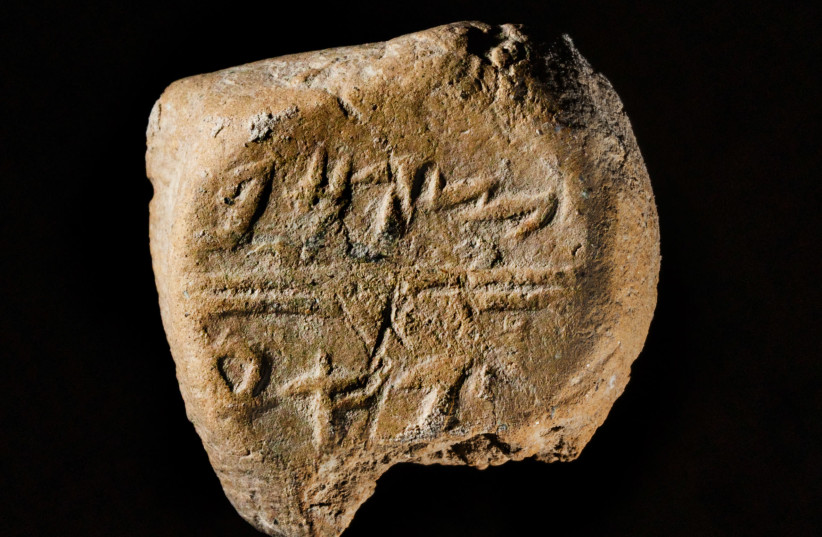
A stamp seal which bears the name “Tsafan" in ancient Hebrew script.  (photo credit: KOBI HARATI/CITY OF DAVID)
A stamp seal which bears the name “Tsafan” in ancient Hebrew script.
(photo credit: KOBI HARATI/CITY OF DAVID)
A section of Jerusalem’s city wall built during the First Temple period and mostly destroyed by the Babylonian army in 586 was uncovered by archaeologists in the City of David National Park, the Israel Antiquities Authority announced Wednesday.
“By the ninth day [of the fourth month] the famine had become acute in the city; there was no food left for the common people. Then [the wall of] the city was breached. (…) On the seventh day of the fifth month—that was the nineteenth year of King Nebuchadnezzar of Babylon—Nebuzaradan, the chief of the guards, an officer of the king of Babylon, came to Jerusalem. He burned the House of the LORD, the king’s palace, and all the houses of Jerusalem; he burned down the house of every notable person,” reads the last chapter of the book of II Kings.
The new part of the wall exposed was built to protect the city from the east on the eastern slope leading to the city. It connects two parts that had been uncovered in the 1960s by British archaeologist Kathleen Kenyon and in the 1970s by archaeologist Yigal Shiloh in the northern and southern areas of the slope. However, most scholars did not believe that the remains were to be considered part of the city wall. The new discovery however shows otherwise.
“The city wall protected Jerusalem from a number of attacks during the reign of the kings of Judah, until the arrival of the Babylonians who managed to break through it and conquer the city,” said directors of the excavation, Dr. Filip Vukosavović of the Ancient Jerusalem Research Center and Dr. Joe Uziel and Ortal Chalaf on behalf of the IAA. “The remains of the ruins can be seen in the archaeological excavations. However, not everything was destroyed, and parts of the walls, which stood and protected the city for decades and more, remain standing to this day.”
Other findings related to the period, such as seal impressions – also known as bullae – have been  found during the excavation.
The section uncovered was about 2.5 m. high and up to 5 m. wide.
The experts believe that when the Babylonians conquered Jerusalem, they might have not targeted the wall on the eastern slope because of its steepness.
However, they did succeed in destroying the city and the Temple, and draw Jews into exile, similar to what would happen about 500 years later at the hands of the Romans.
Once again it was the 9th of Av – which this year will fall on Sunday. To this day, Jews all over the world fast and mourn the loss of Jerusalem, commemorating these days of war and destruction millennia ago.