
The coins, dated to around the Second Temple and Bar Kochba revolt periods, document the Jewish revolt against the Romans.
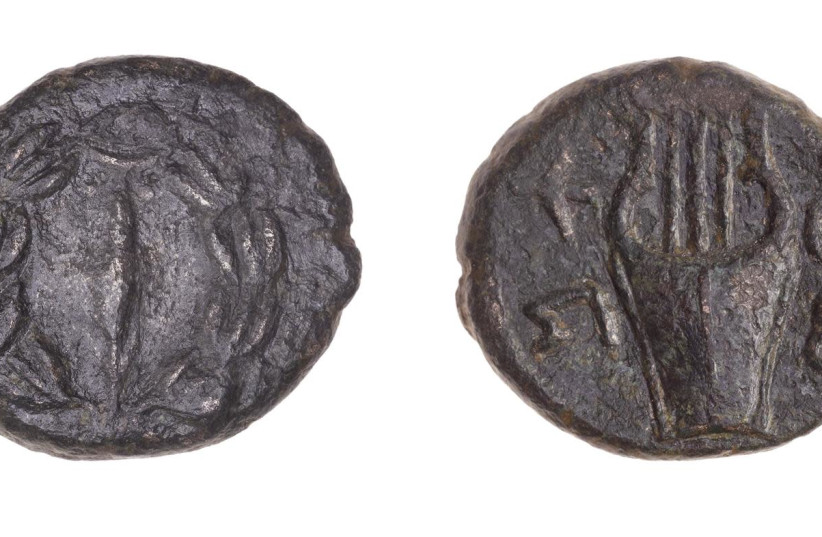
The 2,000-year-old coins that date back to the period of the Jewish revolts against the Romans, July 13, 2021. (photo credit: TAL ROGOVSKY)
The 2,000-year-old coins that date back to the period of the Jewish revolts against the Romans, July 13, 2021.
(photo credit: TAL ROGOVSKY)
Two coins dating back some 2,000 years were found in the Binyamin region of the West Bank during an archaeological survey conducted by Bar-Ilan University, the university and the Binyamin Regional Council announced Tuesday.
The coins date back to the period of the Jewish revolts against the Romans.

The 2,000-year-old coins that date back to the period of the Jewish revolts against the Romans, July 13, 2021. (Credit: TAL ROGOVSKY)The 2,000-year-old coins that date back to the period of the Jewish revolts against the Romans, July 13, 2021. (Credit: TAL ROGOVSKY)

One of them was minted around 67 CE. It features a vine leaf and the Hebrew inscription Herut Zion (Freedom for Zion) on one side, and the inscription “Year Two” on the other. Just three years later, in 70 CE, the Romans would destroyed the Temple in Jerusalem.
The second coin dates back to the time of the Bar Kochba Revolt some 70 years later. It bears a palm branch surrounded by a wreath and the inscription LeHerut Yerushalayim (Freedom to Jerusalem) on one side and a musical instrument and the name “Shimon” on the other – the first name of the rebellion’s leader Bar Kochba.
Other findings, such as pottery sherds, were also uncovered in the survey.

Excavation site where two 2,000-year-old coins were found, dating to the time of the Jewish revolt against the Romans, July 11, 2021. (Credit: Excavation site where two 2,000-year-old coins were found, dating to the time of the Jewish revolt against the Romans, July 11, 2021. (Credit:

The survey included the area of Wadi Rashash, which has dozens of caves that offered refuge to Jewish refugees fleeing the Romans.
“The coin from Wadi Rashash indicates the presence of a Jewish population in the area until the end of the Bar-Kochba revolt, in contrast to what was previously believed by researchers: that the Jewish settlement north of Jerusalem was destroyed during the Great Revolt and not afterward,” said Dr. Dvir Raviv from Bar-Ilan, who led the survey.
The coin is also the first evidence that “the northernmost of the provinces of Judea in Roman times was controlled by the Bar Kochba administration.”

“No one has given a serious thought to the problem,” says Heshmatollah Falahatpisheh, former chairman of the Iranian parliament’s national security and foreign policy committee.

By Neta Bar, Israel Hayom via JNS.org

The former chairman of the Iranian parliament’s national security and foreign policy committee on Sunday blamed Israel’s Mossad spy agency for attacks against his country and criticized Iran’s security forces for not doing enough to stop them.

“All the security attacks against Iran are perpetrated by the Mossad. Although these attacks take place in our country, no one has given a serious thought to the problem,” said Heshmatollah Falahatpisheh, who is affiliated with the conservative political camp in Iran.

He also called Israel “the Islamic Republic’s rival in security and intelligence.”

Falahatpisheh’s words echoed comments made recently by former Iranian President Mahmoud Ahmadinejad and former Iranian Intelligence Minister Ali Younesi, both of whom claimed the Mossad has managed to infiltrate the country’s intelligence services.

A series of cyberattacks, mysterious explosions, fires and mishaps have plagued Iran in recent months.

On Saturday, the Iranian Transportation Ministry’s website was taken down by what state television said was a “cyber disruption,” a day after an apparent cyberattack on the state railway company.

Iran’s Fars news agency reported that the hack led to “unprecedented chaos” at rail stations.

Also on Saturday, a loud blast in north Tehran was caused by an “unknown object” exploding in a park near state television headquarters, Iranian media reported.

Iranian Telecommunications Minister Mohammad Javad Azari-Jahromi warned on Saturday of possible ransomware attacks unless vulnerabilities in computer systems were dealt with, Iranian news outlets reported.


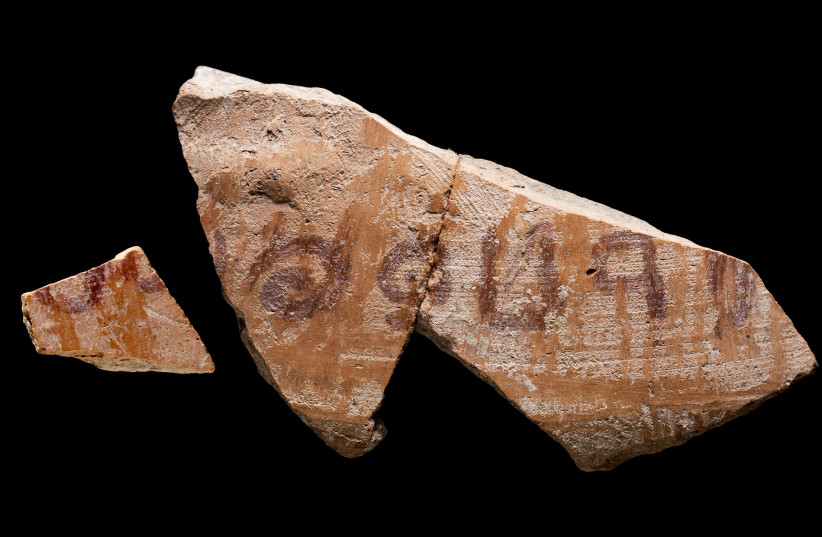
The inscription features the name “Jerubbaal,” a Jewish leader from the Book of Judges, as well as dates from around 1,100 BCE.

The Jerubbaal inscription, written in ink on a pottery vessel. (photo credit: DAFNA GAZIT/ISRAEL ANTIQUITIES AUTHORITY)
The Jerubbaal inscription, written in ink on a pottery vessel.
(photo credit: DAFNA GAZIT/ISRAEL ANTIQUITIES AUTHORITY)
An inscription dating back to some 3,100 years ago bearing the name of a biblical judge was uncovered in the excavations at Khirbat er-Ra‘i, near Kiryat Gat, in the Southern District of Israel, the Israel Antiquities Authority announced Monday.

The inscription features the name ‘Jerubbaal’ as well as dates from around 1,100 BCE.
“The name Jerubbaal is familiar from biblical tradition in the Book of Judges as an alternative name for the judge Gideon ben Yoash,” Prof. Yossef Garfinkel and Sa‘ar Ganor from the Hebrew University of Jerusalem said. “Gideon is first mentioned as combatting idolatry by breaking the altar to Baal and cutting down the Asherah pole. In biblical tradition, he is then remembered as triumphing over the Midianites, who used to cross over the Jordan to plunder agricultural crops. According to the Bible, Gideon organized a small army of 300 soldiers and attacked the Midianites by night near Ma‘ayan Harod.”
Inscriptions from that period are extremely rare. The finding, which was deciphered by the epigraphic expert Christopher Rolston of George Washington University, Washington DC, marks the first time that the name Jerubbaal is mentioned outside the Bible.
 Aerial view of the excavation area where the inscription was found. (Credit: Dafna Gazit, Israel Antiquities Authority.) Aerial view of the excavation area where the inscription was found. (Credit: Dafna Gazit, Israel Antiquities Authority.)

Garfinkel and Ganor, who co-direct the excavations at the site with Dr. Kyle Keimer and Dr. Gil Davies from the Macquarie University in Sydney, Australia – a partner in the dig together with the Israel Antiquities Authority – stressed that there cannot be any certainty that the inscription refers to the Jerubbaal mentioned in the Bible, but even if this was not the case, the artifact sheds light on the period it describes.
“In view of the geographical distance between the Shephelah and the Jezreel Valley, this inscription may refer to another Jerubbaal and not the Gideon of biblical tradition, although the possibility cannot be ruled out that the jug belonged to the judge Gideon,” they said. “In any event, the name Jerubbaal was evidently in common usage at the time of the biblical Judges.”
The researchers highlighted that this discovery supports the notion that the biblical text offers important historical insights.
“As we know, there is considerable debate as to whether biblical tradition reflects reality and whether it is faithful to historical memories from the days of the Judges and the days of David,” Garfinkel and Ganor said. “The name Jerubbaal only appears in the Bible in the period of the Judges, yet now it has also been discovered in an archaeological context, in a stratum dating from this period. In a similar manner, the name Ishbaal, which is only mentioned in the Bible during the monarchy of King David, has been found in strata dated to that period at the site of Khirbat Qeiyafa.”
“The fact that identical names are mentioned in the Bible and also found in inscriptions recovered from archaeological excavations shows that memories were preserved and passed down through the generations,” they added.
