Large explosion in Tehran near state TV, radio headquarters

The explosion happened several hours after a large-scale cyberattack across Iran.

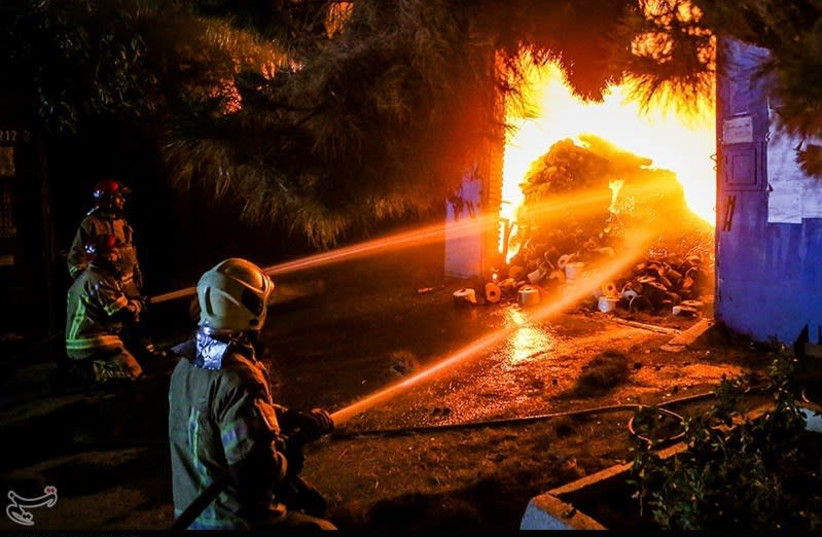
Warehouse fire along Karaj Special Road near Tehran, July 5, 2021 (photo credit: VAHID AHMADI/TASNIM NEWS AGENCY)
Warehouse fire along Karaj Special Road near Tehran, July 5, 2021
(photo credit: VAHID AHMADI/TASNIM NEWS AGENCY)
 A large explosion has been heard in Iran’s capital, according to the Iranian Fars News agency.

Tehran’s fire department head said that they “have not received any reports regarding an explosion,” Fars said, although they reportedly clarified that fire and rescue teams had been sent to the area in the northern part of the city.

Unconfirmed reports have placed the explosion close to a building inside Mellat Park, where television and radio stations run by the Islamic Republic of Iran Broadcasting have their headquarters.

Deputy Security Chief for Tehran Province Hamidreza Goudarzi has been quoted by the IRGC-affiliated Tasnim News as saying that the incident is under investigation, it was unclear at this time what caused it, and it is unknown whether or not it was an act of terrorism.

Iranian media has reported that there were no casualties at the scene.

The explosion happened several hours after a large-scale cyberattack across Iran, with hackers posting the phone number of the country’s supreme leader as the number to call for information for train delays.


“Israeli settlements do amount to a war crime,” Michael Lynk told the UNHRC during its 47th session in Geneva, as he called for an arms embargo against the Jewish state.

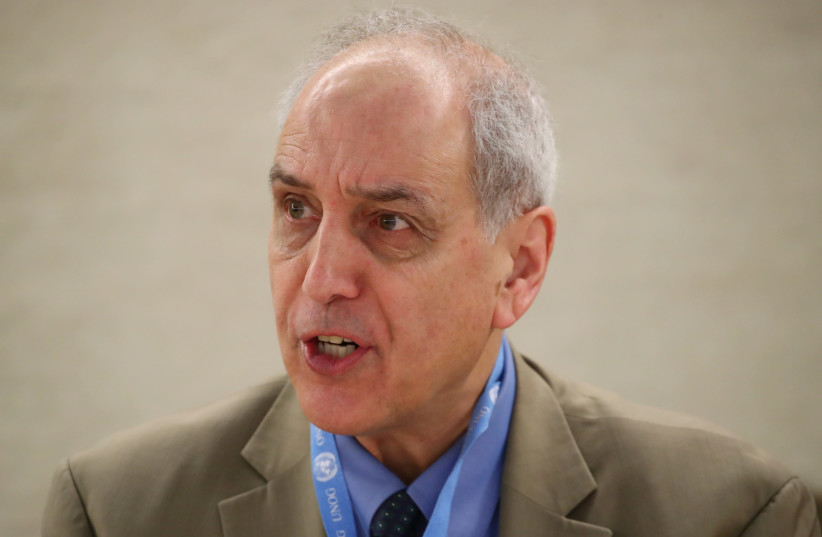
Michael Lynk, Special Rapporteur on the situation of human rights in Palestinian territories, attends a session of the Human Rights Council at the United Nations in Geneva, Switzerland, March 18, 2019 (photo credit: REUTERS/DENIS BALIBOUSE)
Michael Lynk, Special Rapporteur on the situation of human rights in Palestinian territories, attends a session of the Human Rights Council at the United Nations in Geneva, Switzerland, March 18, 2019
(photo credit: REUTERS/DENIS BALIBOUSE)
The international community must hold Israel accountable for the war crime of West Bank settlement activity by backing the International Criminal Court’s probe into such action, the United Nations Human Rights Council investigator Michael Lynk said on Friday.
“Israeli settlements do amount to a war crime,” Lynk told the UNHRC during its 47th session in Geneva, as he called for an arms embargo against the Jewish state until such time has it withdraws from the West Bank and east Jerusalem.
“This [war crimes] finding compels the international community to assess the plentiful accountability measures on its diplomatic and legal menu, and to make it clear to Israel that its illegal occupation, and its defiance of international law and international opinion, can and will no longer be cost-free,” said Lynk.
“The evidence before our eyes is overwhelming that the Israeli occupation will not die of old age,” explained Lynk who holds the post of UN special rapporteur on the situation of human right in the Palestinian territories.
“The Israeli government will suddenly wake up one day and decide on its own that an alien occupation that is metastasizing into annexation and even apartheid, and a one-state reality of vastly unequal rights, is entirely out-of-step with the 21st century,” Lynk said.
“It will only end with the continued activism of Palestinians and the decisive intervention of the international community,” he added.
To that end he called on UN member states to support the ICC and “develop a comprehensive menu of accountability measures to be applied to Israel should it continue to defy international law.”
He added that this includes, “reviewing trade, investment and cultural agreements, and ending arms sales with Israel.”
Lynk, who is a Canadian legal expert, submitted a report to the UNHRC, which was discussed Friday under Agenda 7. The UNHRC is mandated to debate alleged Israeli human rights abuses act each of its sessions.
The report he submitted comes on the heels of a UNHRC decision at the end of May to open a permanent war crimes probe into Israeli actions. This would include an investigation alleged human rights abuses within sovereign Israel, including Jerusalem. It would also include a probe outside Israel’s sovereign boundaries, including the West Bank and the Gaza Strip.
The UNHRC mandate of a standing agenda item against Israel, such as Agenda Item 7 and the open-ended probe into the country’s alleged human rights abuses are unique to Israel. No other countries have such mandates leveled against them.
Israel disputes the accusation that settlement activity is a war-crimes, as did the former Trump administration, which held that that settlement activity was not inconsistent with international law.


Ongoing excavations and new pathways in Western Wall Tunnels provide a thriving second life to underground millennia-old Jerusalem


  • Dr. Shlomit Weksler-Bdolach, excavation director in the Western Wall Tunnels on behalf of the Israel Antiquities Authority. (Yaniv Berman/Israel Antiquities Authority)
    Dr. Shlomit Weksler-Bdolach, excavation director in the Western Wall Tunnels on behalf of the Israel Antiquities Authority. (Yaniv Berman/Israel Antiquities Authority)
  • Remains of the magnificent 2000-year-old building recently excavated and due to be opened to the public as part of the Western Wall Tunnels Tour in Jerusalem's Old City. (Yaniv Berman/Israel Antiquities Authority)
    Remains of the magnificent 2000-year-old building recently excavated and due to be opened to the public as part of the Western Wall Tunnels Tour in Jerusalem’s Old City. (Yaniv Berman/Israel Antiquities Authority)
  • Remains of the splendid fountains that operated in the magnificent 2000-year-old building soon to be opened to the public as part of the Western Wall Tunnels Tour in Jerusalem's Old City. (Yaniv Berman/Israel Antiquities Authority)
    Remains of the splendid fountains that operated in the magnificent 2000-year-old building soon to be opened to the public as part of the Western Wall Tunnels Tour in Jerusalem’s Old City. (Yaniv Berman/Israel Antiquities Authority)
  • Remains of the magnificent 2000-year-old building recently excavated and due to be opened to the public as part of the Western Wall Tunnels Tour in Jerusalem's Old City. (Yaniv Berman/Israel Antiquities Authority)
    Remains of the magnificent 2000-year-old building recently excavated and due to be opened to the public as part of the Western Wall Tunnels Tour in Jerusalem’s Old City. (Yaniv Berman/Israel Antiquities Authority)
  • Stepped pool installed in one of the chambers of the magnificent 2,000-year-old building in Jerusalem's Old City in the late Second Temple period that served as a ritual bath.(Yaniv Berman/Israel Antiquities Authority)
    Stepped pool installed in one of the chambers of the magnificent 2,000-year-old building in Jerusalem’s Old City in the late Second Temple period that served as a ritual bath.(Yaniv Berman/Israel Antiquities Authority)
  • The new visitors’ route in the Western Wall Tunnels. (Yaniv Berman/Israel Antiquities Authority)
    The new visitors’ route in the Western Wall Tunnels. (Yaniv Berman/Israel Antiquities Authority)

Israel Antiquities Authority archaeologists have unearthed what may have been a 2,000-year-old city council building — a few hundred meters from its modern counterpart — during continuing excavations under Jerusalem’s Old City. The grand structure is a new feature on the revamped Western Wall Tunnels Tour, which allows tourists to visit the millennia-old city that exists in a time warp under today’s thriving capital.

“This is, without doubt, one of the most magnificent public buildings from the Second Temple period that has ever been uncovered outside the Temple Mount walls in Jerusalem,” said excavation director Dr. Shlomit Weksler-Bdolach in an IAA press release on Thursday.

Built circa 20 CE, the Roman-era structure stood off a main drag leading to the Temple Mount and was used as a triclinium, or dining room, for notable members of society on their way to worship, according to the IAA release. Originally constructed with an ornate water fountain and decorative Corinthian capitals, the striking edifice underwent a series of structural changes in its 50 years of use prior to the 70 CE destruction of the Second Temple, Weksler-Bdolach told The Times of Israel.

The massive structure will soon be open to the public as part of the Western Wall Tunnels Tour, which has been rejigged to create different paths and experiences, based on several new routes that cut through thousands of years of history, through today’s modern use of part of the tunnels as prayer and event halls.

According to Weksler-Bdolach, originally archaeologists had thought the “city hall” was constructed during the earlier Hasmonean period. Located to the west of Wilson’s Arch, just off the prayer pavilion for men at the Western Wall, one of the chambers was discovered and documented in the 19th century by Charles Warren. Other archaeologists also studied the room in the 20th century.

Volume 90%


However, after taking up some of the ancient flooring and performing carbon-14 dating on organic materials from the building’s base, as well as discovering coins and pottery sherds, archaeologists place the opulent building’s timeframe at no earlier than 20 CE. She noted that because the site is only partially excavated — to preserve other important subterranean structures from other eras — it is more challenging to precisely date and study it. “Every building is important; we cannot take all the buildings apart,” she said.

What archaeologists do know is that during its 50 years of occupation, said Weksler-Bdolach, the large public structure was separated into three different spaces, the fountain was taken out of use, and what appears to be a ritual bath or mikveh was added, just prior to the destruction of Jerusalem.

Dr. Shlomit Weksler-Bdolach, excavation director in the Western Wall Tunnels on behalf of the Israel Antiquities Authority. (Yaniv Berman/Israel Antiquities Authority)

Despite the clear Roman influence in the structure’s architecture, Jerusalem at this time was still a culturally Jewish city, said Weksler-Bdolach. The decorations discovered in the spaces — a sculpted cornice bearing pilasters (flat supporting pillars) — didn’t include graven images, banned by the Torah.

She said the hall was likely used by city, versus Temple, officials who wanted to impress their guests.

“Visitors to the site can now envisage the opulence of the place: the two side chambers served as ornate reception rooms and between them was a magnificent fountain with water gushing out from lead pipes incorporated in the midst of the Corinthian capitals protruding from the wall,” said Weksler-Bdolach in the press release.

Remains of the splendid fountains that operated in the magnificent 2000-year-old building soon to be opened to the public as part of the Western Wall Tunnels Tour in Jerusalem’s Old City. (Yaniv Berman/Israel Antiquities Authority)

There are still several puzzles to work out surrounding the building. For one, what was the water source for the fountain? Weksler-Bdolach laughed and said that is the “million-dollar question,” but the researchers’ working hypothesis is that since clean, freshwater would likely have been used, it was hand filled through an intricate system of lead water piping. The fountain, she said, was likely only used to make a splash with especially important VIPs.

Two ‘living’ cities in parallel

To reach the Western Wall Tunnels Tour, visitors descend beneath noisy, living Jerusalem and go back in time, entering a well-preserved subterranean ancient city.

“In Jerusalem there are several cities under the city,” said Weksler-Bdolach, “especially under the Old City.”

Remains of the magnificent 2000-year-old building recently excavated and due to be opened to the public as part of the Western Wall Tunnels Tour in Jerusalem’s Old City. (Yaniv Berman/Israel Antiquities Authority)

According to Shachar Puni, architect for the Israel Antiquities Authority’s Conservation Department, one of the interesting and unique features of ancient Jerusalem is that many whole sections were left completely intact under the ground.

In most cases, new construction was performed on top of older structures, he, said, with domed ceilings serving as building bases, and still intact chambers underneath used as basements or cisterns, or even hideaway living spaces.

The new visitors’ route in the Western Wall Tunnels. (Yaniv Berman/Israel Antiquities Authority)

Now, with the rerouted paths, said Puni, visitors can experience different elements, time periods, and purposes of the underground city. For example, tourists purely interested in the ancient archaeology will no longer brush up against today’s prayer halls — and vice versa.

“There is a feeling of a whole underground world that it is in parallel with the ‘living world’ above ground,” said Puni. Unlike visits to other “open air” archaeological sites in Israel such as Caesarea or Megiddo, in Jerusalem’s underground universe, “for the visitor, there is the feeling of a whole world that didn’t exactly get destroyed.”

Remains of the magnificent 2000-year-old building recently excavated and due to be opened to the public as part of the Western Wall Tunnels Tour in Jerusalem’s Old City. (Yaniv Berman/Israel Antiquities Authority)

Mordechai Soli Eliav, chairman of the Western Wall Heritage Foundation, says, “It is exciting to reveal such a magnificent structure from the Second Temple period while we mourn the destruction of Jerusalem and pray for its restoration.” The new section of the Tunnels Tour should be open by the Hebrew month of Elul, just ahead of Rosh Hashana, in time for traditional selichot, or penitential prayers.

“What’s fantastic is that there’s a living city moving about aboveground, and in parallel, a whole world that was frozen, but still lives, in the archaeological realm, one under the other,” said Puni.