
Washington cautions Tehran to end its nuclear ‘brinkmanship’; Britain, France, Germany express ‘grave concern’ at latest move violating 2015 nuclear pact they are trying to save


TV cameras in front of the 'Grand Hotel Vienna' where closed-door nuclear talks take place in Vienna, Austria, Sunday, June 20, 2021. (AP/Florian Schroetter)

TV cameras in front of the ‘Grand Hotel Vienna’ where closed-door nuclear talks take place in Vienna, Austria, Sunday, June 20, 2021. (AP/Florian Schroetter)

The United States and Europe warned Iran to stop nuclear “brinksmanship” and European powers expressed “grave concern” over Iran’s latest moves to enrich uranium, saying it would complicate its return to talks aimed at restarting the 2015 nuclear accord.

The statements from Washington and Brussels came hours after the International Atomic Energy Agency (IAEA) reported that Iran intended to enrich uranium to 20 percent, in the latest sign the talks based in Vienna could be stalling.

“It is worrying that Iran is choosing to continue to escalate its non-performance of its JCPOA commitments, especially with experiments that have value for nuclear weapons research,” State Department spokesman Ned Price told reporters, referring to the joint comprehensive plan of action reached between Iran and six nations on restricting Tehran’s atomic program.

“We continue to urge Iran to stop this brinksmanship, to return to Vienna prepared for real talks, and to be in a position to be prepared to finish the work that we have started in April,” he said.

In a separate joint statement, the foreign ministers of Britain, France and Germany said Iran’s moves were “threatening a successful outcome to the Vienna talks despite the progress achieved in six rounds of negotiations to date.”

An IAEA statement said Tehran had told the agency that it would be sending the enriched uranium to its research and development laboratory at the fuel production plant in Isfahan.

The aim would be to make fuel for a research reactor, the agency added, but the European ministers cast doubt over that claim, calling it a “serious violation” of Iran’s commitments under the 2015 nuclear deal.

“Iran has no credible civilian need for uranium metal R&D and production, which are a key step in the development of a nuclear weapon,” they said.
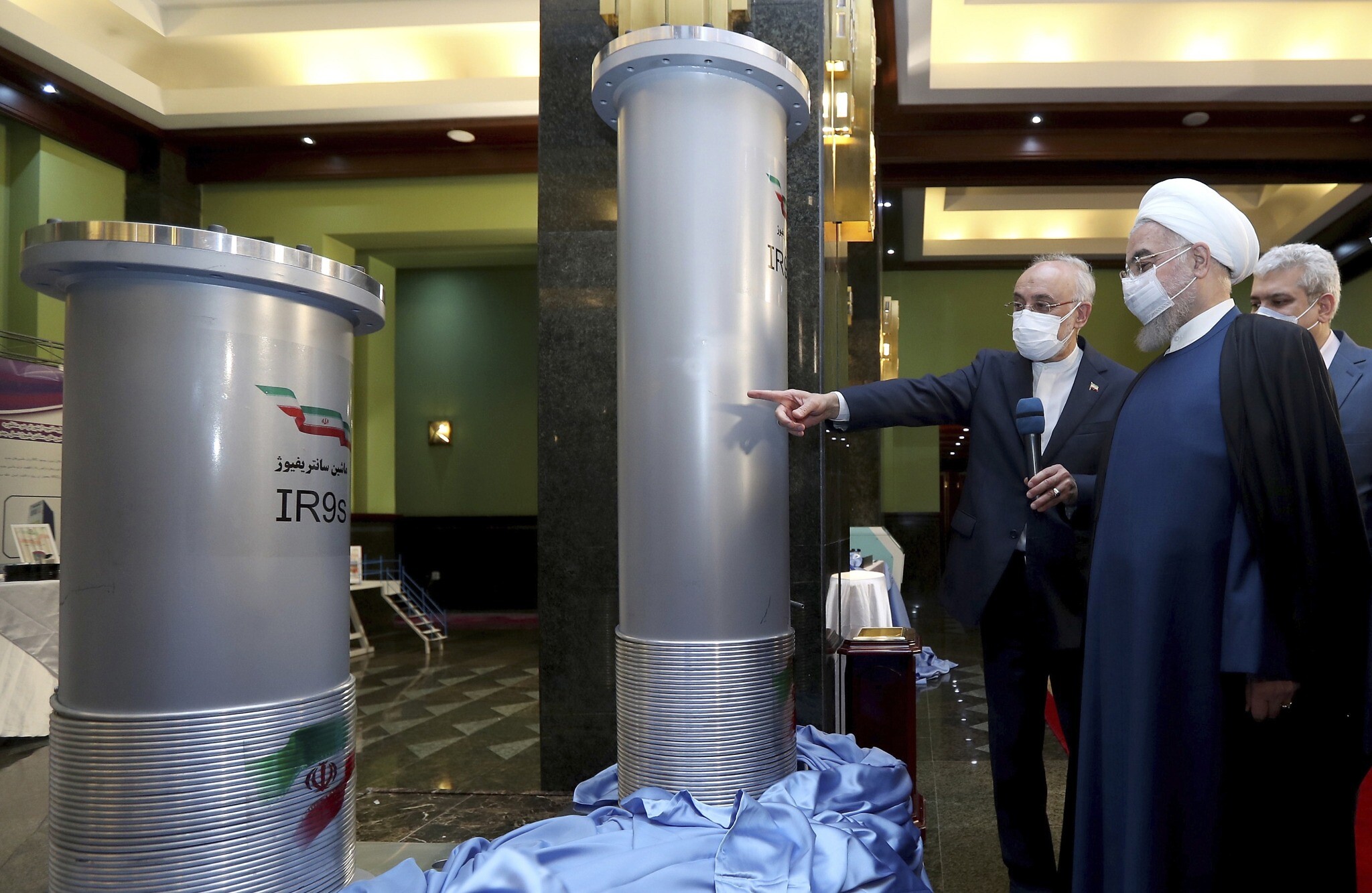
Iranian President Hassan Rouhani, second right, listens to head of the Atomic Energy Organization of Iran Ali Akbar Salehi while visiting an exhibition of Iran’s new nuclear achievements in Tehran, Iran, April 10, 2021. (Iranian Presidency Office via AP)

The latest move takes Iran a step closer to developing materials that could be used to make a nuclear weapon, although Tehran insists it is only interested in the technology to fulfill its energy needs.

Iran has gradually moved away from the terms of the deal it signed with world powers in 2015.

Former US president Donald Trump pulled the US out of the deal in 2018.

The talks in Vienna are aimed at bringing the US, under new President Joe Biden, back into the Joint Comprehensive Plan of Action (JCPOA). Biden has expressed readiness if conditions are met by Iran.

But the talks in Vienna to try and revive the JCPOA have not moved forward in recent weeks and no date has been set for a next round of talks.

“This further step in Iran’s escalation of its nuclear violations is all the more concerning at a time when no date has been set for the continuation of the negotiations in Vienna on a return to the JCPOA,” said the ministers.

Director General of the International Atomic Energy Agency, IAEA, Rafael Mariano Grossi during a news conference at the International Center in Vienna, Austria, March 1, 2021. (Ronald Zak/AP)

Iran should return “without delay” to the negotiations in Vienna in an effort to bring them to “a swift conclusion”, they warned.

“We have repeatedly stressed that time is on no-one’s side,” they said.

Ebrahim Raisi, a new hardline president, is due to take office in Iran on August 3, and its unlikely he’ll give the same backing to the talks afforded by current president Hassan Rouhani.




Iran blamed Israel on Tuesday for a sabotage operation that targeted a building belonging to Iran’s Atomic Energy Organization (IAEO) in Karaj last month, according to the Iranian news agency IRNA.

Ali Rabiee, a spokesperson for the Iranian government, said that Israel conducted the operation with the intention of stopping Iran and halting negotiations between Western countries and the Islamic Republic. The spokesperson claimed that Iran’s power has only increased after Israel’s sabotage operations, including operations in the past.
Rabiee claimed that the operation only lightly damaged the roof of the building, saying that satellite photos published recently were taken as the roof was being changed. The spokesperson added that no important equipment was damaged and no one was injured.
At the time of the operation, Iran claimed that the sabotage had failed and caused no damage. The Jerusalem Post learned at the time that the operation likely caused substantial damage to a centrifuge manufacturing site located in the building.

Yonah Jeremy Bob contributed to this report.


The fire broke out in Karaj, south of Tehran, the city where an alleged attack targeted a nuclear facility reportedly used to produce centrifuges.

A building on fire is seen in Dorud, Iran, in this still image taken from video on December 31, 2017 (photo credit: IRINN/REUTERSTV VIA REUTERS)
A building on fire is seen in Dorud, Iran, in this still image taken from video on December 31, 2017
(photo credit: IRINN/REUTERSTV VIA REUTERS)
A large fire was reported at a warehouse or factory next to a highway near Tehran on Monday afternoon, with the purpose of the warehouse and the background of the incident as of yet unclear.
The IRGC-affiliated Tasnim News Agency reported that the fire was near Karaj, the city where an alleged attack targeted a nuclear facility reportedly used to produce centrifuges.
The Tehran fire and rescue services told Iranian news agency ISNA that the fire took place at a warehouse or factory along the Karaj Special Road. The warehouse was used to store “all kinds of goods,” according to a spokesperson for the fire and rescue services.
It is unclear if there were any injuries in the incident.
A series of explosions and fires have hit industrial sites across Iran, including a number of petrochemical plants, in recent weeks and over the past year. Iranian officials have referred to most of the cases as incidents or accidents, although some reports have claimed that at least some of them involved foul play.
Aging infrastructure in Iran has also been blamed for at least some of the incidents. Frequent blackouts have been plaguing Iran recently amid a heatwave.
Last month, a sabotage operation against a building likely used to produce centrifuges for Iran’s Atomic Energy Organization (IAEO) in Karaj caused major damage, The Jerusalem Post learned.