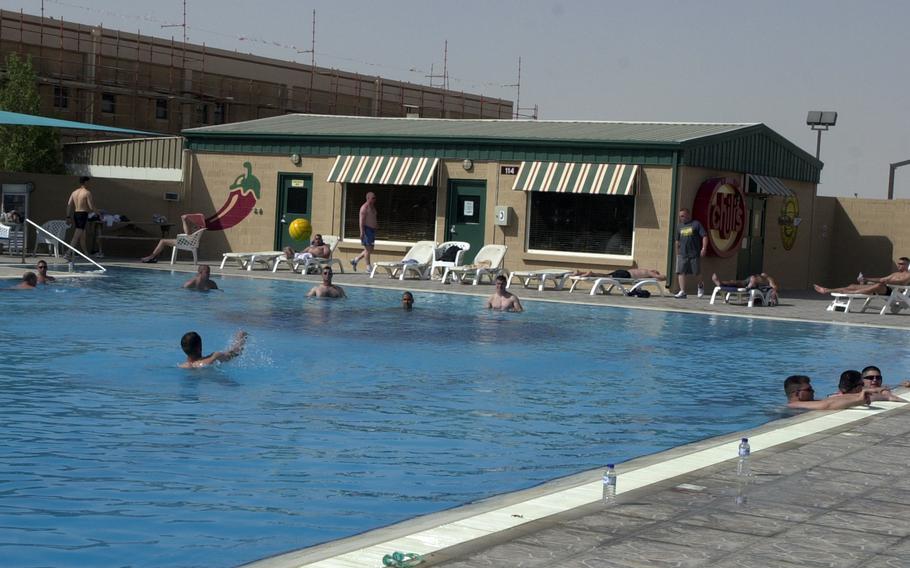
The Olympic-sized swimming pool and Chili's restaurant were popular spots for those resting and recuperating at Camp As Sayliyah, Qatar in 2004. The installation, known among many service members for its Rest and Recuperation Pass Program, which gave some 200,000 deployed troops a four-day vacation, was shuttered in June 2021.

The Olympic-sized swimming pool and Chili’s restaurant were popular spots for those resting and recuperating at Camp As Sayliyah, Qatar in 2004. The installation, known among many service members for its Rest and Recuperation Pass Program, which gave some 200,000 deployed troops a four-day vacation, was shuttered in June 2021. (Stars and Stripes)

The U.S. has closed sprawling bases in Qatar that once stored warehouses full of weaponry and transferred the remaining supplies to Jordan, in a move that analysts say positions Washington to deal better with Iran and reflects the military’s changing priorities in the region.

Military leaders shuttered U.S. Army Camp As Sayliyah-Main last month, along with Camp As Sayliyah-South, and an ammunition supply point named Falcon, an Army statement last week said.

Camp As Sayliyah was known among many service members for its Rest and Recuperation Pass Program, which gave some 200,000 deployed troops a four-day vacation. The program ran from 2002 to 2011 and offered travelers up to two glasses of beer or wine a day, along with golf and beach trips.

The camp also served as a forward staging area for U.S. supplies in the Middle East, with 27 warehouses storing tanks, armored personnel carriers and a variety of equipment, the Army statement said.

Supplies from the three bases, as well as a support mission based there, are now part of Area Support Group-Jordan, a U.S. Central Command statement said.

Closing the bases and moving the mission to Jordan could benefit the U.S. in potential disputes with Iran, said Kamran Bokhari, a national security and policy expert focusing on the region at the Washington-based Center for Global Policy.
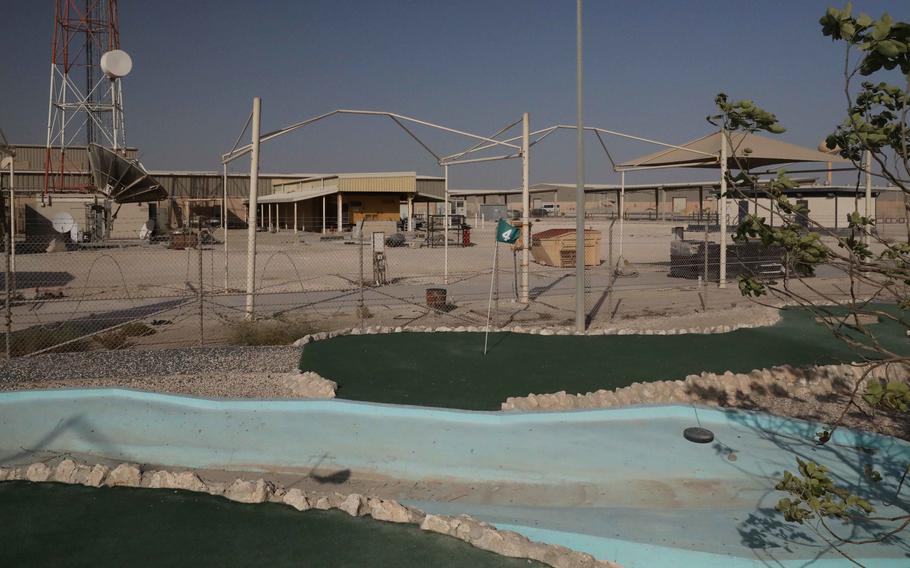
The flag on the fourth hole at the now-closed Camp As Sayliyah-Main, Qatar, miniature golf course waves in the wind on June 14, 2021. The U.S. Army shuttered CAS-Main and its two other installations in Qatar, Camp As Sayliyah-South and Falcon 78.

The flag on the fourth hole at the now-closed Camp As Sayliyah-Main, Qatar, miniature golf course waves in the wind on June 14, 2021. The U.S. Army shuttered CAS-Main and its two other installations in Qatar, Camp As Sayliyah-South and Falcon 78. (Neil W. McCabe/U.S. Army)

The Biden administration has signaled a desire to negotiate a deal with Iran to ensure the country does not develop nuclear weapons. The Trump administration pulled out of a multilateral deal signed in 2015 with Iran, calling the limits on Tehran inadequate.

Moving U.S. troops to Jordan decreases the threat of rocket attacks in the Gulf region from Iranian-backed militias. The threat of missile strikes against U.S. troops like last year’s attack on al Asad Air Base, which left more than 100 injured, is an important tool in Tehran’s negotiating strategy, Bokhari said.

“You want to be able to deny the Iranians that leverage, in a negotiation,” Bokhari said. “If they’re signaling that they have your bases in missile range, that decreases your leverage behind the scenes.”

The closure of the three bases comes as the U.S. shifts resources throughout the CENTCOM area of responsibility. This includes the U.S. drawdown from Afghanistan after 20 years there, as well as the withdrawal of eight Patriot antimissile batteries from Iraq, Kuwait, Jordan and Saudi Arabia.

As troops leave Afghanistan, the stated U.S. goal has been to shift its military focus from counterinsurgency and conflicts in the Middle East to competing with powerful near-peer rivals, such as China.

“It’s about, ‘let’s start pivoting to Asia,’ for real this time,” said Andrew Watkins, a senior Afghanistan analyst at International Crisis Group, a nonprofit think tank based in Brussels.

The U.S. will continue to use Al Udeid Air Base in Qatar, a basing hub for CENTCOM, last week’s Army statement said.



Public broadcaster says head of international think tank tracking Iran’s nuclear program and others believe equipment at Karaj facility was completely destroyed or disabled


The alleged Karaj centrifuge parts plant near Karaj, Iran, seen in a photo posted online by google user Edward Majnoonian in May 2019. (screen capture: Google Maps)

The alleged Karaj centrifuge parts plant near Karaj, Iran, seen in a photo posted online by google user Edward Majnoonian in May 2019. (screen capture: Google Maps)

Experts believe an attack on a facility producing centrifuge parts for Iran’s nuclear program caused extensive damage, destroying or disabling all equipment at part of the site, according to an Israeli report Sunday.

Tehran has maintained that the apparent drone assault on the Karaj factory was thwarted and no damage caused, but satellite photos published by private Israeli intelligence group The Intel Lab Saturday seemingly cast doubt on those claims, showing a large hole in the roof of one building previously identified as a bellows manufacturing plant.

The photos also purportedly showed evidence of a large fire.

According to the Kan public broadcaster, experts who saw the photos concluded that “all equipment in the area had been destroyed completely or rendered inoperable.” It said the experts had made the assessments based on the satellite photos, which were taken July 1.

The station only named one expert it was relying on, David Albright, who heads the Institute for Science and International Security, a non-governmental organization which has attempted to track and expose illicit aspects of Iran’s nuclear program.

According to the report, Albright and other experts say that the Iranians have already begun attempting to repair the damage from the June 23 strike at the Iran Centrifuge Technology Company, or TESA, near the city of Karaj, northwest of Tehran.

A tweet from The Intel Lab on Saturday claimed that the roof had largely been dismantled by Iran as part of rehabilitation activities following the attack. The dismantled roof allowed analysts to peek inside the building, where dark coloration indicated the presence of a large fire inside the building, the smallest of three main structures at the site.

According to a New York Times report last month, the TESA factory was tasked with replacing damaged centrifuges at the Natanz nuclear site, a previous target of apparent sabotage, and also produces more advanced centrifuges that can more quickly enrich uranium.

In 2011, members of the National Council of Resistance in Iran opposition group published photos of the Karaj site claiming that it was being used for the clandestine production of centrifuge parts.

“The various parts that are manufactured in this site include casing, magnets, molecular pumps, composite tubes, Bellows, and centrifuge bases. These are essentially the parts used for the production of IR-1 type centrifuges. But there are also parts related to more advanced centrifuges that are also produced at this site.”

Iran has not identified who it believes was responsible for the drone strike. The country has accused Israel of similar attacks on its nuclear program in the past.

Prime Minister Naftali Bennett appeared to hint at Israel’s role during a speech at a graduation ceremony for Israeli Air Force pilots, a day after the strike. “Our enemies know — not from statements, but from actions — that we are much more determined and much more clever, and that we do not hesitate to act when it is needed,” Bennett said in his speech at the IAF’s Hatzerim Air Base, outside Beersheba.

The centrifuge production site was reportedly on a list of targets that Israel presented to the Trump administration last year, at the same time as it suggested striking Iran’s uranium enrichment site at Natanz and assassinating Mohsen Fakhrizadeh, a scientist who began the country’s military nuclear program decades earlier, an intelligence source told the New York Times.

Fakhrizadeh was killed in November 2020 in an attack Iran blamed on Israel, while a mysterious explosion damaged a large number of centrifuges at the Natanz plant in April 2021. Israel’s former Mossad spy agency chief recently indicated in an interview given after he left office that Israel was behind that incident.

While Iran maintains that the Karaj facility is used for civilian purposes, it has been subjected to United Nations, European Union and American sanctions since at least 2007 for being involved in Iran’s nuclear and ballistic missile programs. The US lifted those sanctions under the 2015 nuclear deal, but then reimposed them in 2018 when Trump unilaterally withdrew from the accord.


This is the scenario the US has been concerned about for years. The pro-Iran attacks may spill over to Syria.

Protesters and militia fighters throw stones towards the U.S. Embassy during a protest to condemn air strikes on bases belonging to Hashd al-Shaabi (paramilitary forces), outside the U.S. Embassy in Baghdad, Iraq January 1, 2020. (photo credit: REUTERS/THAIER AL-SUDANI)
Protesters and militia fighters throw stones towards the U.S. Embassy during a protest to condemn air strikes on bases belonging to Hashd al-Shaabi (paramilitary forces), outside the U.S. Embassy in Baghdad, Iraq January 1, 2020.
(photo credit: REUTERS/THAIER AL-SUDANI)
Iran’s media gave major headlines to claims of attacks on US forces in Syria on July 4. The date was symbolic. It was Independence Day in the US. What better day for Iran to claim it had struck at a US base in Syria. However, it turns out the rumors of the rocket attacks were likely false, and the US-led Coalition denied any incident happened in Syria.

That doesn’t matter for Iran’s media, and the media stations that have links to Iran’s IRGC. The reports claimed there were attacks and “explosions” at a US base. However sources there denied the reports. What Iran may be messaging on this issue is more complex than just rumored attacks. Iran may be pinpointing where the next front will begin in its conflict with the US. Since 2019 Iran has upped attacks on the US in Iraq. It has used militias such as Kataib Hezbollah to carry out numerous attacks. It also downed a US drone in June 2019 and mined ships in the Gulf of Oman in May and June. At the time US Secretary of State Mike Pompeo warned about the Iranian threats. The threats increased rapidly through the fall of 2019.
At the same time in 2019 there were concerns expressed by US officials in the fall of 2019 that Israeli-Iran tensions could affect the US. A report from the US Lead Inspector-General on the anti-ISIS coalition Operation Inherent Resolve (OIR) in November 2019 spotlighted “tensions with Iran and suspected Israeli airstrikes,” as a complication for the OIR mission against ISIS in Iraq. In addition, the report noted that US Central Command was concerned that “Iranian backed forces in Syria might look to target US military personnel or its partner forces in Syria if they view the US as complicit in Israeli strikes on its [Iran’s] forces.”
The report noted a July 2019 incident in which there was the “first of several suspected Israeli drone strikes in Iraq” and that it targeted a Popular Mobilization “munitions depot near Baghdad.” What did this mean? “Tensions with Iran and suspected Israeli airstrikes complicate OIR this quarter,” the report said at the. time. “According to media reports, suspected Israeli airstrikes on Iraqi bases belonging to Iranian-aligned militias this quarter exacerbated ongoing tensions between the United States and Iran and complicated the OIR mission.”
Central Command also noted increased threat against US forces from Iranian-aligned groups in Iraq, writing that “Iranian-backed militias may view the US as complicit in the Israeli strikes, which targeted Iraqi militia bases allegedly housing Iranian weapons.”
That was in the fall of 2019. But much changed soon after as the pro-Iran militias in Iraq killed a US contractor in a rocket attack in December. The US responded with airstrikes, Iranian groups attack the US embassy and the US killed IRGC commander Qasem Soleimani and Iraqi militia leader Abu Mahdi al-Muhandis in January 2020. Then the pro-Iran militias increased the use of rockets to attack US forces. The US consolidated facilities in Iraq. By January 2021 the pro-Iran militias shifted course. They began to target Erbil in the Kurdistan region, using drones and rockets to strike at US forces. US President Joe Biden responded with airstrikes, the most recent of which hit pro-Iran units in Syria in late June. The pro-Iran groups responded by shelling US forces in Syria.
This is the scenario the US has been concerned about for years. The pro-Iran attacks may spill over to Syria. It is widely known Iran has boots on the ground in Syria and has entrenched. It tried to use Hezbollah to launch a drone at Israel in the fall of 2019. It launched a drone at Israel from T-4 in February 2018 and again in May 2021. It also tried to bring its 3rd Khordad air defense system to Syria in April 2018. The same system was used by Iran to down the US Global Hawk drone in June 2019 off Iran’s coast.
What is known today is that Iran appears to be messaging about new attacks on the US in Syria. This could include attacks on US forces at Al-Omar oil field or Conoco, areas the US is known to be stationed. The US is in Syria to defeat ISIS and support the Syrian Democratic Forces. Satellite images published online by Aurora Intel from Planet Labs show that an area of the US facility at Omar field, called “Green village” was allegedly damaged in the June 28 shelling. A warehouse was damaged. Iran’s militias tend to have good intel on US facilities. In April they used a drone to target a secret CIA hangar in Erbil. The June 27 drone attack on Erbil targeted an area near the new US consulate.
There is more to the Iranian threat than just using militias to harass US forces in Syria. Iran’s media reports about the targeting of an “Israeli owned” ship making its way to India from the Gulf is also likely messaging about more targeting of commercial ships linked to Israel. Iran began targeting ships in May 2019 but increased those attacks to target commercial ships linked to Israel in February 2021. Israeli officials accused Iran of at least one of these incidents. Defense Minister Benny Gantz had tough words for Iran on Sunday, saying that Israel would not accept Iran’s activities and entrenchment in the region. He said Iran knows that Israel is ready to act. According to journalist Barak Ravid, Prime Minister Naftali Bennett convened a meeting on Sunday to discuss US-Iran talks and the possibility the US might return to the so-called Iran deal.
These points of concern expressed by Israel, along with the messaging from Iran about targeting a ship and targeting the US in Syria, appear to sketch out the possibilities for a new round of tension. This tension and incidents may include thousands of kilometers of possible strikes by pro-Iran groups. This is how Iran operationalizes these groups from Iraq, Syria, Lebanon and Yemen. Iran doesn’t fight wars, it gets others to do that. Now it wants to provoke more tensions with the US in Syria, and possibly with Israel as well.