Tension rises ahead of Bennett’s expected trip to Washington.
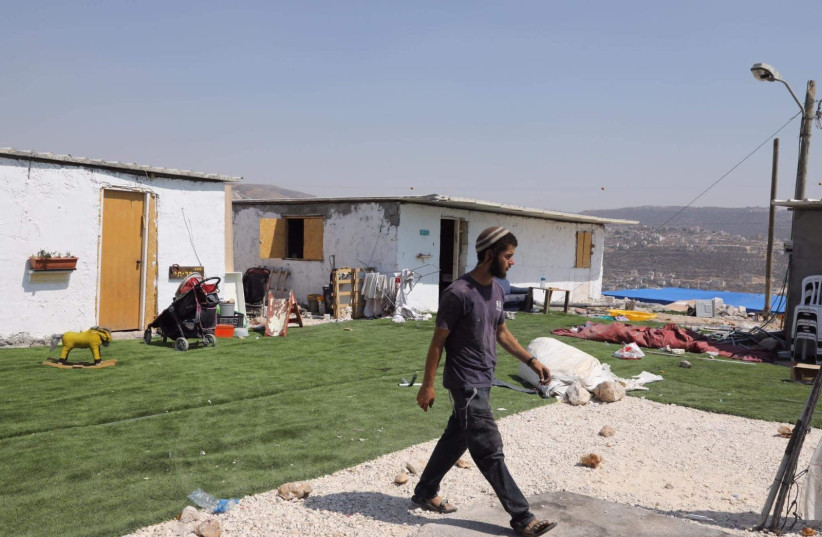
A man in the outpost of Evyatar
(photo credit: MARC ISRAEL SELLEM)
The Biden administration is opposed to the creation of settler outposts such as Evyatar, whose legalization Prime Minister Naftali Bennett has pledged to advance in exchange for avoiding a violent and forced evacuation of the site.
“I’ll continue to underscore that we believe it’s critical to refrain from any unilateral steps that would exacerbate tensions or undercut efforts to advance equal freedoms, security and prosperity, as well as a negotiated two-state solution,” US State Department Deputy Spokesperson Jalina Porter said. “And this would include establishing outposts which are illegal even under Israeli law.”
Porter’s words highlighted the underlying tension that exists between Bennett’s government and the Biden administration with respect to settlement activity.
Past US presidents, save for Donald Trump, have opposed outpost construction and called on Israel to remove them.
Porter spoke in the aftermath of a deal reached Wednesday between settlers and the government for the voluntary evacuation of 53 families and scores of activists from the Evyatar site by Friday at 4 p.m. The outpost was built in May in the aftermath of the Tapuah junction terror attack that claimed the life of 19-year-old Yehuda Guetta.
The deal marks the most significant step Bennett has taken with regard to settlement activity since he was sworn into office last month. It comes in advance of an anticipated visit by Bennett to Washington this summer, possibly this month.
The deal stipulates that once the settlers leave, an army base will be placed at the site, overlooking Route 5050 near Tapuah junction.
The Civil Administration will then examine the possibility of transforming its official classification from survey land to state land. If delineated as state land, a yeshiva will be built at the site and the government will move to legalize the area. In the interim, the buildings constructed there will remain.
It’s unclear if Evyatar would eventually be recognized as an entirely new settlement or as a neighborhood of Kfar Tapuah, located on the opposite side of the junction from Evyatar.
The formal document outlining the terms of the agreement spoke of the legalization process in this way.
“As soon as possible after the completion of the required land and planning procedures, as far as possible, and subject to all necessary government approvals, the state shall allow a permanent civilian presence at the site. Its exact nature will be determined in coordination between the prime minister, the defense minister and the head of the Samaria Regional Council.”
The Evyatar initiative was spearheaded by the Samaria Regional Council and the Nahala movement and has been hailed by them as a sign of victory that underscores the strength of the Zionist love of the Land of Israel.
Its supporters and opponents broke out along the lines of the Right and the Left, such that both the coalition and the opposition were divided on the matter. Yamina has spoken out in support, while Meretz has opposed it.
MK Yair Golan (Meretz) told Radio 103FM that “Bennett does not understand that this compromise deal is mainly bad for him, whatever happens, every month now there will be a new Evyatar.
“Once weakness is shown, the same event will happen over and over.”
Shas leader Aryeh Deri said he hoped Evyatar was in fact the start of a new wave of settlement development.
“I hope this is just the first settlement in a chain of settlement development,” Deri tweeted. He thanked the left-wing flank of the coalition, such as Meretz and Ra’am, for putting aside their ideology to allow for the arrangement.
Yesha Council head David Elhayani told The Jerusalem Post that the agreement was a dramatic one in the history of the settlement movement.
“Without it, yesterday at 6 a.m., children and their parents would have been evacuated from Evyatar. What is preferable: to see a yeshiva and then a settlement or scenes of demolition?” he said.
Elhayani, who left the Likud to support the New Hope Party, which is part of the coalition, said he believed Bennett would stick to the terms of the deal.
Former prime minister Benjamin Netanyahu would never have made such an agreement, said Elhayani, who has never forgiven him for backtracking on his pledge to apply sovereignty to the West Bank settlements.
Prior to leaving office, Netanyahu had spoken of his support for authorizing Evyatar, but Elhayani noted that he has done nothing for it since he became opposition leader.
“Did you see Netanyahu visit Evyatar or say anything about it?” Elhayani asked rhetorically. “Netanyahu was silent.”
Had Netanyahu been in power, he would never have made this deal, and if he had, he would not have kept it, Elhayani said.
Despite the deal, tensions remained high in the West Bank with respect to Evyatar. The office of Samaria Regional Council head Yossi Dagan reported on Thursday that police had assigned him a security detail in light of threats against him by Palestinians as a result of the deal.
Opponents of the deal, including from the villages Yatma and Beita, which claim ownership of the property, have asked Attorney-General Avichai Mandelblit to invalidate it.
Separately, the Biden administration also spoke out against the Israeli demolition of a Palestinian shop in the east Jerusalem neighborhood of Silwan on Tuesday, triggering scuffles between police and protesters, who accused authorities of discriminatory enforcement of building permits in the Holy City.
The shop is one of at least eight properties that residents said were slated for demolition. The residents say many have been there for decades, even from before 1967. The authorities have earmarked the land for a park and say the shops and homes have been built illegally.
Porter said the US had “seen reports that some families made up of approximately 50 Palestinians have been ordered to demolish their homes.” She said that when the US speaks against Israeli unilateral steps, that includes such “demolitions.”
Reuters contributed to this report.