
US tells UN that weekend airstrikes aimed to deter Iran

US Ambassador to the United Nations, Linda Thomas-Greenfield, said the airstrikes hit facilities used by militia blamed for an escalating series of drone and rocket attacks against US personnel.
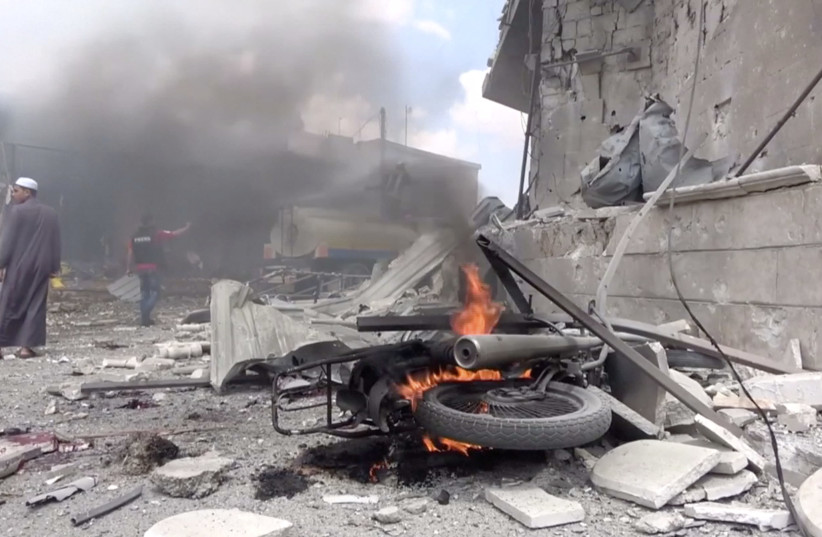
A motorbike burns after an airstrike in this screen grab taken from a social media video said to be taken in Idlib, Syria on July 16, 2019 (photo credit: WHITE HELMETS/SOCIAL MEDIA VIA REUTERS)
A motorbike burns after an airstrike in this screen grab taken from a social media video said to be taken in Idlib, Syria on July 16, 2019
(photo credit: WHITE HELMETS/SOCIAL MEDIA VIA REUTERS)
The United States told the UN Security Council on Tuesday that it targeted Iran-backed militia in Syria and Iraq with airstrikes to deter the militants and Tehran from conducting or supporting further attacks on US personnel or facilities.

Under Article 51 of the United Nations Charter, the 15-member Security Council must immediately be informed of any action that states take in self-defense against armed attack.
US Ambassador to the United Nations, Linda Thomas-Greenfield, said the airstrikes hit facilities used by militia blamed for an escalating series of drone and rocket attacks against US personnel and facilities in Iraq.
“This military response was taken after non-military options proved inadequate to address the threat, with the aim of deescalating the situation and preventing further attacks,” she wrote in a letter, seen by Reuters.
President Joe Biden wrote a similar letter to Congress on Tuesday. “The United States stands ready to take further action, as necessary and appropriate, to address further threats or attacks,” he said.
US troops came under rocket fire in Syria on Monday in apparent retaliation for weekend US air strikes. About 34 rockets were fired in the attack, but there were no injuries, a U.S. military official said on Tuesday.
While the Iraqi and US militaries coordinate closely in a separate battle in Iraq against remnants of the Sunni extremist group Islamic State, Iraq’s government and military condemned the U.S. airstrikes against the Iran-back militia.
The United States began airstrikes against Islamic State in Syria in 2014, telling the United Nations it acted because Syrian President Bashar al-Assad’s government had failed to wipe out safe havens used by the militants to launch attacks on Iraq.
Iraq told the UN Security Council at the time that it requested U.S. help because a safe haven for the militants in Syria had made its border “impossible to defend.”

It has been four days since the IAEA-Iran inspections cooperation deal expired and the Islamic Republic seems to indicate it’s in no rush to answer whether cooperation would continue.

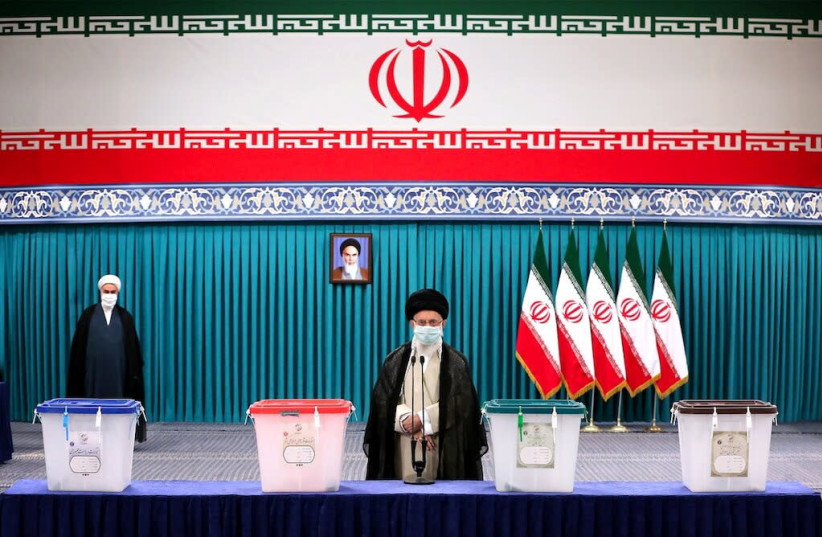
Iran's Supreme Leader Ayatollah Ali Khamenei is seen to vote during Iranian presidential election in Tehran (photo credit: REUTERS)
Iran’s Supreme Leader Ayatollah Ali Khamenei is seen to vote during Iranian presidential election in Tehran
(photo credit: REUTERS)
You would think the sky was falling, but it isn’t.

It has been four days since the IAEA-Iran inspections cooperation deal expired and even on Monday the Islamic Republic seemed to indicate it was in no rush to answer whether cooperation would continue.
If the world is finally blind regarding the nuclear program in a moment when Tehran can already enrich uranium up to the 60% level, which is only one rung down from the 90% weaponized level, how come Israel and the West are so calm?
Why isn’t the world freaked out that this could be the moment that the ayatollahs are breaking out a nuclear weapon and giving 48 hour ultimatums for a preemptive strike?
Sure, US Secretary of State Anthony Blinken has made statements in recent days suggesting that eventually time could run out on the JCPOA nuclear deal negotiations.
France, the IAEA and some others have expressed angst over the situation.
But no one is even threatening a perfunctory emergency referral to the UN Security Council for a high-minded condemnation.
Some of the explanation for the Europeans could be that they do not tend to take action even in a crisis.
Maybe the same could be said for the Biden administration, which to date has mostly emphasized diplomacy over force.
Yet, there is also no sense of emergency from Israel.
There are regular statements by Israeli officials warning about holes in the JCPOA and about the new Iranian president elect Ebrahim Raisi.
But there are no imminent threats from Jerusalem designed to force the Islamic Republic to immediately reinstate the inspections or face the consequences.
Part of the answer is probably that several Iranian IAEA deadlines have come and gone without Tehran taking any leap forward, and a new deal has always been worked out.
All of its nuclear violations have been slow, incremental and forecasted in advance so as to not surprise or provoke the global community.
So what if four days have passed?
There is a strong expectation that since even hardliner Raisi has endorsed a return to the JCPOA, that that is the path the ayatollahs are on, and this is a minor technical face-saving issue.
Even as Iran refused to recommit to IAEA inspections on Monday, its officials noticeably made sure to keep the possibility of a return to inspections open.
One Iranian parliamentary official said that the IAEA would never see all of the recorded footage of Iran’s nuclear facilities which it is holding on to.
But a different official said that the footage was not being destroyed – which means it could still be quietly turned over at some later point.
However, all of these reasons are probably secondary for explaining why Israel and the West are more perturbed than anxious.
The real reason is: boom! – all of the key Iranian nuclear facilities which have been blown up recently.
Two different facilities at Natanz were blown up in July 2020 and April 2021.
After Iranian statements that they had recovered from these attacks, The Jerusalem Post learned from Israeli defense sources that this was not true, and Tehran’s nuclear program is in a sling or worse.
This was later confirmed by an IAEA report which, when read according to the timing of the April 2021 attack, showed how handicapped Tehran’s uranium enrichment is due to destroyed centrifuges.
Then last week there was an attack on a key Iranian nuclear facility at Karaj which was needed to try to start to recover from Natanz repeatedly being blown up.
It is as if Iran has a nuclear ship which sprouts a dozen new holes with water flowing in every time they fill one of the old holes.
None of this means Iran is not a threat. If the IAEA were blind for a longer period – say several weeks – there would be much greater concern from Israel and globally.
But it does mean that if Iran needs a bit more time to sulk before offering a face-saving formula for continuing IAEA cooperation, Jerusalem does not yet need to lose any sleep.


Pro-Iranian forces claim they shelled Americans in Syria

Pro-Iranian militias have fired eight rockets at the American base in Syria in response to US airstrikes.

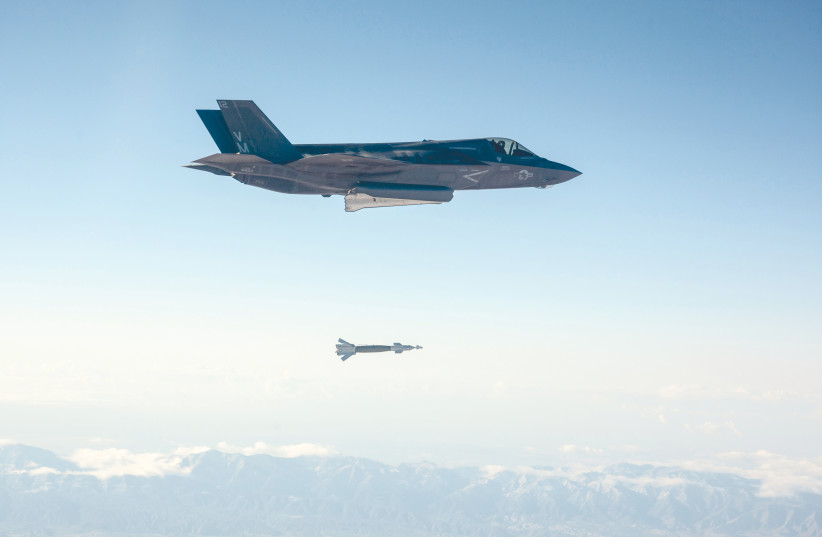
A US Marine Corps F-35B fighter jet drops a laser-guided bomb at Edwards Air Force Base, California. (photo credit: US NAVY VIA REUTERS)
A US Marine Corps F-35B fighter jet drops a laser-guided bomb at Edwards Air Force Base, California.
(photo credit: US NAVY VIA REUTERS)
In the late afternoon, around dusk, reports emerged that pro-Iranian groups had shelled areas in eastern Syria across from Deir Ezzor, ostensibly targeting US forces near the Omar oil fields. This is an important and strategic area and US forces who support the Syrian Democratic Forces, have been reported to have a facility or base in this area. The attack was linked to airstrikes the US had carried out in Syria targeting pro-Iranian groups on Monday.

“US Forces in Syria, while under multiple rocket attack, acted in self- defense and conducted counter-battery artillery fire at rocket launching positions,” wrote Col. Wayne Marotto, the spokesperson for the US-led Coalition to defeat ISIS.

At approx. 7:44 PM local time, US Forces in Syria were attacked by multiple rockets. There are no injuries and damage is being assessed, the US said.

Tasnim and Fars News in Iran both reported that artillery and katyusha rockets were fired. Video appeared to show a rocket trail similar to the kind of rockets Hamas uses in Gaza to target Israel. Open source intelligence accounts on social media confirmed the attack. Omar Abu Layla, who runs Deir Ezzor 24 wrote that “jets strike headquarters of Iranian militias in the vicinity of al-Mayadeen city.” He then retweeted accounts of shelling of the area near Omar oil field where US forces are allegedly located.
According to witnesses, the attack took place in the area of ​​Al-Omar oil field and the surrounding residential sheds, which resulted in heavy material losses in this place and the burning of several vehicles in the area. The attack comes roughly 18 hours after the US carried out airstrikes near Albukamal targeting pro-Iranian units that are linked to Iraq and which the US accuses of drone attacks on US facilities in Iraq. Pro-Iranian militias, such as Kataib Hezbollah and PMU  Brigade 14, known as Kataib Sayyid al-Shuhada, were allegedly targeted.
Pro-Iranian militias operate in Syria from Albukamal on the Iraq border to Deir Ezzor and then via T-4 base to Damascus and Syria. Iran also has IRGC forces in Syria and members of the Fetemiyun brigade, volunteers from Afghanistan and Pakistan. These are Shi’ite groups. Iraqi militias also operate in Syria and have festooned the border area with bases and villas they control. The attacks on the US on the evening of June 28 appear to be retaliation.
Tasnim reports that “witnesses said US occupying forces were present in the area at the time of the attack, but did not say how many were killed. Some media outlets reported that the action was carried out by resistance groups.” After the attack, several reconnaissance planes belonging to the American occupying forces and the international coalition flew over the region, the Iranian media says. The Syrian online newspaper Al-Jasr also reported that the US military base in the Al-Mayadin area of ​​Syria was hit by at least eight Katyusha missiles.
The rapidity of Iranian reporting on the attacks appears to confirm they took place or that Iran is using this as propaganda against the US. Fars News says that the local “Saberin News reported a severe rocket attack on the Al-Omar oil field base in Deir ez-Zor on Syrian soil near the border with Iraq. According to the report, at least eight rockets targeted US coalition headquarters in the Omar oil field. Pillars of fire and smoke have now risen from the Omar oil field, and US helicopters have flown over it, Saberin News said. The report did not specify the source of the rocket fire.” The official Syrian News Agency (SANA) also confirmed the attack on the US military base in the Omar oil field.
The US-led Coalition did not respond to an inquiry but was looking into the reports at the time of writing.