
For coalition to last, US also needs to cooperate – analysis

Washington needs to be smart and sensitive to what it demands from Israel, lest steps it takes leads to this government’s downfall.
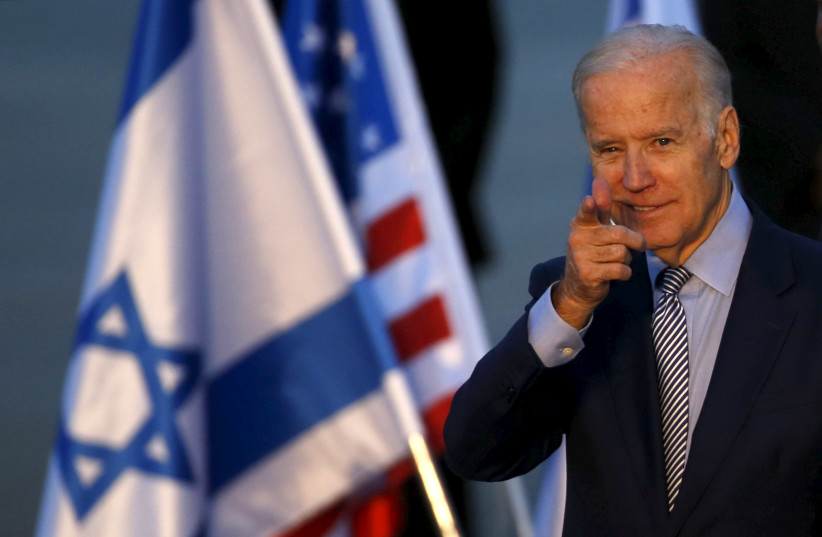
US President Joe Biden gestures after disembarking from a plane upon landing at Ben Gurion International Airport in Lod, near Tel Aviv, Israel March 8, 2016 (photo credit: REUTERS/BAZ RATNER)
US President Joe Biden gestures after disembarking from a plane upon landing at Ben Gurion International Airport in Lod, near Tel Aviv, Israel March 8, 2016
(photo credit: REUTERS/BAZ RATNER)
The only way the current Bennett-Lapid government can last – a government that includes Meretz and Labor on the Left, Yamina and New Hope on the Right, and Ra’am (United Arab List) – is for the parties to put their ideologies in their pockets.
At least temporarily. At least for the duration of this government’s life.
That means, for instance, that Meretz is going to have to stop pushing an anti-settlement agenda, and Yamina must not push a pro-settlement one. In that context, Meretz MK Mossi Raz’s cosponsorship of a
conference in the Knesset on Tuesday discussing Israel as an “apartheid state” is the type of stunt that will shorten the life of this government.
As both Prime Minister Naftali Bennett and Foreign Minister Yair Lapid realize, the only way for this government to survive is to push aside those issues and concentrate on the ones that the Right, Left and Ra’am can rally around – issues such as the coronavirus.
But it is not only up to the coalition to focus on consensus issues and try as much as it can to minimize the bandwidth taken up by the ideological ones; it is not only up to the heads of Meretz and Yamina to realize that now is not the time to run full force with their ideological agendas; it is also incumbent upon the US administration to be sensitive to Israel’s delicate political moment and find ways to avoid pushing issues that will lead to the types of ideological clashes inside the government that could bring it down.
After 12 years of a right-wing government led by then-prime minister Benjamin Netanyahu, a tenure that witnessed unprecedented friction with a Democratic president (Barack Obama) and the Democratic Party, conventional wisdom holds that the US President Joe Biden’s current Democratic administration is pleased to be working with a different team in Jerusalem, and that it probably is not eager for Netanyahu’s return.
As such, Washington needs to be smart and sensitive to what it demands from Israel, lest steps it takes lead to this government’s downfall.

Take the settlement issue, for instance. Given the composition of the current coalition, it is unlikely that the government is going to initiate major building projects in the settlements: Meretz, Labor and Ra’am would all fervently oppose.
But it is also unlikely that this government is going to freeze all construction either, something that Yamina, New Hope and Yisrael Beytenu would oppose. From time to time, therefore, there are likely to be stories about new projects in settlements inside the main settlement blocs, or in neighborhoods in Jerusalem beyond the Green Line.
But whereas the Obama administration, and even the Bush administration before it, would protest loudly and publicly new projects in Jerusalem neighborhoods such as Gilo or Neveh Ya’acov, let alone in Gush Etzion or Ariel, this administration – if it wants to see this government last for more than just a few months, would be wise not to make major issues out of those types of projects, or at least not doing it publicly, to avoid creating a coalition crisis over the matter.
Another issue that is likely to cause disquiet inside the coalition is the US intention to reopen its consulate in Jerusalem to deal with Palestinian issues, an office that before it was closed by former ambassador David Friedman and folded into the US Embassy, was viewed as an unofficial embassy to the Palestinians.
If Washington asks Israel for permission to reopen the consulate, it is an issue likely to split the government, with those on the Right against, and those on the Left in favor.
While it is difficult to imagine that this would lead to a collapse of the coalition – the parties at this early stage will likely find a way to overcome this hurdle, just as they are likely to find a way to jump over the family reunification law hurdle that has been tossed in its way – it would force to the top of the agenda issues that, if the government is to survive, would better be left alone. The administration, if it has an interest in this government’s survival, would do well to prioritize what is worth pursuing, and leave alone those issues that could trigger an Israeli coalition crisis.
Some may argue that the US needs to pursue its own interests without worrying about how this will play out on the Israeli domestic political scene, but that’s a rather naïve view since the domestic Israeli political scene does have an impact on America’s abilities to push forward its own policies in the region.
For instance, opposition leader Netanyahu is waiting impatiently in the wings ready to pounce and paint this government as weak and unable to withstand US pressure and stand firm on Israel’s security interests.
Netanyahu already did that by alleging Monday that Lapid had forfeited Israel’s freedom of action against Iran by agreeing to a “no-surprises” policy with the new administration. If he pounced on a nonissue – because this policy has long been an aspirational hallmark of Israel-US relations – think how much noise he will make if the government acquiesces to a consulate in east Jerusalem or backs down on the settlement issue.
AND THEN there is Iran. Barring any unforeseen developments, the US appears now on track to rejoin the Iranian nuclear deal that former president Donald Trump walked away from.
IDF Chief of Staff Lt.-Gen. Aviv Kohavi is presently in the US, where this is one of the main issues he is discussing. President Reuven Rivlin will meet Biden next week in Washington, where the issue will also be raised, and chances are good that Bennett may be invited to Washington before the US formally rejoins the deal.
It is obvious that Biden and top US officials do not need to meet Israel’s leadership just to hear again how and why Israel is opposed: Netanyahu has made that eminently clear for the last number of months.
What they can do, however, is come to an agreement with the US on a plan of action that will be taken if Iran violates the terms of the agreement; come to a mutual agreement on how to combat Iran’s nonnuclear malign behavior in the region; or even agree to how Israel’s military capabilities can be enhanced in light of the new deal.
Here, too, if the Americans are keen on seeing this government last, it needs to take into account Israel’s fragile political moment and act accordingly, realizing that Netanyahu is just waiting for something he can use to paint Bennett and Lapid as soft on security, to undermine and quickly break up this coalition.


A total of 31 construction plans for projects in various phases in Judea and Samaria were approved on Wednesday by the Civil Administration under the Lapid-Bennett government, according to Ynet.

The subcommittee on settlements in the Civil Administration approved limited construction plans in the Jewish communities of Elkana, Mishor Adumim, Karnei Shomron, Kfar Adumim and Yitzhar.

Among the projects approved were a school for children with special needs in Elkana, a shopping mall in Mishor Adumim and yeshivas and synagogues in Karnei Shomron and Kfar Adumim. Construction of 31 housing units in Yitzhar was also approved.

The subcommittee on settlements approved the projects; the Civil Administration’s Higher Planning Council which usually approves large-scale construction projects has not met since January and no meetings are planned for the foreseeable future.

Yesha Council: Approval Needed by Higher Planning Council
In response to the government announcement, the Yesha Council (Council of Jewish Communities in Judea and Samaria) clarified Wednesday night that construction plans must be approved by the Higher Planning Council, and that hasn’t happened yet.

The Yesha Council said in a statement quoted by Israel’s Channel 20 News, “What was approved today were not building plans.

“It is the Higher Planning Council that approves construction of housing units throughout the area. We have been waiting six months for approval of housing construction; we have waited long enough.”


Israel sending sanctions experts to Washington in sharp departure from past policy; Iran talk of US lifting sanctions overblown – DC source.

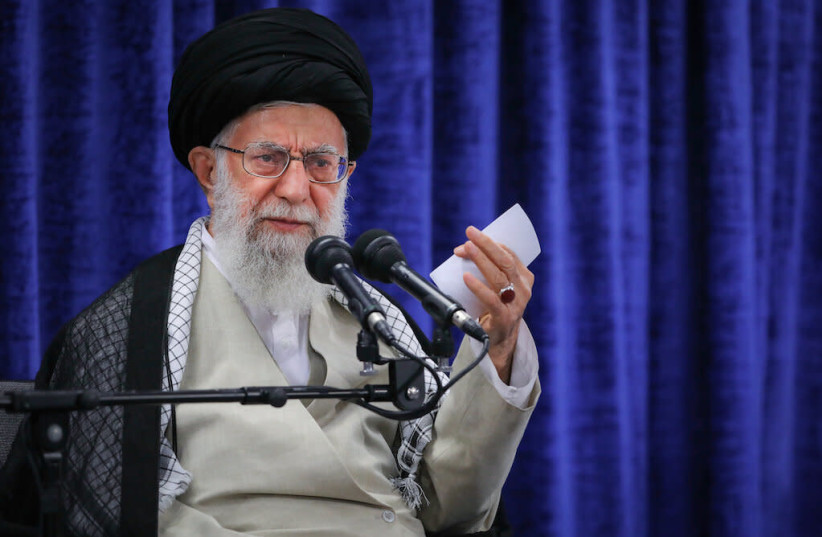
Iranian Supreme Leader Ayatollah Ali Khamenei, May 14, 2019 (photo credit: KHAMENEI.IR)
Iranian Supreme Leader Ayatollah Ali Khamenei, May 14, 2019
(photo credit: KHAMENEI.IR)
The US is seeking to extend the time between rounds of indirect nuclear talks with Iran, in order to talk to the new Israeli government more about its position.

Washington feels that the negotiations to return to the 2015 Iran nuclear deal are worth delaying in order to better cooperate with Israel, a source with knowledge of the US President Joe Biden’s administration’s side of the talks said on Wednesday.
The new government plans to send experts to Washington to discuss ways to better enforce the Joint Comprehensive Plan of Action’s limitations on Iran’s nuclear program, including which sanctions to keep intact as some will be removed if the US returns to the deal.
This is a sharp departure from former prime minister Benjamin Netanyahu’s policy, as he blocked any dialogue about the Biden administration’s plan to reenter the JCPOA.
An expert with close ties to the Biden administration, Middle East Program Director at the Kelman Institute for Conflict Transformation Ofer Zalzberg said that “the sense in Washington is that post-Netanyahu Israel…wants to prevent an Iranian nuclear weapon through a strong agreement.
“The US is keen on cooperative relations with Israel on this, though it would mean taking time for dialogue with Israel’s new government – and hence a delay in negotiations with Iran – and likely placing more demanding positions to Iran,” Zalzberg said.
Foreign Minister Yair Lapid plans to meet with US Secretary of State Antony Blinken in Rome on Sunday, a week after the sixth round of indirect talks between the US and Iran on returning to the 2015 nuclear deal came to a close on Sunday.
The new Israeli government is conducting a policy review on how it plans to handle the Iran nuclear threat and the likelihood that the US will return to the Joint Comprehensive Plan of Action, as the nuclear deal is called.
One question Lapid is expected to ask Blinken is what he means by seeking a “longer and stronger” JCPOA, as Blinken has repeatedly said.
The trip will be Lapid’s first as foreign minister and the first meeting between members of the new Israeli government and US President Joe Biden’s cabinet, exactly two weeks after the new government was sworn in. Blinken and Lapid have spoken twice since then, and sought to meet in person as soon as possible. The meeting will take place in Rome, because Lapid does not want to upstage Prime Minister Naftali Bennett and allow him to have the first trip to Washington.
Iran is one of a number of issues Lapid and Blinken plan to discuss. Another is the US plan to open a consulate to the Palestinians in Jerusalem.
The Iranian remarks, by outgoing President Hassan Rouhani’s chief of staff, echoed previous assertions by officials in Rouhani’s pragmatist camp that Washington is prepared to make major concessions at the talks, under way since April in Vienna.
“An agreement has been reached to remove all insurance, oil and shipping sanctions that were imposed by [former US President Donald] Trump,” Rouhani’s chief of staff Mahmoud Vaezi was quoted as saying by Iranian state media.
Earlier this week, Ebrahim Raisi, the Iranian judiciary chief who sanctioned by the US for human rights violations in light of his involvement in thousands of executions, won the Iranian presidential election. Raisi is due to replace Rouhani in August.
Vaezi said the United States had agreed to take some senior Iranian figures off a blacklist.
“About 1,040 Trump-era sanctions will be lifted under the agreement. It was also agreed to lift some sanctions on individuals and members of the supreme leader’s inner circle.”
Like other Western and Iranian negotiators who have said the talks remain a long way from conclusion, German Foreign Minister Heiko Maas said on Wednesday that Tehran and the powers still had to overcome significant hurdles.
“We are making progress but there are still some nuts to crack,” Maas told a joint news conference with Blinken. Maas said a deal was possible even after the election of Raisi, an implacable critic of the West.
US National Security Adviser Jake Sullivan said on Sunday there was still “a fair distance to travel”, including on sanctions and on the nuclear commitments that Iran has to make to salvage the tattered deal.
Some Iranian officials have suggested Tehran may prefer an agreement before Raisi takes office to give the new president a clean slate and avoid blame if problems subsequently arise.
The Biden administration aims to restore the deal, but the sides disagree on which steps need to be taken and when to defuse mutual suspicions and ensure full compliance.
Iran agreed in 2015 to curbs on its uranium enrichment program, a possible pathway to nuclear weapons, in return for the lifting of international sanctions. The limitations on the nuclear program will expire in 2030 under the original agreement.
Trump abandoned the agreement three years later, calling it flawed to Iran’s advantage, and reimposed harsh sanctions that hammered Iran’s economy.
Tehran responded by violating enrichment limits and starting to develop uranium metal.
IDF Chief of Staff Aviv Kohavi was in Washington on Wednesday, where he met with US National Security Adviser Jake Sullivan and other senior officials to discuss regional challenges, foremost of which was Iranian aggression and its nuclear ambitions, and presented ways to block Iran’s nuclear capabilities, the IDF Spokesperson said.
Kohavi was also expected to meet with CIA Director William Burns and Director of National Intelligence Avril Haines.
The talk in Tehran that the US is close to lifting oil sanctions is an exaggeration, the source with knowledge of the American side of the talks said.