The Chief of Staff to Iranian President Hassan Rouhani has claimed that the US, during the nuclear discussions in Vienna, agreed to remove over 1,000 sanctions that were implemented under the Trump administration.

In the aftermath of the failed nuclear discussion(s) in Vienna over the past several weeks, Iranian President Hassan Rouhani’s Chief of Staff, Mahmoud Vaezi, reported that US officials agreed to remove 1,040 sanctions that were implemented under the Trump administration.

As stated by Vaezi, “All issues of insurance, oil and shipping have been agreed, and about 1,040 sanctions from the Trump era will be lifted according to this agreement.”

According to a report by The Times of Israel, US officials also agreed to remove Iranian officials from America’s blacklist. However, the US has not verified the statements coming from Iran.

The talks in Vienna have reportedly not been going according to plan for anyone, as at least one source has revealed that any of the agreements to have taken place so far are of minor consequence. Furthermore, the most significant topics are yet to even surface in the meetings. German Foreign Minister Heiko Maas stated that there are “several technical questions to resolve.”

Discussions in Vienna became a reality amid Tehran’s continuous violations of the 2015 Joint comprehensive Plan of Action (JCPOA) that was set in place under the Obama administration. However, the Trump White House withdrew from the deal in 2018 after citing Tehran’s longstanding breaches of the agreement. Upon its withdrawal, the Trump administration also implemented several previous and new sanctions.


IDF Chief Lt. Gen. Aviv Kochavi sets out for Washington on Saturday night, June 19 with the tall order of overcoming policy differences with the Biden administration on Iran.  His mission was further complicated by Foreign Minister Yair Lapid’s assurance to Secretary of State Antony Blinken on Thursday, June 17, that Israel would not take the Americans by surprise. Defense Minister Benny Gantz went further to promise “quiet dialogue” before any Israeli action.

These assurances were delivered to the Biden administration before they were cleared by the incoming security cabinet, which holds its first meeting on Sunday, after the IDF chief arrives in Washington. But meanwhile, the US landed a surprise in the form of a Wall Street Journal report that the US was downsizing its air defense forces in the Middle East, in view of “progress” made in the Vienna negotiating track for the US return to the 2015 nuclear accord. President Joe Biden has clearly decided that the Iranian nuclear threat has receded enough to withdraw Patriot and other air defense systems, air force squadrons and their crews from the Middle East, especially from Saudi Arabia, and the time had come to pivot towards “great power confrontation” with Russia and China.

This policy shift was accounted for by the New York Times after the Biden-Putin summit in Geneva as a decision by Biden “to put an optimistic face on his policies.”
Most American foreign policy experts find few grounds for any such  “optimistic face,” fearing it derives more from a naïve blindness to reality rather than a coherent policy. Whereas the US as a military and economic giant can afford to gloss over reality, however, the same can’t be said for Israel. And its new leaders had no business promising not to collide with US policy by surprise actions, certainly not in the shadow of the election of an ultra-extremist, anti-West Iranian president on Friday.

Although US sanctions were imposed on Judge Ebrahim Raisi, the new president, for mass executions of political prisoners, the Biden administration has not wavered from the diplomatic course toward a new nuclear deal with Iran. Neither has the administration been deterred by specific warnings from US intelligence and nuclear experts.

The noted nuclear expert David Albright and Sarah Burkhard this week outlined Tehran’s staged advance towards a nuclear weapon since reaching the forbidden 60pc grade of enriched uranium. This grade “can be used directly in a nuclear explosive,” without resorting to the 90pc grade. With IR-6 high-speed centrifuges, Iran is now producing 0.126 kilos of 60pc-enriched uranium a day and will have amassed enough material for building a single nuclear in one year and three months, say these experts.

By adding a second cluster of centrifuges to the enrichment process, Iran can cut this timeline by eight months. With four clusters, Iran will have accumulated enough 60pc uranium to build a nuke in just four months.

Israel’s military and intelligence are painfully familiar with these figures. This awareness may account for the recent emergence along Israel’s Mediterranean coastal tights of unexplained signs with directions for escaping a tsunami. The sea along this coast is normally pretty placid with only the slightest tidal movement. But what if an Iranian commercial plane flew far out to sea opposite the Israeli shore and dropped just one nuclear bomb in the water, an option rumored to have occurred to Iran’s strategists?  Central Israel’s most densely populated heartland radiating from Tel Aviv would be mortally swamped.

Israel’s security authorities have had to take this peril and others into account. Still, Gen. Kochavi will have his work cut out to convince the current US administration to refrain from giving Iran a fresh lease of life for its nuclear weapons program and malign activities in the region by reviving the 2015 nuclear pact and dropping sanctions. At the very least, he must explain why Israel, confronted with a direct, mortal peril, will have to retain its independence of action, even at the risk of landing surprises on American heads.

For this stance, he will have need of full backing from Prime Minister Naftali Bennett – even if this does not square with his centrist ministers’ message to Washington.


Iran claimed throughout the day that the sabotage failed and caused no damage or casualties.

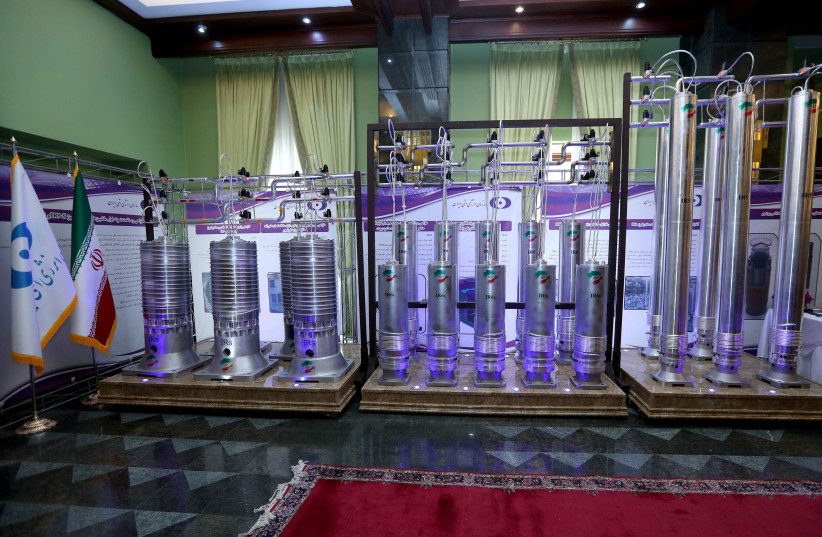
A number of new generation Iranian centrifuges are seen on display during Iran's National Nuclear Energy Day in Tehran (photo credit: IRANIAN PRESIDENCY OFFICE/WANA (WEST ASIA NEWS AGENCY)/HANDOUT VIA REUTERS)
A number of new generation Iranian centrifuges are seen on display during Iran’s National Nuclear Energy Day in Tehran
(photo credit: IRANIAN PRESIDENCY OFFICE/WANA (WEST ASIA NEWS AGENCY)/HANDOUT VIA REUTERS)
A sabotage operation against one of the buildings of Iran’s Atomic Energy Organization (IAEO) caused major damage – despite Iranian denials, The Jerusalem Post learned on Wednesday night.
Although Iran has claimed throughout the day that the sabotage failed and caused no damage or casualties, the Post has been given strong indications otherwise, though it has no way to independently confirm.
The incident is said to be under investigation by Iranian authorities. It is as of yet unclear how the attack was carried out.

The Iranian Mehr News Agency reported on Wednesday that a quadcopter was used in the attempt to sabotage a building at the AEO, but failed and was eventually shot down.
Earlier in the day, the Iranian ILNA news agency reported that a drone attack targeted the Barakat Pharmaceutical Industries complex in Karaj, which is developing a coronavirus vaccine, but subsequently removed the report from their website.
ILNA editor Fatemeh Mahdiani tweeted that the report was removed after a security agency called the news agency and informed them that the target was the AEO building located next to the Barakat complex, and that no damage had been caused.
An informed source from the Khatam al-Anbia Joint Air Defense Base later denied that the incident was a drone attack, telling Iranian media that it was likely an act of sabotage.

Despite Iranian claims on Wednesday, both in July 2020 and April 2021, the Islamic Republic initially lied to the global media in trying to downplay sabotage operations of key nuclear facilities at Natanz.

In both cases, Iranian officials initially claimed that the damage was minor and a routine accident.
These officials admitted that Iran’s centrifuge program for enriching uranium was massively set back only several days after the two Natanz incidents, when The Post and others reported the real full extent of the damage.
Both operations were attributed by foreign sources to the Mossad, which the Post was able to validate.
The update regarding the IAEO facility comes at a sensitive time for Tehran.
On one hand, the US, Iran and the world powers recently finished a sixth round of negotiations in Vienna to resolve the nuclear standoff, with no new meetings yet scheduled.
Leaks from all parties to the negotiations suggest that the sides could reach a deal between now and mid-August when a new Iranian administration takes power.
However, there are clearly still differences between them, and this latest incident could either undermine Iran’s negotiating position or undermine trust between the parties – regardless of who might be responsible.
In addition, Ebrahim Raisi was declared the winner of Iran’s presidential race on Saturday and he has been giving speeches and trying to project a powerful image on the world stage.
This latest incident could undermine his efforts to roll out his aura of strength – or could empower him to clean out political rivals from the outgoing administration.
The incident also comes just days after Iran’s Bushehr Nuclear Power Plant underwent an emergency shutdown.
The IAEO reported that a technical defect led to the power plant being temporarily shut down and disconnected from the national electricity grid, according to the Iranian Fars News Agency.
The organization stated that the plant would be reconnected to the electricity grid in a matter of days.
As of Tuesday, repairs at the Bushehr power plant were still ongoing.
