
Netanyahu: Lapid’s ‘no surprises’ policy endangers Israel

Opposition leader says foreign minister pledged not to act against Iran without informing Biden Admin. first. Lapid denies accusation.

Arutz Sheva Staff , Jun 21 , 2021 7:23 PM


Opposition leader Benjamin Netanyahu today (Monday) attacked the Bennett-Lapid government, saying that Foreign Minister Yair Lapid’s commitment not to act against Iran without first informing the United States is a commitment that harms Israel’s security.

“Last Thursday, Alternate Prime Minister Lapid pledged to the US Secretary of State that there would be a ‘no surprises’ policy between the parties. This is an incredible Israeli commitment that severely damages the core of national security. If this were the case, we would not have destroyed the Iraqi nuclear reactor. I never had such a policy in my 15 years” as prime minister, Netanyahu said.

Netanyahu added: “Many times we acted even without the prior approval of the Americans. I rejected a similar request recently, even when it was made by Biden and his defense secretary. All I promised was to consider the request. Alternate Prime Minister Yair Lapid waived freedom of action.”

According to Netanyahu, “This is the best gift for the position that the ‘hangman of Tehran’ could have asked for. From now on, he and his regime friends know that it is possible to sleep peacefully. There are no surprises – from now on, the new Israeli government must actually coordinate any action against the nuclear program with the administration in Washington, a government that is rushing forward to return to the dangerous nuclear agreement.”

“This is a government that does not deserve to lead Israel for even one day. This is a top national task. This is not a political matter. And we, and the entire opposition, will do everything to replace this government as soon as possible,” the prime minister stressed.

Foreign Minister Yair Lapid denied opposition leader Netanyahu’s claim that Lapid had committed to a “no surprises” policy with the Biden administration. “The first part of the sentence is incorrect and the second part will not be. I thank the chairman of the opposition for the advice. We will continue from here,” said Lapid.

PM: “There is global consensus around the two-state solution, but…the world gets it wrong a lot.” Op-ed.

David Singer , Jun 21 , 2021 8:18 AM


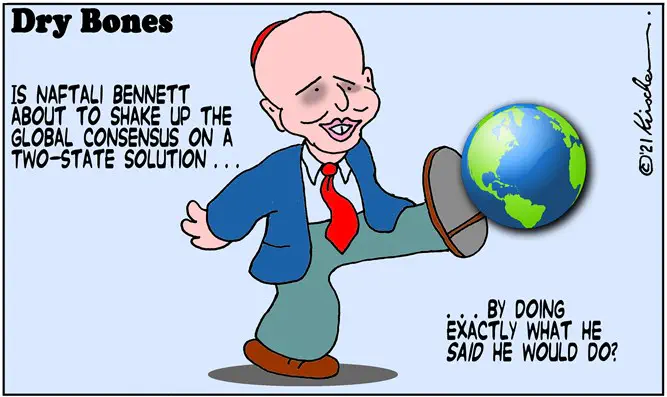
Dry Bones: Bennett and the Two-State Solution

Dry Bones: Bennett and the Two-State Solution

Y. Kirschen

Israel’s new Prime Minister – Naftali Bennett – seems set to challenge the decades-long failure by the international community to achieve its called-for two-state solution, involving creating a second Palestinian Arab state, in addition to Jordan, for the first time in recorded history.

Bennett made his intention very clear when introducing Israel’s next Government – not necessarily with his new coalition partners’ unanimous approval:

“We will ensure Israel’s national interests in Area C – and we will increase standards to that end after much neglect in this area.” (Note: The Oslo Accord divided the disputed region of Judea and Samaria, aka ‘West Bank’, into Areas A, B, and C. Areas A and B were granted autonomy and are governed by the Palestinian Authority, except for security issues in Area B, while Area C has all the Jewish residents and about 4% of the Palestinian Arabs living in the region.)


Bennett – anointed as “Prime Minister and Minister for Settlement Affairs” – is now uniquely placed to promote his “Israel Stability Initiative – February 2012” (Stability Plan) – summarised by him in 2017:

“The main idea of The Stability Plan is to provide full civilian self-governance to the Palestinians so they can elect themselves, pay their taxes, and control those areas that are theirs. We should apply sovereignty in Israeli-controlled areas – known as Area C – and Palestinians living there will become part and parcel of the State of Israel. And since within the State of Israel you cannot have two levels of people, those Palestinians living in Area C – approximately 80,000 people – will be offered full Israeli citizenship, including voting rights. I think most will opt for residency rather than citizenship (like in East Jerusalem) but it’s up to them. They can be Israeli citizens, Israeli residents or Palestinian citizens.

“Those living in the Palestinian-controlled areas (Areas A and B) will govern themselves in all aspects barring two elements: overall security responsibility and not being able to allow the return of decedents [sic] of Palestinians refugees. We can’t have an inflow of millions of great grandchildren of 1948 refugees coming across the Jordan River because in one swoop that would distort the demography of the area, and within a few weeks of their arrival, the local Palestinians in Judea and Samaria would tell them to ‘go back to Jaffa’ which would subsequently create pressure on Israel that could lead to a third intifada inside ‘Smaller Israel’.

“My option is that Palestinians have an ‘autonomy on steroids,’ and I’m open to ideas about how this materialises; it could be a confederation with Jordan, or local municipalities, or a central government. It would encompass full freedom of movement, massive infrastructure investment, the creation of a tourism zone so Christians can enter Haifa, Nazareth, Nablus, Ramallah, Jerusalem and Hebron without going through road blocks. We would have joint industrial centres, and we’d be able to create a land port governed by the Palestinians in Jenin that would be connected to Haifa.”

Bennett continued:

“I understand there is global consensus around the two-state solution, but what the world thinks is no proof for the correctness of a plan. The world gets it wrong a lot.

“I’d say to those in the international community who are so entrenched in the idea of a Palestinian state that (a) the Palestinians have a state in Gaza and they blew it, and (b) after 50 years, at what time do we need to rethink? In the high tech world where I come from, if my employees tried the same solution and failed again and again I’d fire them as I’d expect them to have tried to tackle the challenge from a different angle by now! There is an industry around this topic – think-tanks, journals, professionals and academics who keep on chewing on the same old failed solution. We’re not in Europe, we live in a region with very few democracies, and when we tried this idea out it blew up in our faces and no one showed us any sympathy.”

Is Bennett going to stand behind his earlier plan? Global consensus needs to positively respond to Bennett’s challenge.


Supreme leader now looks to close Vienna talks and have sanctions lifted, while moderates can still be blamed for concessions to West


President Hassan Rouhani, left, speaks with the media after his meeting with President-elect Ebrahim Raisi, right, who is current judiciary chief, in Tehran, Iran, June 19, 2021. (Official Website of the Office of the Iranian Presidency Office via AP)

President Hassan Rouhani, left, speaks with the media after his meeting with President-elect Ebrahim Raisi, right, who is current judiciary chief, in Tehran, Iran, June 19, 2021. (Official Website of the Office of the Iranian Presidency Office via AP)

A day after hardline cleric Ebrahim Raisi was officially declared winner of Iran’s presidential elections, the sixth round of nuclear talks between Tehran and the six world powers known as the P5+1 wrapped up in Vienna.

Iran’s lead negotiator expressing optimism that the sides “are now closer than ever to an agreement.”

With Raisi’s victory, the most pressing question now becomes what effect his election will have on the slow-moving negotiations about a return to the 2015 JCPOA agreement by the US and Iran.

Iran’s strategic approach toward the talks certainly will not change. The overall direction comes from Supreme Leader Ali Khamenei, who is convinced that the country’s most pressing concern is crawling out from under the crippling US sanctions imposed by the United States’ Trump administration.

Protesters with the Lion and Sun flag of the National Council of Resistance of Iran, an Iranian opposition group, near the Grand Hotel in Vienna where diplomats from the EU, China, Russia and Iran are set to hold talks, on April 6, 2021. (Joe Klamar/AFP)

If Khamenei opposed the talks, they would not be happening at all.

But the pace of talks is set to change drastically with Raisi coming into office on August 3.

The first six rounds of talks crawled forward, with both sides expressing guarded optimism, while pointing out that significant gaps remain.

Many believe that Khamenei instructed the negotiators to slow-walk the talks, making sure that a deal was not reached until it was clear who would triumph in the elections.

With less than two months left in President Hassan Rouhani’s tenure, Iran is expected to press ahead toward a deal.

“I sense that the deep state wants the JCPOA to be restored before Raisi comes into office, so that Rouhani gets the blame for any shortcomings,” said Ali Vaez, Iran Project Director at the Crisis Group.

Iranian President Hassan Rouhani walks past a portrait of Supreme Leader Ayatollah Ali Khamenei as he arrives for a news conference in the capital Tehran, on February 16, 2020. (Atta Kenare/AFP/File)

Iran will have to make significant concessions to the West over IAEA access to nuclear sites and restrictions on enrichment, and it is convenient for the supreme leader and the conservative, revolutionary camp to hold up Rouhani and his foreign minister, Mohammad Javad Zarif, as scapegoats who folded to the West when they could have struck a better deal.

If Iran succeeds in getting a deal done during Rouhani’s final days in office, sanctions will gradually be lifted during Raisi’s first months. He will reap the economic dividends, likely winning over many disillusioned Iranians who stayed home during Friday’s elections.

There have been signs that this has been Iran’s intention all along. In early June, an Iranian government spokesman said that he saw no reason an agreement would not be reached before Rouhani left office.

Still, there is no guarantee that the sides will be able to bridge the gaps by August.

Secretary of State Mike Pompeo and Treasury Secretary Steve Mnuchin brief reporters about additional sanctions placed on Iran, at the White House, Friday, Jan. 10, 2019, in Washington. (AP Photo/ Evan Vucci)

If that happens, then it becomes unlikely that the sides will ever return to the 2015 JCPOA.

Raisi would not be eager to make concessions that Rouhani refused to offer, especially not in his first months in office. While the sides continue to posture, and occasionally talk, Iran will keep pushing forward with its enrichment program. Despite his clear desire to return to the deal, US President Joe Biden could well be forced to impose additional sanctions on Iran, which would lead, in turn, to further nuclear escalation.

By then, the sides will be too far apart to return to the deal.

“There will be a need for an entirely new agreement, which is going to be extremely difficult,” said Vaez.

The next few weeks will determine whether the region is headed toward a period of relative calm — at least on the nuclear front — or whether there will be significant escalation that could prove difficult to contain.
