As Shabbat ends, Foreign Minister Yair Lapid issues a statement on the election of Iran’s new president Ebrahim Raisi.

“Iran’s new president, known as the Butcher of Tehran, is an extremist responsible for the deaths of thousands of Iranians,” Lapid, who became Israel’s top diplomat on Sunday, writes on Twitter. “He is committed to the regime’s nuclear ambitions and to its campaign of global terror.”

He adds: “His election should prompt renewed determination to immediately halt Iran’s nuclear program and put an end to its destructive regional ambitions.”

Foreign Ministry spokesman Lior Haiat also issues a statement on Raisi’s election, which he says “makes clear Iran’s true malign intention.”

“More than ever, Iran’s nuclear program must be halted immediately, rolled back entirely and stopped indefinitely. Iran’s ballistic missile program must be dismantled and its global terror campaign vigorously countered by a broad international coalition,” Haiat says.


KHAMENEI HAILS VICTORY FOR NATION OVER ‘ENEMY PROPAGANDA’


Ex-Mossad deputy chief says hardliner’s election as president is proof of Iran’s radicalization on nuclear, terror policies; Putin is only leader to congratulate ultraconservative


In this photo released by the official website of the office of the Iranian Presidency, President Hassan Rouhani, left, speaks with the media after his meeting with President-elect Ebrahim Raisi, right, who is current judiciary chief, in Tehran, Iran, June 19, 2021  (Iranian Presidency Office via AP)

In this photo released by the official website of the office of the Iranian Presidency, President Hassan Rouhani, left, speaks with the media after his meeting with President-elect Ebrahim Raisi, right, who is current judiciary chief, in Tehran, Iran, June 19, 2021 (Iranian Presidency Office via AP)

The head of the Knesset’s Foreign Affairs and Defense Committee said Saturday that the election of hardliner Ebrahim Raisi as Iran’s president would present a challenge for both Israel and the West.

“Raisi’s election as Iran’s next president is conclusive evidence of [Supreme Leader Ali] Khamenei’s decision to radicalize Iran’s conduct on foreign, nuclear and terrorist policies,” tweeted Ram Ben-Barak, a former Mossad deputy chief. “A big challenge has been placed at the door of the West and Israel.”

Raisi’s win puts hardliners firmly in control across the Iranian government as negotiations in Vienna continue to try to save a tattered deal meant to limit Iran’s nuclear program.

Tehran is currently enriching uranium at its highest levels ever, though still short of weapons-grade levels.

Tensions remain high between Iran and both the US and Israel, which Tehran accuses of carrying out a series of attacks targeting Iranian nuclear sites as well as assassinating Mohsen Fakhrizadeh, the scientist who created its military atomic program decades earlier.

Israel has additionally long raised concerns about Tehran’s support for terror groups around the world, particularly in Lebanon and Gaza.
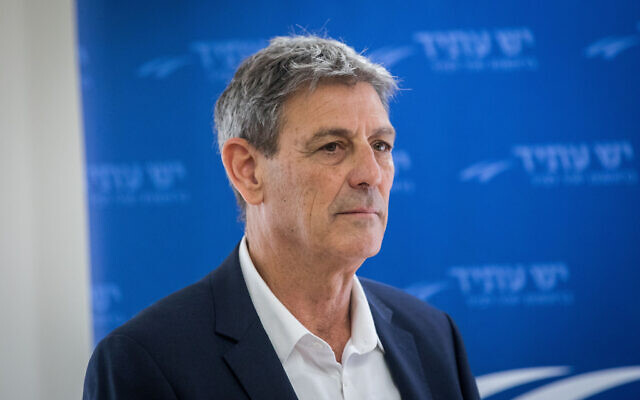
Yesh Atid MK Ram Ben Barak attends a faction meeting at the Knesset on January 15, 2018 (Yonatan Sindel/Flash90)

Meanwhile, Russian President Vladimir Putin on Saturday was the first world leader to congratulate the Iranian judiciary chief on his victory.

Putin additionally welcomed “further development of a constructive bilateral cooperation,” the Reuters news agency reported.

Russian President Vladimir Putin at the Kremlin in Moscow, Russia, March 4, 2021. (Alexei Druzhinin, Sputnik, Kremlin Pool Photo via AP, File)

Raisi won the country’s presidential election in a landslide victory Saturday after a panel under the watch of Supreme Leader Ayatollah Ali Khamenei disqualified his strongest competition.

Raisi’s candidacy, and the sense the election served more as a coronation for him, sparked widespread apathy among eligible voters in the Islamic Republic.

The disqualifications affected reformists and those who backed relative moderate president Hassan Rouhani, whose administration both reached the 2015 nuclear deal with world powers and saw it disintegrate three years later with then-US president Donald Trump’s unilateral withdrawal of America from the accord.

Iran’s Judiciary Chief Ayatollah Ebrahim Raisi pays his respect to the body of slain scientist Mohsen Fakhrizadeh among his family, in Tehran, Iran, November 28, 2020. (Mizan News Agency via AP)

Raisi will be the first serving Iranian president sanctioned by the US government even before entering office, over his involvement in the mass execution of political prisoners in 1988, as well as his time as the head of Iran’s internationally criticized judiciary — one of the world’s top executioners.

On Saturday, Amnesty International called for Raisi to be investigated for alleged crimes against humanity.

Raisi will likely serve two four-year terms and thus may be at the helm at what could be one of the most crucial moments for the country in decades — the death of the 82-year-old Khamenei. Already, speculation has mounted that Raisi may himself be a contender for the position, along with Khamenei’s son, Mojtaba.

Iran’s Supreme Leader Ayatollah Ali Khamenei casts his vote for the presidential election at a polling station in the capital Tehran, on June 18, 2021.(Atta KENARE / AFP)

For his part, Khamenei hailed the results on Saturday as a victory for the nation over “enemy propaganda.”

“The great winner of yesterday’s elections is the Iranian nation because it has risen up once again in the face of the propaganda of the enemy’s mercenary media,” he said.


SAYS HE ‘PRESIDED OVER SPIRALING CRACKDOWN ON HUMAN RIGHTS’


Rights group says Raisi was member of ‘Death Commission’ that forcibly disappeared and extrajudicially executed in secret thousands of opposition prisoners in 1988


Ebrahim Raisi, Head of Iran's Judiciary, speaks during a ceremony on the occasion of first anniversary of death of late Iranian Revolutionary Guards Corps (IRGC) general Qassem Soleimani, in Tehran, Iran, January 1, 2021. (AP Photo/Ebrahim Noroozi)

Ebrahim Raisi, Head of Iran’s Judiciary, speaks during a ceremony on the occasion of first anniversary of death of late Iranian Revolutionary Guards Corps (IRGC) general Qassem Soleimani, in Tehran, Iran, January 1, 2021. (AP Photo/Ebrahim Noroozi)

NICOSIA — Ultraconservative cleric Ebrahim Raisi, who was declared Iran’s next president Saturday, should be investigated for alleged crimes against humanity and a “spiraling crackdown” on human rights, Amnesty International said.

“That Ebrahim Raisi has risen to the presidency instead of being investigated for the crimes against humanity of murder, enforced disappearance and torture, is a grim reminder that impunity reigns supreme in Iran,” Amnesty said in a statement.

Amnesty said Raisi was a member of the “Death Commission” that forcibly disappeared and extrajudicially executed in secret thousands of opposition prisoners in 1988 while serving as Tehran’s deputy prosecutor.

Asked in 2018 and again last year about the executions, Raisi denied playing a role, even as he lauded an order he said was handed down by the Islamic republic’s founder, Ayatollah Ruhollah Khomeini, to proceed with the purge.

Amnesty said the “fate of the victims and the whereabouts of their bodies are, to this day, systematically concealed by the Iranian authorities, amounting to ongoing crimes against humanity.”

The London-based pressure group said Raisi had “presided over a spiraling crackdown on human rights” while serving as Iran’s judiciary chief for the past two years.

Supporters of the presidential candidate Ebrahim Raisi, currently judiciary chief, hold his posters during a campaign rally in town of Eslamshahr southwest of the capital Tehran, Iran, June 6, 2021. (AP Photo/Vahid Salemi)

It said the crackdown had seen “hundreds of peaceful dissidents, human rights defenders and members of persecuted minority groups arbitrarily detained.”

“Under his watch, the judiciary has also granted blanket impunity to government officials and security forces responsible for unlawfully killing hundreds of men, women and children.”

It had also subjected “thousands of protesters to mass arrests and at least hundreds to enforced disappearance, and torture and other ill-treatment during and in the aftermath of the nationwide protests of November 2019.”

Smoke rises during a protest after authorities raised gasoline prices, in the central city of Isfahan, Iran, November 16, 2019. (AP Photo)

“We continue to call for Ebrahim Raisi to be investigated for his involvement in past and ongoing crimes under international law, including by states that exercise universal jurisdiction,” it said.

Amnesty called on the UN Human Rights Council’s member states to take “concrete steps to address the crisis of systematic impunity in Iran.”

It said they should establish “an impartial mechanism to collect and analyze evidence of the most serious crimes under international law committed in Iran to facilitate fair and independent criminal proceedings.”
