Yossi Cohen, who retired as head of the Mossad last week, provided highly specific details of recent Mossad activity against Iran, his interactions with Prime Minister Benjamin Netanyahu, his role in Israel’s normalization with the UAE, and his own undercover career in an extraordinary interview on Israeli television broadcast on Thursday night.
Cohen intimated that his agency blew up Iran’s underground centrifuge facility at Natanz, gave a precise description of the 2018 operation in which the Mossad stole Iran’s nuclear archive from safes in a Tehran warehouse, confirmed that Iran’s assassinated top nuclear scientist Mohsen Fakhrizadeh had been in Mossad’s sights for years, and said the regime needs to understand that Israel means what it says when it vows to prevent Iran attaining nuclear weapons.
In what would appear to be the most revelatory interview ever given by a Mossad chief so close to the end of his active service, Cohen, who was appointed by Netanyahu, said he did not rule out seeking to become prime minister one day, though he wasn’t contemplating such an ambition at the moment.
The interview was presumably approved by Israel’s military censors, and Cohen was circumspect on numerous occasions, but nonetheless talked about his career and key operations with an openness and detail radically atypical of spy chiefs, especially those whose service has only recently ended.
Early in the more than an hour of conversations for journalist Ilan Dayan’s “Uvda” (Fact) documentary show on Israel’s Channel 12, Cohen indicated that he was deeply familiar with Iran’s various nuclear sites, and said that, if given the opportunity, he would take Dayan to the underground “celler” at Natanz, where, he said, “the centrifuges used to spin.”
Get The Times of Israel’s Daily Edition by email and never miss our top storiesFREE SIGN UP

Footage of the Natanz nuclear facility aired by Iranian state TV on April 17, 2021. (Screen capture/Twitter)
“It no longer looks like it did?” Dayan asked.
“Indeed,” said Cohen.
“Unless they fixed it,” she said.
“It doesn’t look like it used to look,” insisted Cohen.
Cohen did not explicitly confirm responsibility for sabotage at Natanz in the interview, but said more generally: “We say very clearly [to Iran]: We won’t let you get nuclear weapons. What don’t you understand?”

Former Mossad chief Yossi Cohen (R) in an interview with Channel 12’s Ilana Dayan broadcast on June 10, 2021 (Screencapture)
Dayan noted that two major blasts at Natanz were attributed in foreign reports to the Mossad in the past year, and said “a huge quantity of explosives” were built into a marble platform used to balance the centrifuges.
Watching Fakhrizadeh
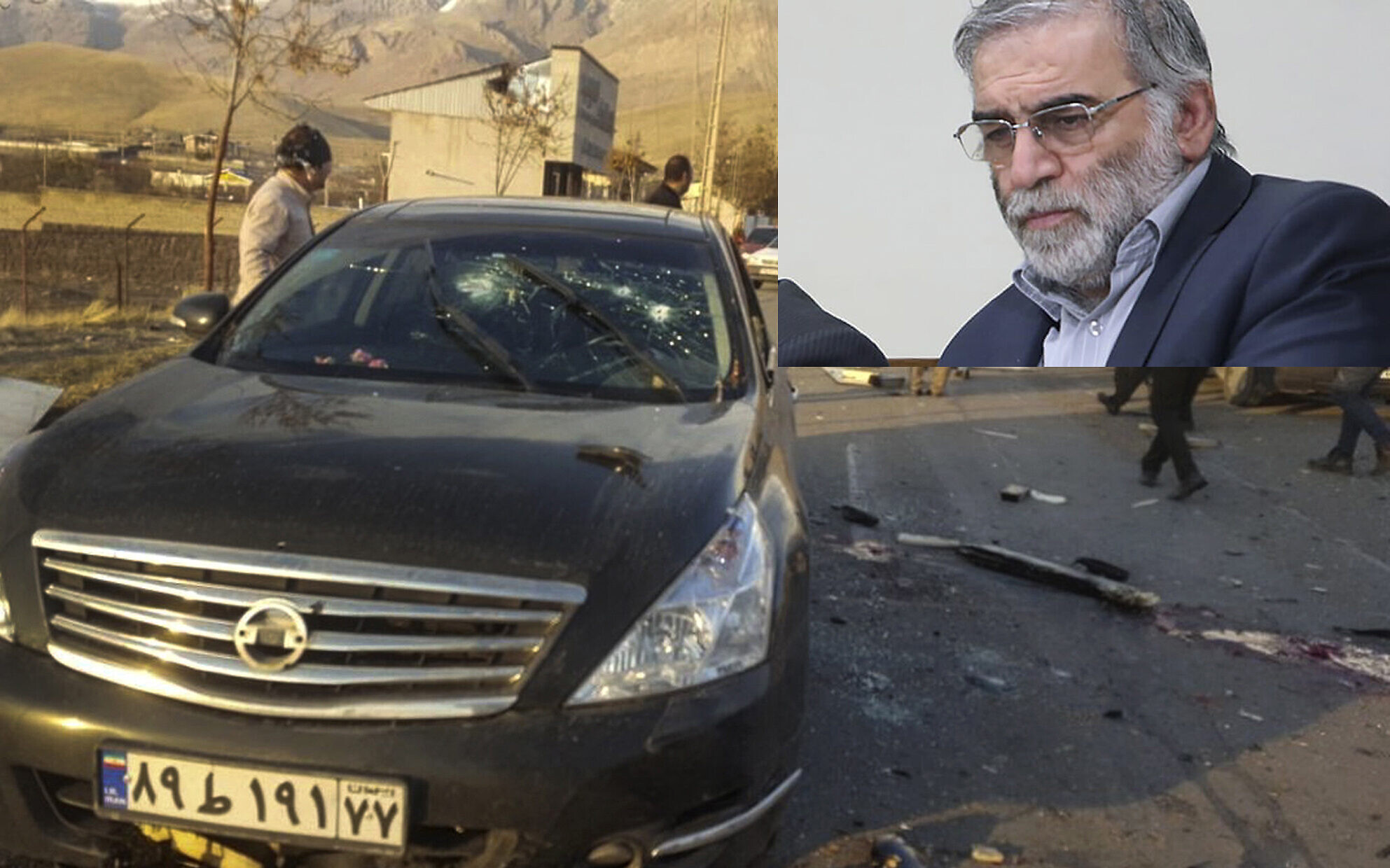
Regarding Fakhrizadeh, identified by Israel as the father of Iran’s rogue nuclear weapons program, who was killed in an ambush near Tehran in November 2020 that has been widely attributed to Israel, Cohen said that he was watched by Mossad for years and that the Mossad was physically close to him before November 2020.
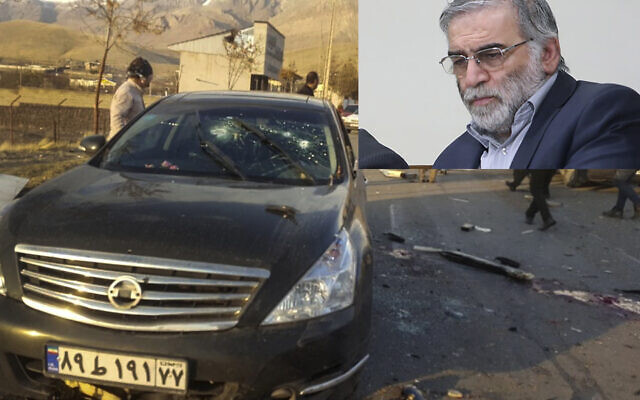
The scene where Mohsen Fakhrizadeh was killed in Absard, a small city just east of the capital, Tehran, Iran, November 27, 2020 (Fars News Agency via AP); inset: Mohsen Fakhrizadeh in an undated photo (Courtesy)
Fakhrizadeh “most troubled us from the point of view of the science, the knowledge, the scientists of the Iranian military nuclear program,” said Cohen, and therefore “he was a target for [intelligence] gathering for many years.”
Interviewer Dayan said of Fakhrizadeh’s killing: “Yossi Cohen cannot take responsibility for this action, but his personal signature is on the entire operation.”
Asked whether he believes killings of potent Israeli enemies are worthwhile, Cohen said: “If the man constitutes a capability that endangers the citizens of Israel, he must stop existing.”
In some cases, however, Cohen said, Israel conveys the message to such a potential target that “if he is prepared to change profession and not harm us any longer, then yes” — implying such a target would be spared.
Did any such people get the hint and become, say, a piano player, Dayan asked?
Yes, said Cohen, and added that this pleased him. Others, however, he said, did not get the message that this was an offer they shouldn’t refuse.
For all the Mossad’s actions, “the Iranians are closer than ever” to the bomb,” Dayan suggested. “Not so,” said Cohen. “That’s not true.”
7 hours in a Tehran warehouse
In the interview, Cohen described the planning and execution of the Mossad’s theft of a vast archive of Iranian nuclear documents from a Tehran warehouse on the night of January 31, 2018 — an operation for which Israel has openly taken credit.
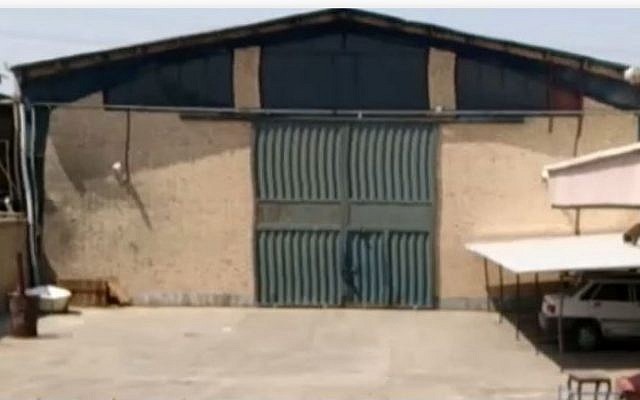
A warehouse in Shorabad, south Tehran, where Mossad agents discovered and extracted tens of thousands of secret files pertaining to Iran’s nuclear weapons program (Prime Minister’s Office)
He said he ran the operation from the Mossad command center in Tel Aviv, and that the agency had begun working towards it, on his instructions, two years earlier.
“We understood they were secretly storing their nuclear secrets — things we didn’t know… I decided we needed to see what the Iranians are planning for us,” Cohen said, “and I told my people to prepare to bring this home” because it would potentially show “the wider picture” of the Iranian program.
Twenty Mossad agents were involved on the ground — none of them Israeli nationals, said Dayan.
Mossad built a replica of the site, learned all about the containers holding the material, and knew how the containers were arranged, Cohen indicated. “We had a certain problem” on the night itself, said Cohen, regarding “something we recognized” that had apparently changed, but the decision was taken to proceed as planned.
Cohen said they knew they had seven hours maximum at the site — “after that trucks and guards and workers” would arrive and “you can’t be jumping off fences and bursting through walls.”
The team neutralized alarms, removed the warehouse doors, and reportedly opened 32 safes holding the material. Opening safes like those takes “more than minutes for each,” Cohen said.

Safes inside a warehouse in Shorabad, south Tehran, where Mossad agents discovered and extracted tens of thousands of secret files pertaining to Iran’s nuclear weapons program (Prime Minister’s Office)
When images of the Farsi documents and other material in the safes were screened in the Tel Aviv command center in real-time “and we realized that we have what we wanted, that we are ‘on’ Iran’s military nuclear program,” said Cohen, “there was incredible excitement for us all.”
Dayan indicated that Mossad had numerous decoy trucks driving around the Tehran area to throw the Iranians off the scent of the single truck bringing the 50,000 documents and 163 discs out of Iran over land, and Cohen did not deny this.
He said the Iranians knew by the morning that the warehouse had been emptied, and all exit points from the country were closed. “We knew they’d chase us,” he said. “We’d taken their most sensitive secrets.” Because of concerns that the material might not make it out, much of it was transferred digitally to Tel Aviv before the truck crossed the border, Dayan revealed.
Cohen said he told Netanyahu “once we had left the site… that the first part of the operation was completed,” and that now the challenge was to bring the material home.
He said all the operatives are alive and well, though some of them needed to be extracted from Iran.

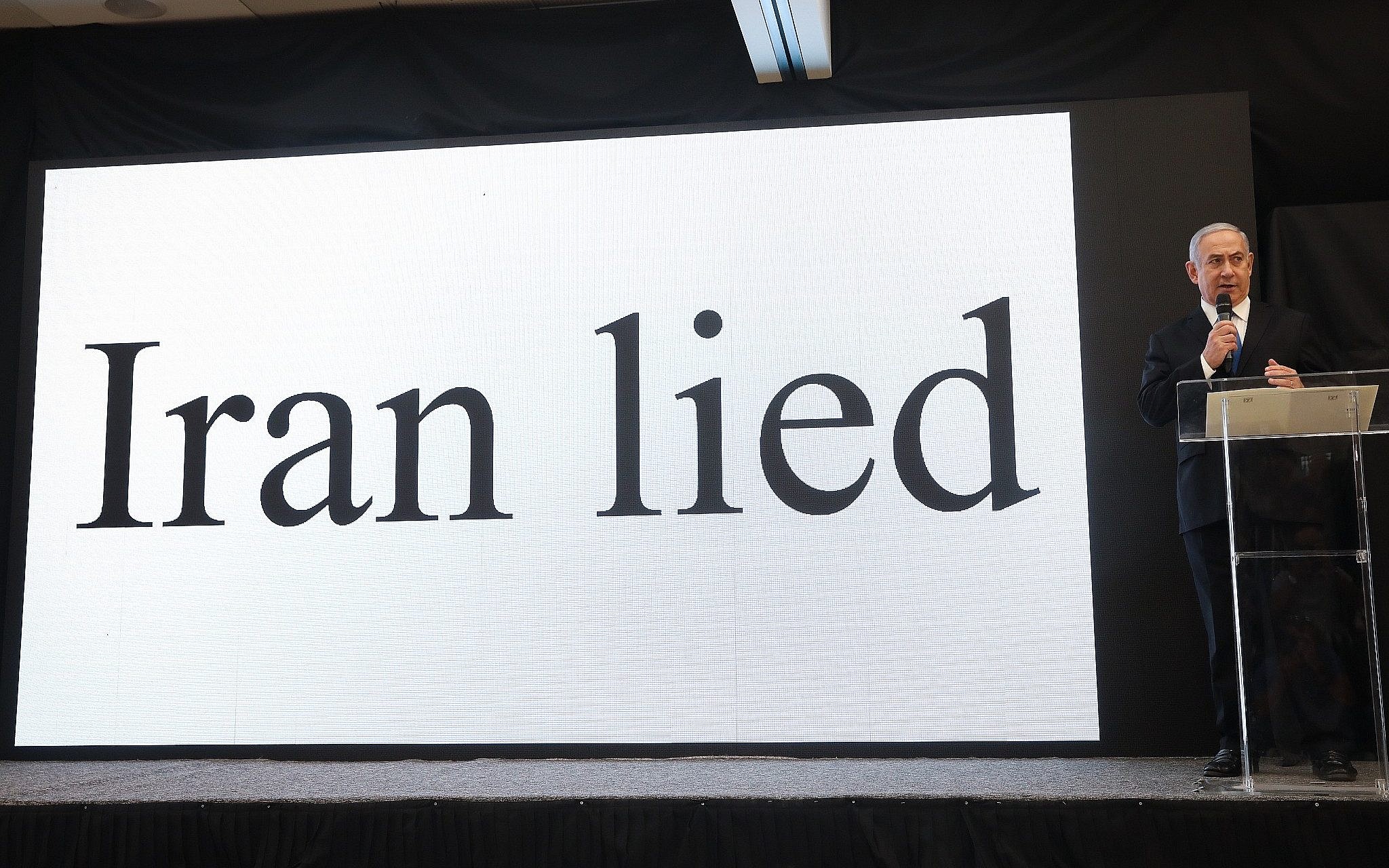
Prime Minister Benjamin Netanyahu gives a speech on files obtained by Israel he says prove Iran lied about its nuclear program, at the Defense Ministry in Tel Aviv, on April 30, 2018. (Miriam Alster/Flash90)
Netanyahu unveiled the trove at an April 2018 press conference, in which he called the operation “one of the greatest intelligence achievements in Israeli history” and proof that “Iran lied” when claiming that it is not seeking nuclear weapons.
Close to Netanyahu
Presented with criticism that he was too close to Netanyahu, and that he had allowed the prime minister to utilize this and other Mossad successes for his political needs, Cohen noted that at the April 2018 press conference, Netanyahu discussed the material, but he “didn’t discuss the operation.”
He said all of Israel’s security chiefs discussed, together with Netanyahu, the pros and cons of making the haul public, and none of them opposed it.
Reminded that his predecessor Tamir Pardo spoke out against “humiliating the enemy,” Cohen was adamant that exposing the intelligence material was the right decision and that Netanyahu acted with “professional integrity” in this and their other dealings.
“It was important to us that the world should see [the material],” said Cohen, who noted that he also personally briefed allied intelligence chiefs. And it was important “that it resonate with the Iranian leadership, to say to them, ‘Dear friends, 1, you’ve been penetrated; 2, we are watching you; 3 the era of hiding and lies is over.”
Among the other revelations in the interview, Cohen said he was inspired as a young man by the British secret service TV drama “Callan,” and that Callan was his initial Mossad codename. He later became known as “The Model” because of his well-groomed appearance. “My father taught me how to iron,” he noted.
Personal life
Cohen, 59, was recruited by Mossad at age 22 when studying overseas in London. He grew up Orthodox, and was one of the few Orthodox agents in the Mossad when he joined. He said he’d had “hundreds” of passports in his career, and recruited hundreds of assets. He described one recruit as a Hezbollah operative recruited in Europe who he said is still alive.
Married with four children, Cohen spoke briefly about his family, including his son Yonatan, who has cerebral palsy.
Appointed by Netanyahu in December 2015, he said he’d hoped to become Mossad chief “from the second day” he worked for the organization.
Questioned about his ties to several wealthy individuals, including US-Israeli Holywood mogul Arnon Milchan and the Australian tycoon James Packer, both of whom figure in one of the corruption cases against Netanyahu, he said that in retrospect, “you need to be more sensitive” regarding such ties.
He said a large gift by Packer for his daughter’s wedding was “being returned.” He denied it was as much as the reported $20,000, and said it had been approved by the Mossad’s attorney general. He said Milchan offered him millions to start a cyber business, and that he seriously considered it and might have accepted the job if he had not been appointed Mossad chief.
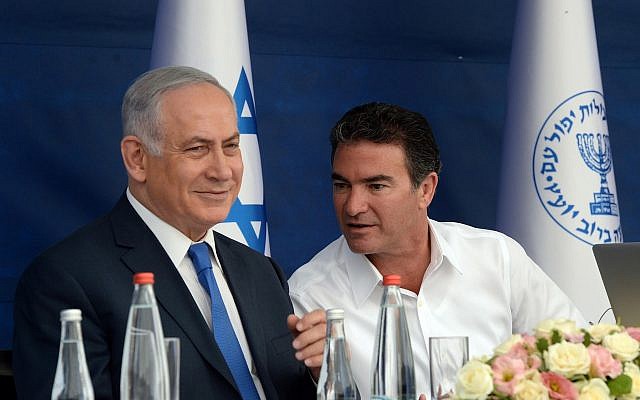
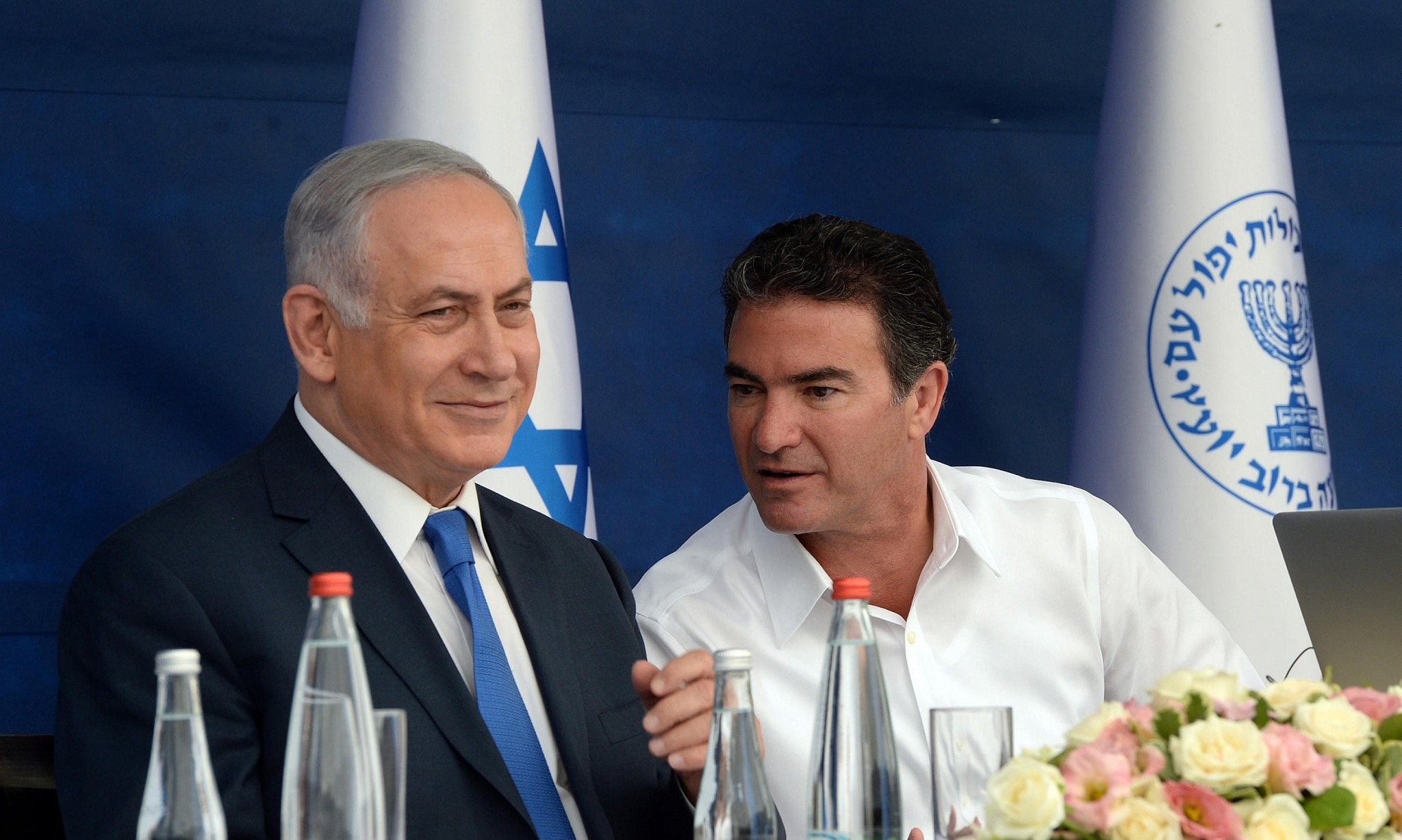
Prime Minister Benjamin Netanyahu (left) and Mossad head Yossi Cohen during a toast for the Jewish New Year on October 2, 2017. (Haim Zach/GPO)
He denied that Netanyahu ever asked him if he would personally “loyal” to him when he was considered for the top Mossad post. His rival for the job, codenamed “N.”, was reportedly asked such a question by Netanyahu and apparently failed to provide a satisfactory answer. Cohen also said he never discussed the post with Sara Netanyahu.
Of his relationship with Netanyahu, Cohen said: “I know I pay a price for my closeness to [Netanyahu]” and that “the relationship of trust I have with the prime minister are very useful for the Mossad’s operations and its development.” He denied allegations that he is so close to Netanyahu as to have compromised the Mossad’s independence. “I work for the highest purpose. I don’t work for the prime minister,” he said.
Relations with the UAE
Deeply involved in the shaping of Israel’s 2020 normalization agreements with the United Arab Emirates, Bahrain, Sudan and Morocco, he said forging ties with the UAE had required “defusing the obstacle” posed by Mossad’s assassination in a Dubai hotel room in 2010 of senior Hamas figure, Mahmoud al-Mabhouh, a Hamas arms importer also wanted by Israel for terrorism. “It was a mine we needed to defuse… It was on the table” when the UAE negotiations got going. “We dealt with it. We removed the obstacle,” he said.
“There are operations that are exposed, to our sorrow,” he said of incidents such as the Mabhouh hit. “When it’s exposed, it hurts, it’s unpleasant and it’s embarrassing.”
He denied helping Netanyahu politically by trying to arrange a pre-election trip to the UAE before the March 23, 2021 elections. “Mossad work plans are not remotely influenced by the political background,” he said. “I wish that visit had gone ahead; the king of Bahrain was supposed to come to — it was important to the State of Israel.”

Mossad chief Yossi Cohen (left) boards the plane to Washington for the Abraham Accords signing ceremony, late on September 13, 2020. The flags of Bahrain, the United Arab Emirates, the United States and Israel are seen either side of the steps. (Screenshot)
On one of his trips in the course of the so-called Abraham Accords negotiations, he said told his team during a flight, “We have a lot fewer enemies now — that’s a giant thing.” Dayan noted that his work had also involved contacts with the Saudis and many others.
Asked whether it was appropriate for the Mossad to be so dominant in Israeli foreign relations, Cohen replied, “The Mossad of 2021, if you’ll permit me, in my view, has to be everywhere.”
Wrong about Hamas
He said he was wrong to have backed and personally helped arrange the influx of hundreds of millions of dollars from Qatar into Gaza in recent years. He stressed that this money was not intended for tunnels and rockets, but to help Gaza’s civilians. He believed that if the lives of Gaza’s civilians were improved, he said, “the motivations for crises and wars would be reduced. “I was wrong,” he said.
He did not believe last month’s 11-day war with Hamas would erupt, for the same reason: “I thought we were in an ‘arrangement’” in which calm would be maintained.
Asked what he would miss most now that his Mossad career is over, Cohen said “the excitement at the completion of a successful operation — I won’t find anything like it.”

From right to left: Prime Minister Benjamin Netanyahu, new Mossad chief David Barnea and the intelligence’s agency’s outgoing leader Yossi Cohen on June 1, 2021. (Kobi Gideon/GPO)
Still, he added, “someone once said, ‘You only climb Everest once. You planted the flag, now you go down and seek out the next summit.”
Asked in that context whether he hopes to be prime minister, Cohen said, “not right now.”
But you’ve not ruled it out? “Correct,” he said.