
Israeli officials express concern following report of sale in Washington Post, amid fears move will dramatically enhance Tehran’s ability to track bases and targets in Israel


Russian President Vladimir Putin takes part in the launch of Gazprom's Amur Gas Processing Plant via videolink at the Novo-Ogaryovo residence outside Moscow, Russia, Wednesday, June 9, 2021. (Sergei Ilyin, Sputnik, Kremlin Pool Photo via AP)

Russian President Vladimir Putin takes part in the launch of Gazprom’s Amur Gas Processing Plant via videolink at the Novo-Ogaryovo residence outside Moscow, Russia, Wednesday, June 9, 2021. (Sergei Ilyin, Sputnik, Kremlin Pool Photo via AP)

Russian President Vladimir Putin on Friday denied a US media report that Moscow is set to deliver an advanced satellite system to Iran that will vastly improve its spying capabilities.

The Washington Post reported Thursday that Moscow is preparing to give Iran a Kanopus-V satellite with a high-resolution camera, allowing the Islamic Republic to monitor facilities of its adversaries across the Middle East.

Putin, who is expected to hear a range of complaints from US President Joe Biden when they meet Wednesday in Geneva, dismissed the report as “garbage.”

“We have cooperation plans with Iran, including the military and technical cooperation,” he told NBC News in an interview ahead of the summit.

“It’s just fake news. At the very least, I don’t know anything about this kind of thing, those who are speaking about it probably will maybe know more about it. It’s just nonsense, garbage.”

The launch of Iran’s newest satellite-carrier rocket, called ‘Zuljanah,’ at an undisclosed location, in Iran, on February 1, 2021. (Official Website of the Iranian Defense Ministry via AP)

Biden, who is on his first foreign tour since entering the White House, is expected to raise a slew of complaints with Putin including over election interference and hacking purportedly linked to Russia.

The Washington Post report said that while technically a civilian satellite, it would give Iran the ability to continuously monitor sites ranging from Israeli army facilities to US military bases to Saudi oil refineries, the officials said.

Meanwhile, Israeli security officials told the Kan public broadcaster that the country was very concerned.

The unnamed official said the move would be a major step up in technical ability for the Iranians, giving them “the unprecedented ability to surveil Israeli military bases, strategic sites, potential targets across the Middle East.”

The Post reported that the satellite would be supplied in the next few months and be launched by Russia.

A Middle Eastern official told the Post that the Kanopus-V would feature Russian hardware, including a camera with a resolution of 1.2 meters — a significant improvement over Iran’s current capabilities, though still far short of the quality achieved by US spy satellites or high-end commercial satellite imagery providers.

However, Iran would be able to “task” the new satellite to spy on locations of its choosing, and as often as it wished, the officials said.

“It’s not the best in the world, but it’s high-resolution and very good for military aims,” the Middle Eastern official told the Post. “This capability will allow Iran to maintain an accurate target bank, and to update that target bank within a few hours” every day.

The official also said that Iran would be able share the images with its terror proxies across the region, like Hezbollah in Lebanon, the Houthis in Yemen, and militias operating in Iraq.

Iran has stepped up its attempts at a satellite program in recent years. In April 2020 Iran’s Revolutionary Guard launched their first satellite into space, dramatically revealing what experts described as a secret military space program.
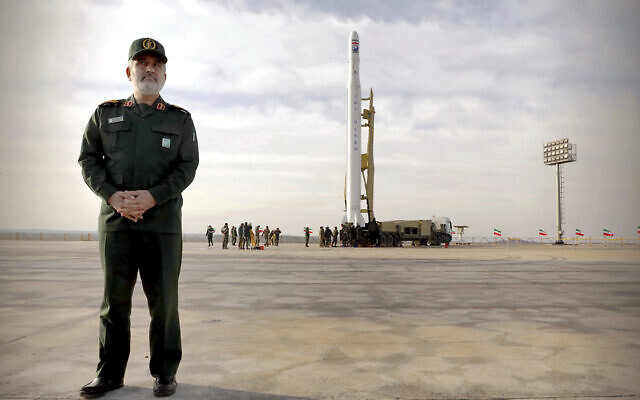
Gen. Amir Ali Hajizadeh, the head of the Revolutionary Guard’s aerospace division stands in front of an Iranian rocket carrying a satellite in an undisclosed site believed to be in Iran’s Semnan province, April 22, 2020. (Sepahnews via AP)

The Washington Post said that senior Revolutionary Guards officials have made multiple trips to Russia since 2018 to help negotiate the terms of the agreement to purchase the satellite, while Russian experts were in Iran to help train ground crews that would operate the satellite from a newly built facility near the northern city of Karaj.

The Guard, which operates its own military infrastructure parallel to Iran’s regular armed forces, is a hardline force answerable only to Supreme Leader Ayatollah Ali Khamenei.

The report comes as the US is involved in indirect talks with Tehran to reenter the Iran nuclear deal, and ahead of a meeting between US President Joe Biden and Russian leader Vladimir Putin.

In the past, the US and Israel have condemned Iran’s satellite efforts as defying a UN Security Council resolution calling on Iran to undertake no activity related to ballistic missiles capable of delivering nuclear weapons.

Kan said Israel hoped that the US would address the issue of the satellite in nuclear talks. Washington wanted to expand the deal to include controls over Tehran’s ballistic missile program too, something Iran rejects.

Iran, which long has said it does not seek nuclear weapons, previously maintained its satellite launches and rocket tests do not have a military component. The Guard launching its own satellite calls that into question.

Russia has also defended Iran’s right to launch satellites.

Months after the launch of the Noor, Russia defended Iran’s right to launch a satellite, dismissing US claims that Tehran was defying the UN resolution endorsing the 2015 nuclear deal between Iran and six major powers by sending it into space.

Russia’s UN ambassador, Vassily Nebenzia, said that “the ongoing attempts of the United States side to deprive Iran of the right to reap the benefits of peaceful space technology under false pretexts are a cause for serious concern and profound regret.”




On June 9, Fox News revealed unusual activity at the Sanjarian nuclear site in 25 miles outside the capital Tehran, Iran. According to new satellite images obtained from Maxar, there were 18 vehicles at the site on October 15, 2020. The Iranian government has used more vehicles and excavation in January along with a new access road that was later covered up in March.

Fox News mentioned that Iranian authorities had already practiced “shock wave generators,” which allow the government to miniaturize a nuclear weapon. The International Atomic Energy Agency (IAEA) had declared that Tehran halted the scientific program to build nuclear weapons in 2003.

Iranian Opposition Exposed the Sanjarian Nuclear Site in 2009

In a press conference in Paris, the Iranian opposition National Council of Resistance of Iran (NCRI) had exposed the site on September 24, 2009. At the time, the NCRI revealed that operated site is located in the Sanjarian village.

“The regime conducts scientific research at a site located in Tehran Pars district, called Metfaz. And this site produces the results of research. Residents of the Sanjarian village have special ID cards for communicating,” said Mehdi Abrishamchi, the NCRI Peace Commission chair, at the conference regarding the Iranian government’s attempts for producing nuclear weapons.

The NCRI’s September 24, 2009 revelation is one of a string of revelations by the Iranian Resistance since 2003, when the international community was taken aback by Tehran’s secret nuclear-bomb-making projects for the first time.

On May 7, 2019, David Albright, the IAEA’s Action Team associate (1992-1997) and the first non-governmental inspector of Iraq’s nuclear program, and Olli Heinonen, the IAEA’s operations director (1995-2005), published their joint research about Tehran’s nuclear activities.

“This site was first publicly identified in 2009 by the National Council of Resistance of Iran (NCRI), which called it the ‘Research Center for Explosion and Impact’ near Sanjarian, known under its Farsi language abbreviation METFAZ. The NCRI stated that this site was developing high-explosive detonators for use in atomic bombs and manufacturing components for these detonation systems,” they wrote.

The IAEA’ Questions About the Sanjarian Site Remain Unanswered

In the past two decades, the world powers tried time and again to contain Iran’s provocative nuclear projects. Instead, Tehran only responded with cheating and more concealing. For instance, Iranian authorities never declared their sites’ location or the quality of their activities before being revealed by the opposition or other counterparties.

For years, the ayatollahs had been refusing the UN nuclear watchdog access to their sensitive site. “Regarding Iran’s nuclear program, I provided a clear assessment since 2003 to 2009. In 2011, I raised 12 fields and said, ‘Iran should respond these questions,” said the late Yukio Amano, the former IAEA director-general in May 2019.

The first question was about producing detonation for the nuclear explosion, which was applied at the Sanjarian site, with alias Nourabad. The IAEA asked Tehran about developing detonations, in clause C-5, and beginning tests of severe explosions and relevant experiments, in clause C-6.

At the June 7 convention of the IAEA Board of Governors, the IAEA director-general Rafael Grossi once again declared his frustration towards Iran’s secrecy. “The lack of progress in clarifying the agency’s questions concerning the correctness and completeness of Iran’s safeguards declarations seriously affects the ability of the IAEA to provide assurance of the peaceful nature of Iran’s nuclear program,” said Grossi at the meeting.

Just like his predecessor, Grossi expressed alarm that after many months, the Iranian regime has not provided the necessary explanation for the presence of the nuclear material particles at any of the three locations where the agency has conducted complementary accesses.

“In the absence of such an explanation from Iran, I am deeply concerned that nuclear material has been present at the three undeclared locations in Iran and that the current locations of this nuclear material are not known by the agency. Nor has Iran answered the questions with regard to the other undeclared location or clarified the current location of natural uranium in the form of a metal disc,” he said.

U.S. and Eu Negotiators’ Frustration Over the JCPOA

Tehran’s contradictory behavior has also disappointed U.S. and EU negotiators. In his Presidential campaign, U.S. President Joe Biden had vowed that he would rejoin the 2015 Iran nuclear deal, formally known as the Joint Comprehensive Plan of Action (JCPOA).

However, Tehran still renounces direct talks with the U.S. and avoids full compliances with the JCPOA. Aside from uranium traces in some sites, Tehran recently acknowledged the enrichment of uranium up to 60-percent fissile purity.

“We have a country that has a very developed and ambitious nuclear program, which is enriching at very high levels, enriching uranium at very high levels, very close to weapons-grade,” Grossi said.

Ayatollahs Understand the Language of Firmness

“It remains unclear whether Iran is willing and prepared to do what it needs to do come back into compliance,” Reuters quoted U.S. Secretary of State Antony Blinken as saying on June 7. “Meanwhile, its program is galloping forward…. The longer this goes on, the more the breakout time gets down.”

In such circumstances, the international community faces a complicated situation regarding Tehran’s nuclear ambitions. On the one hand, Tehran seemingly intends to keep negotiations in a limbo, and it still continues provoking attempts for achieving nuclear weapons on the other hand.

“To guarantee its survival, the clerical regime has not abandoned its atomic bomb project,” said NCRI President-elect Maryam Rajavi on June 7. The recent IAEA report “also shows that to buy time, the regime has continued its policy of secrecy to mislead the international community. At the same time, the regime is blackmailing its foreign interlocutors into lifting sanctions and ignoring its missile programs, export of terrorism, and criminal meddling in the region.”


Mohsen Rezaei suggests trading American hostages for billions of dollars to fix Iran’s ailing

Dan Verbin, Canada , Jun 11 , 2021 8:21 PM


Iran

Iran

iStock

Mohsen Rezaei, a conservative candidate for the Iranian Presidency, said in a recent interview that his plan to boost the country’s ailing economy was to kidnap 1,000 Americans and demand several million dollars in ransom per hostage.

Iranian journalist and activist Masih Alinejad posted a video of Rezaei’s statement to Twitter.

“This is surreal. Mohsen Rezaei candidate for Iran presidential elections said he’d take 1000 more American hostages to boost iran’s economy. For every hostage he’d ask several (million dollars) as a solution to Iran’s failing economy,” she tweeted along with the hashtags #IraniansBoycottElections and #NotVotingForIR.

In the video, an anchor said in Farsi, “So he’d take hostages to extort money.”

The video cuts to a clip Rezaei who said, “We’ll take 1,000 Americans hostage. America will have to pay several billions to get every single one freed.”

“This is how we can solve our economic problems,” he added.

Rezaei was described by Saeid Jafari writing for the Atlantic Council as a “perpetual candidate” for the presidency.

He first ran for president in 2005. He also ran in 2009 and 2013.

Reza was the Iranian Republican Guard Corps commander-in-chief for 17 years.

In February, 2020, he said that Iran was looking for an excuse to destroy Tel Aviv as payback for the “martyrdom” of Revolutionary Guards Quds Force commander Qassem Soleimani, alleging Israeli involvement.

(Arutz Sheva’s North American desk is keeping you updated until the start of Shabbat in New York. The time posted automatically on all Arutz Sheva articles, however, is Israeli time.)
