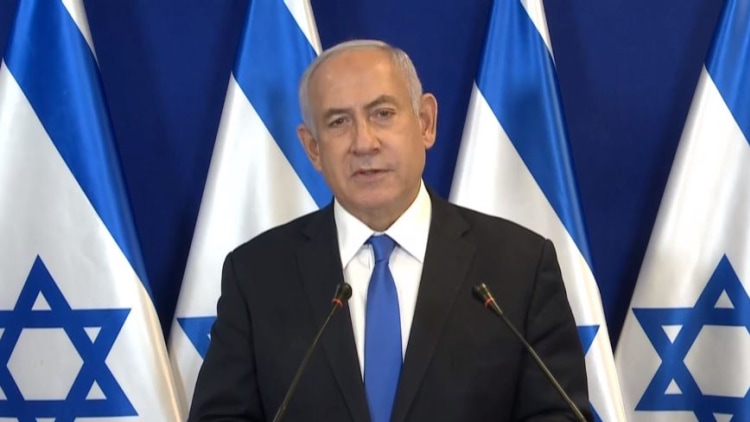
HAMAS THRIVES ON DESPAIR, ON MISERY, ON DESPERATION’

Top US diplomat indicates plans for active US involvement in region after 11-day conflict while stressing administration’s support for two-state solution
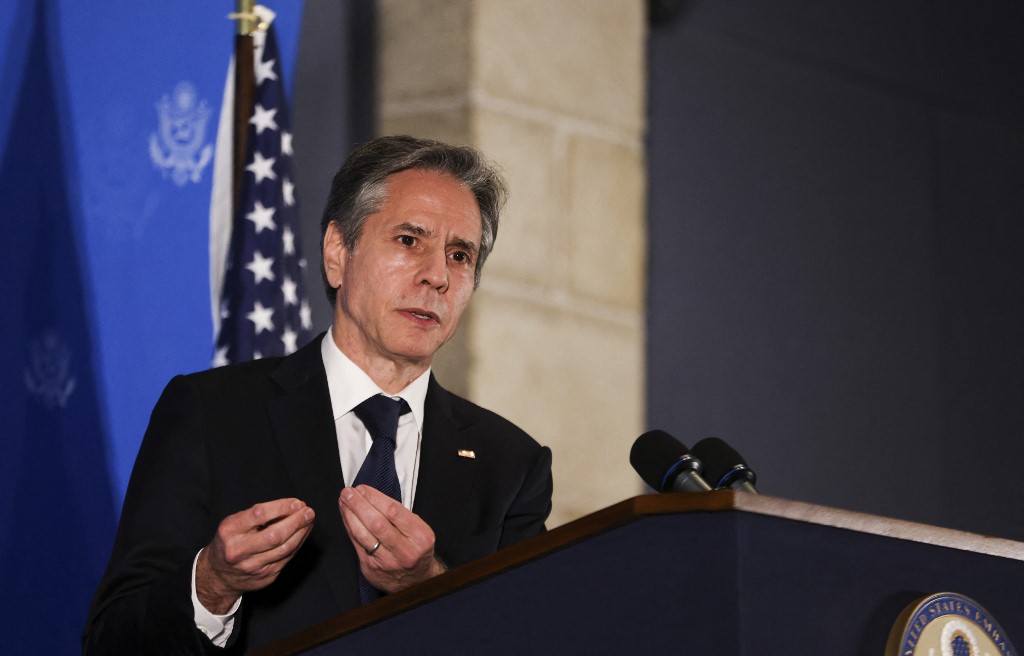
US Secretary of State Antony Blinken addresses the media in Jerusalem on May 25, 2021. (RONEN ZVULUN / POOL / AFP)

US Secretary of State Antony Blinken addresses the media in Jerusalem on May 25, 2021. (RONEN ZVULUN / POOL / AFP)

In the wake of the recent conflict in Gaza and unrest in Jerusalem, the United States plans to focus on addressing “the underlying causes” that could spark yet another round of violence, US Secretary of State Antony Blinken said Tuesday evening.

Speaking at a press conference in central Jerusalem, Blinken indicated that the Biden administration will be actively involved in the Israeli-Palestinian conflict, echoing comments he made earlier in the day during a meeting with Prime Minister Benjamin Netanyahu.

“America’s words matter, America’s actions matter, America’s engagement matters,” he stressed.

Blinken is the highest-level American official to visit Israel since US President Joe Biden entered office in January.

He met with top Israeli officials Tuesday — including Netanyahu, Foreign Minister Gabi Ashkenazi and Defense Minister Benny Gantz — before heading to Ramallah for high-level meetings with Palestinian Authority leaders, including Palestinian Authority President Mahmoud Abbas.

Prime Minister Benjamin Netanyahu (R) and US Secretary of State Antony Blinken arrive for a joint press conference in Jerusalem on May 25, 2021. (Menahem Kahana/AFP)

The top US diplomat argued that rebuilding Gaza and improving conditions in the Strip will weaken Hamas, the terror group that rules the coastal territory.

“If we do this right, reconstruction and then relief for the people of Gaza — far from empowering Hamas — has the potential to undermine it,” Blinken said. “Hamas thrives, unfortunately, on despair, on misery, on desperation, on a lack of opportunity.”

America’s goal is to “give the Palestinian people, including those in Gaza, a renewed sense of confidence, of optimism, of real opportunity,” Blinken said. “If we are able to do that together, then Hamas’s foothold in Gaza will slip. We know that, and I think Hamas knows that.”

People clean the streets of debris beside a building  following a cease-fire reached after an 11-day war between Hamas and Israel, in Gaza City, May 21, 2021. (AP Photo/John Minchillo)

Blinken said earlier in the day that the Biden administration will ask Congress to approve $75 million in aid to the Palestinians.

Humanitarian aid and reconstruction  could put efforts for a two-state solution back on track, Blinken said, calling it “the only way to truly ensure Israel’s future as a Jewish and democratic state, and to give the Palestinians the state they’re entitled to.”

“Leaders on both sides will need to chart a better course, starting by making real improvement in the lives of people in Israel, Gaza and the West Bank,” he said.

Blinken was noncommittal regarding a timeline for the re-opening of a US consulate in Jerusalem that serves the needs of Palestinians in the West Bank and East Jerusalem. But he stressed the importance of having “that platform to be able to more effectively engage not just the Palestinian Authority, but Palestinians from different walks of life.”

Blinken also stressed the “critical role” played by Egypt in brokering the Gaza ceasefire, and called Jordan “a voice for peace and stability in the region.”

Blinken will visit Egypt and Jordan Wednesday after meeting with opposition leader Yair Lapid and President Reuven Rivlin.

Foreign Minister Gabi Ashkenazi (R) shakes hands with US Secretary of State Antony Blinken before their meeting in Jerusalem on May 25, 2021, days after an Egypt-brokered truce halted fighting between Israel and Hamas. (Alex Brandon / POOL / AFP)

Blinken laid out four objectives for his trip: to demonstrate the commitment of the United States to Israel’s security; to work to reduce tensions in the West Bank and Jerusalem; to support reconstruction in Gaza; and to rebuild the US relationship with the Palestinian Authority and the Palestinian people.

Blinken spoke of conversations with two local State Department staff: one Israeli from the Gaza periphery area, and one Palestinian from the Strip. “Both recounted how the violence in recent weeks repeatedly forced them and their families to take cover. Both feared they would be killed.”

Turning to the talks in Vienna on the return of the US and Iran to the 2015 nuclear deal, Blinken emphasized that “the United States and Israel are absolutely united in the proposition that Iran must never be allowed to acquire a nuclear weapon.”

“We share exactly the same goal. It’s no secret that sometimes we have differences about the best way to achieve that goal.”


In a throwback to the days of the Cold War, the Russian swing-wing bombers will fly maritime missions in NATO’s “backyard.”

Tu-22M3 in SyriaRUSSIAN MINISTRY OF DEFENSE SCREENCAP

Russia has officially confirmed that Tu-22M3 Backfire-C bombers are now at Khmeimim airbase in Syria, as we reported yesterday. The Russian Ministry of Defense has also now stated that they will operate in a maritime role over the Mediterranean Sea, reflecting Russia’s expanding reach in the region and suggesting a return to the kinds of missions that Soviet bombers flew in the Cold War, when they kept track of NATO warships operating in the area.

We now know that three Tu-22M3s touched down at Khmeimim yesterday, making use of the extended second runway at the base, which has been resurfaced and outfitted with new lighting and communications equipment. The base, as The War Zone predicted earlier this year, is now better able to support operations by all three of Russia’s bombers — the others being the Tu-95MS and Tu-160 — as well as heavy transport and maritime patrol aircraft.

RUSSIAN MINISTRY OF DEFENSE SCREENCAP

Crew disembark from a Tu-22M3 bomber after landing at Khmeimim Air Base.

“Crews of the long-range bombers will acquire practical skills in practicing training tasks in new geographic areas during flights in the airspace over the Mediterranean Sea,” a statement from the Russian Ministry of Defense declared, although there were no details about the duration of the deployment or whether the Tu-22M3 will become a more regular visitor to the Syrian base.

“After completing training tasks for the development of airspace in the maritime zone of the Mediterranean Sea, the long-range bombers will return to permanent airfields on the territory of the Russian Federation,” the statement adds. According to independent defense analyst Guy Plopsky, the individual bombers have been drawn from Russian Aerospace Forces, or VKS, bases at Shaykovka, in western Russia, and Belaya, in the Russian Far East.

Clearly, positioning even a handful of long-range bombers at Khmeimim provides Russia with a significant force-projection capability around the Mediterranean and not just in Syria, where these bombers have been used in combat in the past. Based on the unrefueled range of a typical, armed Tu-22M3, targets within the Black Sea are also within reach, as is Libya, where Russia is also involved in an ongoing civil war, and the basing provides added reach across northeastern Africa and the Middle East, as well.

PHOTO © 2021 PLANET LABS INC. ALL RIGHTS RESERVED. REPRINTED BY PERMISSION

A satellite image of Khmeimim Air Base on the morning of May 24, 2021. The extended second runway is visible at the top of the picture.

As well as being embroiled in the Libyan crisis, Russia has also been looking to expand its activities, and physical presence, elsewhere in Africa, especially. That has included plans to establish a Russian naval logistics and support base in Sudan in the east of the continent. More recently this effort was reportedly suspended, although Moscow has disputed this.

Notably, the three bombers at Khmeimim are not capable of inflight refueling, which would be of tremendous utility when operating in this theater. However, the refueling probe, deleted from the Backfire under the START I (Strategic Arms Reduction Treaty) regulations, is reportedly now being reinstated in the wide-ranging Tu-22M3M upgrade.

GOOGLE EARTH / WWW.SCOTTMURRAY.ME

A graphic showing the typical unrefueled range of a Tu-22M3, armed with a single anti-ship missile, operating from Khmeimim. The mission profile includes portions of the mission at high altitude, plus some supersonic flight.

Even so, the confirmation of a primary maritime tasking is also significant, as it provides Russia with additional offensive capabilities against NATO surface vessels in the region, as well as ports, airbases, and other coastal infrastructure.

A tweet showing a purported flight track of a Tu-22M3, said to be conducting its first training mission from Khmeimim, on May 25:

During the Cold War, approximately half of the Backfire fleet was assigned to Soviet Naval Aviation, but since 2011 all surviving aircraft have been operated by the Russian Air Force, today known as the VKS.

The switch to maritime training in the Mediterranean suggests that the VKS is now working to reinstate at least something of this Cold War-era capability. In many ways, the Tu-22M3 is better suited to anti-shipping strike and other offensive maritime missions than aerial bombing sorties over land. As we have discussed before, its weapons options against ground targets are limited to unguided ordnance, albeit some aircraft being upgraded with the SVP-24-22 navigation/attack system that improves accuracy when using ‘dumb’ bombs.

In its maritime role, the primary weapon of the Tu-22M3 was traditionally the Kh-22 standoff missile, known in the West as the AS-4 Kitchen. This is a huge, delta-winged weapon now carried exclusively by the Backfire. The first of these missiles were completed as long ago as 1962. The 38-foot Kh-22 is powered by a liquid-fuel rocket that propels it to a speed of over Mach 4 for the terminal run-in to the target.

PAVEL ADZHIGILDAEV/WIKIMEDIA COMMONS

A Kh-22 missile preserved on a former Ukrainian Air Force Tu-22M3.

The Kh-22 is available with an active radar seeker for attacking warships. There is also a version that combines radar with Doppler navigation that is used to attack stationary targets on land, such as airfields or harbors. The missiles carries either a nuclear warhead or an optional high-explosive charge, the conventional version being limited to the anti-ship version. Each weapon weighs around 12,000 pounds and the Tu-22M3 normally carries one or two, although three can theoretically be fitted. Maximum range after launch from high altitude is over 300 miles, reduced to around 200 miles when launched from lower altitude.

The successor to the Kh-22, again only available to the Tu-22M3, is the Kh-32, which appears outwardly similar to the earlier missile. This weapon has improvements to the motor, control system, and a different flight profile, providing a range of over 500 miles. Some reports suggest this missile is available only as an anti-ship weapon. Work to introduce the Kh-32 to the Tu-22M3 has been ongoing for some time now, with the bombers gradually being equipped to utilize the new weapons.

The anti-ship mission could well take on an additional resonance if the bombers are still stationed at Khmeimim when the Royal Navy’s Carrier Strike Group 21 (CSG21) maritime task force arrives in the Mediterranean as planned. The centerpiece of this is the aircraft carrier HMS Queen Elizabeth, making its first operational deployment. The carrier sailed from its homeport on May 22 and its embarked F-35B stealth fighters are slated to conduct combat operations over the Middle East. The presence of supersonic-capable Russian bombers, armed with powerful anti-ship missiles, could alter limited aspects of that deployment.

The latest Backfire mission continues Moscow’s pattern of stationing long-range bombers at airfields outside Russia, with previous deployments to Venezuela and South Africa, albeit both on a short-term basis. The move is a significant development for Russia geopolitically, as well as underscoring why Moscow has spent so much effort propping up the Syrian dictator Bashar Al Assad. However the Tu-22M3s are ultimately used from their Syrian staging post, the deployment provides evidence that Russia is keen to once again wield long-range airpower in the Mediterranean region and potentially provide another means of holding NATO targets in Europe at risk.

Contact the author: thomas@thedrive.com


In unusually stark remarks, PM says he appreciates US friendship, but there could be a situation where Tehran’s nuclear threat necessitates ‘brave and independent decisions’


Israeli Prime Minister Benjamin Netanyahu in a televised address, May 15, 2021. (GPO)

Israeli Prime Minister Benjamin Netanyahu in a televised address, May 15, 2021. (GPO)

On the eve of US Secretary of State Antony Blinken’s first visit to Israel and neighboring countries, Prime Minister Benjamin Netanyahu made unusually tough remarks regarding Iran, including hinting that Jerusalem could take military action against the Islamic Republic’s nuclear sites without Washington’s okay.

In a ceremony marking the appointment of incoming Mossad chief David Barnea, and with many Mossad members in attendance, Netanyahu said: “The first task of each one of you is to prevent Iran from arming itself with nuclear weapons.”

“I very much appreciate our friend the United States, which has been standing by our side for many years. That’s an integral part of our national security,” Netanyahu continued.

“But there could be a situation in which our highest goal — to guarantee that the ayatollahs don’t end the thousands of years of existence of the Jewish people — will require us to take brave and independent decisions,” the premier said.

“In any event — with or without a deal — we will do everything to deny Iran nuclear weapons, because this concerns our very existence.”

Prime Minister Benjamin Netanyahu, center, outgoing Mossad director Yossi Cohen, right, and incoming director David Barnea at a ceremony conferring the Prime Minister’s Award on exception Mossad agents, May 24, 2021. (Amos Ben Gershom/GPO)

Global powers have been meeting in Vienna since early April in a bid to bring Washington back to the 2015 nuclear deal with Tehran, which the US left in 2018.

The withdrawal under then-US president Donald Trump and the reimposition of sanctions has led Iran to step up its nuclear activities.

Iran’s parliament speaker said Sunday that international inspectors may no longer access surveillance images of the Islamic Republic’s nuclear sites, escalating tensions.

Over a year ago, a US drone strike killed a top Iranian general, prompting Tehran to later launch ballistic missiles that wounded dozens of American troops in Iraq.

A mysterious explosion also struck Iran’s Natanz nuclear facility, which Iran has described as sabotage and blamed on Israel. In November, Iranian scientist Mohsen Fakhrizadeh, who founded the country’s military nuclear program some two decades earlier, was killed in an attack Tehran also blames on Israel.

US Secretary of State Antony Blinken waves as he boards a plane on May 24, 2021, at Andrews Air Force Base, Maryland, en route to the Middle East. (AP Photo/Alex Brandon, Pool)

Blinken was heading to Israel Monday for his first trip to the region as US secretary of state, days after Washington helped broker a ceasefire that brought an end to the most significant escalation of violence between Israel and Hamas in seven years.

The goals of the three-day trip — which will also include stops in Ramallah, Cairo and Amman — will be to ensure that the ceasefire between Israel and Gaza terror groups holds while also pushing steps that will improve the quality of life for both sides in the absence of immediate peace talks to end the Israeli-Palestinian conflict, a senior State Department official told reporters in a phone briefing ahead of Blinken’s takeoff.

The secretary will also work with the parties to help kickstart efforts to rehabilitate Gaza, while preventing international aid from reaching the enclave’s ruling Hamas terror group, the official added.

In Israel, Blinken will meet with Prime Minister Benjamin Netanyahu, President Reuven Rivlin, Foreign Minister Gabi Ashkenazi, and other senior Israeli officials, discussing the Biden administration’s “ironclad commitment to Israel’s security,” the White House said in a statement.

Jacob Magid contributed to this report.