
“I don’t think we’re in a place where getting to some kind of a negotiation for what ultimately, I think, has to be the result, which is a two-state solution, is the first order of business.”
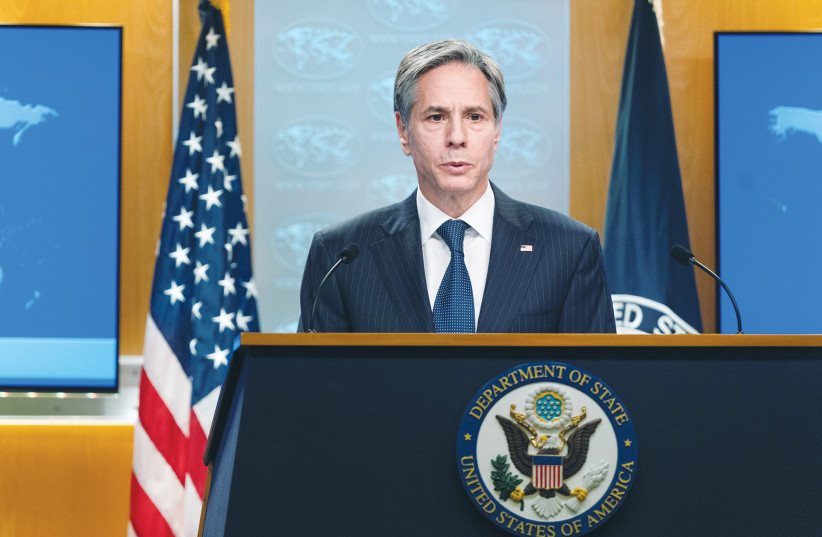
US SECRETARY of State Antony Blinken speaks during a news conference at the State Department last month.  (photo credit: MANUEL BALCE CENETA/REUTERS)
US SECRETARY of State Antony Blinken speaks during a news conference at the State Department last month.
(photo credit: MANUEL BALCE CENETA/REUTERS)
 The United States does not plan to jump start negotiations for a two-state solution at this time, Secretary of State Antony Blinken told CNN on Sunday morning.

“I don’t think we’re in a place where getting to some kind of a negotiation for what ultimately, I think, has to be the result, which is a two-state solution, is the first order of business,” Blinken told CNN’s Fareed Zakaria.
In the aftermath of the IDF-Hamas ceasefire that brought an end to the 11-day Gaza war, US President Joe Biden has spoken strongly about the need for peace and a two-state resolution to the Israeli-Palestinian conflict.
“We still need a two-state solution,” Biden told reporters on Friday. “It is the only answer. The only answer.”
Unlike his predecessor Donald Trump, Biden did not enter the White Houses in January with a pledge to put forward a plan to resolve the Israeli-Palestinian conflict.
But the brief IDF-Hamas war raised speculation that he might have reconsidered that option.
“Is there really a prospect of some kind of movement toward a genuine political solution?” Zakaria asked?
“I think there has to be,” Blinken said. “I think both sides are reminded that we have to find a way to break the cycle, because if we don’t, it will repeat itself at great cost and at great human suffering on all sides.”
He clarified, however, that at this time the focus was on rebuilding Gaza and trying to put in place conditions that would allow for a genuine peace process.  “But that is not the immediate order of business,” Blinken said.
When asked if he would revive Trump’s peace plan for a two-state solution, Blinken gave a neutral answer.
“We’re going to look at everything that’s been done before, learn from that just as we have in other areas, and see what makes sense and what doesn’t,” Blinken said. “But our focus right now relentlessly is on dealing with the humanitarian situation, to do reconstruction and rebuild, and engage intensely with everyone, with Palestinians, with Israelis, with partners in the region.”
European Union foreign policy chief Josep Borrell, said that the international community could not afford to place the peace process on the back-burner.
“Now that there is a truce in place, some might be tempted to ‘move on’ and leave aside the underlying causes of the conflict,” Borrelll wrote in a blog he posted on Friday. “This would most likely lead to new cycles of violence that will only further strengthen extremists. We must do all we can to find that narrow political pathway: to return to meaningful negotiations for a two-state solution.”
He added that he planned to work toward the resumption of an Israeli-Palestinian peace process, the last such process ending in 2014.
Borrell said he planned to speak with all the relevant parties, including the Middle East Quartet made of up of the US, the UN, the EU and Russia.
“I will do all I can to try to re-open the space for negotiations and develop confidence-building measures,” Borrell said.


Iran reports explosion at plant that reportedly produces UAVs

At least 9 injured in blast at Sepahan Nargostar Chemical Industries; Netanyahu on Thursday said explosive drone downed by IDF was launched by Iran


Illustrative. Iranian Revolutionary Guard Commander Gen. Hossein Salami, left, and the Guard's aerospace division commander Gen. Amir Ali Hajizadeh talk while unveiling a new drone called "Gaza" in an undisclosed location in Iran, in a photo released on May 22, 2021. (Sepahnews of the Iranian Revolutionary Guard, via AP)

Illustrative. Iranian Revolutionary Guard Commander Gen. Hossein Salami, left, and the Guard’s aerospace division commander Gen. Amir Ali Hajizadeh talk while unveiling a new drone called “Gaza” in an undisclosed location in Iran, in a photo released on May 22, 2021. (Sepahnews of the Iranian Revolutionary Guard, via AP)

At least nine people were injured in a blast on Sunday at a plant producing explosive materials in Iran’s central province of Isfahan, ISNA news agency reported.

The blast occurred at Sepahan Nargostar Chemical Industries at 4 a.m. local time (2330 GMT) due to “unclear reasons still being investigated,” said Mansour Shisheforoush, head of the province’s crisis management organization.

Nine factory workers were injured and transferred to the hospital, he added.

He said several investigative teams were at the scene to determine the cause of the blast.

The plant is located about 45 kilometers (just under 30 miles) northwest of Isfahan city.

The company manufactures “industrial-commercial explosive materials” and was established in 1941, according to its website.

According to The Guardian, the plant produces drones.

The blast comes days after Prime Minister Benjamin Netanyahu on Thursday said a drone downed by the Israel Defense Forces earlier this week was launched by Iran and was armed with explosives. According to the premier, the drone was made by Iran and launched by Iranian forces toward Israel from either Syria or Iraq.

Netanyahu accused Iran of providing support and technical assistance to terror groups throughout the Middle East, including the Palestinian Islamic Jihad, which receives most of its funding from Tehran, as well as Hamas, which also gets weapons and other help from the Islamic Republic.

Iran’s Revolutionary Guards on Friday unveiled a new combat drone dubbed “Gaza” in a tribute to Palestinians, the force’s official website reported, hours after a ceasefire between Israel and Palestinian terror groups took effect. It was not immediately clear where the drone was manufactured.

The drone was named as “an eternal honor for those who today in (Gaza) stand against the Zionists’ invasion and aggression,” Guards commander Major General Hossein Salami said at the unveiling event, quoted by Sepah News.


Blinken reaffirms two-state support ahead of Mideast tour

Top US diplomat emphasizes need for major reconstruction in Gaza, insists ‘trusted, independent parties’ can ensure aid to Gaza doesn’t go to Hamas


US Defense Secretary Lloyd Austin, left, speaks as US Secretary of State Antony Blinken looks on during their meeting with South Korean President Moon Jae-in at the Presidential Blue House in Seoul, South Korea, March 18, 2021. (Kim Hong-Ji/Pool Photo via AP)

US Defense Secretary Lloyd Austin, left, speaks as US Secretary of State Antony Blinken looks on during their meeting with South Korean President Moon Jae-in at the Presidential Blue House in Seoul, South Korea, March 18, 2021. (Kim Hong-Ji/Pool Photo via AP)

WASHINGTON — US Secretary of State Antony Blinken, speaking ahead of a trip to the Middle East, reaffirmed on Sunday US support for a two-state solution as the only way to provide hope to Israelis and Palestinians that they can live “with equal measures of security, of peace and dignity.”

His remarks came two days after Israel and Hamas agreed to a ceasefire, halting 11 days of Hamas rocket bombardment on Israel and Israeli retaliatory airstrikes that killed more than 200 Gazans and 13 people on the Israeli side.

“If there isn’t positive change, and particularly if we can’t find a way to help Palestinians live with more — with more dignity and with more hope — this cycle is likely to repeat itself, and that is in no one’s interest,” Blinken said on ABC’s “This Week.”

The State Department announced Thursday that Blinken will travel to the Middle East “in the coming days,” with plans to meet with Israeli, Palestinian, and regional counterparts.

US President Joe Biden (C), flanked by US Secretary of State Antony Blinken (L) and others participate in an expanded bilateral meeting with South Korean President Moon Jae-in (out of frame) in the State Dining Room of the White House in Washington, DC, May 21, 2021. (Brendan Smialowski/ AFP)

Blinken’s support for a two-state solution — the vision of Israel and a Palestinian state living peacefully side by side — restates a long-time US goal, though he conceded that this was not “necessarily for today.”

But his remarks about “equal measures” for Israelis and Palestinians seemed to shift the tone, at least, from Donald Trump’s administration, which cut aid to the Palestinian Authority and issued a Middle East peace plan with strong Israeli backing, but no support from Palestinians.

The top US diplomat emphasized the need to provide humanitarian aid to Palestinians while beginning a major effort at reconstruction.

‘Something more positive’

Saying the ceasefire would help mark a pivot from violence to “something more positive,” he added, “That has to start now with dealing with the grave humanitarian situation in Gaza.

“Then reconstruction, rebuilding what’s been lost, and critically, engaging both sides in trying to start to make real improvements” in people’s lives.

A Palestinian policeman walks on the rubble of Arafat City, Gaza’s Hamas police headquarters in Gaza City on May 22, 2021. (Emmanuel DUNAND / AFP)

He was asked on ABC how the Biden administration could ensure that aid would go to ordinary Palestinians and not help the Hamas terror group, which launched thousands of rockets at Israel.

“We’ve worked in the past and we continue to work with trusted, independent parties that can help do the reconstruction and the development, not some quasi-government authority,” he said.

“The real challenge here is to help the Palestinians and particularly to help the Palestinian Authority deliver better results for their people, and of course, Israel has a profound role to play in that too.”

Israel’s response to the Hamas rocket barrages has drawn sharp criticism from some liberal members of the US Congress who have questioned American arms sales to the Jewish state.

Asked about that, Blinken replied, “The president has been clear we’re committed to giving Israel the means to defend itself… At the same time, any arms sale will be done in full consultation in Congress.”
