
Jerusalem and the Trap Hamas Laid for Jordan and the PA

MAY 23, 2021 3:53 AM

by David Wurmser / JNS.org

OPINION

Thousands of Muslims perform Eid prayers at the Al Aqsa Mosque, in Jerusalem’s Old City, marking the muslim holiday of Eid al-Adha on September 12, 2016. Photo: Sliman Khader/Flash90.

JNS.org – President Biden last Thursday evening claimed credit for brokering a ceasefire between Israel and Hamas, saying: “I want to also thank the secretary of state, the secretary of defense, our national security adviser, and everyone on our team for their incredible efforts to bring this about, this outcome that we’re about to see.” There is no doubt that the president is to be granted his due by the media and his allies, but it may well be that he will soon come to wish he hadn’t attached so much of his reputation to it. Indeed, the ceasefire may enable Hamas not only to assert its dominance over the Palestinian Authority, but also to threaten and potentially even unravel the Jordan-Israeli peace treaty using the issue of Jerusalem.

Jordan already felt the heat as the war was ending. Just before the ceasefire took effect, the King of Jordan’s court released a tweet that noted that King Abdullah II had received a phone call from US Vice President Kamala Harris, and the two “affirm the need to continue all efforts to stop the Israeli escalations in East #Jerusalem and the aggression on Gaza.” It is dubious that Harris used such loaded language to describe Israeli moves, but the king tends to weigh in in inflated terms on Palestinian issues because he believes he can co-opt them and thus neutralize the threat they can pose. But the statement issued by the King of Jordan following his call with Harris is very troubling because this is not something that can be co-opted, defanged, and domesticated.

At the end of the ceasefire, Hamas issued the claim that Israel had yielded on Jerusalem issues and surrendered both the Temple Mount and Jerusalem’s Sheikh Jarrah neighborhood. It would be a grave mistake to simply dismiss this as face-saving rhetoric. Indeed, we, Jordan, and Israel are walking into an extremely dangerous trap on Jerusalem that Hamas has laid in the framework of this ceasefire.

Israel denies it ever agreed to such a devastating concession, and yet, it does not matter whether Hamas is telling the truth. The fact is, since the rioting escalated to the Temple Mount surrounding the Muslim holiday of Laylat al-Qadr two weeks ago, the Israeli government has barred any Jew from setting foot on the Temple Mount. It did so as a temporary tactical move to calm unnecessary tensions. However, the war is now over, which means in the coming days, Israel will have to make a decision as to whether it will lift that ban. If it does lift the ban, Jews will again be able to go to the Temple Mount, at which point Hamas will ensure that there will be violence so that it maintains and emphasizes its control of events.

That event will represent an immediate escalation, and Jordan will be unable to take a neutral position given the cul-de-sac into which it has rhetorically maneuvered itself. The resulting violence Hamas will instigate now that it has such immense currency on the Palestinian street will not only threaten the survival of the Palestinian Authority, but it could even reverberate enough to destabilize the Hashemite monarchy in Jordan.

On the other hand, if Israel buckles to avoid escalation and continues to bar Jews from the Temple Mount after the ceasefire, then it creates a de facto new status quo that cannot be reversed and will quickly become permanent. This would give Hamas a devastating victory over not only Israel, but over the Jewish people, ripping a hole in the soul of the nation. The political power Hamas would gain from this would make it at any rate master of both the PA and Jordan, which so unwisely laid down a stake on this issue rather than try to ride it out with as low a profile as possible.

The historical record of this particular king with regard to his ability to escape this trap is not encouraging, since he has thus far displayed neither the political nor geopolitical skills to navigate previous crises elegantly without threatening the stability of his throne. As such, there is little hope that he could outsmart Hamas and help the United States or Israel regain control over the situation, or even whether he has the agility to survive.

In short, Hamas has positioned itself in a win-win position over all its enemies, presenting the world with the final verdict in this 12-day war and positioning itself to gut Judaism and threaten both Jordan and the PA.

We will see shortly whether Israel lifts the prohibition and a Jew ascends the Mount. If so, then we have a crisis in which Jordan, because of its imprudent intervention, will be forced to react with such intensity that it may cause the peace treaty to falter materially. If on the other hand the ban is not immediately lifted, then Hamas has successfully changed the status quo to ban Jews, leaving Jordan and PA leader Mahmoud Abbas fatally weakened.

This ceasefire is fraught with great peril, and the president should be careful not to attach too much of his or the United States’ reputation and stature to it. It may indeed turn out to be a historical turning point, but not a positive one.

Dr. David Wurmser is director of the Center for Security Policy’s Project on Global Anti-Semitism and the U.S.-Israel Relationship. He is a former U.S. Navy Reserve intelligence officer with extensive national security experience working for the State Department, the Pentagon, Vice President Dick Cheney, and the National Security Council.

This article was first published by the Center for Security Policy.
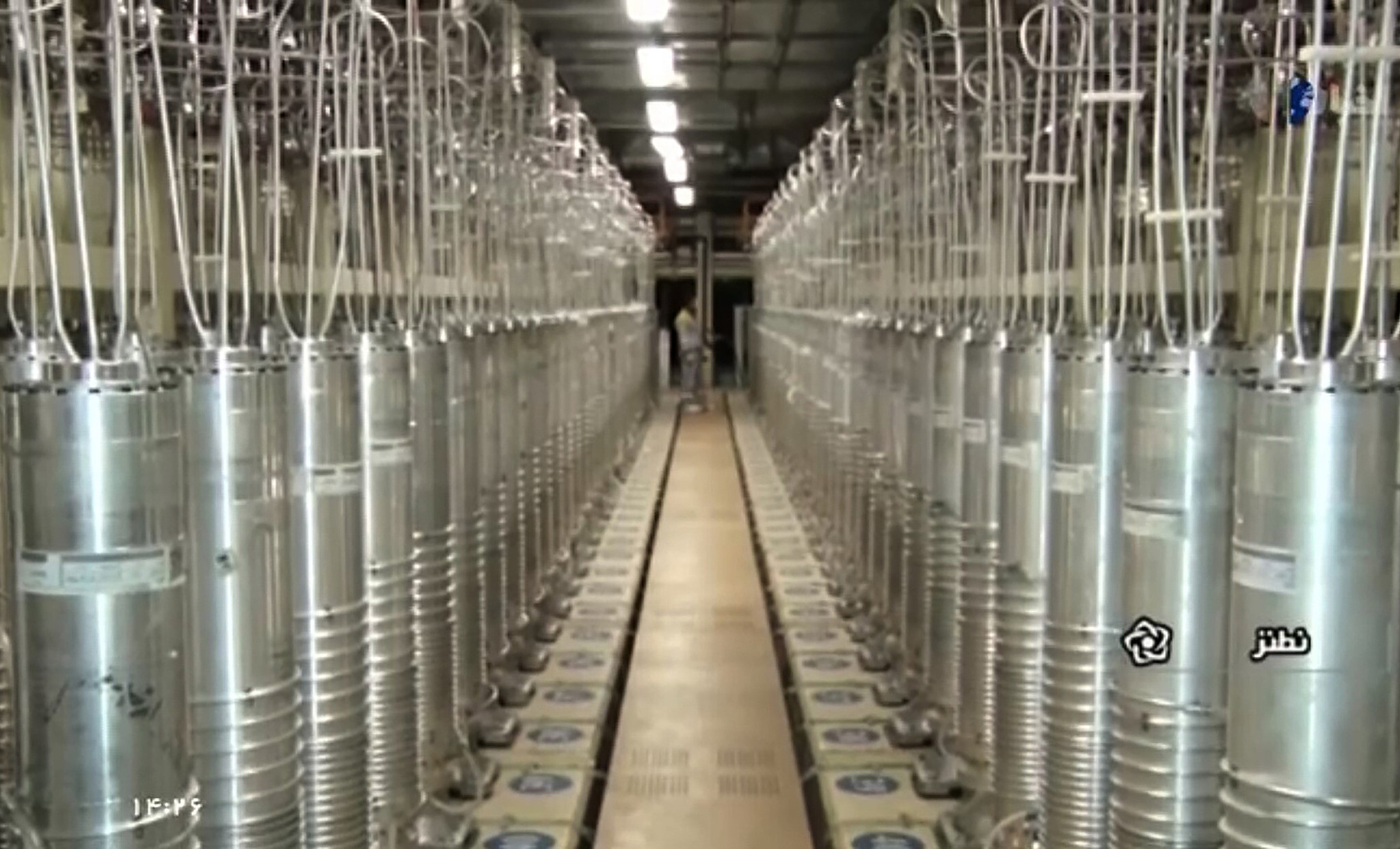

Iran denies UN inspectors access to images of nuclear sites

International Atomic Energy Agency chief to give statement as Tehran may have already deleted 3 months of footage from enrichment facilities across the country


In this image made from April 17, 2021, video released by the Islamic Republic Iran Broadcasting, IRIB, state-run TV, various centrifuge machines line a hall at the Natanz Uranium Enrichment Facility, Iran. (IRIB via AP)

In this image made from April 17, 2021, video released by the Islamic Republic Iran Broadcasting, IRIB, state-run TV, various centrifuge machines line a hall at the Natanz Uranium Enrichment Facility, Iran. (IRIB via AP)

TEHRAN, Iran —Iran’s parliament speaker said Sunday that international inspectors may no longer access surveillance images of the Islamic Republic’s nuclear sites, escalating tensions amid diplomatic efforts in Vienna to save Tehran’s atomic accord with world powers.

The comments by Iran’s parliament speaker Mohammad Bagher Qalibaf, aired by state TV, further underscored the narrowing window for the US and others to reach terms with Iran. The Islamic Republic is already enriching and stockpiling uranium at levels far beyond those allowed by its 2015 nuclear deal.

“Regarding this, and based on the expiration of the three-month deadline, definitely the International Atomic Energy Agency will not have the right to access images from May 22,” Qalibaf said. May 22 was Saturday.

The International Atomic Energy Agency had said its director-general would brief reporters later Sunday in Vienna. The United Nations agency did not immediately respond to a request for comment.

Director General of the International Atomic Energy Agency Rafael Grossi addresses the media after a meeting of the IAEA board of governors at the International Center in Vienna, Austria, Monday, March 1, 2021 (AP Photo/Ronald Zak)

Under what is called an “Additional Protocol” with Iran, the IAEA “collects and analyzes hundreds of thousands of images captured daily by its sophisticated surveillance cameras,” the agency said in 2017.

The agency also said then that it had placed “2,000 tamper-proof seals on nuclear material and equipment.”

Iran’s hard-line parliament in December approved a bill that would suspend part of UN inspections of its nuclear facilities if European signatories did not provide relief from oil and banking sanctions by February.

The IAEA struck a three-month deal with Iran to have it hold the surveillance images, with Tehran threatening to delete them afterward if no deal had been reached.

Mohammad Bagher Qalibaf, center, is surrounded by a group of lawmakers after being elected as speaker of the parliament, in Tehran, Iran, May 28, 2020. (AP Photo/Vahid Salemi, File)

It wasn’t immediately clear if the images from February had been deleted. Before Qalibaf’s remarks, lawmaker Ali Reza Salimi urged an open session of parliament to ensure Iran’s civilian nuclear arm “erased” the images. The Atomic Energy Organization of Iran did not immediately comment on the decision.

“Order the head of the Atomic Energy Organization to avoid delay,” said Salimi, a cleric from Iran’s central city of Delijan. The “recorded images in the cameras should be eliminated.”

It also wasn’t clear what this meant for in-person inspections by the IAEA. There are 18 nuclear facilities and nine other locations in Iran under IAEA safeguards.

Iran’s Supreme Leader Ayatollah Ali Khamenei addresses the nation in a televised speech marking the Iranian New Year, in Tehran, Iran, March 21, 2021. (Office of the Iranian Supreme Leader via AP)

Qalibaf said Iran’s Supreme Leader Ayatollah Ali Khamenei, who has final say on all matters of state, supported the decision.

In 2018, then-President Donald Trump pulled the US unilaterally out of the nuclear deal, known as the Joint Comprehensive Plan of Action. An escalating series of incidents since Trump’s withdrawal has threatened the wider Mideast.

Over a year ago, a US drone strike killed a top Iranian general, causing Tehran to later launch ballistic missiles that wounded dozens of American troops in Iraq.

A mysterious explosion also struck Iran’s Natanz nuclear facility, which Iran has described as sabotage, which Tehran blamed on Israel. In November, Iranian scientist Mohsen Fakhrizadeh, who founded the country’s military nuclear program some two decades earlier, was killed in an attack Tehran also blames on Israel.

Despite the threat over the images, last week, Iran’s president offered his most optimistic assessment yet of ongoing talks to resuscitate the nuclear deal with world powers, claiming there had been “major” agreement among diplomats even as other nations involved suggested challenges remain.

Speaking at a Thursday ceremony inaugurating several petrochemical projects, President Hassan Rouhani asserted that solutions to “major issues like sanctions” had been agreed to by diplomats, while other issues remained under discussion.

“We have taken a major and big step and the main agreement has been done,” Rouhani said.

Russia’s governor to the International Atomic Energy Agency, IAEA, Mikhail Ulyanov smokes a cigarette in front of the ‘Grand Hotel Wien’ where closed-door nuclear talks with Iran take place in Vienna, Austria, April 20, 2021 . (AP Photo/Lisa Leutner, file)

That comment came just as Mikhail Ulyanov, a Russian diplomat involved in the talks, tweeted that it “is obvious now that the Vienna talks on (deal) will not be completed by May 21 as the participants hoped.” He described the situation as “regrettable but not dramatic.”

“May 21 wasn’t a deadline but a target date. It helped us not to forget about time pressure,” Ulyanov wrote. “The talks will continue until successful outcome.”

That mirrored comments Wednesday by Enrique Mora, the European Union official who chaired the talks between Russia, China, Germany, France, Britain and Iran. He said told reporters “we have made substantial progress” though there were “still things to be worked out.”

Chinese diplomat Wang Qun was paraphrased by the state-run Xinhua news agency as saying “there is still some distance away from the goal of reaching an agreement.” European diplomats involved said after the talks that they were “beginning to see the contours of what a final deal could look like” but that “success is not guaranteed.”

Diplomats agreed to resume the talks in Vienna this week.

Times of Israel staff contributed to this report.


About Those ‘DOA’ Abraham Accords

Biden Administration policy—not a failed “peace process”—is the underpinning of the current Hamas war against Israel.

Shoshana Bryen • 

It is hard to be against a peace agreement. Really hard. But the Biden Administration is giving it a go.

White House Press Secretary Jen Psaki slammed Donald Trump’s policies in the Middle East and called the Israel-United Arab Emirates-Bahrain Abraham Accords “DOA.”

“We felt there was not a constructive action by the prior administration, aside from putting forward a peace proposal that was dead on arrival. We don’t think they did anything constructive really to bring it into the long-standing conflict in the Middle East.”

Psaki appears to be channeling Washington Post columnist Max Boot. “The clashes in recent days between Israelis and Palestinians make clear that there is no ‘peace’ and no ‘new Middle East.’ It remains the same blood-soaked mess as ever. The Abraham Accords were nice, but they did nothing to resolve underlying conflicts in Yemen, Syria, Libya—or the West Bank and the Gaza Strip.”

It is understandable that critics choose not to consider the accords in their own context. Yemen, Syria, and Libya weren’t on the table. Neither was world hunger, relief for China’s Uighurs, or the U.S. national debt. And, deliberately, neither were the Palestinians.

In the immediate aftermath of the September 2020 signing, a horde of pundits and politicians including Samantha Power, John Kerry, Senators Bernie Sanders (I-Vt.) and Chuck Schumer (D-N.Y.), Representative Mark Pocan (D-Wis.), and media including Reuters, CNN, The New Yorker, Foreign Policy, the Guardian and more, spewed their litany about how much more dangerous the region had become and how the United States was doomed to fail. They are joined now by Representatives Rashida Tlaib (D-Mich.), Ilhan Omar (D-Minn.), Gregory Meeks (D-N.Y.), Bernie Sanders (again), and others.

They are wrong.

The Abraham Accords arose in part from the debacle of the Obama Administration’s Arab Spring policies: Egypt, Libya, and wars since then that killed tens of thousands, wrecked industry, fueled the migrant crisis, and provided weapons for ISIS and al-Qaeda. In Syria, the promise of the Spring encouraged the uprising that led to the civil war (in which the United States supported and armed militias that it did not understand) that killed more than 600,000 people, displaced more than half of the Syrian population, and included the use of poison gas. Much of this was funded by Iran’s largesse, which was partially American largesse.

Obama’s policies frightened governments around the region. The Gulf States, Saudi Arabia, Sudan, Tunisia, Morocco, Iraq, Lebanon, and Jordan didn’t want to be like Syria, if they had a choice. They did.

Since the accords (plus agreements with Morocco and Sudan, and air overflight agreements with Saudi Arabia and Kuwait) were signed, Israel and its new partners have enjoyed various levels of political, social, and financial engagement, while Israel and Jews find themselves broadly accepted as an integral part of the Middle East for the first time. There is nothing quite like the establishment of the Bet Din (Jewish Court) of Arabia to make the point.

There were also two broad regional security changes engendered by the Accords, both anathema to the Biden Administration and its minions. First, Iran now faces formidable opposition in its quest for regional hegemony; and second, the Gulf State leaders chose the national interests and needs of their people over Palestinian intransigence and corruption.

The Biden Administration set a two-pronged strategy to undermine the Accords and its parties and return to the halcyon days of the Obama Administration, the JCPOA and the “two-state solution.”

First, negotiations with Iran are designed to restore funds to the Islamic Republic, though the mullahs are likely to do the same thing with the money as before.

Second, the administration restored funding to the Palestinian Authority, despite its ongoing incitement of violence against Israelis and continued payments to Palestinian terrorists and their families in violation of the American Taylor Force Act. The administration also resurrected the Obama Administration’s failed policy of pressuring Israel to pay the Palestinians in hopes of changing the fundamental Palestinian rejection of Jewish nationhood. (To be fair, just a little, every U.S. administration has put the Palestinians in the middle of the quest for regional peace. And to be fair, they all were wrong.)

Relief from American political pressure on Iran, and the hope of relief from financial pressure, emboldened Iran and its proxy Hamas. The evident desire of the Biden Administration to engage the Palestinian Authority regardless of its behavior emboldened Mahmoud Abbas to incite further acts of violence against Israelis. And, seeking political control of Palestinians in Jerusalem and the West Bank, Hamas began a criminal aerial bombardment of Israeli cities and towns with Iranian-provided weapons. Hamas is committing war crimes knowing full well it can’t win but believing that ultimately the administration will ask “both sides” for restraint, as Obama used to do.

This Biden Administration policy—not the civil suit against squatters who refuse to pay rent to Jewish landlords in Jerusalem or a failed “peace process”—is the underpinning of the current Hamas war against Israel. And as such, it is Israeli-Palestinian peace, or even a modus vivendi, that is “dead on arrival.”
