
US National Security Adviser Jake Sullivan said on Friday the talks were in “an unclear place,” meaning it was uncertain whether they would lead to an agreement.
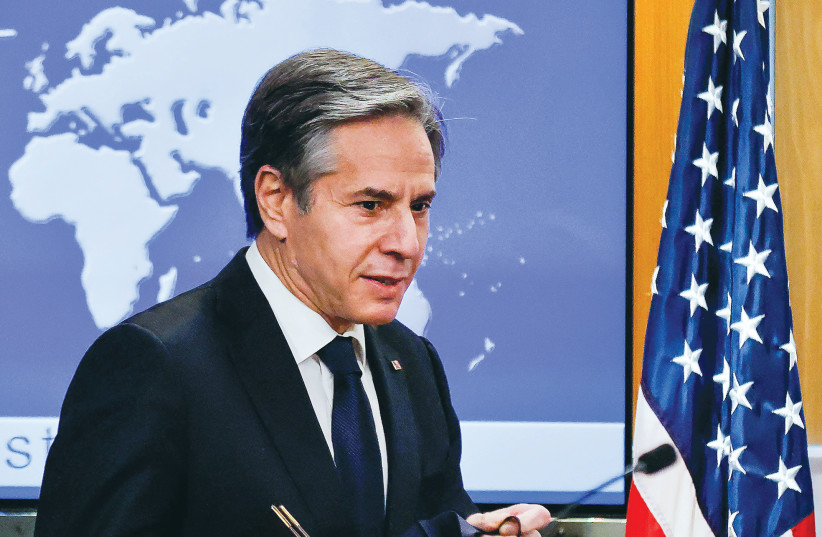
US SECRETARY OF State Antony Blinken arrives at his first press briefing at the State Department in Washington, last week. At his Senate confirmation hearing last month, Blinken said ‘we are a long ways’ from returning to the Iran deal. (photo credit: CARLOS BARRIA / REUTERS)
US SECRETARY OF State Antony Blinken arrives at his first press briefing at the State Department in Washington, last week. At his Senate confirmation hearing last month, Blinken said ‘we are a long ways’ from returning to the Iran deal.
(photo credit: CARLOS BARRIA / REUTERS)
Iran’s chief nuclear negotiator said that Tehran expects US sanctions on oil, banks and other sectors and on most individuals and institutions to be lifted based on agreements reached so far at talks in Vienna, Iranian state media reported on Saturday.

Russia and Western European powers, meanwhile, gave contrasting accounts of the task ahead in the talks to bring Iran and the United States fully back into compliance with the 2015 nuclear deal, as the talks adjourned for six days.

“Sanctions… on Iran’s energy sector, which include oil and gas, or those on the automotive industry, financial, banking and port sanctions, all should be lifted based on agreements reached so far,” Deputy Foreign Minister Abbas Araqchi was quoted as saying by Iranian state media.

Araqchi did not say under what mechanism sanctions would be lifted, or refer to how Tehran would meet Washington’s demands and return to its commitments under the deal.

“We will negotiate until the two sides’ positions come closer and our demands are met,” he said. “If they are met there will be an agreement, if not there will naturally be no agreement.”

The US State Department had no immediate comment on Araqchi’s remarks.

US President Joe Biden is seeking to return to the deal after Washington pulled out in 2018 under president Donald Trump and reimposed sanctions against Tehran. Iran responded by breaching many of the deal’s limits on its nuclear activities.

Israel has opposed the revival of the Iran deal and believes that the continuation of the crippling US sanctions the Trump administration imposed on Iran are the best method to prevent Tehran from producing nuclear weapons.

“The Iranian regime will only compromise if it faces determined pressure to do so,” an Israeli official told The Jerusalem Post on Saturday night. “Of course they want the sanctions lifted, and if that happens prematurely, the leverage to get the Iranians to dismantle their nuclear infrastructure will be all but lost.”

Mossad Director Yossi Cohen and National Security Advisor Meir Ben-Shabbat were in Washington last week to discuss regional strategic threats, as well as the dangers of reviving the Iran deal.

According to Israel’s Channel 12 news station, Cohen met with Biden in the White House on Friday. He was briefed by Prime Minister Benjamin Netanyahu prior to the meeting. Members of the US National Security Council were also present.

State Department spokesman Ned Price told reporters in Washington on Thursday that the US has “updated our Israeli counterparts before every round of negotiations, after every round of negotiations, and we’ve been consulting with them during these negotiations as well.”

He confirmed that a delegation of US officials was headed to the Middle East this week to speak with US allies. “A senior interagency delegation will be traveling over the coming week to discuss a number of important matters related to US national security and ongoing efforts to de-escalate tensions in the Middle East,” Price said.

“I suppose I would hasten to add that this delegation is not focused on any one issue, certainly not focused just on Iran and anything that may emanate from the ongoing discussions in Vienna.”

Talks to revive the Iran deal began last month in Vienna with the remaining parties to the deal – Iran, Russia, China, France, Britain and Germany – meeting in the basement of a luxury hotel, and the United States based in another hotel across the street. Iran has refused to hold direct meetings with US officials.

“We have much work, and little time, left,” senior diplomats from the so-called E3 – France, Britain and Germany – said in a statement. “Against that background, we would have hoped for more progress this week.”

Officials have said they hope to reach a deal by May 21, when an agreement between Tehran and the UN nuclear watchdog on continued monitoring of some Iranian nuclear activities is due to expire.

“We have yet to come to an understanding on the most critical points,” they added. “Success is by no means guaranteed, but not impossible.”

US National Security Adviser Jake Sullivan said on Friday that the talks were in “an unclear place,” meaning it was uncertain whether they would lead to an agreement.

“We should not expect breakthroughs in the days to come,” Mikhail Ulyanov, Russia’s ambassador to the UN nuclear watchdog, told reporters after a meeting of the remaining parties that wrapped up the third round of talks.


Will Biden sacrifice Israel over Iran? – opinion

The Biden administration might be prepared to sacrifice a strong strategic alliance with Israel if it were to oppose the US return to the Iran deal.

THEN-US vice president Joe Biden and Prime Minister Benjamin Netanyahu in Jerusalem in 2016. (photo credit: DEBBIE HILL/REUTERS)
THEN-US vice president Joe Biden and Prime Minister Benjamin Netanyahu in Jerusalem in 2016.
(photo credit: DEBBIE HILL/REUTERS)
Since the current negotiations among the major powers signatory to the Joint Comprehensive Plan of Action began with Iran and the participation of the US in 2015, I keep reading analyses and reports of a growing mismatch between American and Israeli positions on the US return to the nuclear deal.

I have even been led to imagine that the Biden administration might sacrifice a strong strategic alliance with Israel if it were to oppose his position on returning to the deal.

There are several Western reports of clear messages from the US, described by some as “surprise orders” for Israel to stop its attempts to derail the ongoing negotiations in Vienna with Iran. Washington may be very concerned by the comments of Foreign Minister Gabi Ashkenazi.

Ashkenazi said his country would “do everything” to ensure that Iran does not have nuclear weapons. Similar – if not harsher – statements were made by Prime Minister Benjamin Netanyahu. Other reports have pointed to a widening gap between American and Israeli positions on how to deal with the Iranian threat.

There may be a lack of trust, transparency and coordination between the two sides. But they want to avoid a public rift between the two allies, as happened during the negotiations that led to the signing of the 2015 agreement, the same sources said.
One report quotes Israeli officials as saying that in a recent meeting with his US counterparts, national security adviser Meir Ben-Shabbat expressed Tel Aviv’s concern that the Biden administration was not concretely taking Israel’s viewpoint into account.
On the other hand, according to Israeli officials, the US side has expressed concern about Israel’s involvement in military and intelligence operations against Iran without full coordination with Washington.

Clearly, one reason for Israel’s concern is that it is not fully aware and informed of what is happening in the Vienna negotiations, and what the US has proposed in those negotiations to persuade the Iranian mullahs to stop violating the terms of the nuclear deal. How does the White House plan to lift sanctions on Iran in exchange for Iran’s commitment to the deal?

Based on analysis of available and published information, the frequency of recent visits between US and Israeli officials, particularly at the military and intelligence levels, reflects the Biden administration’s desire not to anger the Israeli ally. But this does not preclude the possibility of a split around President Joe Biden’s views.

The latter shows strong support for the need to reach an agreement on his country’s return to the nuclear deal, which many see as an unwarranted “rush” by the US. This opens the door for the mullahs to tighten and impose their terms at the negotiating table. This is despite the fact that they need a deal guaranteeing the lifting of US sanctions imposed by former president Donald Trump more than the US.

Looking at the atmosphere of US-Israeli relations, one must separate Biden’s strong and stated commitment to the security of the Israeli ally from his relationship with Netanyahu.
In this sense, the delay in contacting Netanyahu should not be taken as an indicator of Biden’s relationship with Israel. But it does not diminish the concern in Israeli circles that the experience of the 2015 agreement might repeat itself.

All the more so if we know that the present American foreign relations and national security officials were among the architects of this agreement. I have no doubt that the mullahs of Iran are playing on the line of disagreement between the US and Israel. Although they know the depth of this alliance, they continue to try to destabilize it.

Indeed, Israel is most concerned about the uncertainty surrounding the level of secrecy in Iran’s nuclear program. It fears that there are Iranian plans to enrich uranium in secret facilities, safe from inspection.

Biden’s team, starting with National Security Adviser Jake Sullivan, Secretary of State Tony Blinken and Iran Chief Robert Malley, all agree that returning to the nuclear deal is imperative. This, they say, is the only way to deal with the Iranian nuclear threat and to turn attention to the Chinese challenge.

But Israel is also entitled to be concerned about this dynamic. This is because the agreement that everyone is seeking to return to is a Trojan horse that the mullahs of Iran have used over the past five years to expand and intervene grossly in several countries, and to extend their geopolitical influence in the Middle East.

It is also because the agreement is full of loopholes and does not address all sources of Iranian threat. Add to this the aggressive intentions and considerations of geographic proximity, especially after the stationing of Iranian militias in Syria, and we can easily understand Israel’s concerns.

These concerns are very similar to the Gulf Cooperation Council countries’ concerns about Iran’s nuclear program. During his recent visit to Israel, US Secretary of Defense Lloyd Austin emphasized the US’s full commitment to Israel’s security, noting its position as a strategic partner.

Bilateral relations, he added, are important to stabilize the Middle East. Israeli political and security circles are well aware of this. But the experience of the 2015 agreement casts a shadow over relations.

The question here is not really about whether Prime Minister Netanyahu is exploiting the Iranian issue politically or not, for the simple reason that Israel’s intelligence and cyber-military operations to reduce the Iranian threat require consensus at the highest level of Israeli security and military and cannot come from a political level alone.

The question now: is Israel poised to derail the agreement signed in Vienna with sudden military action against Iran’s nuclear facilities, which increasingly risks involving the US administration in a war of necessity against the mullahs?

This question resonates in the minds of some observers, and I think that avoiding this is linked to the policy of the Biden administration. Experts and specialists believe that it is more committed to Israel’s long-term security. That is regardless of anything that former president Trump has achieved on this front.

But what is certain on this issue is that Biden will not risk angering his Israeli partners. However, results are not just a matter of intentions. Rather, it is necessary to listen properly to the views of fellow countries in order to formulate a strategic approach that meets the requirements and interests of all parties.

The writer is a UAE political analyst and former Federal National Council candidate.


As the number and severity of Palestinian and Iranian attacks against Israel increase, US President Joe Biden moves quickly to restore former president Barack Obama’s Iran nuclear deal.

A man holds up a sign as he and several thousand other protestors demonstrate during a rally opposing the nuclear deal with Iran in Times Square (photo credit: REUTERS)
A man holds up a sign as he and several thousand other protestors demonstrate during a rally opposing the nuclear deal with Iran in Times Square
(photo credit: REUTERS)
Over strong Israeli opposition, and despite Iranian promises to destroy the Jewish state, US President Joe Biden is moving quickly to restore Barack Obama’s Iran nuclear deal, paving the way for Iran to acquire nuclear weapons.

At the same time, there has been a decided uptick in the number and severity of Palestinian and Iranian attacks against Israel. My sources inside the US government suggest one factor behind this may be tacit Biden permission or support for increased violence from Gaza and a new intifada if Israel refuses to accede quietly to a new Iran deal or takes “unapproved” steps to defend itself against the Iranian threat. This would be a catastrophic mistake and horrific breach of trust. But on the facts, the idea the Biden government would pressure the Israeli government by green-lighting Iranian or Palestinian terror attacks against innocent Israelis cannot lightly be dismissed.

The evidence of Biden/Obama duplicity regarding Iran is hard to miss. Recently, The New York Times reported that Iranian Foreign Minister Mohammad Javad Zarif was recorded on recently leaked tapes saying John Kerry, secretary of state during the Obama administration, informed him of more than 200 secret Israeli operations in Syria. This report is credible given Kerry’s happy collusion with Iranian leaders to undermine the Trump administration’s efforts to isolate the mullahs, impose an effective sanctions regime, and choke out their nuclear and conventional weapon programs.

That Kerry, who has a seat on Biden’s National Security Council, was passing US intelligence information on Israeli defense activities to a regime sworn to wipe Israel from the map might seem to be an unseemly betrayal of America’s closest Middle-Eastern ally. But when it came to Iran, the Obama administration did not merely betray the Israelis. It also lied repeatedly to Congress and the American people.

For example, Obama famously failed to disclose the existence of secret side-deals on inspections when he transmitted the nuclear accord to Capitol Hill. They were only uncovered by chance when then-representative Mike Pompeo and Sen. Tom Cotton learned about them during a meeting with International Atomic Energy Agency officials in Vienna. Then, the Obama administration secretly sent a plane to Tehran loaded with $400 million in Swiss francs, euros and other currencies on the same day Iran released four American hostages, which was followed by two more secret flights carrying another $1.3 billion in cash.

The Obama administration worked closely with the Iranians to indirectly transfer billions of dollars, subsequently used to fund Iranian activities in Syria and to support Hezbollah in Lebanon. For example, it signed a secret agreement with Iran to lift UN sanctions from two Iranian banks that helped finance Iran’s ballistic-missile program.

In 2018, the Senate Permanent Subcommittee on Investigations, led by Sen. Rob Portman (R-Ohio), revealed the Obama administration secretly tried to help Iran use US banks to convert $5.7b. in Iranian assets while promising Congress that Iran would not get access to the US financial system. Treasury official Adam Szubin played a key role in this effort.
Months before Szubin testified in front of congressional committees promising Iran would not have access to the US financial system, the Treasury Department issued a specific license to Bank Muscat permitting the conversion of Iranian assets in precisely that way. Portman’s report noted a 2016 email showing Szubin taking steps to facilitate Iranian access to the money. For his efforts, and almost certainly to delay and obstruct incoming Trump officials, Szubin was rewarded with an appointment as acting Treasury secretary.

At roughly the same time Kerry was passing intelligence on the Israelis to the Iranians, and Szubin was misleading Congress and working to bypass Iran sanctions, the Obama administration was directing US taxpayer dollars to build a political campaign infrastructure to subvert Israel’s government. Obama was caught and exposed by the bipartisan Senate Permanent Subcommittee on Investigations paying hundreds of thousands of dollars in taxpayer grants to a nonprofit front group to build Israeli voter databases, train activists, and hire Obama campaign political operatives, all to take down Prime Minister Benjamin Netanyahu. The State Department’s top diplomat in Jerusalem was informed of these activities in emails, but the official, then-consul general Michael Ratney, claimed never to have seen them. Not surprisingly, this overt and poorly executed foreign election interference was buried by the American media.

This history is instructive because the Biden administration is staffed by many of the same individuals responsible for executing Obama’s policies. And the evidence is Obama’s Iran playbook is back in use.

To begin with, Biden has ended the Trump administration’s policies of strong support for Israel and vigorous opposition of Iran. “Negotiations” are back in full swing to relax Iran sanctions and ensure Iran again has a clear path to a nuclear weapon by hamstringing Israel’s defense. And once more, American officials are working to stop Israel from defending itself. According to The Wall Street Journal, “unnamed” US government officials recently leaked information on longstanding covert Israeli efforts to stop Iranian oil and weapons shipments. Biden’s people have informed Jerusalem of their displeasure over recent attacks against Iranian targets attributed to Israel for interfering with a quick deal. What John Kerry did, it seems, is being done again.

Also, “indirect” funding of the Iranian government may again be on the table. Republican legislators recently asked Treasury Secretary Janet Yellen for information into foreign reports that the United States is facilitating “ransom” payments of over $1b. from South Korea to Iran. Yellen never answered, directing Congress to the State Department for additional information. What Adam Szubin did, it seems, is being done again.

For now, the Biden administration has the benefit of working in the shadows. Congressional Republicans are in the minority with limited oversight tools and leverage. During the Obama years, Democrats, even (or especially) those claiming to be “pro-Israel,” fought meaningful steps to expose, oversee or oppose that administration’s support for Iran. Given their extraordinary silence about the metastasizing anti-Israel/pro-Iran Biden foreign policy and national security apparatus, there is no reason to believe they will do anything to oppose the Biden administration either.

Israel is not entirely on her own in confronting Iran and its Palestinian proxies. But it is time to tell the truth: In Biden’s administration, Israel’s security will be sacrificed, and happily so, for a deal with Iran.

The writer is a former Trump administration official who served as deputy associate attorney-general, senior adviser to the Treasury secretary, and general counsel at the US Department of Education.