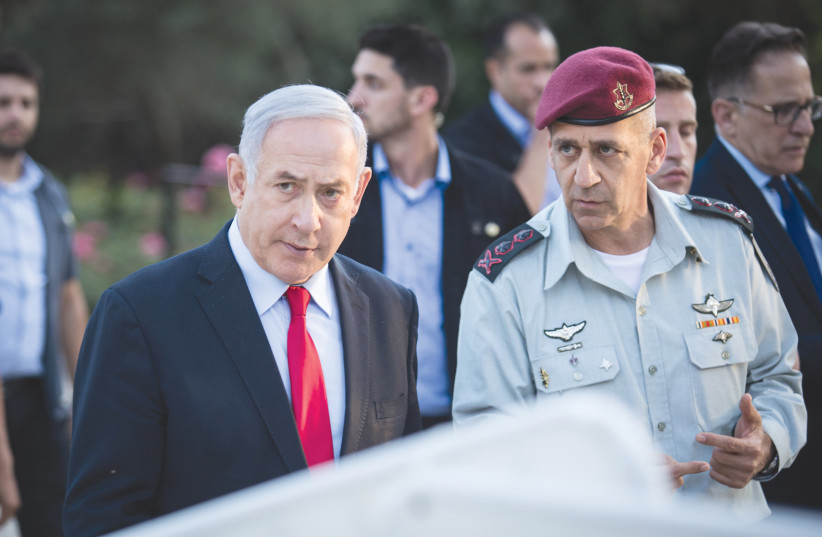
Prime Minister Benjamin Netanyahu said to “prepare for any scenario” vis-a-vis the Gaza Strip on Saturday afternoon amid soaring tensions with the Hamas-run enclave following overnight barrages of rockets fired at Israel. The premier made the remark following an urgent security meeting earlier Saturday at the Israel Defense Forces’ Kirya headquarters in Tel Aviv with IDF Chief of Staff Aviv Kohavi, Defense Minister Benny Gantz, Minister of Public Security Amir Ohana, the head of the Shin Bet internal security service, and other high-level officials.
The meeting was held shortly after the military announced that Kohavi has delayed a planned trip to the United States to discuss the threat of Iran’s nuclear program and its entrenchment throughout the region. The army chief had been set to depart late Saturday.
Kohavi had met with security chiefs to discuss the situation following the firing of 36 rockets at Israel overnight from the Gaza Strip and amid clashes between Palestinians and Israeli security forces in Jerusalem and the West Bank.
“In assessing the situation, the chief of staff ordered a series of possible steps, responses and assessments for escalation,” the Israel Defense Forces said in a statement.
“In light of the events and expected developments, the chief of staff decided to postpone his trip to the United States at this stage,” the statement read.

Israeli tanks stationed along the Israel-Gaza border, on April 24, 2021 (JACK GUEZ / AFP)
Kohavi had been set to leave on Sunday for the trip — his first since entering his position — which was to take place amid considerable tensions between the United States and Israel over the Iran nuclear issue.
US President Joe Biden’s administration intends to return to the 2015 nuclear deal with Iran, a move that Israeli officials, including Kohavi, staunchly and publicly oppose.
Shortly after Biden’s inauguration in January, Kohavi made waves with a particularly blunt, overt speech arguing against the US rejoining the deal, saying it was a “bad thing.”

In this image made from April 17, 2021, video released by the Islamic Republic Iran Broadcasting, IRIB, state-run TV, various centrifuge machines line the hall damaged on Sunday, April 11, 2021, at the Natanz Uranium Enrichment Facility, some 200 miles (322 km) south of the capital Tehran. (IRIB via AP, File)
Kohavi was set to meet with a number of top US defense officials, including Defense Secretary Lloyd Austin, National Security Adviser Jake Sullivan, Chairman of the Joint Chiefs of Staff Mark Milley, head of the US Central Command Kenneth McKenzie, and head of the US Special Operations Command Richard Clark.
In the coming weeks, a number of other top Israeli defense officials are slated to visit the United States, including National Security Adviser Meir Ben-Shabbat, Mossad chief Yossi Cohen, and Military Intelligence commander Tamir Hayman.

IDF Chief of Staff Aviv Kohavi speaks at a ceremony on February 28, 2021. (Israel Defense Forces)
Israel is generally concerned that the US is rushing too quickly into a return to the 2015 accord, known formally as the Joint Comprehensive Plan of Action, and is ignoring the concerns of Israel and other Middle Eastern countries, notably those in the Gulf. Israeli sources told the Axios news outlet that Americans countered that Israel was not sufficiently heeding the administration’s request for “no surprises” from either side concerning Iran policy.
Israel and the US set up a strategic group, which last convened on April 13, to coordinate their efforts to prevent Iran from acquiring nuclear arms. The group is led by Sullivan and Ben-Shabbat.
Earlier this week, Kan news reported that Israel was lobbying the US to push for improved international oversight of Iran’s nuclear program, having concluded there will not be significant changes to the treaty but nonetheless seeking to slightly improve the terms of the pact, which is being negotiated in Vienna, with Europeans acting as intermediaries between Washington and Tehran.
Iranian President Hassan Rouhani said Tuesday that 60-70 percent of issues had been resolved in Vienna.

Iran’s President Hassan Rouhani, right, is shown new centrifuges and listens to head of the Atomic Energy Organization of Iran Ali Akbar Salehi, while visiting an exhibition of Iran’s new nuclear achievements in Tehran, Iran, April 10, 2021. (Iranian Presidency Office via AFP)
The Biden administration had repeatedly said that it would only return to the nuclear deal if Iran first returns to compliance.
However, on Tuesday, US State Department Spokesperson Ned Price said at a press conference that Washington would only need to be sure that Iran intended to return to compliance.
But the US National Security Council’s Brett McGurk reportedly told American Jewish leaders Friday that no sanctions would be removed from the Islamic Republic before Washington gets clear commitments on Iran’s return to the accord.
Israeli officials, including Netanyahu, have adamantly opposed the US returning to the nuclear deal, putting Jerusalem openly at odds with the new White House administration.
Critics have long denounced the deal’s so-called “sunset clauses,” aspects of the agreement barring Iran from certain nuclear activities that end after a certain number of years. Though the deal technically prohibits Iran from ever developing a nuclear weapon, detractors of the agreement say these clauses will allow Iran to do so with impunity once the sanctions against the regime end.
The agreement does not address Iran’s development of nuclear-capable ballistic missiles that can reach Israel and parts of Europe, as well as its ongoing funding and support of terror groups like Hezbollah.
Proponents of the agreement generally argue that while the deal is imperfect, it was the best possible deal that could be struck under the circumstances.
Judah Ari Gross contributed to this report.