IDF strikes Syrian missile launcher, air-defense systems following incident, the most serious violence between Israel and Syria in years. Incident points to likely Iranian involvement.

A missile launched from Syria was fired into southern Israel early Thursday, setting off air raid sirens near the Shimon Peres Negev Nuclear Research Center in the southern town of Dimona, the Israeli military said. In response, it said it attacked the missile launcher and air-defense systems in neighboring Syria.

The incident, marking the most serious violence between Israel and Syria in years, pointed to likely Iranian involvement. Iran, which maintains troops and proxies in Syria, has accused Israel of a series of attacks on its nuclear facilities, including sabotage at its Natanz nuclear facility on April 11, and vowed revenge. It also threatened to complicate US-led attempts to revive the international nuclear deal with Iran.

The Israeli military said it had deployed a missile-defense system but could not confirm if the incoming missile was intercepted, though it said there had been no damage. The air raid sirens were sounded in Abu Krinat, a village just a few kilometers from Dimona, the desert town which, according to foreign reports, houses the country’s undeclared atomic weapons program. Explosions heard as far away as Jerusalem and the Shfela District area might have been the air-defense systems.

The Israel Defense Forces initially described the weapon fired as a surface-to-air missile, which is usually used for air defense against warplanes or other missiles, that it said had been fired at Israeli aircraft during an earlier strike and had overflown its target and reached the Dimona area.

A SAM SA-5 missile is seen in Libya on Sept. 2, 2011 (AFP / Carl de Souza)

The errant Syrian missile was an SA-5, one of several fired at Israeli Air Force planes, according to the spokesman.

However, Dimona is some 300 kilometers (185 miles) south of Damascus, a long range for an errantly fired surface-to-air missile.

The IDF said that in response to the launch, it attacked several missile batteries in Syria, including the one that fired the projectile that struck its territory.

Syria’s state-run SANA news agency said four soldiers had been wounded in an Israeli strike near Damascus, which also caused some damage. The agency did not elaborate other than to claim its air defense intercepted “most of the enemy missiles,” which it said were fired from the Israeli Golan Heights.

A Syrian military defector said the Israeli strikes targeted locations near the town of Dumair, some 40 km northeast of Damascus, where Iranian-backed militias have a presence. It is an area that Israel has hit repeatedly in past attacks

There was no immediate claim of responsibility for the missile strike or comment from Iran. But on Saturday, Iran’s hardline Kayhan newspaper published an opinion piece by Iranian analyst Sadollah Zarei suggesting Israel’s Dimona facility be targeted after the attack on Natanz. Zarei cited the idea of “an eye for an eye” in his remarks.

Action should be taken “against the nuclear facility in Dimona,” he wrote. “This is because no other action is at the same level as the Natanz incident.”

Israeli media have said for weeks that air defenses around the Dimona facility and the Red Sea port Eilat were being beefed up in anticipation of a possible long-range missile or drone attack by Iranian-backed forces – perhaps from as far away as Yemen.

While Kayhan is a small circulation newspaper, its editor-in-chief, Hossein Shariatmadari, was appointed by Supreme Leader Ayatollah Ali Khamenei and has been described as an adviser to him in the past.

Zarei has demanded retaliatory strikes on Israel in the past. In November, he suggested Iran strike the Israeli port city of Haifa over Israel’s suspected involvement in the killing of a scientist who founded Iran’s military nuclear program decades earlier. However, Iran did not retaliate then.

All the incidents come as Iran negotiates in Vienna with world powers

SA-5 flies from Syria all the way to Negev in longest-range attack by Syria. Patriot missile activated in response.

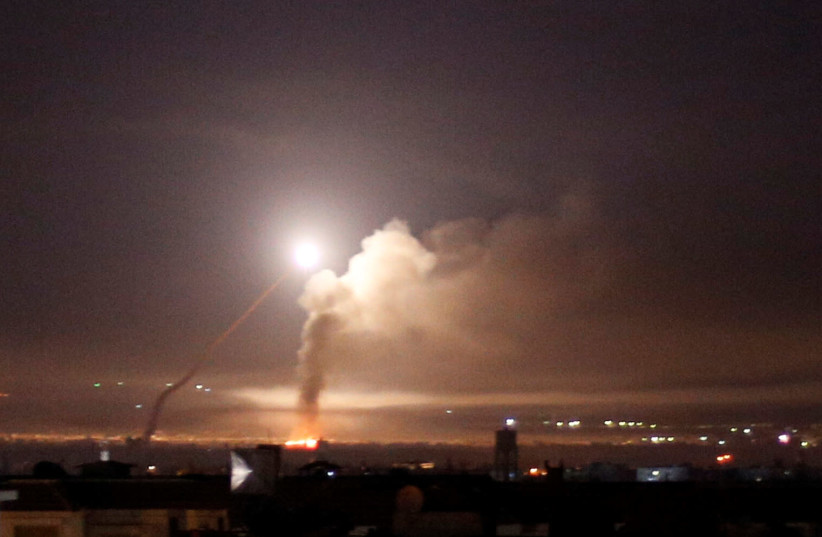
Missile fire is seen from Damascus, Syria May 10, 2018. (photo credit: REUTERS)
Missile fire is seen from Damascus, Syria May 10, 2018.
(photo credit: REUTERS)
Israel and Syria exchanged missile attacks early Thursday morning after Damascus launched an advanced surface-to-air missile that landed all the way in the Negev Desert.

Alarms sounded in Abu Qrenat near Dimona in the South. Syria fired the missile in response to what it claims was an Israeli Air Force bombing near Damascus. Israel frequently strikes Syria to prevent Iranian entrenchment in the country as well as weapons shipments to Hezbollah in Lebanon.

Reports from across the country, including central Israel and Jerusalem, spoke of “loud explosions” that “shook the houses.”

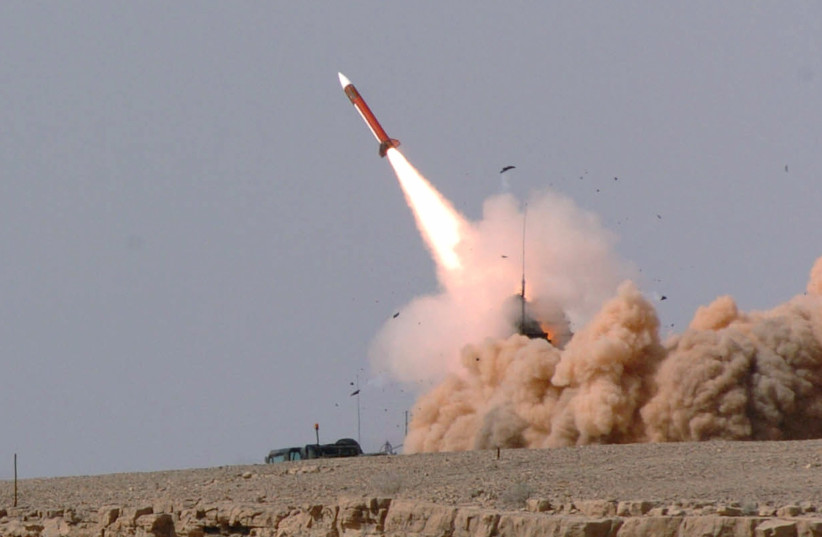
Early reports indicated that the explosion was the result of a Patriot missile battery – a missile defense system – responding to the firing of the missile into Israel. The IDF later confirmed the reports and on Thursday morning, missile parts were located in the Negev desert.

“Due to a surface to air missile entering Israeli territory, air defense systems were activated,” a statement by the IDF read, noting that the IDF was still investigating the incident.

The Patriot was reportedly launched from near the city of Dimona, not far from the location of Israel’s secretive nuclear reactor.

The military said that in response to the launch, it attacked several missile batteries in Syria, including the one that fired the projectile that struck its territory.
Syria’s state news agency said Syrian air defenses intercepted the Israeli attack that targeted areas in the Damascus suburbs.
“Air defenses intercepted the rockets and downed most of them,” the agency said.
However, four soldiers were injured in the attack and some material damage took place, it said.
A Syrian military defector said the Israeli strikes targeted locations near the town of Dumair, some 40 km northeast of Damascus, where Iranian-backed militias have a presence. It is an area that Israel has hit repeatedly in past attacks

It was unclear at first where the missile was launched from. Several indications pointed to the missile being launched from Iraq, while according to other reports, it came from the city of Daraa in southern Syria following an Israeli airstrike.

IDF Spokesperson Brig.-Gen. Hidai Zilberman told reporters that the explosion was due to the firing of an SA-5 surface to air missile that was fired towards Israel from Syria and that it exploded in the southern Negev.

The firing of the missile came during Israeli air strikes in southern Syria. The missile was not directed towards any target, Zilberman said.

According to the spokesman, Israel responded to the firing of the SA-5 towards IAF jets by striking several anti aircraft batteries in Syria, including the one which fired the missile that exploded in southern Israel.


Residents from across the country reported hearing “loud explosions”

A picture released by Israeli Defence Forces press office shows a launch of a Patriot missile in southern Israel (photo credit: REUTERS)
A picture released by Israeli Defence Forces press office shows a launch of a Patriot missile in southern Israel
(photo credit: REUTERS)
Alarms sounded in Abu Qrenat near Dimona in southern Israel early Thursday morning, the IDF‘s Spokesperson’s Unit reported.

Residents from across the country, including central Israel and Jerusalem, reported hearing “loud explosions” that “shook the houses.”

Early reports indicated the explosion being the result of a patriot battery responding to a missile launched toward Israel. The IDF later confirmed the reports.

The patriot was reportedly launched from near the city of Dimona.

It was unclear at first where the missile was launched from. Several indications pointed to the missile being launched from Iraq, while according to other reports, it came from the city of Daraa in southern Syria following an Israeli airstrike.

Brig.Gen. Hidai Zilberman later told reporters that the explosion was due to the firing of an SA-5 surface to air missile that was fired towards Israel and that it exploded in the southern Negev.

The firing of the missile came during Israeli air strikes in the south of Syria. The missile was not directed towards any target, Zilberman said.

According to the spokesman, Israel responded to the firing of the SA-5 towards IAF jets by striking several anti aircraft batteries in Syria, including the one which fired the missile that exploded in southern Israel.