
The Biden administration is open to hearing Israeli concerns, but doesn’t seem to be taking them into consideration, the source added.
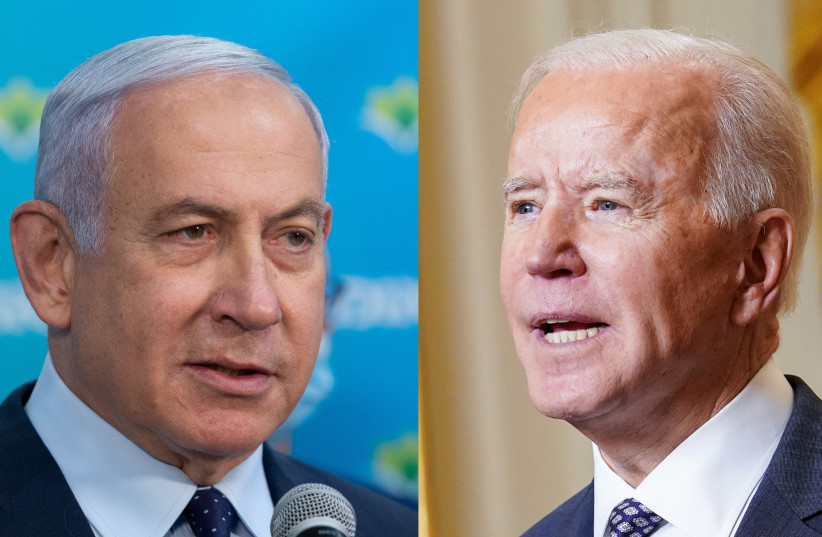
Prime Minister Benjamin Netanyahu and US President Joe Biden (photo credit: REUTERS/KEVIN LAMARQUE AND ALEX KOLOMOISKY/POOL)
Prime Minister Benjamin Netanyahu and US President Joe Biden
(photo credit: REUTERS/KEVIN LAMARQUE AND ALEX KOLOMOISKY/POOL)
Israeli ministers expressed concern about the nuclear talks between the US and Iran, following a diplomatic-security cabinet meeting on Sunday.
“The Americans want a deal at all costs and the Iranians know it,” said a source in the meeting.

The Biden administration is open to hearing Israeli concerns, the source added, but doesn’t seem to be taking them into consideration.
The diplomatic-security cabinet meeting – the first in two months – focused on the Iranian threat a week after a major attack on the nuclear site at Natanz, as well as an attack on an Iranian ship serving as a military base on the Red Sea, both by Israel according to security sources, and as the US and Iran hold indirect negotiations.
Cabinet ministers heard security briefings from the head of security branches, including National Security Adviser Meir Ben-Shabbat and Mossad chief Yossi Cohen, who plan to travel to Washington next week and meet with Biden administration officials. The ministers discussed how to respond to the US position, and will continue meeting on the topic next week.

Indirect talks between the US and Iran with European mediation have been ongoing in Vienna for the past two weeks, and the stated goal is for both sides to return to compliance with the Joint Comprehensive Plan of Action, as the 2015 Iran nuclear deal is known.
US National Security Advisor Jake Sullivan told FOX News Sunday that the US will not make any concessions until it has confidence Iran will return to compliance with the 2015 Iran deal.
Sullivan said the talks “have been constructive in the sense that there is real effort under way there with the permanent five members of the [UN] Security Council plus Germany on the one hand, and Iran on the other hand, to get on the table all of the issues related to both sanctions and nuclear issues so that we could end up back in the deal on a compliance-for-compliance basis.”
However, he would not detail what “compliance-for-compliance” would mean.
“What I will say,” Sullivan added, “is that the United States is not going to lift sanctions unless we have clarity and confidence that Iran will fully return to compliance with its obligations under the deal.”
Those obligations include stopping advancements in its nuclear program, expanding its breakout time and reducing its enrichment, he said. Last week, Iran increased its uranium enrichment from 20% to 60%, more than ever before; the maximum purity of uranium allowed in the JCPOA is 5%.
Israeli officials have said that the Biden administration’s current goal to return to the JCPOA is not enough, and will allow Iran to develop a nuclear weapon with an international imprimatur after the deal expires in 2030.
Ambassador to the US Gilad Erdan pointed out that US Secretary of State Antony Blinken said the Iran deal needs to be “longer and stronger.”
“This is the same criticism the prime minister brought up years ago,” Erdan told Channel 12 on Saturday night, “that the agreement will expire in a number of years and if we return to this agreement, Iran will have the legal permission to have thousands of centrifuges, bringing it closer to the ability to have a nuclear weapon.”
Erdan denied a report that the Biden administration asked Israelis to be more discreet in their comments on the attack on Natanz and other actions against Iran. Officials in Jerusalem have not publicly acknowledged an Israeli role in the attack, but it was leaked to local and not foreign media, and has not been censored by the military censor, an unusual move for an operation of that kind.
In response to those reports, Erdan said that when Prime Minister Benjamin Netanyahu spoke with US President Joe Biden, he said that “Israel is a sovereign and independent country, and we reserve for ourselves all the options to behave as we see fit. Israel isn’t in the same situation as the US; it’s an existential threat. Iran threatens to destroy Israel directly.”
Meretz MK Yair Golan, former IDF deputy chief of staff, said on Sunday that he supports a return to the Iran deal.
Golan said that the IDF analyzed the JCPOA in 2015 and found that “no step, open or secret, by any of the nations of the world against the Iranian project, rolled back the nuclear program like the agreement did. In effect, the agreement brought about a situation in which, instead of dealing with an immediate problem of when Iran will break out to a bomb, Israel could for the first time in a decade deal with the Iranian nuclear threat without feeling like a sword is at its neck.”
The Meretz MK argued that delaying the nuclear program and the creation of a united international front against an Iranian nuclear program were effective and positive for Israel.
To those who oppose the deal, Golan said: “There is no better alternative that can be achieved. [Netanyahu] must understand that… all Israel can do is cooperate with the Biden administration and ensure that Israel’s interests are expressed as best as possible in the future agreement.”


Rockets strike Iraqi base housing US trainers

The incident was the latest in a string of attacks that have targeted mostly American installations in Iraq in recent weeks.

By Associated Press

Multiple rockets hit an Iraqi airbase just north of the capital Baghdad Sunday, wounding two Iraqi security forces, an Iraqi military commander said.

In comments to Iraq’s official news agency, Maj. Gen. Diaa Mohsen, commander of the Balad airbase, said at least two rockets exploded inside the base, which houses U.S. trainers. The attack comes days after an explosives-laden drone targeted U.S.-led coalition forces near a northern Iraq airport, causing a large fire and damage to a building.

Mohsen said the attack resulted in the injury of two security forces, one of them in serious condition and the other only slightly. There was no material damage inside the base from the attack, he added.

The incident was the latest in a string of attacks that have targeted mostly American installations in Iraq in recent weeks. There was no immediate responsibility claim, but U.S. officials have previously blamed Iran-backed Iraqi militia factions for such attacks.

American forces withdrew from Iraq in 2011 but returned in 2014 at the invitation of Iraq to help battle the Islamic State group after it seized vast areas in the north and west of the country. In late 2020, U.S. troop levels in Iraq were reduced to 2,500 after withdrawals based on orders from the Trump administration.

Calls grew for further U.S. troop withdrawals after a U.S.-directed drone strike killed Iranian Gen. Qassem Soleimani and an Iraqi militia leader in Baghdad in January 2020.

Last month, a base in western Iraq housing U.S.-led coalition troops and contractors was hit by 10 rockets. One contractor was killed.


Tuesday night reports of fatal incident — seen as highly implausible and largely ignored in Israeli media — are false, says Kurdish Regional Government


A fighter loyal to the Iraqi federal government is seen in the region of Altun Kupri, about 50 kilometers (30 miles) from Irbil, the capital of autonomous Iraqi Kurdistan, on October 20, 2017. (AFP Photo/Marwan Ibrahim)

A fighter loyal to the Iraqi federal government is seen in the region of Altun Kupri, about 50 kilometers (30 miles) from Irbil, the capital of autonomous Iraqi Kurdistan, on October 20, 2017. (AFP Photo/Marwan Ibrahim)

The Kurdistan Regional Government released an official statement Wednesday denying reports in pro-Iranian media that “unknown forces” had attacked a Mossad facility and killed Israelis in northern Iraq.

“We can confirm that news reports about an attack on an Israeli intelligence facility in the region are false,” the KRG statement said.

The KRG added that no Mossad base exists in the Kurdistan Region of Iraq.

The report, which first appeared in the Iraqi outlet Sabereen News — affiliated with Iran-backed militias in the country — claimed the attack had left a number of Israelis dead and injured.

Security sources cited in the report did not provide any details on the attack, raising widespread doubts about its authenticity. Widely regarded as implausible, the claim has been largely ignored in Israeli media.

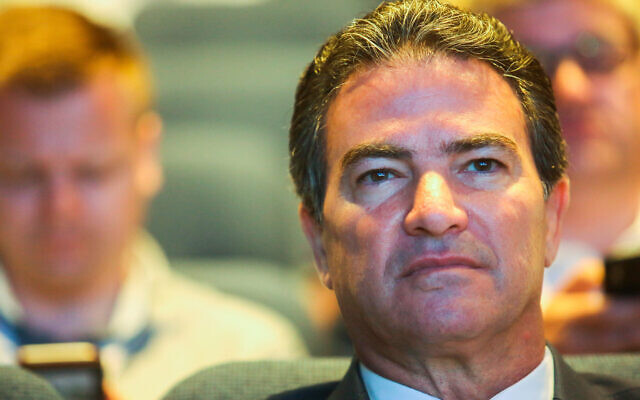
Mossad chief Yossi Cohen at a Tel Aviv University cyber conference on June 24, 2019. (Flash90)

A senior Kurdish journalist told The Times of Israel that the outlets that first reported the attack are not credible.

Prime Minister Benjamin Netanyahu’s office declined to comment on the reports.

The reports emerged amid spiraling tensions with Iran, including at sea. In the third attack of its kind in months, the MV Hyperion Ray — which sails under the Bahamas flag — reportedly came under missile fire on Tuesday near the emirate of Fujairah on the coast of the Gulf of Oman. There was no immediate claim of responsibility for the strike, but officials in Jerusalem believe Iran is responsible, according to Hebrew media reports.

The New York Times cited an Israeli security official saying no retaliatory attack was planned on an Iranian vessel since the Jewish state wants to deescalate the situation in the Persian Gulf.

Hebrew media said the missile strike caused no injuries and very minor damage. The ship was en route to the UAE from Kuwait, according to Channel 12 news.

A spokesperson for the Hyperion Ray said there was no damage and the ship continued on its route.

FILE: The Israeli-owned cargo ship MV Hyperion Ray departing Koper Port in Slovenia, October 2020. (Screenshot: YouTube)

The reported strike came as Iran threatened to avenge an attack on its Natanz nuclear site that it blames on Israel.

Iran’s Natanz nuclear facility was hit by a suspected attack on Sunday. Israel is widely believed to have carried out the assault that damaged centrifuges, though it has not claimed it.

A senior Iranian official confirmed that the blast destroyed or damaged thousands of centrifuges used to enrich uranium. Alireza Zakani, the hardline head of the Iranian parliament’s research center, referred to “several thousand centrifuges damaged and destroyed” in a state TV interview. However, no other official has offered that figure and no images of the aftermath have been released.

Tehran and Jerusalem are also engaged in a maritime shadow war, with both sides blaming the other for explosions on vessels, marking a new front in the conflict that was previously carried out on land, by air, and with alleged espionage and cyberattacks.

The MV Saviz, an Iranian cargo ship said to serve as a floating base for Iran’s paramilitary Revolutionary Guard forces off the coast of Yemen, was struck by an explosion last Tuesday, likely from a limpet mine.

In recent months, at least two Israeli-owned cargo ships have been damaged in alleged Iranian attacks, one in the Gulf of Oman and the other as it was sailing to India.
