NEW FIRE BREAKS OUT IN IRANIAN NUCLEAR FACILITY

Senior Iranian official says additional fire has broken out at Natanz uranium enrichment plant, which was earlier hit by sabotage.

Arutz Sheva Staff , Apr 11 , 2021 10:19 PM


Iran

Iran

צילום: ISTOCK

Fires broke out in an Iranian nuclear facility Sunday night, hours after the facility was struck by saboteurs, a senior Iranian official said.

Mohsen Rezaee, secretary of the Islamic regime’s Expediency Discernment Council, announced Sunday night that an additional fire has broken out in the uranium enrichment facility at Natanz.

An official from the Atomic Energy Organization of Iran was injured after the fire broke out, suffering a blow to the head and a sprained ankle after he went to assess the damage done to the Natanz facility from the initial attack.

A previous ‘incident’ at the Natanz facility was attributed to Israel’s Mossad agency, according to several Western intelligence officials.

The attack is said to have significantly impaired Iran’s uranium enrichment operations, forcing a temporary halt to all uranium enrichment efforts in the country. Power has yet to be restored to the Natanz facility.

Earlier on Sunday, an Iranian official blamed “sabotage” for the disruption of the electrical distribution grid of the country’s Natanz nuclear facility Sunday.

Malek Shariati Niasar, the spokesman for the Iranian parliament’s energy committee, wrote on Twitter that the accident, which occurred one day after the plant began enriching uranium, was “very suspicious” and speculated that it was caused by “sabotage and infiltration.”

Iran has stated that there were no casualties or radiation leakage from the incident.

Iran’s top nuclear official condemned the attack on the country’s uranium enrichment plant at Natanz as an act of “nuclear terrorism”, and hinted that Iran may retaliate.

Ali Akbar Salehi, the head of the Atomic Energy Organization of Iran and a former Foreign Minister, spoke with Irib News Sunday about the prospects of lifting US sanctions, as well as the recent attack on the Natanz nuclear facility.

Salehi downplayed the impact of the attack, saying that the ‘incident’ had failed to cause serious damage to Iran’s nuclear program.

“The action taken against the Natanz enrichment center shows the failure of the opponents of the country’s industrial and political progress to prevent the significant development of the nuclear industry.”

Nevertheless, Salehi castigated those responsible, calling the attack an act of “nuclear terrorism”. Salehi also hinted that Iran may retaliate for the incident.

“The Islamic Republic of Iran, while condemning this despicable move, emphasizes the need for the international community and the International Atomic Energy Agency to deal with this nuclear terrorism and reserves the right to take action against the perpetrators.”

“To thwart the goals of the commander of this terrorist movement, the Islamic Republic of Iran will continue to seriously expand nuclear technology on the one hand and to lift oppressive sanctions on the other.”
Natanz has in the past been targeted by Israeli cyber operations. In 2010, Stuxnet attacked the facility, destroying 1,000 centrifuges.

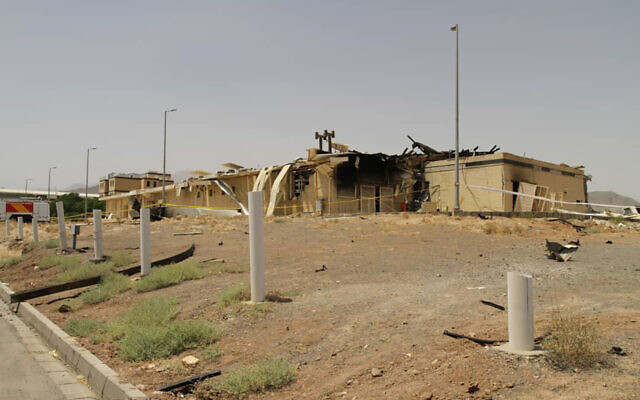
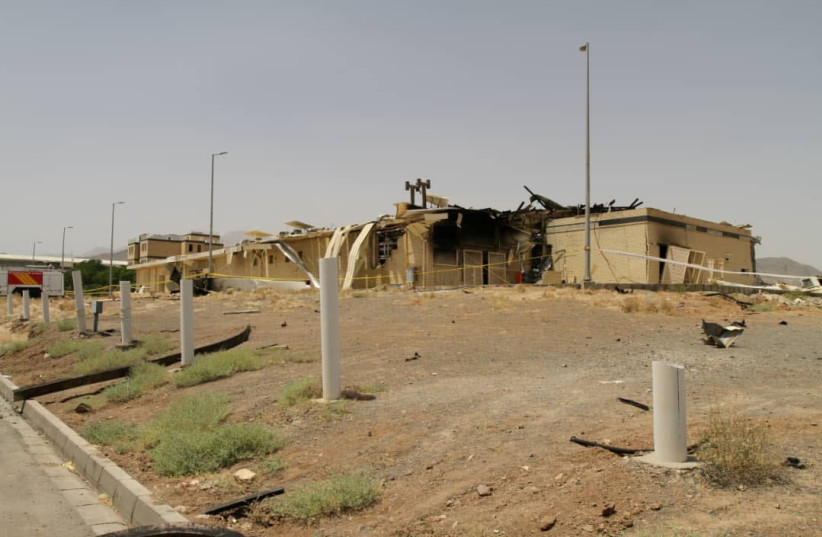
VIEW OF a damaged building after a fire broke out at Iran’s Natanz Nuclear Facility, in Isfahan on July 2. (photo credit: ATOMIC ENERGY ORGANIZATION OF IRAN/WANA VIA REUTERS)
VIEW OF a damaged building after a fire broke out at Iran’s Natanz Nuclear Facility, in Isfahan on July 2.
(photo credit: ATOMIC ENERGY ORGANIZATION OF IRAN/WANA VIA REUTERS)
The incident at Natanz on Sunday morning was not an “accident” and the damage is much graver than what Iran is presenting to the public, The Jerusalem Post has learned.

An “accident” occurred on Sunday morning in the electricity distribution network at Iran’s Natanz nuclear facility, the country’s main uranium enrichment facility, Atomic Energy Organization of Iran spokesman Behrouz Kamalvandi told the Iranian Fars News Agency.

Based on reports, it seems that the so-called accident was caused by a cyber attack, possibly by Israel. Natanz has in the past been targeted by Israeli cyber operations, according to foreign reports. In 2010, the Stuxnet virus attacked the facility in a joint operation with the United States, destroying over 1,000 centrifuges.

No injuries or pollution were caused by the incident, Kamalvandi said, adding that the cause of the incident is under investigation and further information will be announced later.
On Saturday, Iranian President Hassan Rouhani announced that Iran had begun injecting uranium hexaflouride gas into advanced IR-6 and IR-5 centrifuges at Natanz.
The reported incident comes less than a month after the International Atomic Energy Agency (IAEA) reported that Iran had restarted enrichment at the Natanz facility and less than a year after Israel was blamed by foreign reports for an alleged attack on the facility which reportedly impacted Iran’s nuclear program significantly.

Recently the Post reported that Iran is still nowhere near having recovered to the point it had been before that July 2020 explosion in terms of its capacity for assembling new advanced centrifuges.
In the alleged attack last year, Iranian reports also originally referred to the explosion as an “incident” without providing further details.

“The centrifuge assembly hall was blown up by the enemy a few months ago, but we did not stop and temporarily set up the hall that made up for the lost hall,” said AEO head Ali Akbar Salehi on Saturday, according to Fars. Salehi did not specify which “enemy” was behind the attack last year.
Salehi added that Iran is working to move sensitive facilities at Natanz further underground, with hopes that new underground halls will be ready next year.

US Defense Secretary Lloyd Austin was set to arrive in Israel on Sunday to discuss Iran’s nuclear program and Iranian activity in the region, among other issues, with Israeli officials. This will be the first visit of a high-ranking official of the Biden administration.

“The IDF’s operations in the Middle East are not hidden from the eyes of the enemies,” said IDF Chief of Staff Aviv Kohavi during a ceremony on Sunday, according to Army Radio. “Thanks to complex and sophisticated operations, the past year has been one of the safest years known to the citizens of the State of Israel. We will continue to act with power and discretion.”
The incident also comes as tensions rise between Israel and Iran amid a number of attacks on Iranian and Israeli maritime vessels, with recent reports claiming that Israel has hit dozens of Iranian ships in recent years.
On Tuesday, a spokesman for the Iranian military blamed Israel and the US for causing an explosion on the Islamic Revolutionary Guards Corps’ Saviz vessel in the Red Sea, in a statement to Sputnik news on Thursday.
“The United States undoubtedly has a hand in all attempts to undermine and harm Iran,” said the spokesman, adding that Tehran was not accusing any of the Gulf states of being involved in the incident.
The report also comes as Iran meets with European and American officials to discuss a possible return to the Joint Comprehensive Plan of Action, the formal name for the nuclear agreement signed in 2015 between the Islamic Republic and world powers.
Prime Minister Benjamin Netanyahu has warned multiple times in the past week that Israel would defend itself against Iranian threats, stressing that Israel would work to combat Iran’s nuclear ambitions.


State TV provides few details about electrical problem; on Saturday, Rouhani inaugurated cascades of IR-6s and IR-5s at same plant, in open breach of nuclear deal


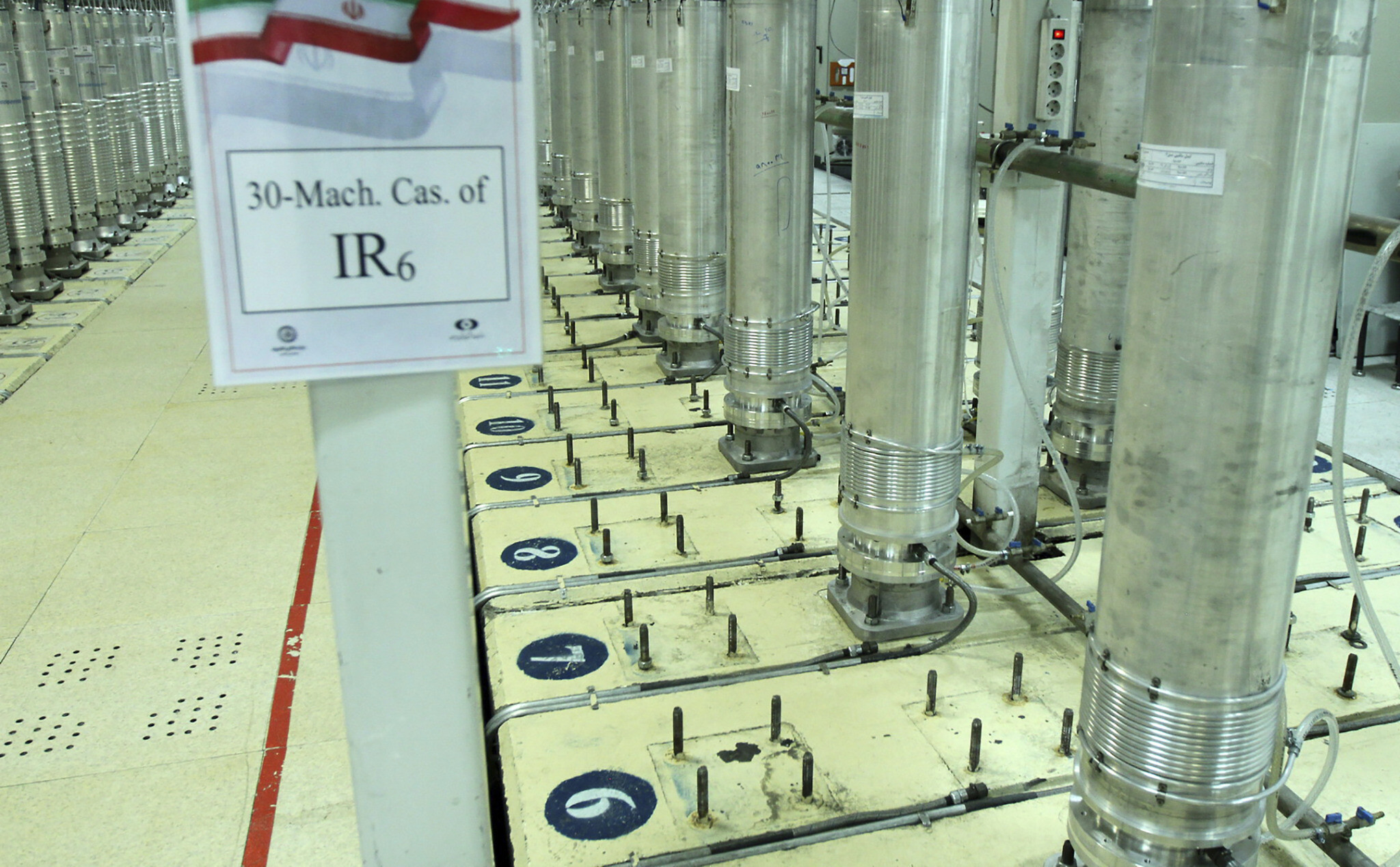
Centrifuge machines in the Natanz uranium enrichment facility in central Iran, in an image released on November 5, 2019. (Atomic Energy Organization of Iran via AP, File)

Centrifuge machines in the Natanz uranium enrichment facility in central Iran, in an image released on November 5, 2019. (Atomic Energy Organization of Iran via AP, File)

Iran’s Natanz nuclear site suffered a problem Sunday involving its electrical distribution grid just hours after starting up new advanced centrifuges that more quickly enrich uranium, state TV reported.

It was the latest incident to strike one of Tehran’s most-secured sites amid negotiations over the tattered atomic accord with world powers.

State TV quoted Behrouz Kamalvandi, a spokesman for the Atomic Energy Organization of Iran (AEOI), announcing the incident.

Kamalvandi said there were no injuries or pollution caused by the incident.

In this photo released by the official website of the office of the Iranian Presidency, President Hassan Rouhani, second right, listens to head of the Atomic Energy Organization of Iran Ali Akbar Salehi while visiting an exhibition of Iran’s new nuclear achievements in Tehran, Iran, April 10, 2021. (Iranian Presidency Office via AP)

The word state television used in its report attributed to Kamalvandi in Farsi can be used for both “accident” and “incident.” It didn’t immediately clarify the report, which ran at the bottom of its screen on its live broadcast.

The AEOI did not immediately issue a formal statement about the incident on its website.

Israel has been blamed for an attack on an advanced centrifuge development and assembly plant at Natanz in July. It has also been blamed, together with the US, for the Stuxnet virus that sabotaged Iranian enrichment centrifuges a decade ago.

Tehran and Jerusalem are currently believed to be engaged in a maritime shadow war, with both sides blaming the other for explosions on vessels.

A building Iran claims was damaged by a fire at the Natanz uranium enrichment facility some 200 miles (322 kilometers) south of Tehran, on July 2, 2020. (Atomic Energy Organization of Iran via AP)

Amid rising tensions in the region surrounding Iran’s nuclear activities and a possible revival of the 2015 nuclear accord, a deal Prime Minister Benjamin Netanyahu has vehemently opposed, US Defense Secretary Lloyd Austin will arrive in Israel on Sunday for talks with senior officials.

Iran announced on Saturday that it had started up advanced IR-6 and IR-5 centrifuges that enrich uranium more quickly, in a new breach of its undertakings under the troubled 2015 nuclear agreement.

It also said it has begun mechanical tests on an even faster nuclear centrifuge: The output of Iran’s IR-9 centrifuge, when operational, would be 50 times quicker than the first Iranian centrifuge, the IR-1, which is the only one that the 2015 deal allows it to use. Iran’s nuclear program is also developing IR-8 centrifuges.

On Friday night, Kamalvandi said the country was enriching material at a rapid pace — in violation of the nuclear deal — adding that should “Western parties” continue to delay the lifting of sanctions, they would be the “big loser.”

“The number of our centrifuges and the amount of enriched (nuclear) material are increasing rapidly,” said Behrouz Kamalvandi in comments broadcast on Instagram and cited by the Tasnim news agency Saturday.

On Friday, the International Atomic Energy Agency (IAEA) said in a report that Iran had again violated limits on its stockpile of enriched uranium, according to Reuters.

The IAEA report does not explicitly say that Iran violated the deal’s terms, but the agency releases such reports when a breach occurs. Diplomatic sources told Reuters that the report indicated that a breach of the deal had occurred.

The 2015 deal placed strict limits on Iran’s uranium stockpile. The IAEA determined on Wednesday that Iran had violated those limits by recovering uranium from items called scrap fuel plates.

This satellite photo from Planet Labs Inc. shows Iran’s Natanz nuclear facility on April 7, 2021 (Planet Labs Inc. via AP)

Iran met with the deal’s signatories in Vienna last week. The talks broke Friday, with no clear signs of progress.

The US said it had offered “very serious” ideas on reviving the nuclear accord but was waiting for Tehran to reciprocate.

Iran’s Governor to the International Atomic Energy Agency (IAEA), Kazem Gharib Abadi, leaves the ‘Grand Hotel Wien’ where closed-door nuclear talks with Iran are taking place in Vienna, Austria, April 9, 2021. (AP Photo/Florian Schroetter)

US President Joe Biden hopes to return to the 2015 agreement, which his predecessor Donald Trump had trashed as he launched a “maximum pressure” campaign in hopes of bringing Tehran to its knees.

Biden argues that the 2015 nuclear deal negotiated under former president Barack Obama had been successful, with UN inspectors saying Iran was meeting its promises to scale back nuclear work dramatically.

Iran has demanded that the United States first lift all sanctions imposed by Trump, which include a sweeping unilateral ban on its oil exports, before it falls back in line with obligations it suspended.

The “US —- which caused this crisis —- should return to full compliance first,” Iranian Foreign Minister Mohammad Javad Zarif wrote on Twitter, adding that “Iran will reciprocate following rapid verification.”

Talks are set to resume Wednesday with Iran again meeting the other nations in the deal — Britain, China, France, Germany and Russia as well as the European Union.