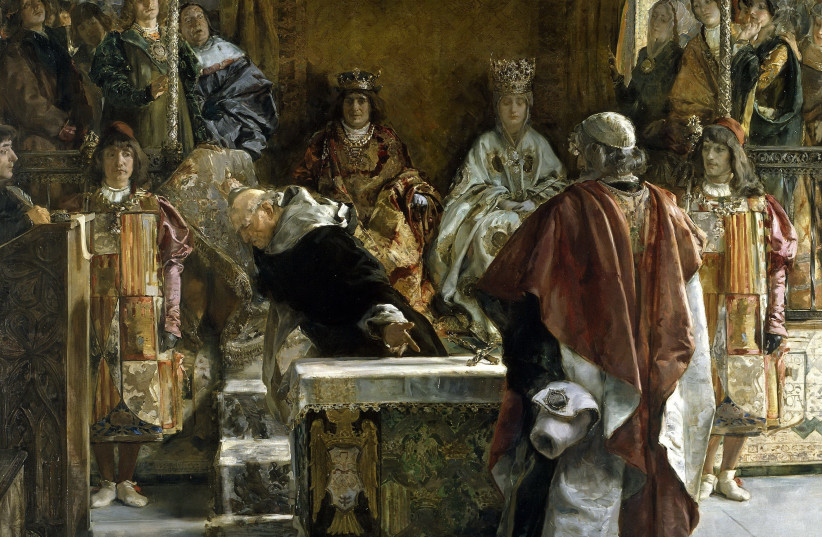
March 31 1492 marked a tragic day for Spanish Jewry, when the infamous Alhambra Decree declared the expulsion of all Jews from Spain. While explorer Christopher Columbus set out to ‘sail the ocean blue,’ the Jews of Spain were packing their things and fleeing for their lives.
“The counsel and advice of prelates, great noblemen of our kingdoms, and other persons of learning and wisdom of our Council… resolve to order the said Jews and Jewesses of our kingdoms to depart and never to return or come back,” declared King Ferdinand and Queen Isabella.
This edict of expulsion demanded that “all Jews and Jewesses of whatever age they may be, who live, reside, and exist in our said kingdoms and lordships,” no matter their personal status or identity, leave their homes within four months of the declaration. Those who did not obey were sentenced to death without trial and the confiscation of their property by the government.
The final expulsion of Spanish Jewry in 1492 followed more than 200 years of persecution by Christian authorities and antisemitic mobs. Though many Jews converted to Christianity, as conversos, and achieved high positions in both the church and government, they were still targeted. On March 14, 1473 the papal decree “Exigit sinceras devotionis affectus,” translated as “sincere devotion is required,” allowed for the legal persecution of the conversos. The auto de fé, act of faith, ceremonies began soon after, putting suspected heretics of the Christian faith on public trial.
By 1484, Grand Inquisitor Tomás de Torquemada published the “28 articles” that officially authorized the Spanish Inquisition. Interrogations including torture and cruel punishments were instituted against suspects of church betrayal and execution was permitted through civil authority.
King Ferdinand and Queen Isabella feared that
converts to the Christian faith were practicing Judaism in secret and assigned inquisitors to investigate the matter.
“There were some wicked Christians who Judaized and apostatized from our holy Catholic faith,” they wrote in the edict. The inquisitors informed the throne,”that great injury has resulted and still results, since the Christians have engaged in and continue…to steal faithful Christians from our holy Catholic faith and to separate them from it…and persuading them as much as they can to hold and observe the law of Moses, convincing them that there is no other law or truth except for that one.”
Enraged at the secret Jewish practices of the conversos, the Alhambra Decree was meant to put an end to such “heresy.”
“Every day it is found and appears that the said Jews increase in continuing their evil and wicked purpose wherever they live and congregate…True remedy for all these injuries and inconveniences was to banish them from all our kingdoms.”
The expulsion of over 200,000 Jews from Spain that ensued four months later was catastrophic for Spanish Jewry. Jews were forced to hand their possessions and estates over to the unsympathetic hands of their Christian neighbors at prices well below what they were worth. With nothing but the clothes on their back, Spanish Jews fled their homeland.
However, their struggles did not end there.
“Spanish ship captains charged Jewish passengers exorbitant sums, then dumped them overboard in the middle of the ocean,” and “Rumors spread throughout Spain that the fleeing refugees had swallowed gold and diamonds, and many Jews were knifed to death by brigands hoping to find treasures in their stomachs,” wrote Rabbi Joseph Telushkin in his book Jewish Literacy.
Many who fled to other countries experienced additional expulsion, most notably in
Portugal during the 1496 expulsion. Spanish Jews became nomads, constantly running from one persecution to the next.
Only on December 16, 1968 did Spain officially annul the Alhambra Decree, offering citizenship to descendants of Spanish Jews as reconciliation for the injustice.
Many historians claim that the Spanish Inquisition and the expulsion of the Jews were necessary evils in the unification of the country, but historian and Rabbi José Faur wrote that such persecution displayed “the dark side of humankind : the manipulation of religion (or other ideologies) for cynical purposes” (Jews, Converso, and Native Americans: The Iberian Experience).
He pointed out that, “Other European countries attained national unity without pursuing any of the Spanish policies.”
This brutal expulsion was devastating for Jews of Spanish origin, who were once major contributors to Spanish society and culture; many felt deep animosity and betrayal by the country they once proudly called home.