
Would Iran be prepared to attack a US military base in America?

Iran’s Islamic Revolutionary Guard Corps discussed attacking a US military base using an explosive-laden boat.
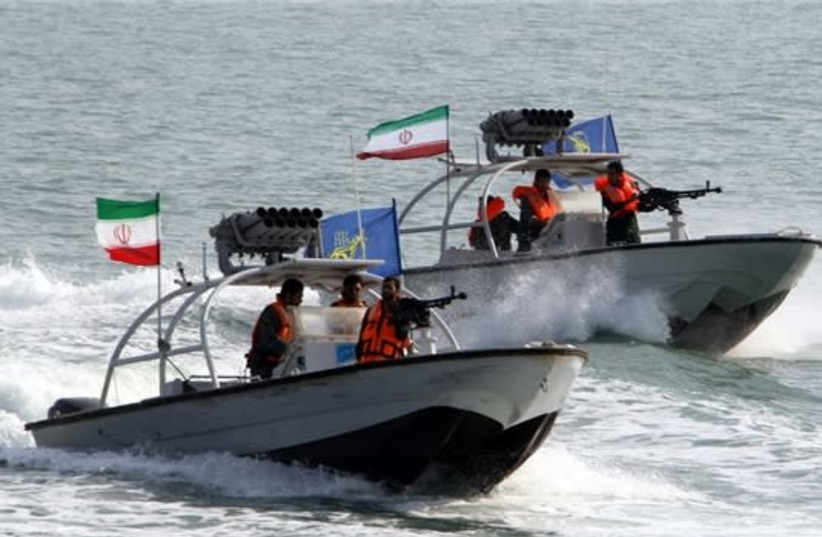
IRGC siezes ship near Bu Musa Island, Iran (photo credit: Wikimedia Commons)
IRGC siezes ship near Bu Musa Island, Iran
(photo credit: Wikimedia Commons)
Members of Iran’s Islamic Revolutionary Guard Corps discussed attacking a US military base, according to the Associated Press. The Fort McNair Army base is a 10-minute drive from the White House and is located in the US capital. The National Security Agency intercepted the communications in January and they include discussions of using some kind of explosive-laden boat as was used in a 2000 attack in Yemen against the USS Cole.
“The intelligence also revealed threats to kill Gen. Joseph M. Martin and plans to infiltrate and surveil the base, according to the officials, who were not authorized to publicly discuss national security matters and spoke on condition of anonymity. The base, one of the oldest in the country, is Martin’s official residence,” the report says.
It was not clear how advanced the threat was or how high level the officers involved were or if they had the means and opportunity, skills or even ability to carry out such an attack.
However, two intelligence officials described the report to the AP. “They said Tehran’s military commanders are unsatisfied with their counterattacks so far, specifically the results of the ballistic missile attack on Ain al-Asad airbase in Iraq in the days after [Qasem] Soleimani’s killing. No US service members were killed in that strike but dozens suffered concussions.” The report came amid discussions of providing more security for the base and restrictions in the area.
Iran’s Tasnim media highlighted the report, which could indicate Iran approves of this type of attack or wants to message a threat to the US.
“According to the two intelligence officials, the US military has sought to strengthen the security of Fort McNair after the revelation of the plan,” the report notes. “The US military is working to increase the [security buffer] area of Fort McNair from 250 feet (about 76 meters) to 500 feet (more than 150 meters), but Washington officials say the move will give the public access to the Potomac River.” This would limit access to the Potomac, an important river that once gave its name to part of the Union Army forces in the US Civil War.
US military bases have been threatened in the past.
These threats usually come from jihadists inspired by al-Qaeda or ISIS. In 2009, there was a shooting at Fort Hood and a plot to attack Fort Dix in 2007. In 2019, there was a terrorist attack at Naval Air Station Pensacola that was inspired by al-Qaeda. Iran has been accused of hosting senior al-Qaeda leaders in the past.
In November 2020, The New York Times reported that Israel, acting at the behest of the US, coordinated the killing of al-Qaeda’s number two, Abdullah Ahmed Abdullah al-Masri, in Tehran. He was a mastermind behind attacks on US embassies in the 1990s.
It’s not clear if Iran may have learned from al-Qaeda about the use of USS Cole-style attacks and the attack on US bases by jihadists in the US and whether the IRGC was inspired by these acts to plan a brazen attack on Fort McNair. Iran usually uses proxies in places like Iraq to attack US bases and doesn’t usually want to use actual Iranians to carry out its plots because it wants to pretend the attacks are local.
Iran has vowed revenge for the US killing of IRGC Quds Force head Qasem Soleimani. Iran labeled US Central Command a “terrorist” organization after the US labeled the IRGC “terrorists” in April 2019.
Any link to Iran in an attack on a US base would likely lead to a major US response. Iran would likely be reticent to carry out such an attack. It might conceivably use proxies or provide means to others to do such an attack.


Report: Israel attacked more than 12 Syria-bound Iranian ships

Reports alleging Israel has struck at least a dozen oil tankers en-route for Syria to be used in sponsoring terrorist activities.

Arutz Sheva Staff , Mar 21 , 2021 9:55 AM


https://youtu.be/ANdxfjK_5fI


Knowing Israel can destroy their nuclear sites will deter Iran from trying to produce a nuclear weapon.

A B-52 STRATOFORTRESS prepares for refueling during a close-air-support mission. (photo credit: US AIR FORCE/SGT. LANCE CHEUNG/REUTERS)
A B-52 STRATOFORTRESS prepares for refueling during a close-air-support mission.
(photo credit: US AIR FORCE/SGT. LANCE CHEUNG/REUTERS)
US President Joe Biden’s administration seeks to negotiate with Iran. If it does not work, the US will have to deter Iran from producing nuclear weapons. Another scenario is that the 2015 nuclear agreement with Iran, the Joint Comprehensive Plan of Action, might survive and even be improved following future negotiations.
It would include strict monitoring of Iran’s nuclear program, but this will not be sufficient. Deterrence will also be required. Negotiations will deficiently be needed when the JCPOA expires – or even before that if Iran assumes it has the opportunity to produce the bomb. This could happen if the US is deeply busy with a major crisis somewhere, such as with China. Either way deterrence, based on boosting Israel’s military capabilities, should be part of the effort to make sure Iran does not try to produce a nuclear weapon
Israel can help, especially since the US wants to reduce its commitments in the Middle East. In a way, Israel could replace the US in deterring Iran. It will make it easier for the US and actually for Israel too. Although Israel needs its American patron relying on Israel’s strength works for Israel. It has been its traditional approach: to depend on itself as much as possible, particularly in military affairs. It requires having a big stick i.e. holding the arsenal needed to deter Iran.
In late 2020 there was a bipartisan bill in the US congress aimed at providing Israel with a giant bunker-buster bomb capable of destroying Iran’s heavily protected nuclear sites. Israel also needs the B-52 to carry that huge bomb. Knowing Israel can destroy their nuclear sites will deter Iran from trying to produce a nuclear weapon.
If Iran tries to produce a nuclear weapon, Israel will rush to attack with its available arsenal out of desperation. It might not be enough to destroy heavily protected Iranian sites. The US does not want to urge Israel to attack Iran let alone if this raid escalates into a war, one that might drag the US into it. If Israel is better armed it might not be necessarily bring a strike against Iran. Instead, Israel can deter Iran from producing a nuclear weapon to begin with.
Iran’s best fighters – such as the MIG-29 and F-14 – are almost obsolete. They would not be much of a match to Israel’s superior aircraft. The Israel Air Force has also advanced air-to-air missiles and worldwide reputation in air to air combat. The IAF can reach Iran and overcome Iran’s air defenses and air force. Israel’s main problem will be to penetrate Iran’s highly protected nuclear sites, such as the one in Fordow. The IAF has bunker buster bombs, the GBU-28, but they can’t crack the fortification of targets like Fordow. For that mission the IAF requires the MOP (Massive Ordnance Penetrator), a US made bomb that weighs 30,000 pounds.
Israel needs its American patron to provide the IAF not only with the MOP, but also with a heavy bomber to carry that huge bomb. The IAF does not have heavy bombers, only fighter-bombers: the F-15, F-16 and F-35.  Israel should not ask for the B-2, but for the B-52. The veteran B-52 is quite old, which will make it easier for the US to give a few B-52s to Israel.
Israel should at least get the MOP. Getting the B-52 faces difficulties of arms control.