
Presidents of Germany, France, and Austria invite Israeli counterpart for meetings about Tehran’s nuclear program, ICC war crimes probe


President Reuven Rivlin shakes hands with German President Frank-Walter Steinmeier (L) at the President's Residence in Jerusalem on January 22, 2020. (Hadas Parush/Flash90)

President Reuven Rivlin shakes hands with German President Frank-Walter Steinmeier (L) at the President’s Residence in Jerusalem on January 22, 2020. (Hadas Parush/Flash90)

President Reuven Rivlin will travel to Germany, France, and Austria next week to speak to their presidents about the growing threat from Iran’s nuclear program and the International Criminal Court’s decision to open a probe into alleged war crimes by Israel and Palestinian terror groups.

Rivlin was invited by the presidents, his office said in a statement Thursday. He will be accompanied by IDF Chief of Staff Aviv Kohavi, who will brief the European presidents on security matters.

They will discuss the “intensification” of Iran’s nuclear project, the International Criminal Court’s decision, and the danger of the Iran-backed Lebanese terror group Hezbollah’s growing power, the statement said.

Rivlin has previously met with all three of the presidents in Jerusalem.

The three-day trip comes as the UN’s nuclear watchdog is working to save a 2015 agreement between world powers and Iran that has unraveled ever since former US president Donald Trump pulled out of it in 2018. Germany and France are both signatories to the so-called Joint Comprehensive Plan of Action, which gave Iran relief from sanctions in return for curbs to its nuclear program.

After its withdrawal from the pact, the US reapplied strict sanctions on Iran, which responded by stepping away from its own commitments to the deal, in particular by ramping up uranium enrichment, a key process in producing a nuclear weapon.

President Reuven Rivlin greets Austrian President Alexander van der Bellen (R) at the President’s Residence in Jerusalem on January 22, 2019. (Mark Neyman/GPO)

ICC chief prosecutor Fatou Bensouda announced earlier this month that she was opening an investigation into actions committed by Israel and the Palestinians in the West Bank, Gaza, and East Jerusalem since 2014.

The Palestinians have already said they will cooperate with the probe by the Hague-based court. Israel has yet to decide how it will respond but the decision to open an investigation was condemned by top Israeli officials, including Prime Minister Benjamin Netanyahu who called the decision “undiluted anti-Semitism and the height of hypocrisy.”

Rivlin will leave on March 16 to meet German President Frank-Walter Steinmeier in Berlin.

The following day he will head to Vienna for a meeting with President Alexander Van der Bellen of Austria. While in the country he will also deliver remarks at a Holocaust remembrance ceremony at the memorial for Jewish Austrians, the statement from his office said.

On Thursday, the last day of his trip, Rivlin will head to Paris to meet France’s President Emmanuel Macron before returning to Israel.

French President Emmanuel Macron (L) and President Reuven Rivlin at a press conference in Jerusalem on January 22, 2020. (Jacques Witt/Pool/AFP)

US President Joe Biden and his administration have repeatedly said they will return to the JCPOA if Tehran first returns to compliance. Iran has insisted the US remove sanctions before it returns to the deal’s terms, putting the two sides at a stalemate.

In recent months, Iran has repeatedly taken steps to violate the deal and turn up the heat on the US, including by enriching uranium past the accord’s limits and barring UN inspections of its nuclear facilities.

On Thursday, Israeli and US officials were to hold the first session of a bilateral strategic group aimed at collaborating in the effort to prevent Iran from obtaining a nuclear weapon, an official familiar with the matter told The Times of Israel.
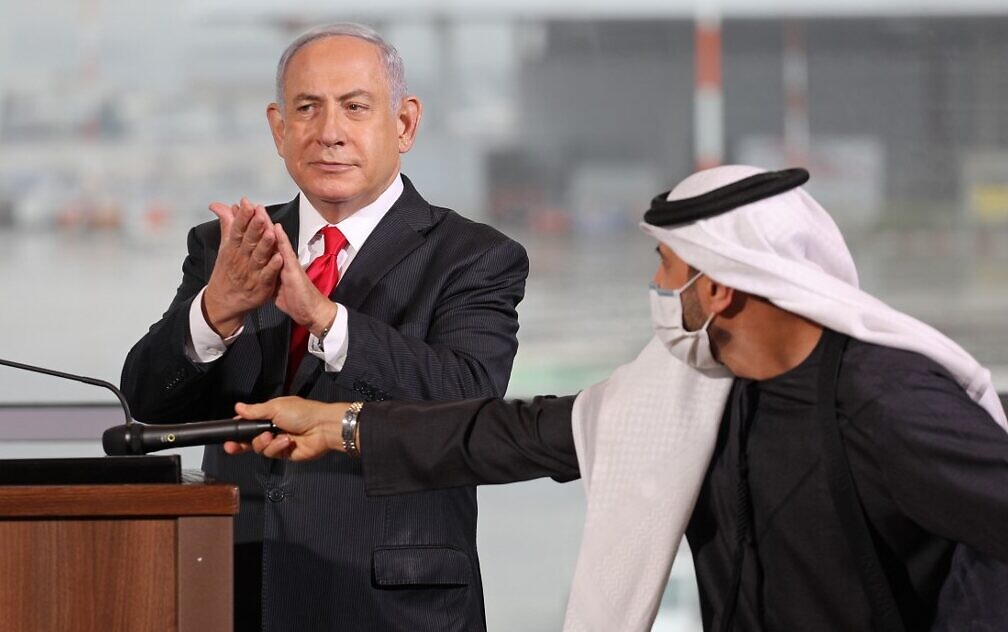

PM had been scheduled for whirlwind Abu Dhabi visit Thursday; official says Amman refused to approve flight route amid quarrel over its crown prince’s scrapped Temple Mount tour


Prime Minister Benjamin Netanyahu (L) claps during a ceremony welcoming passengers on a flight operated by budget airline flydubai to Ben Gurion Airport, near Tel Aviv, on November 26, 2020. (Emil Salman/Pool/AFP)

Prime Minister Benjamin Netanyahu (L) claps during a ceremony welcoming passengers on a flight operated by budget airline flydubai to Ben Gurion Airport, near Tel Aviv, on November 26, 2020. (Emil Salman/Pool/AFP)

Prime Minister Benjamin Netanyahu canceled his whirlwind visit to the United Arab Emirates Thursday, Israeli officials told Hebrew media, after his wife was hospitalized and after Jordan refused to approve his flight path over the Hashemite kingdom.

Sara Netanyahu was hospitalized with an appendix infection late Wednesday.

In a separate hitch, an Israeli official said earlier Thursday that Jordan had yet to approve the prime minister’s flight path over the country to the Gulf state, holding up the trip at the last minute.

The official said this was likely in retaliation for the Jordanian crown prince’s canceled trip to the Temple Mount on Wednesday, which he called off amid a fight with Israel over entry permits for his security detail.

Abu Dhabi’s Crown Prince, Sheikh Mohamed bin Zayed Al Nahyan, smiles during a meeting at the White House in Washington, May 15, 2017. (Andrew Harnik/AP)

Netanyahu had been scheduled to meet Crown Prince Mohammed bin Zayed Al Nahyan Thursday, in his first official visit to the UAE since Jerusalem and Abu Dhabi forged diplomatic ties last year.

Reports on Wednesday suggested Netanyahu may have also been hoping to meet Saudi Arabian Crown Prince Mohammed bin Salman and Sudanese Prime Minister Abdalla Hamdok during the trip, which was scheduled to be held 12 days before Israel holds its fourth national election in two years.

The trip has been planned for several months but postponed on numerous occasions, most recently in February. Netanyahu had originally been set to make the trip in November, then December, and then in January and February, but the pandemic, scheduling issues, and internal political crises led to repeated delays.

The Prime Minister’s Office said last month that the trip would be indefinitely postponed due to the closing down of air travel to and from Israel as part of a national lockdown aimed at preventing coronavirus variants from being imported from abroad.

Netanyahu has been seen as eager to make the trip before the March 23 elections to tout his diplomatic achievements and boost his campaign.

The trip was expected to be a celebration of Israel’s normalization deals as well as a move to boost Netanyahu’s diplomatic credentials ahead of elections. Netanyahu may also hope to use the visit to consolidate a campaign against a US return to the Iran nuclear deal.

National Security Adviser Meir Ben-Shabbat elbow bumps with an Emirati official ahead of boarding the plane before leaving Abu Dhabi, United Arab Emirates, September 1, 2020. (Nir Elias/Pool/AFP)

Emirati officials told the Walla news site Wednesday that there had been concerns the visit would be seen as an intervention in the Israeli elections, but in the end Abu Dhabi agreed to the trip.

Surveys show the prime minister struggling to muster the 61-seat Knesset majority that would enable him to form a coalition, though his rivals also have no clear route to power, and the timing of the trip may bolster Netanyahu’s campaign.

Netanyahu tasked Mossad intelligence agency chief Yossi Cohen with persuading the UAE to agree to the visit, Axios reported, and it was not clear what, if anything, was promised to the Emiratis in return for their consent. “The Emiratis sent signals that they’d rather postpone the visit until after the elections, but Netanyahu and Cohen pressed hard until the Emiratis agreed,” Axios said.

The Kan public broadcaster reported Wednesday that there had been “advanced contacts” on setting up a meeting with the de facto leader of Saudi Arabia. The report, which did not cite a source, didn’t provide further details.

Left: Prime Minister Benjamin Netanyahu at a ceremony in Tel Aviv, Israel, Monday, March 8, 2021 (Miriam Alster/Pool via AP); Right: Saudi Arabia’s Crown Prince Mohammed bin Salman attends a virtual G-20 summit held over video conferencing, in Riyadh, Saudi Arabia, Sunday, Nov. 22, 2020 (Bandar Aljaloud/Saudi Royal Palace via AP)

The Reuters news agency, however, cited an official Saudi source denying that Prince Mohammed bin Salman would visit the UAE Thursday or meet Netanyahu.

Separately, Channel 13 news reported Wednesday that Netanyahu may meet with his Sudanese counterpart Abdalla Hamdok while in the UAE. The report said Israel was in talks to make the meeting happen, but didn’t give further details.

Netanyahu met last year in Uganda with Gen. Abdel-Fattah Burhan, the head of Sudan’s ruling sovereign council.

Sudan’s Prime Minister Abdalla Hamdok at a press conference in Khartoum, Sudan, August 21, 2019. (AP Photo)

Channel 12 news reported Wednesday that the premier would only be at the airport in Abu Dhabi and Thursday’s trip wasn’t expected to last more than a few hours.

The network also reported that Defense Minister Benny Gantz was set to meet with the Abu Dhabi crown prince at the UAE arms fair last month before the Israeli delegation’s appearance was canceled over safety concerns.


Erdogan confidant calls for ‘re-normalized’ ties with Israel

As Turkey finds itself increasingly shut out of cooperation between Mediterranean states, Ankara continues to send friendly signals to Jerualem.

A close associated of Turkish President Recep Tayyip Erdogan, Admiral Cihat Yayci, said in an interview Wednesday to the Turkish Jewish newspaper Şalom that “it is in the interests of both Turkey and Israel to re-normalize relations.”

Yayci called on Israel to take up the proposal of a shared maritime border, first reported by Israel Hayom on March 5. A more detailed version of the plan was published in the Turkeyscope monthly journal published by the Moshe Dayan Center at Tel Aviv University.

Yayci gave the interview after Turkey suffered another diplomatic blow when Egypt and Greece agreed this week to disagree about proposed areas for gas and oil drilling in the Mediterranean Sea.

This occurred five days after Turkish Foreign Minister Mevlüt Çavuşoğlu said that Turkey could reach an agreement with Egypt on a maritime border.

Greek Foreign Minister Nikos Dendias said that the dispute over one of Egypt’s three drilling areas was “technical” and had been resolved. According to reports, teams from Egypt met and re-drew maritime borders for the problematic area, a deal that directly affects Turkey, since the Turks claim ownership of the area delineated by Greece and Egypt.