Years of Jordanian frustration with Prime Minister Benjamin Netanyahu boiled over this week, as officials in Amman appeared to accuse him of endangering the region for political reasons and alleged that Israel had violated agreements with them.
At a press conference Thursday, Jordanian Foreign Minister Ayman Safadi assailed “those who are toying with the region and its peoples’ right to live in peace for the sake of electoral and populist concerns… destroying the trust which is the basis for ending the conflict.”
Safadi’s comments came the day after Jordan’s Crown Prince Hussein bin Abdullah abruptly canceled a planned visit to the Temple Mount in the Old City of Jerusalem over a disagreement with Israeli authorities about his security detail.
Jordan retaliated by delaying approval for the prime minister’s flight path over the country to the United Arab Emirates for a planned visit Thursday. Netanyahu’s trip was eventually postponed to an unknown date.
“The crown prince wanted to make a religious visit to the Al-Aqsa mosque and pray there on the night of the Israa’ and the Mi’araj, as it is of great religious significance to all Muslims,” said Safadi. “We had reached arrangements for visits with the Israeli side. We were surprised when they sought to impose new arrangements and change the plan for the visit in a manner which would have distressed Jerusalemites during that night of worship. As such, the crown prince decided that he would not impose that upon Muslims or disturb the purity of that night.”
The foreign minister’s unusually harsh comments extended to the status of the Temple Mount in Jerusalem. “Al-Aqsa mosque is entirely a place of worship for Muslims. Israel has no sovereignty upon it… nor do we accept any Israeli intervention in its affairs,” he said.
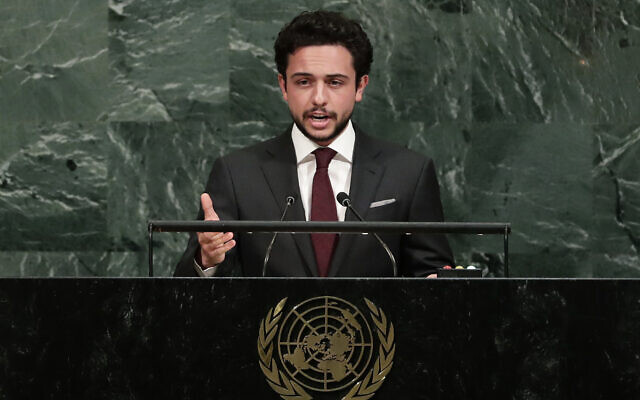
Jordan’s Crown Prince Hussein bin Abdullah addresses the United Nations General Assembly, at the United Nations headquarters, September 21, 2017. (Frank Franklin II/AP)
Israel captured the Temple Mount and Jerusalem’s Old City in the 1967 Six Day War and extended its sovereignty over Jerusalem. However, it allowed the Jordanian Waqf to continue to maintain religious authority atop the mount, where Jews are allowed to visit, but not to pray. Jordan’s role as custodian was enshrined by the landmark Israeli-Jordanian peace agreement in 1994.
On the surface, this week’s diplomatic crisis seemed to have erupted out of nowhere.
“There were positive developments recently,” said Oded Eran, senior research fellow at the Institute for National Security Studies in Tel Aviv and a former ambassador to Jordan. Eran referenced last week’s meeting between Safadi and Foreign Minister Gabi Ashkenazi at the Allenby Crossing between the West Bank and Jordan, the third such meeting at the crossing.
But the encouraging signs in recent weeks couldn’t paper over the way officials in Jordan feel about Israel’s leader.
“The Jordanians are not particularly happy with Netanyahu, and haven’t been happy with him for a long time,” said Joshua Krasna, Middle East expert at the Moshe Dayan Center at Tel Aviv University.
Jordan’s King Abdullah said in 2019 that relations between Israel and Jordan were “at an all-time low” after a series of incidents that prompted Amman to recall its ambassador to Israel.
That year, Jordan terminated special arrangements that allowed Israeli farmers to easily access plots of land inside Jordan. Israel’s arrest of two Jordanian citizens for suspected terrorism also caused a minor diplomatic spat.
Jordan and Israel share strong security ties, but political relations have also soured over Israel’s policies on the Palestinians and the Temple Mount in Jerusalem, which is under Jordanian custody, even as Israel moved closer to other Sunni Arab states.
In 2017, Netanyahu gave a hero’s welcome to an Israeli security guard after he shot dead two Jordanians during a stabbing attack on him at an apartment belonging to the Israeli Embassy in Amman.
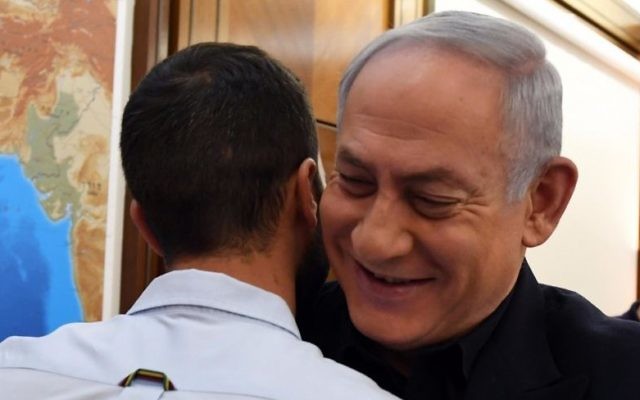
Prime Minister Benjamin Netanyahu on July 25, 2017 meets with security guard ‘Ziv,’ who shot dead two Jordanians as he was being stabbed by one of them at the Israeli Embassy compound in Amman on July 23. (Haim Zach/GPO)
Israel paid some $5 million in compensation to the Jordanian victims, though the guard was not tried in an Israeli court, as Amman had demanded.
“That was a major provocation,” said Oraib Rantawi, a Jordanian analyst and head of the Al-Quds Center for Political Studies.
The Jordanians are also frustrated because of the normalization agreements known as the Abraham Accords that Israel signed with Bahrain and the United Arab Emirates.
Publicly, Amman has no choice but to praise the agreements. It has close ties with the UAE and with the United States, which brokered the deal under former president Donald Trump, and is trying to restore close cooperation with Saudi Arabia.
“But they are unhappy,” Krasna explained. “Part of that unhappiness is expressed in the fact that they are constantly saying, including Safadi yesterday, that these agreements shouldn’t be coming at the expense of the Palestinians and that the only way to solve the Palestinian issue is by a two-state solution.”
Krasna called Jordan’s displeasure at the accords the “unhappiness of the wife with the new mistress.”
“The Jordanians — and the Egyptians by the way — paid a high price when they made peace treaties with Israel,” he emphasized.
Yet Israel’s neighbors had to watch as the Trump Administration engineered the landmark regional peace deals that did not depend on Egyptian or Jordanian involvement.
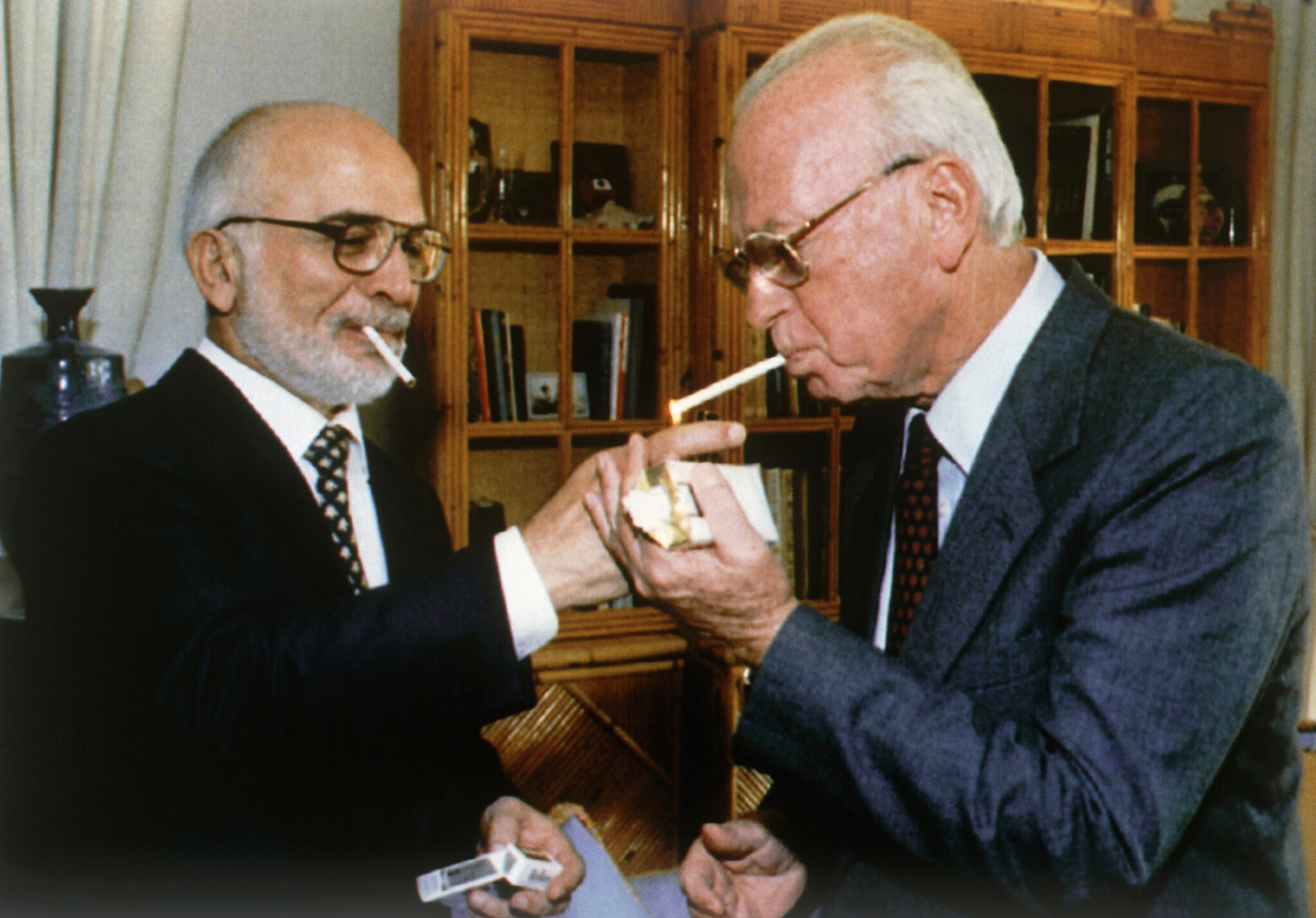
King Hussein of Jordan, left, holds a light for Prime Minister Yitzhak Rabin’s cigarette after the signing ceremony of the Israeli Jordanian peace treaty on Wednesday, October 26, 1994 in Aqaba, Jordan. (AP Photo/pool/IGPO)
“Suddenly Israel is talking about the wonderful relations and the wonderful opportunities it has with the UAE, and that it has with Bahrain and perhaps with other states… The Jordanians and Egyptians feel left out twice,” Krasna said.
“Once, when all this was going on no one was telling them, including the Americans. Second, they’re saying, ‘We’re the ones who went the extra mile and did the really hard work. It’s easier for the UAE and Bahrain to make peace with Israel than it is for Egypt and Jordan. But for some reason the shiny new partners are more attractive to the Israelis than us old pedestrian partners who have been working and plugging away at this relationship for a long time.’”
Jordan — and to some extent Israel — feels disappointed with the results of the 1994 peace deal. “It is a cold peace, and our relationship is getting colder,” King Abdullah II acknowledged in an interview 12 years ago.
Neither side organized any major events to mark the 25th anniversary of the treaty in 2019.
Even when the sides have signed major deals meant to benefit all parties, things have turned sour. A $10 billion deal signed in 2016 was meant to provide 45 billion cubic meters of Israeli gas to Jordan over 15 years. But in 2020, only days after Israeli gas imports began, Jordan’s parliament voted unanimously to ban such deliveries (though it lacks ability to enforce such a measure). The deal also locked in higher prices than the 2021 market rate.
The past two years of repeated elections in Israel have made matters worse, leaving Jordan feeling it is a pawn in Netanyahu’s political maneuvering. Abdullah publicly opposed Netanyahu’s push to annex parts of the West Bank last year — widely seen as an elections ploy — which the prime minister dropped as part of the agreement to normalize ties with the UAE.
“It puts them in a place where they don’t want to be,” said Krasna. “They have a lot of connections with the Palestinians. And Israel, for election reasons, put things that used to be dealt with quietly as maybe the cornerstone of Netanyahu’s most recent election campaign.”
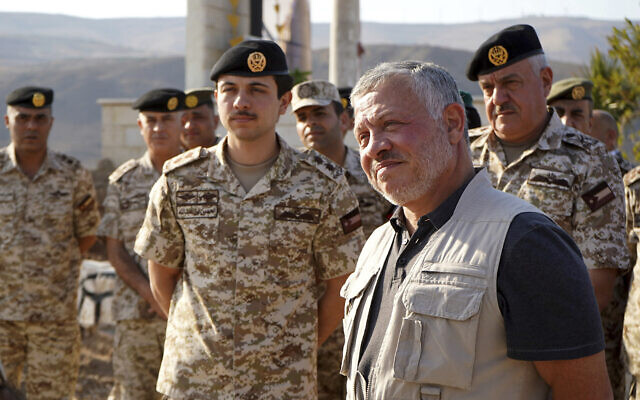
Jordan’s King Abdullah II, second right, tours an enclave formerly leased by Israel with Crown Prince Hussein and military officers, November 11, 2019. (Yousef Allan/Jordanian Royal Court via AP)
While Abdullah reportedly met quietly with Defense Minister Benny Gantz recently, he is said to have turned down requests by Netanyahu to meet.
“It’s very clear to the Jordanians that any meeting with Netanyahu over the past two years would immediately be used for election purposes,” said Krasna.
Adding to Jordan’s recent displeasure with Israel is concern over eroding influence on the Temple Mount. In 2019, Abdullah claimed he was under pressure to alter his country’s historic role as custodian of the Jerusalem holy sites. He vowed to keep protecting Islamic and Christian holy sites in Jerusalem, calling it a “red line” for his country.
Middle East pundits have in the past suggested that Saudi Arabia is interested in taking over responsibility for the Temple Mount and the mosques within its compound. Saudi Arabia is already the custodian of the two holiest Muslim sites in Mecca and Medina, both within its territory.
In January 2018, then-opposition leader Isaac Herzog said Saudi Arabia could play a key role in Jerusalem, taking responsibility for administering Muslim holy sites in any peace deal between Israel and the Palestinians.
“They’re in competition with other players in the region,” said Krasna. “The Palestinian Authority is constantly trying to increase its influence on the Temple Mount. The Turks are constantly trying to increase their influence.”
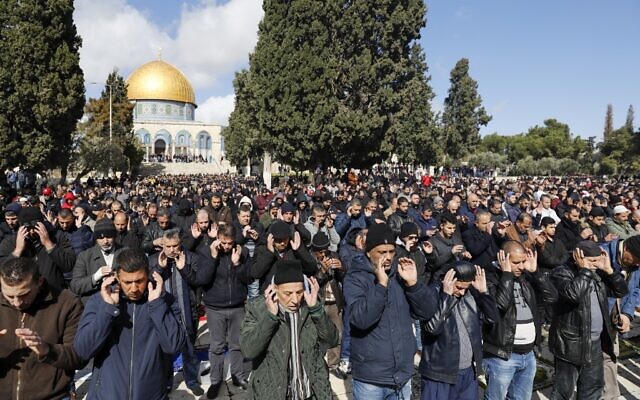
Muslim men attend Friday prayers on the Temple Mount in Jerusalem’s Old City on January 31, 2020. (Ahmad Gharabli/AFP)
“This is a prestige issue for the royal family, for Jordan. But not only a prestige issue. It’s one of the issues that the Jordanian royal family really sees as a key to its continued political legitimacy.”
So this week, what was supposed to be a celebration of Israel’s normalization deals with the UAE — as well as a move to boost Netanyahu’s diplomatic credentials ahead of the elections — could now be an unwelcome burden on Netanyahu.
Many observers are putting the blame on his handling of ties with Jordan.
“This is something that shouldn’t have happened,” said Eran, the former ambassador to Jordan. “There’s a lack of trust between the sides, a lack of dialogue at the highest levels, and this is what happens.”
“The current crisis didn’t come from nowhere,” said former Zionist Union MK Ksenia Svetlova, now a fellow at the Mitvim Institute. “Netanyahu governments throughout the years harm our strategic relationship with Jordan. The time has come to value our close neighbor and to invest in repairing the relations with it.”
AP contributed to this report.







PRINT
TEXT
20