PM scheduled to jet off to Abu Dhabi Thursday for a whirlwind visit, meeting with Emirati crown prince; Sara Netanyahu hospitalized with appendix infection


Prime Minister Benjamin Netanyahu (L) claps during a ceremony welcoming passengers on a flight operated by budget airline flydubai to Ben Gurion Airport, near Tel Aviv, on November 26, 2020. (Emil Salman/Pool/AFP)

Prime Minister Benjamin Netanyahu (L) claps during a ceremony welcoming passengers on a flight operated by budget airline flydubai to Ben Gurion Airport, near Tel Aviv, on November 26, 2020. (Emil Salman/Pool/AFP)

Prime Minister Benjamin Netanyahu was reportedly considering canceling his whirlwind visit to the United Arab Emirates Thursday due to his wife’s illness.

According to Hebrew media reports, the prime minister was leaning toward scrapping Thursday’s trip after Sara Netanyahu’s hospitalization with an appendix infection late Wednesday. Officials said a final decision would be made soon.

Netanyahu had been scheduled to meet Crown Prince Mohammed bin Zayed Al Nahyan Thursday, in his first official visit to the Gulf country since Jerusalem and Abu Dhabi forged diplomatic ties last year.

Reports on Wednesday suggested Netanyahu may also meet Saudi Arabian Crown Prince Mohammed bin Salman and Sudanese Prime Minister Abdalla Hamdok during the trip, which comes 12 days before Israel holds its fourth national election in two years.

The trip has been planned for several months but postponed on numerous occasions, most recently in February. Netanyahu had originally been set to make the trip in November, then December, and then in January and February, but the pandemic, scheduling issues, and internal political crises led to repeated delays.

Prime Minister Benjamin Netanyahu and his wife Sara address their supporters on the night of elections, at Likud party headquarters in Tel Aviv, on March 3, 2020. (Olivier Fitoussi/Flash90)

The Prime Minister’s Office said last month that the trip would be indefinitely postponed due to the closing down of air travel to and from Israel as part of a national lockdown aimed at preventing coronavirus variants from being imported from abroad.

Netanyahu has been seen as eager to make the trip before the March 23 elections to tout his diplomatic achievements and boost his campaign.

The trip was expected to be a celebration of Israel’s normalization deals as well as a move to boost Netanyahu’s diplomatic credentials ahead of elections. Netanyahu may also hope to use the visit to consolidate a campaign against a US return to the Iran nuclear deal.

National Security Adviser Meir Ben-Shabbat elbow bumps with an Emirati official ahead of boarding the plane before leaving Abu Dhabi, United Arab Emirates, September 1, 2020. (Nir Elias/Pool/AFP)

Emirati officials told the Walla news site Wednesday that there had been concerns the visit would be seen as an intervention in the Israeli elections, but in the end Abu Dhabi agreed to the trip.

Surveys show the prime minister struggling to muster the 61-seat Knesset majority that would enable him to form a coalition, though his rivals also have no clear route to power, and the timing of the trip may bolster Netanyahu’s campaign.

Netanyahu tasked Mossad intelligence agency chief Yossi Cohen with persuading the UAE to agree to the visit, Axios reported, and it was not clear what, if anything, was promised to the Emiratis in return for their consent. “The Emiratis sent signals that they’d rather postpone the visit until after the elections, but Netanyahu and Cohen pressed hard until the Emiratis agreed,” Axios said.

Regional Cooperation Minister Ofir Akunis, of Netanyahu’s Likud party, appeared to confirm the planned trip Thursday in an interview with Army Radio. He denied it was being organized as an election stunt.

Likud MK Ofir Akunis speaks at the Knesset, on May 20, 2019. (Noam Revkin Fenton/Flash90)

“The visit isn’t the result of pleading,” Akunis said. “Netanyahu was meant to go there in the past, but the trip was delayed due to Israel’s skies closing. Attributing this to the election is like attributing the [COVID-19] vaccination [campaign] to the elections.”

The Kan public broadcaster reported Wednesday that there had been “advanced contacts” on setting up a meeting with the de facto leader of Saudi Arabia. The report, which did not cite a source, didn’t provide further details.

The Reuters news agency, however, cited an official Saudi source denying that Prince Mohammed bin Salman would visit the UAE Thursday or meet Netanyahu.

Separately, Channel 13 news reported Wednesday that Netanyahu may meet with his Sudanese counterpart Abdalla Hamdok while in the UAE. The report said Israel was in talks to make the meeting happen, but didn’t give further details.

Netanyahu met last year in Uganda with Gen. Abdel-Fattah Burhan, the head of Sudan’s ruling sovereign council.

Sudan’s Prime Minister Abdalla Hamdok at a press conference in Khartoum, Sudan, August 21, 2019. (AP Photo)

Channel 12 news reported Wednesday that the premier would only be at the airport in Abu Dhabi and Thursday’s trip wasn’t expected to last more than a few hours.

The network also reported that Defense Minister Benny Gantz was set to meet with the Abu Dhabi crown prince at the UAE arms fair last month before the Israeli delegation’s appearance was canceled over safety concerns.


Cyprus-Israel reach understanding over gas reserves

cyprus-israel-reach-understanding-over-gas-reserves

Cyprus and Israel have reached an understanding over gas reserves straddling their maritime border, the Cypriot energy minister said on Tuesday, in a key step toward resolving a nine-year impasse over offshore spoils.

Development of the Aphrodite gas field in Cypriot waters has been held up because a small part of it stretches into Israel’s maritime zone and another gas field there.

The Cypriot field was first discovered in 2011. Cyprus Energy Minister Natasa Pilides said she and her Israeli counterpart Yuval Steinitz had agreed upon a framework to resolve the issue, and guidelines would be passed on to the companies involved in the project.

“The framework will be set out in a joint letter which is being prepared. We are both very satisfied we are now at this point after nine years of discussion,” Pilides told reporters as Steinitz, who was in Cyprus to sign a memorandum of understanding on another project, prepared to depart the island.

[Reuters]


Saudi Arabia should not be pushed into a corner by US policies that are critical of the Kingdom. It should be listened to regarding Iranian threats.

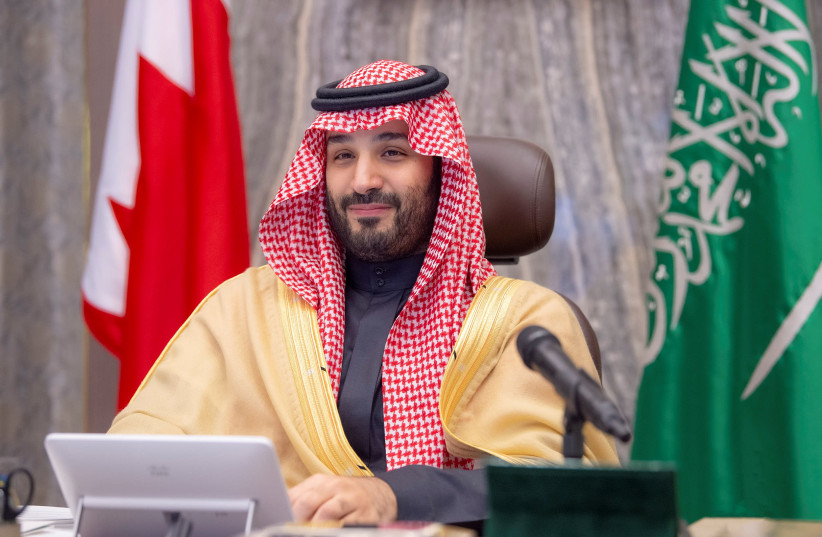
Saudi Crown Prince Mohammed bin Salman chairs first season of the Saudi-Bahraini Coordination Council, virtually with Bahrain's Prime Minister and Crown Prince Salman bin Hamad al-Khalifa, in Riyadh, Saudi Arabia (photo credit: BANDAR ALGALOUD / SAUDI ROYAL COURT / REUTERS)
Saudi Crown Prince Mohammed bin Salman chairs first season of the Saudi-Bahraini Coordination Council, virtually with Bahrain’s Prime Minister and Crown Prince Salman bin Hamad al-Khalifa, in Riyadh, Saudi Arabia
(photo credit: BANDAR ALGALOUD / SAUDI ROYAL COURT / REUTERS)
 Reports that Saudi Arabia’s Crown Prince Mohamed bin Salman is ready to meet Prime Minister Benjamin Netanyahu during a possible trip to Abu Dhabi should come as no surprise. This is not only because of a rumored meeting last November, but because of wider regional dynamics that have brought Israel and Saudi Arabia, as well as Israel and the Abraham Accord partners in the Gulf closer.

While support for Saudi Arabia has waned in some Western countries, perceptions of Saudi Arabia’s importance to the recent Abraham Accords and thus to the region and Israel in general, have grown.

This paradoxical change in affairs has happened for a variety of reasons, including Iran’s increasing threats through groups like the Houthis in Yemen, and changes in Riyadh over the last decade that led to the conclusion that possible US reduction in focus on the region required a closer alignment with Israel.

The milestones on the way to the current mutual interests between Israel and Saudi Arabia include several key symbolic incidents. Saudi Arabia had an increasingly acrimonious relationship with the Obama administration in the wake of the 2015 Iran Deal. It intervened in Yemen that year to stop the Iranian-backed Houthis taking Aden and putting an Iranian foothold on the strategic Bab el-Mandab straits.
Reuters reported in 2017 on secret contacts between Israel and Saudi Arabia. At the time, it was known that former Saudi Intelligence head Prince Turki al-Faisal had shaken hands with Yaakov Amidror, a former senior adviser to Netanyahu, at the Washington Institute for Near East Policy.

In 2018, Israel denied a report that Saudi Arabia was seeking to purchase its Iron Dome air defense system. Saudi Arabia was key to enabling the Abraham Accords and signaled its support. Since then, rumors included the November meeting in Saudi Arabia and a February report about a possible four country defensive pact.

For Israel, the positive position of Saudi Arabia on various issues is important. More challenging is the cold shoulder Riyadh has increasingly received from the US. That is balanced by Washington’s signals that it wants to listen to Israel and the Gulf states more regarding any new Iran deal. This is a major departure from the lead-up to the 2015 agreement.