
Amir Hatami says ‘Zionist regime out of desperation’ threatens Islamic Republic but knows the consequences; Rouhani urges Europe not to exert pressure over 2015 nuclear deal


Iranian Defense Minister Amir Hatami listens during the Conference on International Security in Moscow, Russia, April 4, 2018. (Alexander Zemlianichenko/AP)

Iranian Defense Minister Amir Hatami listens during the Conference on International Security in Moscow, Russia, April 4, 2018. (Alexander Zemlianichenko/AP)

Iranian Defense Minister Amir Hatami on Sunday threatened that his country will give a devastating response to any Israeli attack, and that the Jewish state is aware of the peril, according to Iranian media reports.

“Sometimes, the Zionist regime [Israel] out of desperation makes big claims against the Islamic Republic of Iran to allegedly threaten it,” Hatami said at a ceremony for soldiers, according to English-language reports of his remarks. “It must know that if it does a damn thing, we will raze Tel Aviv and Haifa to the ground.”

He went on to say that Iran has all the power it needs to “maintain the stability of the country” and boasted of its regional power via “resistance groups.”

His remarks came after last week Israel’s Defense Minister Benny Gantz said during an interview with Fox News that if the world doesn’t do something about Iran’s nuclear program then Israel may go it alone. He said that Israel is updating its plans for a prospective military strike.

“If the world stops them [Iran] before, it’s much the better. But if not, we must stand independently and we must defend ourselves by ourselves,” said the defense minister.

Israel has twice conducted military strikes against the nuclear programs of its enemies — Iraq in 1981 and Syria in 2007 — under what’s become known as the Begin Doctrine, which maintains that Jerusalem will not allow an enemy country to obtain an atomic weapon.

Gantz has previously warned Israel would carry out a military strike against Iran, if necessary.

His remarks came after Israel accused Iran of targeting an Israeli-owned cargo ship that was sailing in the Persian Gulf at the end of last month. The explosion reportedly punched two holes in the MV Helios Ray on its port side and two on its starboard side, just above the waterline.

Prime Minister Benjamin Netanyahu accused Israel’s regional foe Iran of attacking the ship. Iran swiftly denied the charge.

Rouhani: ‘No threats or pressure’

Also Sunday, Iran’s President Hassan Rouhani Sunday urged Europe to avoid “threats or pressure” in any negotiations with Tehran.

The deal, known formally as the Joint Comprehensive Plan of Action (JCPOA), has been hanging by a thread since former US President Donald Trump unilaterally withdrew from it in 2018 and reimposed punishing sanctions on Tehran.

Following Joe Biden’s US presidential election victory in November, the US, the European parties to the deal — France, Germany and Britain — and Tehran have been trying to salvage the accord.

Iranian President Hassan Rouhani, right, and Irish Foreign Minister Simon Coveney greet at the start of their meeting in Tehran, Iran, March 7, 2021. (Iranian Presidency Office via AP)

“The best way to solve problems with European partners at various bilateral, regional and international levels, is negotiations based on mutual respect and avoiding any threats or pressure,” Rouhani told Irish Foreign Minister Simon Coveney, according to a statement by the Iranian presidency.

Ireland is not party to the nuclear deal, but currently sits on the UN Security Council.

The Iranian president criticized Europe’s “inactivity on JCPOA commitments” and added that Iran is committed to “preserving the JCPOA and is the only party that has paid a price for it.”

“But this situation cannot continue as it is,” Rouhani stressed. “Preserving and reviving” the deal requires all sides to act on their commitments, he said.

The three European parties to the nuclear deal on Thursday scrapped a draft resolution at the UN’s International Atomic Energy Agency that criticized Iran’s suspension of some nuclear inspections, a move welcomed by Tehran.

Biden has signaled his readiness to revive the deal but insists Iran first return to all its nuclear commitments, most of which it suspended in response to the US sanctions. Tehran meanwhile demands Washington take the first step by scrapping the sanctions.

Iran on February 23 started to restrict some IAEA inspections. But a visit to Tehran by the UN nuclear watchdog chief Rafael Grossi just before the restriction came into force led to an interim technical deal for up to three months.

The arrangement would allow the body to continue monitoring “all the key activities,” Rossi said at the time.

Rouhani noted that “Iran still remains committed to cooperation with the IAEA.” He added that Iran is ready to reverse the restrictions “after the lifting of America’s illegal sanctions and it stopping the policy of threats and pressure.”


Iran has hit back at Israel after the latter said it was updating plans to attack Iranian nuclear sites, with the Iranian defense minister pledging that Tehran will raze Tel Aviv and Haifa if the occupying regime commits any mistake.

“Sometimes, their heads bite off more than they can chew and make threats that are clearly out of desperation. Leader of the Islamic Revolution Ayatollah Seyyed Ali Khamenei responded well to the Zionists many years ago. He said that the Zionist regime is not our main enemy and not at the level to be hostile against the Islamic Republic. The Zionist regime knows, and if it does not know, it should know that the Islamic Republic will raze Tel Aviv and Haifa to the ground if it commits a mistake,” Brigadier General Amir Hatami said on Sunday.

“The order of the Commander-in-Chief of the Iranian Armed Forces has been carefully enacted and turned into a blueprint, which will be implemented with a single beckon from the Commnad-in-Chief. I advise them not to make this mistake, even verbally.”

The remarks came after the Israeli minister of military affairs said the regime was updating plans for military strikes on Iran’s nuclear sites in case Tehran continues what he characterized as “nuclear escalation”.

In an interview with Fox News, Benny Gantz was asked about Iran’s nuclear program and whether Israel was completing preparations to attack Iranian targets.

“We have them (plans) in our hands of course but we will continue constantly improving them,” he said.

“The Iranian nuclear escalation must be stalled. If the world stops them before, it’s very much good. But if not, we must stand independently and we must defend ourselves by ourselves.”

Iran has repeatedly enunciated its nuclear program as exclusively civilian, subject to the most intensive UN supervisions ever.

Tehran signed the Joint Comprehensive Plan of Action (JCPOA) in 2015 with six world countries, which led to the forging of close cooperation between the Islamic Republic and the International Atomic Energy Agency (IAEA), despite intensive Israeli lobbying to torpedo the nuclear agreement.

However, the administration of former US president Donald Trump severely undermined the JCPOA by abandoning it in May 2018 amid numerous IAEA reports on Tehran’s full compliance with the accord.

Israel supported Washington’s unilateral withdrawal from the deal and the “maximum pressure” campaign that the US launched against Iran.

The new US administration, under President Joe Biden, has expressed a willingness to bring Washington back to the JCPOA. But it is demanding that Iran walk back all its remedial steps which it has taken in response to the US violations and the Europeans’ failure to meet their end of the bargain.


Troubled Middle East geopolitics in the Biden era – comment

The Biden administration ended Trump’s “foreign terrorist organization” designation of the Iranian-supported Houthi rebels in Yemen on February 5.

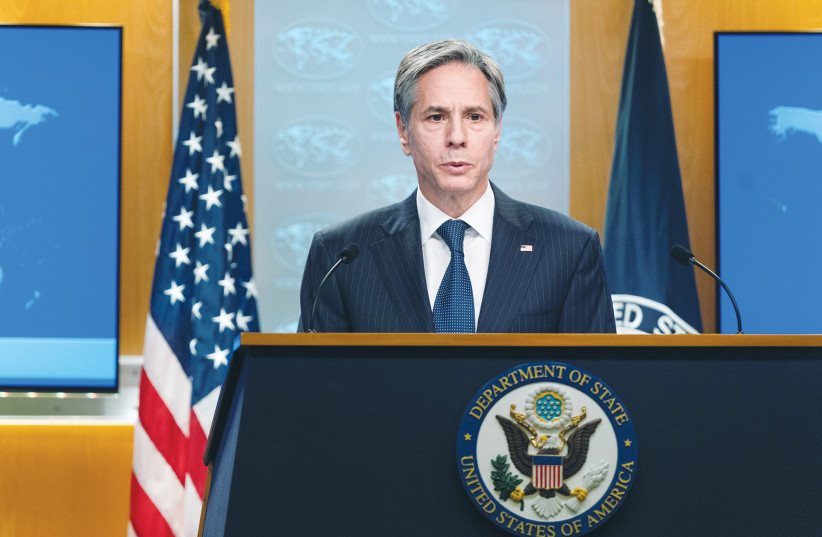
US SECRETARY of State Antony Blinken speaks during a news conference at the State Department last month.  (photo credit: MANUEL BALCE CENETA/REUTERS)
US SECRETARY of State Antony Blinken speaks during a news conference at the State Department last month.
(photo credit: MANUEL BALCE CENETA/REUTERS)
Now that US President Joe Biden’s administration, in just over a month since the president’s inauguration, has shown an almost reflexive eagerness to reverse former US president Donald Trump’s policies and executive orders, Middle East geopolitics seem set for tough and dangerous readjustments. On the campaign trail, Biden had signaled his intentions to resurrect former US president Barack Obama’s 2015 nuclear agreement with Iran. All early indicators suggest that the Biden presidency will renew Obama’s failed Middle East policy of distancing from the traditional US allies among the Gulf Arab monarchies and Israel while working for a rapprochement with Iran as part of the two-state “solution” to the Israeli-Palestinian conflict.

All about being ‘Not-Trump’

In a re-assessment of US ties to Saudi Arabia (which Biden had once called a “pariah” state), the administration lost no time is effecting change from the status quo ante. Biden’s State Department halted the previous administration’s proposed sale of US precision guided missiles worth $290 million to Saudi Arabia. It ended US support for offensive operations by the Saudi-led military coalition fighting the Houthi movement in Yemen, underscoring Biden’s intention to make human rights a key issue in US-Saudi relations. Biden pledged to allow the re-opening of the PLO mission in Washington, resume financial aid to, and restore diplomatic relations with, the Palestinian Authority. And Biden is the first US president in 40 years not to contact Israel’s prime minister as one of his first actions in the White House.

In a what seems like a bizarre unilateral concession to Iran, the Biden administration ended Trump’s “foreign terrorist organization” designation of the Iranian-supported Houthi rebels in Yemen on February 5. Just a few days later, Biden’s State Department felt compelled to issue a statement urging the Houthis to “refrain from destabilizing actions” as it emerged that the Houthi insurgents carried out terrorist attacks on Saudi civilian targets in the southern provinces.

Also among his first actions, Biden spiked relations with the United Arab Emirates by pausing the huge $23 billion deal made in the final days of the Trump administration to supply the Emirates 50 F-35 stealth fighters. This risks undermining one of the UAE’s key motivations in the Abraham Accords: the signing of the normalization agreement in return for US supplies of advanced armaments. Given the UAE’s brokering role in the Sudan-Israel deal, as well as the prospective Mauritania-Israel normalization agreement, the Biden administration also risks undermining the UAE’s active role in promoting rapprochement between Israel and its neighbors in the Middle East and North Africa.

The Abraham Accords as bulwark

The Abraham Accords, which were signed on September 15th at the White House by Israel, the UAE, Bahrain and the US, set in motion a normalization process that was unimaginable even by seasoned observers of the region less than a year ago. Sudan and Morocco quickly signed similar agreements within months. The trope widely purveyed by the Western mainstream media that Trump was “disengaged” from Middle East affairs and uncommitted to regional security does not bear scrutiny.

In a signal achievement of the dramatically-changed regional political order during Trump’s last year in office, the normalization agreements were not accompanied by widespread street demonstrations in the cities of the Arab world – Amman, Beirut, Tunis, Algiers or Rabat. The unquestioned premise of the regional order prior to the diplomatic breakthroughs achieved under Trump – that Arab states would not normalize relations with Israel without a resolution of the Israel-Palestinian conflict – became irrelevant in a strategic realignment of the Arab Gulf states with Israel (with the exception of maverick Qatar) against Iran.

Obama 2.0 diplomacy

Trump’s upending of the strategic map of the Middle East with the Abraham Accords established facts on the ground that the Biden administration cannot easily overturn. But President Biden seems well on the way to reversing the significant gains in Middle East diplomacy brokered by the Trump administration.

Biden’s foreign policy team, dubbed “Obama 2.0,” includes US Secretary of State Antony Blinken, Deputy Secretary of State Wendy Sherman, US National Security Advisor Jake Sullivan and envoy to Iran Robert Malley – all of whom played a key role in negotiating the 2015 Iran nuclear deal. Iran has already adopted its maximalist position, demanding an end to US sanctions prior to negotiations with the US over the resumption of the nuclear deal. Having announced that it had begun increasing its uranium enrichment levels to 20% in late January in its most significant breach of the nuclear deal, Iran then followed up with the production of uranium metal according to the International Atomic Energy Agency, the UN atomic agency.

Iran exhibited its willingness to assert its claims in the region as Biden prepared to take office when its forces seized a South Korean oil tanker in Persian Gulf waters in early January. Emboldened by the change in US presidency, Iran is already pushing more oil onto the market, even as sanctions remain in place, as it tests the Biden administration’s resolve. There is little doubt that Iran will weigh in on Oman – which has long been neutral in its diplomatic relations with Iran and its Arab Gulf neighbors – in the latter’s deliberations to normalize relations with Israel.

Hanging together… or separately

Obama’s visceral distancing from Saudi Arabia, the UAE and its allies in the Gulf while “normalizing” Iran was perceived by the Gulf Arab monarchies as nothing short of betrayal. For them, the likely state of affairs under a Biden presidency would seem a terrible case of déjà vu. In their deliberations of statecraft, the moderate Gulf Arab leaders – along with their key allies in Egypt and Israel – may well ponder the words attributed to Benjamin Franklin on the eve of declaring independence for the Continental Congress in 1776 when he and his colleagues were putting their lives on the line: “we must all hang together, or… we shall all hang separately.”

The writer is visiting senior research fellow at the Middle East Institute and National University of Singapore. He is a regular Forbes contributor and has published op-eds in the ‘South China Morning Post,’ ‘Asia Times,’ ‘Straits Times’ (Singapore), ‘Business Times’ (Singapore), ‘Business Standard’ (India), ‘Far Eastern Economic Review’ and elsewhere.