
Russia & China’s partnership not only about ‘containing’ American aggression, also vital for creation of multi-polar world order
It’s common for Western observers to dismiss the emerging strategic partnership between Russia and China as merely a “marriage of convenience” and a union excessively reliant on shared opposition to US foreign policy ambitions.

Russia and China: Strategic partnership or a marriage of convenience?

Thus, it’s expected that under the surface, centuries of distrust linger, and as China continues to grow, eventually, power rivalry and a “divorce” would follow.

Their common opposition to the US has indeed intensified the partnership, and historical distrust and power asymmetries between Russia and China must be managed. However, Beijing will not replace Washington as the nemesis of Moscow – instead Greater Eurasia is being organised as a multipolar region capable of accommodating Russia.

Russia’s vision of a multipolar order is not possible without a strong China. After the Western support for the 2014 Maidan coup in Ukraine, Russia ended its three-centuries-long Western-centric foreign policy and the post-Cold War ambition to integrate with the West. Russia replaced its ambition for Greater Europe with the Greater Eurasia Initiative that advanced economic integration on the supercontinent. At the centre of the Greater Eurasia Initiative is a strategic partnership with China.

The unipolar moment and continued containment of Russia

After the Cold War, the US embraced a security strategy based on world domination. This has been conceptualised benignly as a “liberal order” or “rules-based order” and common good for the world as stipulated by hegemonic stability theory. Yet, these terms and intentions neglect the underlying power considerations that perpetuate the containment of Russia.

A unipolar security strategy is dangerous as power maximisation becomes the ultimate objective, as opposed to security. Security through global dominance is dangerous as it creates incentives for conflicts to marginalise adversaries and maintain security dependence by allies. US strategic planners cynically view escalating tensions in the Himalayas as an opportunity to bring India into the US fold and to distract China from the South China Sea. The domineering role of the US in Europe has similarly relied on finding a raison d’etre for NATO after the Cold War, which is achieved as conflicts emerge from expanding the military alliance towards Russian borders. The hegemonic security architecture defends from security threats caused by its own existence.  Less than two months after the collapse of the Soviet Union, the strategic Pentagon paper, the Defence Planning Guidance (DPG), was leaked, which outlined a security strategy based on global dominance. Security and stability relied on preventing the emergence of any possible future rivals. The DPG advocated for missile defence to undercut Russia’s nuclear second-strike capabilities, which lay the foundation for nuclear parity and stability, as Russia was identified as “the only power in the world with the capability of destroying the United States”. In 2002, the security strategy of global dominance was formalised in the US Security Strategy, as world peace was believed to depend on no foreign powers even having the ambition to rival the US. The first sentence of the recently de-classified Indo-Pacific strategy of the US similarly states “how to maintain US strategic primacy”.

Multipolar Greater Eurasia

Russia’s aim to establish a multipolar order is not possible without the rapidly ascending China. Moreover, the growing power of China will not destine the collapse of the Russian-Chinese partnership as a multipolar system creates incentives for China to accommodate Russia.

Russia and China have different visions for an integrated Greater Eurasia, yet there are incentives for harmonising interests, as neither format is possible without cooperation with the other. Subsequently, even though Chinese influence in Central Asia competes with Russian influence, Beijing makes great efforts to include Russian interests. This stands in contradiction to Western unipolar policies that explicitly aim to peel away Russia’s neighbours.

ALSO ON RT.COMMoscow must continue ‘necessary’ policy of de-dollarization to end dependence on US currency, says Russian Senate chief MatvienkoRussia can accept that China is economically more powerful as a multipolar system balances itself. While an independent Russian role in Europe has been vehemently opposed by the West, an independent Russian foreign policy in Greater Eurasia enjoys wide support.

Other powers across the Greater Eurasian region share Moscow’s objective of preserving Russia as an independent pole of power in a multipolar system. The obvious motivation is to prevent Russia’s pivot to Asia from merely becoming a pivot to China.

Japan is reaching out to Russia to deepen economic connectivity, as excessive dependence on China will likely challenge Russia’s neutral stance in the China-Japan rivalry. India is similarly working towards greater economic connectivity with Russia to ensure that Beijing does not wield excessive influence over Moscow.

The West has similar incentives to accommodate Russia, although unipolar policies in a multipolar world result in self-harm.To be fair, both Germany and France have recognised that continuing to push Russia towards China will weaken Europe. Even the US has incentives to change course and cease hostilities: Washington could accommodate Russia in greater Europe and even support the Russian-led Eurasian Economic Union to restrain Chinese influence in Central Asia. However, the endeavour to restore US unipolarity is instead driving its key adversaries together.

Greater Eurasia – not inherently an anti-American partnership

The US is confronted with a dilemma as its relative power declines. Washington can accommodate a multipolar world order and use its leverage to maintain its leadership as the “first among equals”. Alternatively, the US can attempt to prolong its domineering role by containing rising powers, although then the new institutions will be without US influence and in opposition to the US.

ALSO ON RT.COMBye Bye Benjamin! Russia & China speed up de-dollarization process: most trade no longer conducted in greenbacksThe US has gone with the second option, which has predictably resulted in the Russia-China strategic partnership intensifying and taking on anti-American characteristics. Yet, the partnership is not dependent on anti-American sentiments. The changing international distribution necessitates Russia and China to deepen economic connectivity and construct institutions for a multipolar Greater Eurasian Region.

Think your friends would be interested? Share this story!

The statements, views and opinions expressed in this column are solely those of the author and do not necessarily represent those of RT.
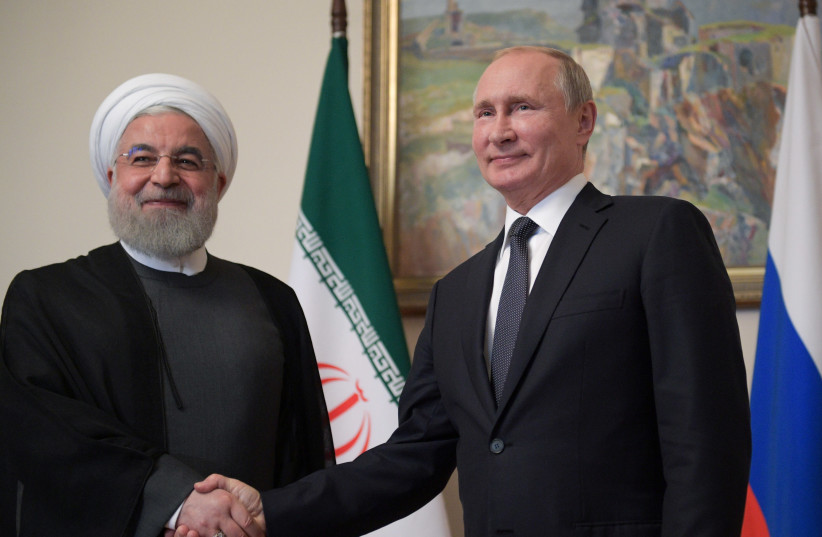

Where could the “bilateral cooperation continue,” as the Russian Foreign Ministry has indicated it might? On Iran, Russia sees US steps so far as pragmatic.

Russian President Vladimir Putin shakes hands with Iranian President Hassan Rouhani during a meeting on the sidelines of a session of the Supreme Eurasian Economic Council In Yerevan, Armenia October 1, 2019 (photo credit: REUTERS)
Russian President Vladimir Putin shakes hands with Iranian President Hassan Rouhani during a meeting on the sidelines of a session of the Supreme Eurasian Economic Council In Yerevan, Armenia October 1, 2019
(photo credit: REUTERS)
Russia is signaling a willingness to open a new page in relations with the US as the new administration settles into power in Washington. TASS state media in Moscow said that Russia’s foreign ministry would respond constructively to US signals.
“We look upon these relations as those of an equal, mutually respectful and mutually beneficial partnership,” the ministry said. Russia says that it has never refused to cooperate with the US, even in difficult times.

However, Moscow is suspicious of the new Biden administration’s support of sanctions on Russia that have been pushed in Europe. Clearly the message from Moscow is that Russia wants to be seen as an equal on the international stage and that there could be movement on some issues.

Russia has tried to claw back its historic power that it had during the Cold War, and has spent decades rehabilitating its military and foreign policy influence globally.

Where could the “bilateral cooperation continue,” as the Russian Foreign Ministry has indicated it might? On Iran, Russia sees US steps so far as pragmatic.

The United States’ willingness to return to the original Joint Comprehensive Plan of Action (JCPOA, known as the Iran nuclear deal) is a pragmatic and right approach, Mikhail Ulyanov, Russia’s Permanent Representative to International Organizations, including the IAEA, in Vienna, said in a televised interview on Rossiya-24 news channel on Friday, TASS reported.

“In this situation, we see that either Tehran or Washington starts saying that the other side must make the first step. It is a road to nowhere. The only way to make progress is to synchronize practical steps so that nobody could assume they have lost face,” he added.
The statements seem to indicate an attempt by Moscow to put a positive face on relations and the prospect of change. Moscow has done this before with every US administration.

While Vladimir Putin remains in charge in Russia, the US has had several leaders since 2000. Russia sought better relations with the Bush administration and then a “reset” during the Obama administration. It also sought to work with Trump and now is open to Biden.

From the US perspective, Russia is accused of meddling in the 2016 election. The US opposes Russia’s role in Nord Stream 2 gas pipeline to Europe and has stuck by Ukraine in disputes over Russia’s annexation of Crimea. The US also opposes countries like Egypt increasing arms purchases from Russia.

On the other side of the coin, Russia and the US could discuss the future of Syria. The US backs the Syrian Democratic Forces in eastern Syria.

In late February the US carried out airstrikes on Iranian-backed militias in Syria near Albukamal and the Iraqi border. Russia only received a few minutes warning before the strikes, reports say.

In the past, the US and Russia have de-conflicted in Russia so that their air forces don’t run into each other. Other recent headlines indicate that both Russia and Turkey want the US to return to the Iran deal.

Middle East Eye reports that Russia could be a “broker” between Israel and Syria. Turkey’s TRT suggests that Iran’s disruptive proxies in Syria might lead to Russia’s concerns about Iran’s role in Syria.

Iran’s role could undermine Russia’s attempts to stabilize the Syrian regime. Other reports at Al-Monitor note that Iran and Russia compete for influence with private security companies in Syria.

It’s not clear if the US could move forward on discussions about Syrian stabilization with Russia, that might see Iran’s role eroded. It may be that the US and Russia share interests in reducing Iran’s role in Syria.

Israel, Turkey and others on the sidelines also likely want Iran’s role reduced. How that might come about is not yet clear because the US administration has been in close contact with Israel but has done less with Russia or Turkey.

It’s not clear what the Biden game plan is for Syria. An Iranian-backed militia attack on US forces at Al-Asad base in Iraq in early March illustrates that pro-Iranian groups will continue to target US forces in Iraq. The US is careful not to blame Iran for the attacks.


Defense minister not yet ruling out environment minister’s charges that disaster was an Iranian act of eco-terrorism, but so far no proof found


Pieces of tar from an oil spill in the Mediterranean Sea wash up on a beach in the Gdor Nature Reserve near Michmoret, Israel, Monday, March 1, 2021. The cleanup from the disastrous oil spill that has blackened most of the country's shoreline is expected to take months. (AP Photo/Ariel Schalit)

Pieces of tar from an oil spill in the Mediterranean Sea wash up on a beach in the Gdor Nature Reserve near Michmoret, Israel, Monday, March 1, 2021. The cleanup from the disastrous oil spill that has blackened most of the country’s shoreline is expected to take months. (AP Photo/Ariel Schalit)

Defense Minister Benny Gantz on Friday said that there was currently no evidence to conclude that the oil spill off Israel’s coast that polluted most of the country’s beaches was a deliberate act of “environmental terrorism.”

Speaking to supporters of his Blue and White party, Gantz was asked about Environmental Protection Minister Gila Gamliel’s assertion that Iran deliberately caused the spill of Israel’s coast.

“I can’t completely rule out that it was deliberate, but at this stage, we can’t determine that it was done on purpose,” Gantz said.

Israeli TV reported Thursday that Israel’s security establishment is investigating the alleged Iranian link to the oil spill.

Defense Minister Benny Gantz during a visit to the Druze village of Julis in northern Israel, February 23, 2021 (David Cohen/Flash90)

The network said the Environmental Protection Ministry had handed over its report on the matter to security bodies, which were reviewing its findings. Sources in the defense establishment, however, were quoted as saying there was no indication the spill was deliberate.

The report added that Israel’s intelligence apparatus has now also been recruited to look further into the claim of Iranian sabotage.

A Libyan-owned ship, the Emerald, was smuggling crude oil from Iran to Syria at the time of the spill, the Environmental Protection Ministry said in a statement Thursday, citing satellite images by the TankerTrackers monitoring group. The ship has since returned to Iran and is currently anchored there.

In an interview with Channel 12 on Thursday evening, Gamliel again insisted, without providing proof, that the spill constituted an Iranian terror attack on Israel.

“There are people who do not look at the risks properly,” she said when challenged on her claim, pointing the finger at Opposition Leader Yair Lapid and saying that “only Netanyahu knows how to deal with the Iranian threat properly.”

The environmental group Greenpeace blasted Gamliel for her claims, saying the assertion of a terror attack “is outrageous and factually baseless at this stage.”

The group said that in making the claim, the minister “is minimizing the well-known and widespread phenomenon of marine pollution by ship oil spills. The minister’s conduct on the matter smells of electioneering and an attempt to score political points over an ecological disaster.”

On Wednesday, Gamliel initially said she did not believe the spill was deliberate. But at a press conference later that evening she pinned responsibility on Iran.

“We have discovered that this wasn’t merely environmental criminality, but rather environmental terror,” she said. “Now we have found that Iran doesn’t only carry out terror via nuclear weapons or via attempts to establish a presence on our borders. Iran carries out terrorism by damaging the environment.”

The minister’s allegation of Iran’s involvement was immediately disputed by senior security officials, however, with Channel 13 news quickly reporting that Israel’s defense establishment “does not share this assessment.” The network said it was “striking” that neither the Mossad intelligence agency nor other defense bodies were involved in formulating Gamliel’s conclusion.

Speaking to Army Radio on Thursday morning, Gamliel pushed back at suggestions that the spill was an accident, saying, “To say that this isn’t terror is simply inappropriate.”

Prime Minister Benjamin Netanyahu and Environmental Protection Minister Gila Gamliel walk on the beach in Ashdod, on February 21, 2021, after an offshore tar spill (Kobi Gideon / GPO)

She went on to say there had been a “failure” by security services in monitoring Iranian crude oil smuggled to beat international sanctions imposed on Syria due to its human rights record.

Asked directly if the spill was deliberate or an accident she said, “If they had fired a missile at an Israeli ship would anyone ask if it was a mistake or deliberate? In my view, it was a deliberate act of terror.”

On Thursday afternoon, the Environmental Protection Ministry’s director-general, David Yahalomi, said the spill was a form of terrorism, even if not deliberate.

“It doesn’t matter if it was deliberate or not,” Yahalomi told the Kan public broadcaster. “An enemy state that transfers 45 million oil barrels illegally and improperly through Israel’s economic waters is harmful.”

He said the potential harm under such circumstances “is a ticking bomb, and so it is correct to call it environmental terrorism.”

He estimated that about 1,000 tons of tar have hit Israel’s Mediterranean coast since last month’s spill, and said the impact could be 100 times worse, causing irreversible damage, if an entire tanker shed its oil off Israel’s coast.
