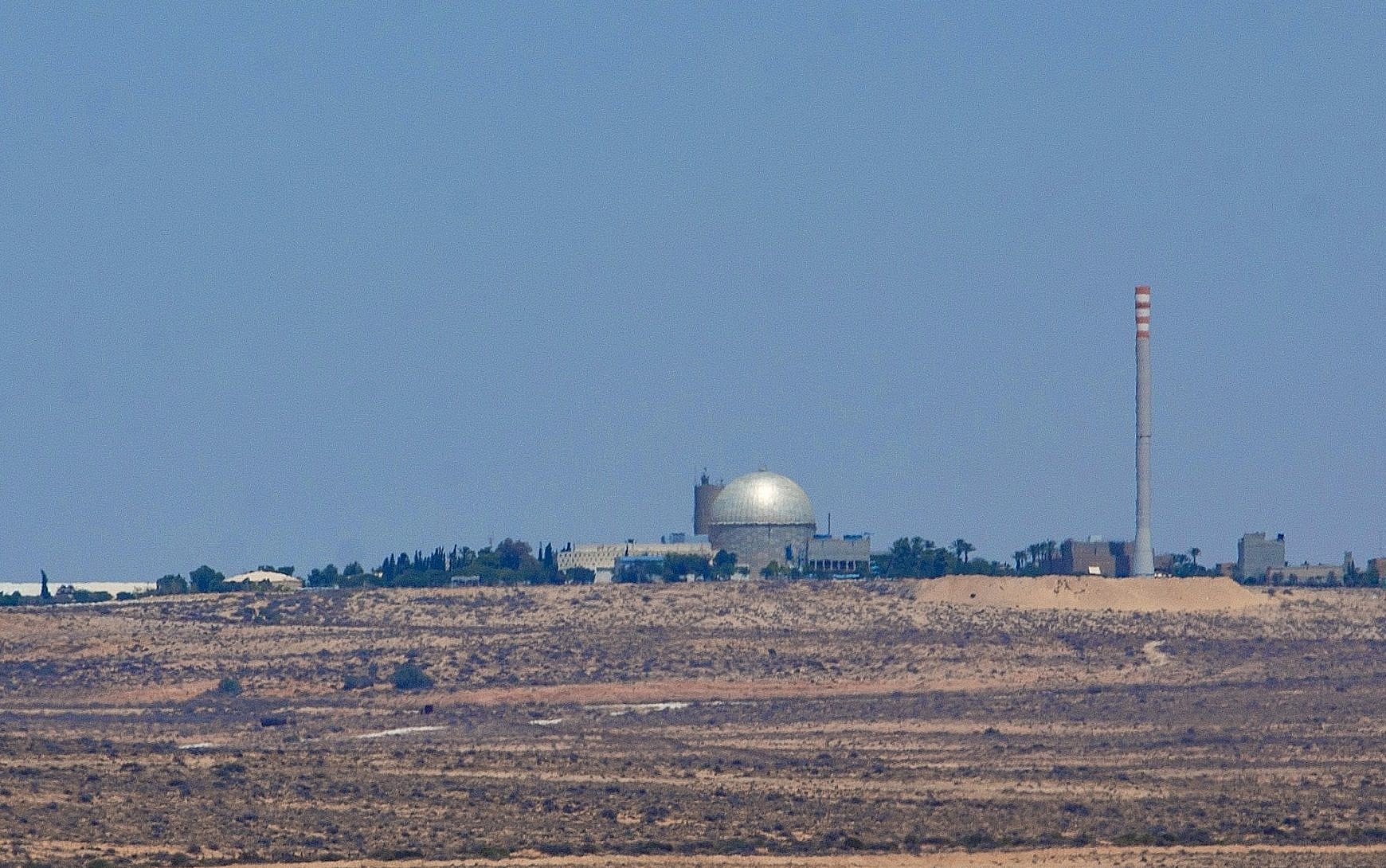
Israel reportedly expands Dimona nuclear complex

Construction work at top-secret facility visible in satellite imagery, The Guardian reports


View of the nuclear reactor in Dimona, southern Israel, in 2016. (Moshe Shai/Flash90)

View of the nuclear reactor in Dimona, southern Israel, in 2016. (Moshe Shai/Flash90)

Israel’s top-secret nuclear research facility near the southern city of Dimona is undergoing a major expansion, according to a Thursday report.

The UK’s Guardian newspaper reported the development, saying the construction work is visible in satellite imagery published by an independent expert group.

The section of the complex under construction is several hundred meters (yards) from the complex’s reactor and reprocessing plant, and the purpose of the construction is not known, the report said.

A researcher with the International Panel on Fissile Material, which first noticed the construction in the satellite images, told The Guardian that the construction appeared to have started in early 2019 or late 2018.

Israel’s Dimona nuclear research facility is officially called the Shimon Peres Negev Nuclear Research Center.

To this day, Israel has never acknowledged that it has a nuclear arsenal, instead maintaining a policy of “nuclear ambiguity” while vowing that it will not be the first to use nuclear weapons in the Middle East.


IAEA finds uranium particles at two Iranian sites

Diplomats say International Atomic Energy Agency preparing to rebuke Tehran for failing to explain the presence of the particles.

Elad Benari, Canada , Feb 19 , 2021 11:27 PM
Bushehr main nuclear reactor in Iran

Bushehr main nuclear reactor in Iran

Reuters

The International Atomic Energy Agency (IAEA) found uranium particles at two Iranian sites it inspected after months of stonewalling, diplomats told Reuters on Friday.

According to the report, the UN nuclear watchdog is preparing to rebuke Tehran for failing to explain the presence of the particles.

Although the sites where the material was found are believed to have been inactive for nearly two decades, opponents of the 2015 nuclear deal Iran signed with world powers say evidence of undeclared nuclear activities shows that Iran has not been acting in good faith.

Iran’s ambassador to the International Atomic Energy Agency, Kazem Gharibabadi, declined to comment, as did the IAEA itself.

A senior Iranian official said, according to Reuters, “We have nothing to hide. That is why we allowed the inspectors to visit those sites.”

The report comes as the Biden administration is set to start negotiations with Iran on a return to the 2015 nuclear deal, from which former President Donald Trump withdrew.

Iran has consistently scaled back its compliance with the 2015 deal in response to Trump’s withdrawal from it.

Iran has set a deadline of next week for Biden to lift the sanctions that were reimposed by Trump, or it will halt snap IAEA inspections under the deal. Next week is also when the IAEA is expected to issue a quarterly report on Iran’s nuclear activities.

Seven diplomats told Reuters the agency will use that opportunity to rebuke Iran for failing to explain to its satisfaction how the uranium particles wound up at two undeclared sites. The rebuke could come either in the quarterly report or in an additional report released the same day.

The IAEA, which monitors Iran’s nuclear program, recently released a report which found that Iran has fired up advanced uranium-enriching centrifuges that it had installed at its Natanz site in violation of the 2015 agreement.

In a previous report, the UN agency said that the Islamic Republic’s stockpile of enriched uranium now stands at more than ten times the limit set down in the 2015 nuclear deal with world powers.

(Arutz Sheva’s North American desk is keeping you updated until the start of Shabbat in New York. The time posted automatically on all Arutz Sheva articles, however, is Israeli time.)


“Israel believes that going back to the old agreement will pave Iran’s path to a nuclear arsenal.”

US President Joe Biden delivers remarks in the State Dining Room at the White House in Washington, US, February 5, 2021. (photo credit: REUTERS/KEVIN LAMARQUE/FILE PHOTO)
US President Joe Biden delivers remarks in the State Dining Room at the White House in Washington, US, February 5, 2021.
(photo credit: REUTERS/KEVIN LAMARQUE/FILE PHOTO)
Israel warned that the United States was helping Iran develop a nuclear weapons arsenal with its decision late Thursday night to push to rejoin the 2015 Iran deal.

“Israel remains committed to preventing Iran from getting nuclear weapons and its position on the nuclear agreement has not changed,” the Prime Minister’s Office said.
“Israel believes that going back to the old agreement will pave Iran’s path to a nuclear arsenal. Israel is in close contact with the United States on this matter,” it added.
From the onset Prime Minister Benjamin Netanyahu had opposed the 2015 Joint Comprehensive Plan of Action, known as the Iran deal, that was agreed upon between Tehran and the six world power powers; the US, France, Germany, the United Kingdom, Russia and China.
Former US president Donald Trump had exited the deal, which had been brokered during the tenure of the administration of former US president Barack Obama.
US President Joe Biden’s administration has now formally declared its intent to seek a return to that deal.
Iran will “immediately reverse” actions in its nuclear program when U.S. sanctions are lifted, its foreign minister said on Friday, reiterating Tehran’s position on Washington’s offer to revive talks.
The Biden administration said on Thursday it was ready to revive a 2015 agreement between Iran and world powers that former president Donald Trump abandoned in 2018 before reimposing sanctions on Iran.
When sanctions are lifted, “we will then immediately reverse all remedial measures. Simple,” Iranian Foreign Minister Mohammad Javad Zarif said on Twitter.
Highlighting the urgency of a diplomatic solution to the standoff, a senior Iranian official told Reuters that Tehran was considering Washington’s offer to talk about the revival of the deal.
“But first they should return to the deal. Then within the framework of the 2015 deal, a mechanism to basically synchronize steps can be discussed,” the official said.
Washington said on Thursday it was ready to talk to Iran about both nations returning to the nuclear accord that aimed to prevent Tehran from acquiring nuclear weapons.
“We have never sought nuclear weapons and this is not part of our defense doctrine,” the official said. “Our message is very clear. Lift all the sanctions and give diplomacy a chance.”
Tehran has set a February 23 deadline for Washington to begin reversing sanctions, otherwise, it says, it will take its biggest step yet to breach the deal – banning short-notice inspections by the U.N. nuclear watchdog, the International Atomic Energy Agency (IAEA).
The United States and the European parties to the accord have urged Iran to refrain from that step and repeated their concerns over recent actions by Tehran to produce uranium enriched up to 20% and uranium metal.
“We have to implement the law. The other party must act quickly and lift these unjust and illegal sanctions if they want Tehran to honor the deal,” said the official.
The IAEA’s short-notice inspections, which can range anywhere beyond Iran’s declared nuclear sites, are mandated under the IAEA’s “Additional Protocol” that Iran agreed to honor under the deal. It signed up to the Protocol in 2003 but has not ratified it.
Earlier, Zarif said in an interview posted on a government site that the United States had not only failed to fulfill its obligations, but continues Trump’s “failed maximum pressure” despite claiming it is ready to revive the nuclear agreement.
“Thus the Europeans must note that pressure on Iran does not work, nor are worthless remarks of any use,” Zarif said, adding: “As soon as we see steps by the United States and Europe toward fulfilling their obligations, we will immediately react and return to our commitments.”
In London, UK junior foreign minister James Cleverly reiterated that Iran had to resume compliance with the deal, adding the West should not send signals that it is prepared to overlook Tehran’s breaches of the accord.
Biden has said that he will use the revival of the nuclear deal as a springboard to a broader agreement that might restrict Iran’s ballistic missile development and regional activities.
Tehran has ruled out negotiations on wider security issues such as Iran’s missile program.