
Recently declassified operation reveals that IDF special forces neutralized large explosive devices on the Israel-Syria border, placed by local residents likely working for Iran’s infamous Quds Force.

An Israeli tank on the border overlooking Syria | File photo: AP
EXCLUSIVE – The terrorists approached under the cover of darkness. They knew the area well and assumed no one could see them. They inched to a distance just 25 yards from the security fence and placed their explosives. Their objective was clear – kill IDF soldiers and set the sector ablaze. After placing the bombs they retreated back toward Syria, tracked the entire time by IDF spotters, and now under heavy fire from Israeli troops.
The lethal ambush was exposed last November on the Israeli-Syrian border on the Golan Heights. A tranquil area with pastoral vistas, but highly volatile due to the ongoing fight between the IDF and Iran in what has come to be known as the “war between wars.” Three months earlier, in August, an Iranian cell was detected and eliminated by IDF commandos while laying bombs along the fence.
Video: IDF Spokesperson’s Unit
Exclusive documentation obtained by Israel Hayom, sheds light on what happened that night when terrorists attempted to kill IDF troops on routine patrol along the border. For the first time, the IDF has shared how the event unfolded, step by step, along with more details about who was behind the attempted attack the could have sparked a war had it been successful.
“The area is of great strategic importance,” Brig. Gen. Ze’ev Cohen told Israel Hayom, “among other reasons because there’s a tremendous lack of goods on the other side and a real struggle to live, to the point of having no food. There is complete chaos there and every fighting force is trying to gain a foothold in the area. Terrorist elements are trying to recruit these poor people to act against us, which was also the case during the incident in question. In hindsight, we understand that those who placed the bombs are residents of the area, proxies of Iran. It’s clear to us that Unit 840 of the Quds Force dispatched them.”
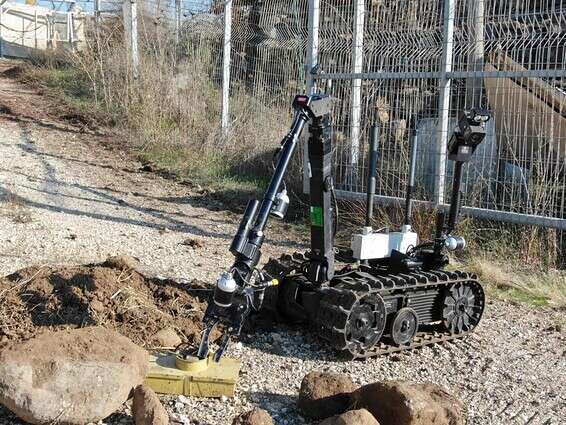
explosive ordnance disposal robot at the scene (IDF Spokesperson’s Unit)
The bombs were detected in the early morning. “My teams are active in the field at all times,” says Maj. G, a commander in the Engineering Corps’ elite Yahalom unit. His soldiers are tasked with diffusing explosive devices across the northern sector and were therefore deployed immediately to the scene. “There were three anti-personnel bombs, very powerful, which targeted the patrols operating from the nearby outpost. They specifically targeted the route used by the patrols, and would have claimed lives, without a doubt.”
Ultimately, explains Maj. G, the Yahalom sappers used highly sophisticated tools to diffuse the devices on the spot.
Although the incident occurred three months ago, IDF officials say there’s been a significant rise in terrorist activity along the border. It’s only safe to assume that some of this activity is orchestrated by Iran. “The northern border is tricky. On one hand, it’s a quiet border, and since the Second Lebanon War nothing supposedly dramatic has happened, but the moment an event does occur, it is on a different scale,” notes Maj. G.
According to Cohen, “When you analyze the explosive device, you understand the potential damage it could have caused. It makes you realize that the Golan Heights region isn’t as tranquil as it seems on the surface.”
He adds: “There are people who want to harm us, who want to undermine our sovereignty, and it’s our responsibility to make sure that doesn’t happen. We are in a constant race against the other side to learn and we are trying to understand his methods. There are incidents in the sector every day – we see people approaching [the security fence], shepherds that don’t always appear innocent. Therefore, we are always scanning the areas where bombs might be placed. It’s our bread and butter.”
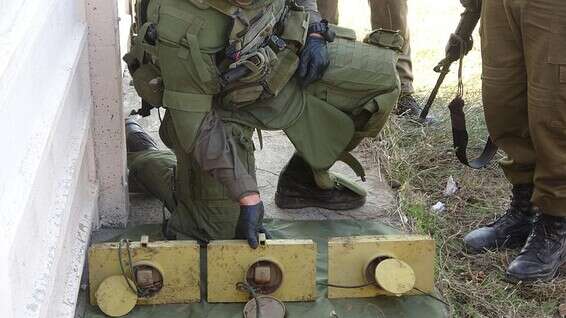
Asked whether another ambush of this sort could be around the corner, Maj. G says, “We are ready for any event. We are studying the gamut of the enemy’s capabilities – whether it’s Iran, Hezbollah or Hamas; roadside bombs in Syria aren’t similar to the Gaza sector, which is why we in the unit are always learning and preparing accordingly.”
Alongside the army’s overt countermeasures, meanwhile, is covert activity. Four months ago, one month before the attempted roadside bomb attack, a Western intelligence organization conducted a clandestine operation in the heart of Damascus against Unit 840 of the Quds Force, Israeli intelligence website INTELLI TIMES reported several days ago. During the nighttime operation, operatives raided an apartment in a residential building in the middle of the Sousa neighborhood in northern Damascus, just 500 yards from the Iranian embassy and three kilometers (1.8 miles) from Syrian President Bashar Assad’s palace.
A source who revealed the information to the website said the operatives seized information and documents about the activities of the Quds Force in Syria and plans against Israeli targets.