Attorney General Mandelblit says ICC ‘lacks any jurisdiction’ over Israel, ‘no sovereign Palestinian state exists.’

Arutz Sheva Staff , Feb 06 , 2021 7:37 PM


International Criminal Court at The Hague

International Criminal Court at The Hague

iStock

Attorney General Avichai Mandelblit on Saturday responded to the International Criminal Court’s (ICC) decision to investigate Israel for alleged “war crimes” in the Palestinian Authority and Gaza.

In a statement, Mandelblit wrote: “Yesterday (05.02.2021), Pre-Trial Chamber I of the International Criminal Court (ICC) issued a decision regarding the scope of the ICC’s territorial jurisdiction over issues pertaining to the Israeli-Palestinian conflict.”

“As previously published, the Attorney General’s position is that the ICC lacks any jurisdiction on this matter given, among other reasons, that no sovereign Palestinian state exists nor does any territory belonging to such an entity; and moreover, that the Palestinian Authority has no jurisdiction over Israeli citizens (for more information, see the Memorandum of the Attorney General dated 20.12.2019).

“This legal position has garnered the support of leading nations and world-renowned legal experts, yet the Court’s majority opinion disregarded many of the substantial legal arguments made in this context.

“The State of Israel is a law-abiding democracy with an independent legal system. Israel is committed to the fundamental values of international law, and is fully capable of examining alleged violations of the law on its own. For this reason as well, there is absolutely no place for the ICC’s intervention in matters that are under the jurisdiction of the State of Israel.

“The relevant political and legal authorities in Israel have been closely following for some time the attempts to draw the ICC into the Israeli-Palestinian conflict, and are fully prepared to deal with any possible developments in the ICC arena. The Attorney General and his team will continue to assist the Israeli Government and Israel’s citizens in addressing any situation arising out of the ICC.”

Best Regards,
Noam Sharvit, Adv.
Acting Head of the Spokesperson Department
Ministry of Justice


Diplomats tell Wall Street Journal UN agency seeking explanations for radioactive materials found in locations Tehran blocked access to last year


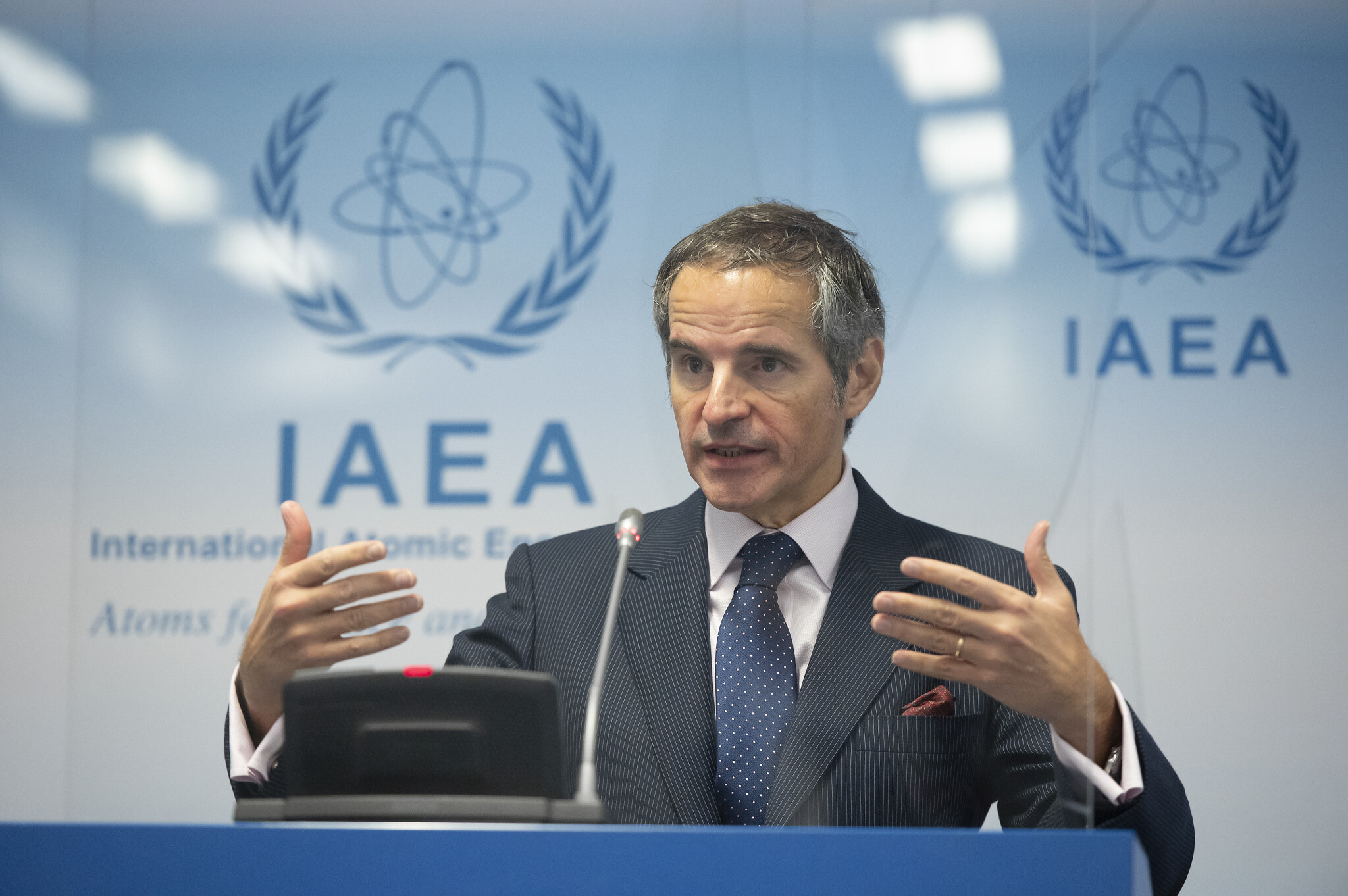
Director-General of the International Atomic Energy Agency (IAEA), Rafael Mariano Grossi, speaks during a press conference during an IAEA Board of Governors meeting at the IAEA headquarters of the UN in Vienna, Austria, November 18, 2020. (Christian Bruna/Pool Photo via AP)

Director-General of the International Atomic Energy Agency (IAEA), Rafael Mariano Grossi, speaks during a press conference during an IAEA Board of Governors meeting at the IAEA headquarters of the UN in Vienna, Austria, November 18, 2020. (Christian Bruna/Pool Photo via AP)

United Nations nuclear inspectors have found traces of radioactive material at Iranian nuclear sites that could indicate work on nuclear weapons, according to a report Saturday.

The Wall Street Journal story cited several unnamed diplomats briefed on the matter, who said the locations in which the material was found contributed to suspicions.

Tehran barred inspectors from accessing those same locations for a number of months last year, it said.

The report did not make clear whether the suspected weapons development was recent or old. The International Atomic Energy Agency and Western intelligence services all believe Iran had a clandestine nuclear weapons program until 2003, though Tehran denies ever attempting to obtain such weapons.

The diplomats noted that they themselves did not have specific knowledge about the details of the findings. They said the IAEA was seeking explanations from Iran, and had not yet updated member states on their findings.

An International Atomic Energy Agency inspector disconnects the connections between the twin cascades for 20% uranium production at Natanz nuclear power plant south of Tehran on January, 20, 2014 (Photo credit: Kazem Ghane/IRNA/AFP)

Last fall Iran allowed IAEA inspectors to visit two sites where the agency suspected undeclared nuclear activity might have taken place in the early 2000s. Their exact locations have not been made public. IAEA Director General Rafael Grossi said at the time that analyzing the samples collected would take several months.

Iran had denied the agency access to the locations last year, prompting the IAEA’s board of governors to pass a resolution in June urging Iran to comply with its requests.

One of the sites was reported to be in Abadeh, south of Isfahan — a location that in September 2019 was flagged by Prime Minister Benjamin Netanyahu as the site of an alleged secret nuclear facility.

Netanyahu said at the time that Iran had tried to destroy the site along with any evidence it had been used to develop nuclear weapons.

The landmark 2015 deal between Iran and the United States, China, Russia, Britain, France, and Germany to curb Tehran’s nuclear ambitions has been largely in tatters since former US president Donald Trump withdrew from it in 2018 and reimposed harsh sanctions on the Islamic Republic.

Iran has since been steadily violating restrictions on the amount of uranium it can enrich and the purity it is allowed to enrich to, and other limits.

Iran recently informed the International Atomic Energy Agency of its plans to increase enrichment to 20 percent, a technical step away from weapons-grade levels of 90%.

It also has said it plans to produce uranium metal, which can be used as a component in nuclear weapons. Iran had signed up to a 15-year ban on “producing or acquiring plutonium or uranium metals or their alloys” under the 2015 accord.
Illustrative: Iran’s alleged atomic warehouse in Turquzabad, Tehran. (YouTube screenshot)

European powers have voiced deep concern over Tehran’s moves, warning it has “no credible civilian use” for the element.

“The production of uranium metal has potentially grave military implications,” said the foreign ministers of Britain, France and Germany, the so-called E3, in a joint statement last month.

A law passed by Iran’s conservative-dominated parliament last month, despite opposition from a reformist government, mandates Iran to discontinue certain international inspections by late February if key conditions are not met, stoking international concerns about a possible expulsion of UN inspectors.

Iran’s foreign ministry on Monday said Tehran does not intend to expel the UN nuclear watchdog’s inspectors.

Tehran has signaled a readiness to engage with US President Joe Biden, who took office on January 20 and who has likewise expressed willingness to return to diplomacy with Tehran.

Iranian President Hassan Rouhani speaks during a cabinet meeting in Tehran, Iran, January 6, 2021. (Iranian Presidency Office via AP)

However, the sides have already sparred publicly, with Washington insisting Tehran must return to compliance to the deal before the US reenters, while Iran says America must first remove all sanctions and rejoin the accord.

Meanwhile, regional US allies including Israel, Saudi Arabia and Gulf states are all expected to strongly oppose a US return to the deal in its original form. Biden has indicated he wishes to address elements outside that worry Middle East nations, including Iran’s ballistic missiles program and its malign regional actions. Tehran has said this is a nonstarter.

Agencies contributed to this report.


US Senate approves amendment to keep embassy in Jerusalem

The amendment was put forward by Republican Senators Jim Inhofe of Oklahoma and Bill Hagerty of Tennessee.

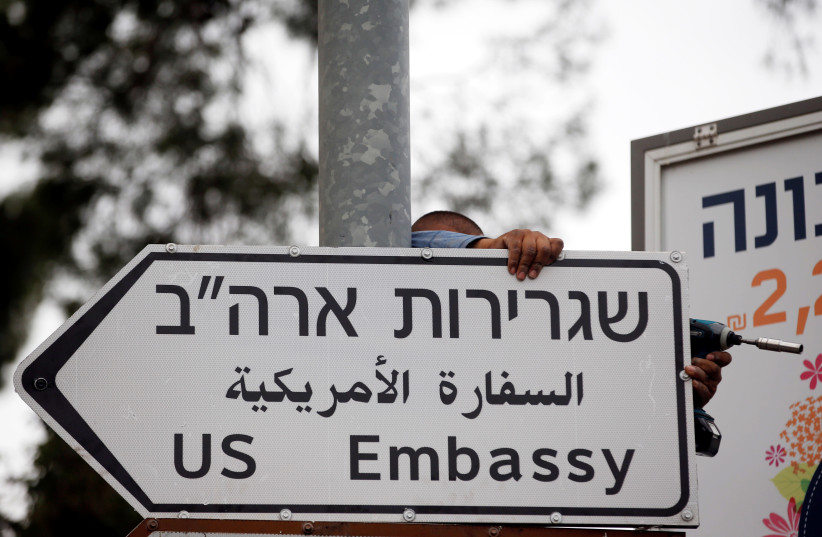
A worker hangs a road sign directing to the U.S. embassy, in the area of the U.S. consulate in Jerusalem, May 7, 2018.  (photo credit: REUTERS)
A worker hangs a road sign directing to the U.S. embassy, in the area of the U.S. consulate in Jerusalem, May 7, 2018.
(photo credit: REUTERS)
The United States Senate voted 97-3 late Thursday to support an amendment to the COVID-19 budget resolution that affirmed the country’s intention to keep its embassy in Jerusalem.

It was put forward by Republican Senators Jim Inhofe of Oklahoma and Bill Hagerty of Tennessee.
Inhofe tweeted that the amendment “would make the U.S. Embassy in Jerusalem permanent, effectively preventing it from being downgraded or moved. It’s an important message that we acknowledge Jerusalem as the capital of Israel.”

On the Senate floor Inhofe said that the “amendment should not be controversial to anyone. It has been our position in the US for 25 years. Jerusalem is the capital of Israel and we should have our embassy in Jerusalem.”
He referenced past Senate votes to place the US Embassy in Jerusalem: “In 1995 the same amendment was 93-5. In 2017 it was 90-0.”
Hagerty said that Jerusalem was “the eternal and indivisible capital of the Jewish state of Israel.” He added that, “establishing this embassy is paving the way for peace across the region and should be preserved. Now our allies there know we will stand with them.”

The three opposing votes were Democratic Senators Bernie Sanders of Vermont, Elizabeth Warren of Massachusetts and Tom Carper of Delaware.
The vote is largely viewed as symbolic since the Biden administration has already stated that it has no intention of relocating the embassy.
When Biden was in the Senate, he supported the Congressional 1995 US Embassy Act, which mandated that the American Embassy be relocated from Tel Aviv to Jerusalem.
Former presidents Bill Clinton, George Bush and Barack Obama all made use of a waiver option to delay implementation of the act.

The embassy was relocated to Jerusalem only in 2018, by former US president Donald Trump.