
Former Iranian diplomat says the Islamic legal opinion issued in 2003 ‘might be changed’ and Biden could be forced back into nuclear deal ‘with no preconditions’
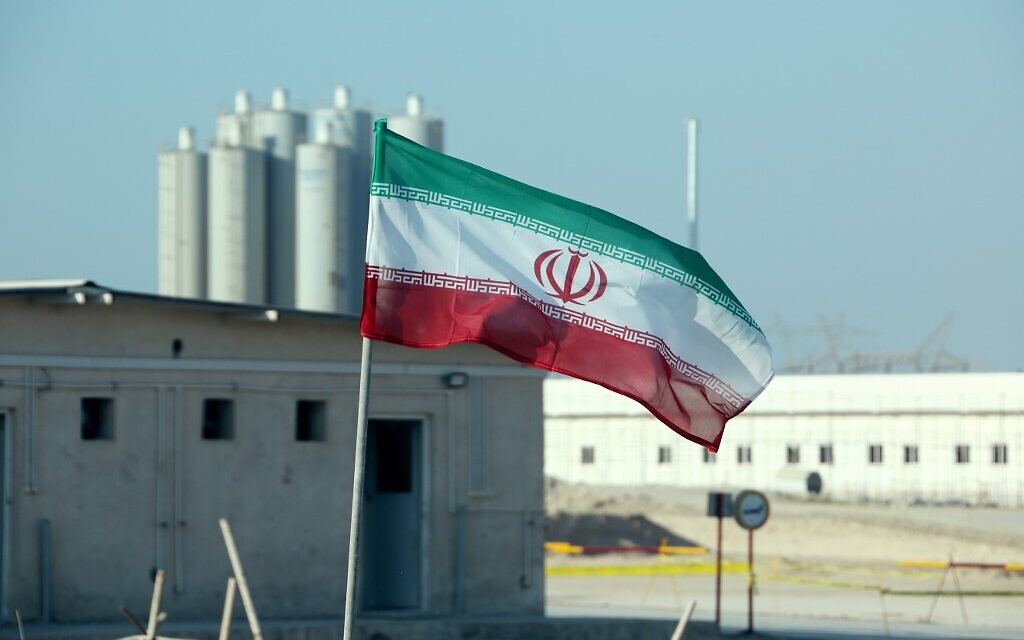
An Iranian flag flutters at Iran's Bushehr nuclear power plant on November 10, 2019. (Atta Kenare/AFP)
An Iranian flag flutters at Iran’s Bushehr nuclear power plant on November 10, 2019. (Atta Kenare/AFP)

A former Iranian diplomat has said that if Israel or the US take “dangerous” steps, the Islamic Republic’s Supreme Leader Ayatollah Ali Khamenei may reverse the religious opinion that forbids the acquisition, development or use of nuclear weapons.

Speaking during a January interview with the Lebanese al-Mayadeen TV, ex-Iranian diplomat Amir Mousavi said, “A fatwa is issued in accordance with developing circumstances. Therefore, I believe that if the Americans and Zionists act in a dangerous manner, the fatwa might be changed,” according to a translation published this week by the Middle East Media Research Institute (MEMRI).

The fatwa, a nonbinding Islamic legal opinion, issued in 2003, says that nuclear weapons and other weapons of mass destruction are against Islam.

Former Iranian diplomat Amir Mousavi (MEMRI screenshot)

Mousavi added that former US president Barack Obama “was forced to sign the nuclear agreement with Iran” following the downing of an American UAV by the Islamic Revolutionary Guard Corps (IRGC) in 2011, and allegedly because “he strived to win the Nobel prize.”

In this photo released on March 20, 2020 by the official website of the office of the Iranian supreme leader, Supreme Leader Ayatollah Ali Khamenei poses for a portrait prior to delivering his message for the Iranian New Year, or Nowruz, in Tehran, Iran (Office of the Iranian Supreme Leader via AP)

With the new US administration, Mouvasi claims, “Iran is holding some significant cards, which it can use to force President [Joe] Biden to return [to the JCPOA] with no preconditions,” adding that “the Iranian leadership is not in a hurry.”

“As the Americans delay carrying out their obligations and lifting the sanctions, Iran will further develop its nuclear and defensive capabilities. I believe that the international community is the one that stands to lose and not Iran,” Mousavi said.

The United States and Iran are “a long way” from a return to the 2015 nuclear deal with Iran, US State Department spokesman Ned Price said Tuesday.

Price said US President Joe Biden has been “very clear” that “if Iran comes back into full compliance with its obligations under the [deal], the United States would do the same, and then we would then use that as a platform to build a longer and a stronger agreement that also addresses other areas of concern.”

Iranian Deputy Forein Minister Abbas Araghchi (Center-R) and Helga Schmid (Center-L), secretary general of the European Union’s External Action Service (EEAS), take part in a meeting of the Joint Commission of the Joint Comprehensive Plan of Action (JCPOA) attended by the E3+2 (China, France, Germany, Russia, United Kingdom) and Iran on July 28, 2019, at the Palais Coburg in Vienna, Austria. (Alex Halada/AFP)

The United Nations’ nuclear agency said Iran has continued to ramp up its nuclear program in recent weeks by further enriching uranium and installing new centrifuges at its underground Natanz plant, according to a Tuesday report.

In January, Israel Defense Forces Chief of Staff Aviv Kohavi said he has directed the military to prepare fresh operational plans to strike Iran to block its nuclear program.

IDF Chief of Staff Aviv Kohavi speaks at the Institute for National Security Studies think tank’s annual conference on January 26, 2021. (Screen capture/INSS)

Defense Minister Benny Gantz said in an interview broadcast Sunday that Israel was still keeping open the possibility of taking action against Tehran’s nuclear project if necessary.

A Likud minister close to Prime Minister Benjamin Netanyahu said Tuesday that the US would never attack Iran’s nuclear program, and Israel would have to decide whether to launch such a strike alone or come to terms with a nuclear-armed Islamic Republic.
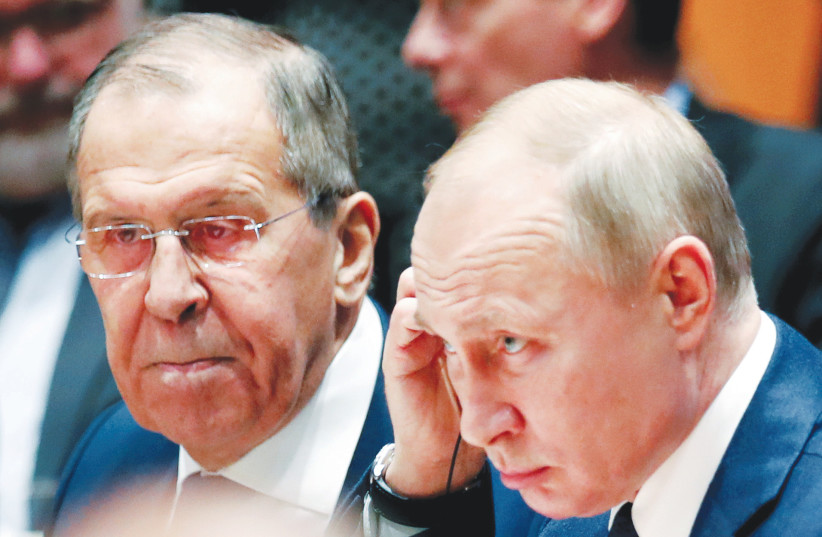

Speaking about jailed Kremlin critic Alexei Navalny, Lavrov said it was necessary to “respect” the law and judicial system of Russia, the statement said.

RUSSIAN PRESIDENT Vladimir Putin and Foreign Minister Sergey Lavrov attend the Libya summit in Berlin, Germany, January 2020 (photo credit: HANNIBAL HANSCHKE/REUTERS)
RUSSIAN PRESIDENT Vladimir Putin and Foreign Minister Sergey Lavrov attend the Libya summit in Berlin, Germany, January 2020
(photo credit: HANNIBAL HANSCHKE/REUTERS)
US Secretary of State Antony Blinken called for the release of Americans detained in Russia during a call with Russian Foreign Minister Sergei Lavrov on Thursday that also encompassed nuclear arms control and China, a State Department spokesman said.
Blinken also raised with Lavrov Russia’s interference in the 2020 United States election, its military moves in Ukraine and Georgia, the poisoning of Kremlin critic Alexei Navalny, and last year’s cyberattack on US government agencies that Washington blames on Russia.
“The Secretary reiterated President Biden’s resolve to protect American citizens and act firmly in defense of US interests in response to actions by Russia that harm us or our allies,” spokesman Ned Price said in a statement.
“This includes the release of Paul Whelan and Trevor Reed so that they are able to return home to their families in the United States.”
A Russian court in July convicted Trevor Reed, a student at the University of North Texas, of endangering the lives of two police officers while former US Marine Paul Whelan was sentenced in June to 16 years in jail for espionage. Both Reed and Whelan deny the charges.
Blinken took on the role of top US diplomat last week, as the country’s approach to Russia is expected to radically change under President Joe Biden from the friendly attitude embraced by former President Donald Trump’s administration.
Despite Washington and Moscow having several disputes, both sides earlier this week announced that they extended the new START arms control treaty for five years, preserving the last treaty limiting deployments of the world’s two largest strategic nuclear arsenals.
The Russian foreign ministry said Lavrov told Blinken that Russia was open for normalization of relations but reminded him that it was necessary to “respect” the law and judicial system of Russia when Blinken raised Navalny.
Navalny, one of President Vladimir Putin’s most prominent critics, was arrested at the Russian border on Jan. 17 after returning from Germany where he had been recovering from being poisoned with a military-grade nerve agent. A Russian court handed anti-corruption blogger Navalny a jail sentence on Tuesday.


Cairo reportedly prepared to host PM before elections, but plans snagging on demand he show goodwill toward Palestinians


Prime Minister Benjamin Netanyahu (left) with Egyptian President Abdel-Fattah el-Sissi (right) on the sidelines of the UN General Assembly in New York on September 27, 2018. (Avi Ohayon / PMO)

Prime Minister Benjamin Netanyahu (left) with Egyptian President Abdel-Fattah el-Sissi (right) on the sidelines of the UN General Assembly in New York on September 27, 2018. (Avi Ohayon / PMO)

Prime Minister Benjamin Netanyahu reportedly wants to fit an official visit to Egypt in to his schedule ahead of the approaching March 23 elections.

According to a Wednesday report by the Walla news site, though the Egyptians like the idea as a way to boost ties with the US, they have conditioned the trip on Netanyahu making a gesture toward the two-state solution in the conflict with the Palestinians.

Citing two unnamed sources familiar with the developments, the report said that a trip has been in the works for months, ever since last September, when the Abraham Accords normalizing relations between Israel and the United Arab Emirates and Bahrain were signed in Washington. A visit was scheduled to go ahead a month ago, but after the Knesset dissolved at the end of December, triggering fresh elections, the Egyptians put the idea on hold.

When contacts were resumed, Egyptian President Abdel-Fattah el-Sissi made his demand that Netanyahu issue a declaration about Palestinian statehood before the visit or during the visit, or make some other practical gesture on the ground to aid the Palestinians.

However, Netanyahu has reportedly balked at taking any such action in the run-up to the elections, in which he will aim to win support from right-wing voters who are generally opposed to the idea of a Palestinian state.

The report said the issue was raised against during a visit to Israel last week by the head of Egyptian intelligence, Abbas Kamel, who earlier in the month had met with Palestinian leaders in Ramallah, in the West Bank.

Kamel reiterated Sissi’s demands to Israeli officials, according to the report.

However, sources close to Netanyahu denied to Walla that Egypt has laid down any such conditions or that the subject was raised during meetings with Kamel.

US President Donald Trump, left, and Prime Minister Benjamin Netanyahu take part in an announcement of Trump’s Middle East peace plan in the East Room of the White House in Washington, DC on January 28, 2020. (Mandel Ngan/AFP)

Egypt sees a visit by Netanyahu as a way to get off to a good start with the new administration in Washington while also repositioning itself as a key player in resolving the Israeli-Palestinian conflict, the report said.

The Trump administration peace plan for the Israeli-Palestinian conflict was seen as diverging from the two-state solution in that it granted Israel the right to annex sections of the West Bank where it maintains settlements, along with the strategic Jordan Valley.

Though the plan was embraced by Israel, it was rejected by the Palestinians, who want the entire West Bank, including the Jordan Valley region and East Jerusalem, for a future state.

US President Joe Biden has said he will make human rights issues a central plank of his administration’s foreign policy, leading to concerns in Cairo that ties might not be as tight as they were during the Trump administration, the report said.

Netanyahu’s last public visit to Egypt was a decade ago when Hosni Mubarak was still in power. Since then, he has made several covert visits to the country, according to the report.
