Turkey hosted Iran’s Foreign Minister Javad Zarif in Ankara on Friday in a sign of growing relations that seek to work closely with Tehran against
US interests in the Middle East. The meeting illustrated that Turkey’s recent push for Azerbaijan to fight Armenians in the Caucasus now will end with Ankara, Moscow and Tehran cooperating in the Caucasus region to carve it up into spheres of influence, like Syria and Libya.
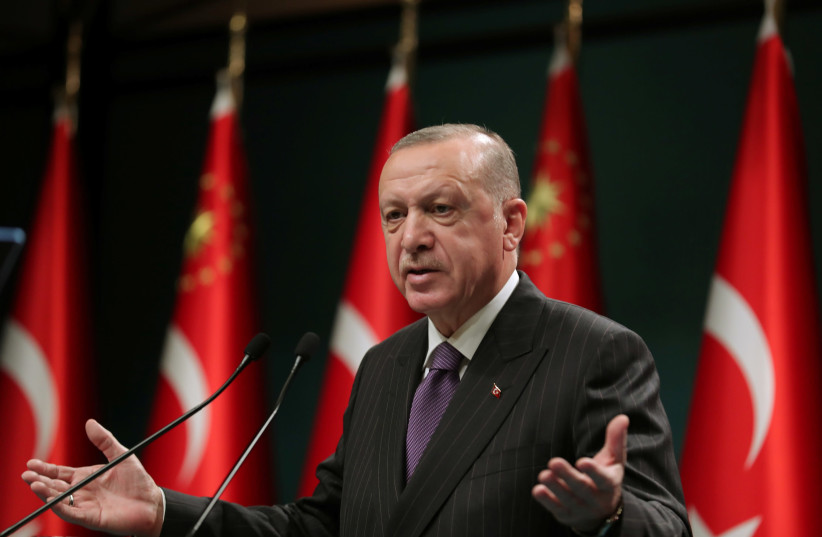
Ankara has pivoted in the last several years, fueled by the former Trump administration which worked closely with Turkish President Recep Tayyip Erdogan, to work with Russia and Iran. This appears counterintuitive because Washington wanted to work with Turkey and even gave Turkey a greater role in Syria. However Ankara’s goal was to use the blank check it had from the Trump administration to move away from NATO into the orbit of Moscow and Tehran to partition areas of the Middle East and remove the US and EU.
Turkey has a well-oiled pro-government media machine and lobby that works to tell one story to Iran hawks in Washington, and another to regional media. For instance Turkey has been pushing a media narrative that it wants reconciliation with Israel and could sideline Hamas, which has a red carpet in Ankara. However, in reality Turkey and Iran both back Hamas and Zarif’s visit to Ankara was symbolic of the Turkey-Iran alliance.
Turkish and Iranian media, which are all pro-government, heralded the new era of Turkey-Iran ties. Turkey has pushed for the US to return to the Iran Deal. Turkey told the Trump administration that it was a bulwark against Iran and Russia, but secretly it always supported the Iran Deal, opposing the Trump administration’s tough talk on Tehran. Yet to get key support from the US State Department and men like US Syria envoy James Jeffrey, Turkey was willing to pretend it cared about confronting Iran.
Ianian Foreign Minister Mohammad Javad Zarif said in Ankara on Friday that both Iran and Turkey have a common stance that stability will be restored to the region only through “synergy”. Press TV in Iran notes “Zarif made the remarks in a post on his official Twitter account on Friday at the end of his visit to Turkey where he held “constructive, friendly, and fruitful” talks with President Recep Tayyip Erdogan and Foreign Minister Mevlut Cavusoglu.”
Turkey and Russia are also opening a coordination center in Karabakh, the Armenian area that Turkey prodded Azerbaijan to retake in September. This illustrates. That Russia and Turkey will now work closely in Idlib in Syria, in Libya and in Azerbaijan. While the US and Italy appear to be slowing down arms sales to Saudi Arabia, Turkey is buying Russia’s S-400 air defense system and moving closer to Moscow and Tehran in key deals. Turkish media also praised the “Iron Silk Road,” a new rail line to Baku and then Russia that will carry goods. Turkey is also shipping goods via rail to China. Anadolu reports “Though trains had traveled this route to China before, this is the first time that exports are being hauled from Turkey to Russia via rail, Turkish Transport and Infrastructure Minister Adil Karaismailoglu stressed during an event at the train station…Karaismailoglu underlined the importance for Turkey of China’s Belt and Road initiative, which aims to create a network of transportation infrastructure between China, Asia, Europe and the Middle East.”
The talks with Zarif and reports about rail links illustrate that a much larger alliance system is rising. It is based on Turkey, Russia, China and Iran working together. Turkey and Russia have partitioned Libya, Syria and the Caucasus. Iran and Turkey will begin to work more in concert on many files.