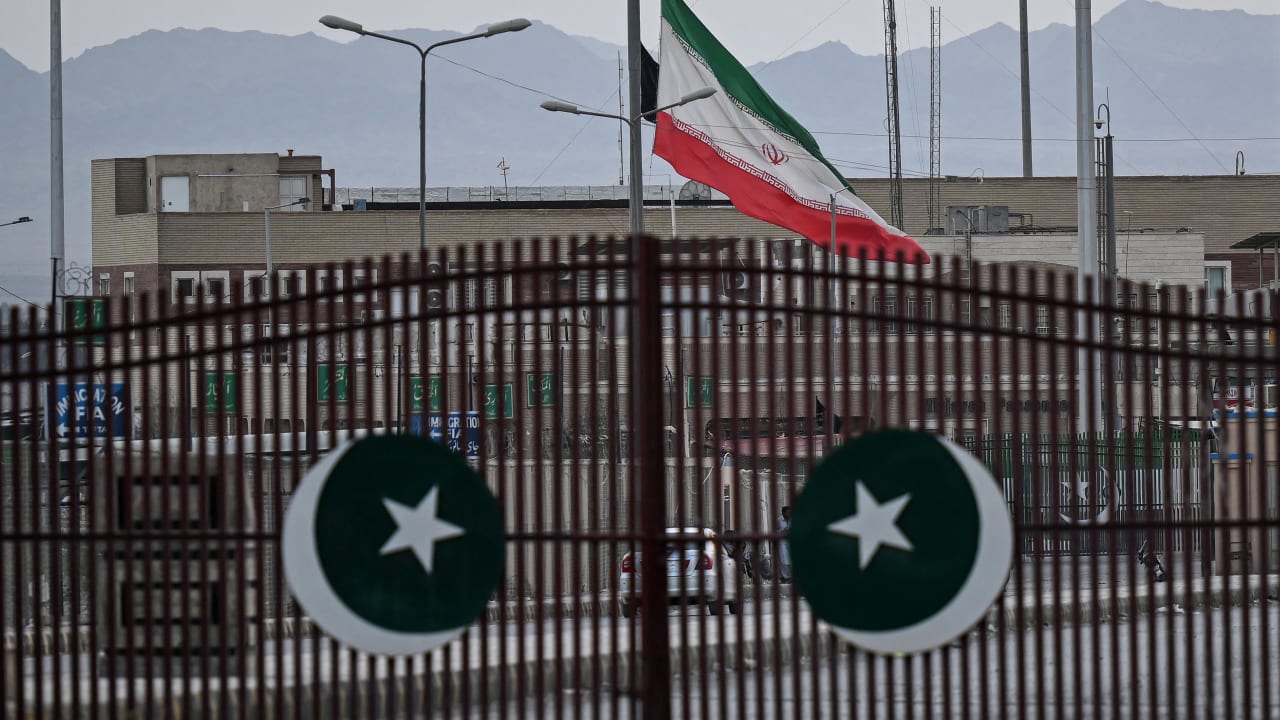
Two days after presenting the Iranians with the latest US message in the negotiations, Syed Mohsin Naqvi held another round of talks with Iranian Foreign Minister Abbas Araqchi in Tehran.

Iranian Parliament Speaker Mohammad Bagher Ghalibaf meets with Pakistan army chief Asim Munir, in Tehran, Iran, April 16, 2026.
(photo credit: Iranian Parliament Speaker Office/WANA (West Asia News Agency)/Handout via REUTERS) 
Iran’s foreign minister met Pakistan’s interior minister on Friday to discuss proposals to end the US-Israeli war, Iranian media reported, with Tehran and Washington still at odds over Tehran’s uranium stockpile and controls on the Strait of Hormuz.

Two days after presenting the Iranians with the latest US message in the negotiations, Syed Mohsin Naqvi held another round of talks with Iranian Foreign Minister Abbas Araqchi in Tehran, the semi-official Tasnim and ISNA news agencies reported.

Naqvi was facilitating communication to try and achieve a framework for ending the war and resolving differences, ISNA reported.

US Secretary of State Marco Rubio told reporters on Thursday that there had been “some good signs” in the talks, but there could be no solution if Tehran enforced a tolling system in the Strait of Hormuz, which it effectively closed to most shipping after the war began on February 28.

“There’s some good signs,” Rubio said. “I don’t want to be overly optimistic… So, let’s see what happens over the next few days.”

A woman walks past the mural showing U.S. flag with barbed wire and the Statue Of Liberty with skull face in Tehran, Iran June 25, 2019.
A woman walks past the mural showing U.S. flag with barbed wire and the Statue Of Liberty with skull face in Tehran, Iran June 25, 2019. (credit: Nazanin Tabatabaee/Nazanin Tabatabaee/West Asia News Agency via REUTERS)
A senior Iranian source told Reuters on Thursday that gaps had been narrowed, although uranium enrichment and the Strait of Hormuz remained among the sticking points.

Trump: ‘The US will recover Iran’s stockpile of uranium’

The war has wreaked havoc on the global economy, with the surge in oil prices stoking fears of rampant inflation. About a fifth of the world’s oil and liquefied natural gas shipments traveled through the Strait of Hormuz before the war.

The US dollar was near its highest level in six weeks on Friday amid the uncertainty over the peace talks, while oil prices climbed as investors doubted the prospects of a breakthrough.

“We’re coming to the end of week 12, we’re six weeks in the ceasefire, and I’m just not really that convinced we’re any closer to a resolution between the US and Iran,” Tony Sycamore, a market analyst at IG, said of the Middle East war.

US President Donald Trump said the US would eventually recover Iran’s stockpile of highly enriched uranium, which Washington believes is destined for a nuclear weapon, though Tehran says it is intended purely for peaceful purposes.

“We will get it. We don’t need it, we don’t want it. We’ll probably destroy it after we get it, but we’re not going to let them have it,” Trump told reporters at the White House on Thursday.

Two senior Iranian sources told Reuters before Trump’s comments that Iranian Supreme Leader Ayatollah Mojtaba Khamenei had issued a directive that the uranium should not be sent abroad.

The US president also railed against Tehran’s intentions to charge fees on ships using the strait.

“We want it open, we want it free. We don’t want tolls,” Trump said. “It’s an international waterway.”

Trump faces domestic pressure ahead of November midterm elections, with Americans angry over the surge in fuel prices and his approval rating near its lowest level since he returned to the White House last year.

Tehran submitted its latest offer to the US earlier this week.

Tehran’s descriptions suggest it largely repeats terms Trump previously rejected, including demands for control of the Strait of Hormuz, compensation for war damage, lifting of sanctions, release of frozen assets, and the withdrawal of US troops.

World’s worst energy shock

The International Energy Agency says the conflict has produced the world’s worst energy shock.

It warned on Thursday that the peak of summer fuel demand, coupled with a lack of new supply from the Middle East, meant the market could enter the “red zone” in July and August.

Traffic through the strait has fallen to a trickle compared with 125 to 140 daily passages before the war.

Iran has said it aims to reopen the strait to friendly countries that abide by its terms, which could potentially include fees.

“It would make a diplomatic deal unfeasible if they were to continue to pursue that. So it’s a threat to the world if they were trying to do that, and it’s completely illegal,” Rubio said.

Trump and Israeli Prime Minister Benjamin Netanyahu said their war aims were to curb Iran’s support for regional militias, dismantle its nuclear program, destroy its missile capabilities, and make it easier for Iranians to topple their rulers.

But Iran has so far retained its stockpile of near-weapons-grade enriched uranium, and its ability to threaten neighbors with missiles, drones, and proxy militias.


WaPo report says US fired 300 interceptors, including over half its THAADs, while Israel fired 190; US official says even more would be used if war resumes because Israel has sent some missile defense batteries for maintenance

The US military deploys a THAAD missile defense system in Israel, March 2019. (US Army Europe/File)

The US military deploys a THAAD missile defense system in Israel, March 2019. (US Army Europe/File)

The US reportedly used up more than half of its inventory of THAAD anti-missile interceptors while defending Israel from Iranian attacks during the recent war.

According to The Washington Post on Thursday, the United States used over 200 THAAD interceptors to shoot down missiles bound for Israel. It also launched more than 100 SM-3 and SM-6 interceptors to defend Israel, which itself used fewer than 100 Arrow interceptors and around 90 from the David Sling’s system, the report said, quoting Defense Department data.

Overall, the report said, the US “expended far more advanced interceptors to protect Israel than Israeli forces did.”

A US official told the newspaper that if fighting renews with Iran, the US will likely need to use even more interceptors defending Israel because Israel has sent some of its missile defense batteries for maintenance.

“Israel is not capable of fighting and winning wars on its own, but nobody actually knows this, because they never see the back end,” said a US official quoted in the report.

The Pentagon denied to The Washington Post that there is any issue of burden sharing with Israel, saying, “Ballistic missile interceptors are just one tool in a vast network of systems and capabilities.”

The Israeli Embassy in Washington said in response that “the US has no other partner with the military willingness, readiness, shared interests and capabilities of Israel.”

Interceptor missiles are fired at Iranian ballistic missiles over central Israel, March 9, 2026. (Yossi Aloni/Flash90)

Israel has consistently denied claims that it is running low on interceptors, and last month, it approved plans to dramatically accelerate the production of Arrow interceptor missiles.

During the early days of the war, the US also insisted it had enough offensive and defensive munitions after a Post report said it may need to begin conserving interceptors.

Israel has a multi-layered air defense array, with a variety of systems intercepting threats at different altitudes.

The top tier consists of the anti-ballistic missile Arrow systems, with Arrow 2 operating both within the Earth’s atmosphere and in space, and Arrow 3 intercepting above the Earth’s atmosphere.

A single Arrow 3 missile has an estimated price of $2-3 million and takes a few months to produce, although the exact time frame has not been made public by Israel due to security concerns.

The joint US-Israel campaign against Iran, launched on February 28, aimed to degrade the Iranian regime’s military capabilities, distance threats posed by Iran — including its nuclear and ballistic missile programs — and “create the conditions” for the Iranian people to topple the regime, the military and other Israeli leaders have said. A fragile ceasefire came into effect on April 8.

An Israeli air defense missile intercepts missiles launched from Iran, as seen over Modi’in, March 25, 2026. (Jonathan Shaul/Flash90)

Some 650 ballistic missiles were launched from Iran at Israel during the war, killing 21 Israeli civilians and foreign nationals, along with four Palestinians in the West Bank.

In all, at least 16 missiles carrying conventional warheads with hundreds of kilograms of explosives struck populated areas in Israel, causing extensive damage. There were also more than 50 incidents of missiles carrying cluster bomb warheads hitting populated areas, with hundreds of separate impact sites.


DIPLOMATIC AFFAIRS: The Iran war is pushing the UAE and Israel into unprecedented cooperation, while Saudi Arabia looks elsewhere to counter Tehran without empowering Jerusalem.

US President Donald Trump attends a GCC summit photo session in Riyadh, alongside Qatari, Saudi, and  Bahraini leaders, May 2025.
US President Donald Trump attends a GCC summit photo session in Riyadh, alongside Qatari, Saudi, and Bahraini leaders, May 2025.
(photo credit: BRIAN SNYDER/REUTERS)
Here’s something you don’t see every day in diplomacy: the prime minister of one country saying he visited another country, only for that country’s foreign ministry to deny the visit ever took place.

Yet that is exactly what happened last week when the United Arab Emirates issued a statement rejecting claims made a day earlier by Prime Minister Benjamin Netanyahu’s office that he had secretly visited the UAE and met with its leader, Sheik Mohammed bin Zayed, and that the meeting had resulted in a “historic breakthrough” in relations between the two countries.

The UAE foreign ministry called the Prime Minister’s Office statement “entirely unfounded,” adding that relations between the two states “are public” and “not based on non-transparent or unofficial arrangements.”

Coming so soon after reports that Israel sent an Iron Dome battery to the UAE during the war with Iran, along with personnel to operate it, and amid reports that the heads of both the Mossad and the Shin Bet (Israel Security Agency) had visited Abu Dhabi in recent weeks for high-level coordination, the episode of the Netanyahu – or non-Netanyahu – meeting left some scratching their heads.

It was a fly in what otherwise appeared to be the heady perfume of blossoming Israel-UAE ties.

And it was a fly spawned in domestic Israeli politics.

Prime Minister Benjamin Netanyahu and President of the UAE Sheikh bin Zayed Al Nahyan.
Prime Minister Benjamin Netanyahu and President of the UAE Sheikh bin Zayed Al Nahyan. (credit: .Abdulla Al Neyadi / UAE Presidential Court/Handout, ILLUSTRATIVE)

The UAE did not take kindly to being a player in an Israeli political game

According to a Channel 12 report, Netanyahu announced the visit to avoid being upstaged by former prime minister Naftali Bennett, who was reportedly scheduled to visit the kingdom the next day.

What’s the problem? The Emirates did not take kindly to being a bit player in an Israeli political game. It wants to manage the optics of this rapidly expanding relationship and not be turned into a political trophy for Netanyahu.

But the political theater surrounding the disclosure obscured a much larger story: despite occasional hiccups over optics and timing, relations between the two countries are deepening dramatically as a result of the war with Iran.

The relationship between Israel and the UAE has moved well beyond the symbolism of the Abraham Accords. What began in 2020 as a breakthrough in normalization with Arab states, even though the Palestinian issue has not been resolved, is, under the pressure of the wars with Iran – both last year’s and the current conflict – evolving into something far more consequential: a strategic partnership shaped by security coordination, intelligence sharing, air defense cooperation, and even discussions about the region’s postwar architecture.

CNN quoted Yoel Guzansky, a fellow at the Institute for National Security Studies, as saying that the UAE is one of the countries closest to Israel globally. “It’s not just security. It’s tourism, science, investment, trade. There is no Arab country closer.”

This closeness also goes a long way toward explaining why the UAE was hit so hard by Iran during the recent war, absorbing more ballistic missiles and drone attacks than any other country in the region, including Israel.
While the relationship may not be only about security, security is clearly its beating heart.

Middle East Eye, a London-based digital platform that is decidedly pro-Palestinian and sharply critical of Israel, reported this week that Israel and the UAE have established a fund to jointly acquire and develop new weapons systems as part of a new defense partnership, and that this was the agreement cemented by Netanyahu’s visit to the Gulf state.

Guzansky told the website that this type of venture is a logical next step in the relationship.

“Israel will need UAE money. We have the technology, but we lack the resources. The UAE has the resources, but lacks the technology,” he said.

The growing closeness of the relationship, evident in talk of a joint fund, made the Emirati irritation over Netanyahu’s disclosure noteworthy but not alarming. It also points to a larger shift in UAE strategy that the war with Iran has accelerated.

Abu Dhabi is increasingly acting less like a conventional member of an Arab consensus and more like a state determined to chart its own course, even when that means breaking with the other Gulf countries.

Its decision last month to leave OPEC after some 60 years may have been framed primarily as an economic move, but it also reflected something political: a willingness to step outside existing structures and define its interests with far greater freedom.

In that sense, the deepening relationship with Israel is not just about shared threat perceptions or military utility. It is also about autonomy and independence.

The UAE wants Israel’s technology, intelligence, and the practical benefits of closer security coordination. But it also wants to remain in control of the relationship, which is precisely why the Netanyahu episode seemed to irritate it.

The issue was not that the relationship is fragile. It was that Abu Dhabi does not want to be cast as a prop in Israeli domestic politics, or folded into a narrative of a new Israeli-led regional order it does not itself define.

Cinzia Bianco, a visiting fellow at the European Council on Foreign Relations who specializes in the Gulf states, framed the UAE’s decision to leave OPEC as an expression of a strategic shift accelerated by the Iran war and an indication that the UAE is now “increasingly unbound by Arab and Muslim consensus politics or inherited institutions such as OPEC.”

One of the reasons for this willingness to go it alone is deep disappointment in the Arab world’s response to Iran’s attacks on it.

“Israel’s counter-drone lasers and its Iron Dome system were crucial in intercepting over 95% of Iranian projectiles targeting the UAE,” she wrote. “For Abu Dhabi, this stands in stark contrast to what many Emirati officials see as a complete lack of tangible Arab solidarity during the crisis.”

Riyadh may well welcome seeing Iran weakened

Tareq al-Otaiba, a former official at the UAE’s national security council, wrote in an article for the Arab Gulf States Institute that the current crisis, which he dubbed the region’s most significant since the 1990 Iraqi invasion of Kuwait, “is not only testing the Gulf’s air defenses, it is exposing the hollowness of Arab solidarity.

“In the face of Iranian aggression, several states have stepped up to provide real assistance to the UAE. Primarily, the United States and Israel have proved to be true allies by offering support through extensive military aid, intelligence sharing, and diplomatic backing. The same support has not come from the Arab world.”

While the UAE appears to be moving steadily closer to Israel as a practical security partner, Saudi Arabia is not. Rather, it is charting a different course.

Riyadh may well welcome seeing Iran weakened and its regional reach curtailed, but it is also wary of any outcome that leaves Israel emerging from the conflict as the Middle East’s dominant power.

Witness what happened after the 12-Day War last June when the US and Israel significantly degraded Iran’s nuclear capabilities. One might have thought that this would have led to a Saudi-Israel opening. It didn’t. In fact, there was an uptick in anti-Israel and even antisemitic rhetoric from Saudi officials, religious figures, and the media.

How to explain this phenomenon? While Saudi Arabia welcomes the weakening of Iran and thwarting its plans to become the Middle East hegemon, it does not want to see Israel’s power in the region increase, nor does it want to do anything that would serve to increase the country’s reach, which normalizing ties with it would necessarily do.

So while the UAE is forging closer ties with Israel as a bulwark against Iranian aggression in the future, Saudi Arabia is looking in other directions – strengthening its ties with Pakistan and Turkey. The three countries drafted a trilateral defense agreement in January, signaling the emergence of a new Sunni axis in the region.

Reuters reported this week that Pakistan has deployed some 8,000 troops, a squadron of fighter jets, drone units, and a Chinese-operated air defense system to Saudi Arabia as part of a confidential mutual defense pact signed late last year.

So, rather than lean toward Israel, this is all an indication of how Saudi Arabia is looking elsewhere for security guarantees.

The UAE is moving toward deeper operational coordination with Israel, while Saudi Arabia is maneuvering to preserve a regional balance in which neither Tehran nor Jerusalem becomes too powerful. The way for it to do that is to look to Ankara and Islamabad for defense support, not Jerusalem – something that would be highly unpopular on the Saudi street.

The current war, as a result, is not only degrading Iran’s power; it is also exposing the region’s new strategic fault line.

The UAE is increasingly turning to Israel as a security partner that can deliver when it matters. Saudi Arabia, meanwhile, is hedging – looking to Pakistan and Turkey rather than Jerusalem because it wants Iran weakened, but not at the price of seeing Israel emerge as the region’s new heavyweight.

And that growing split – between the UAE moving closer to Israel, and Saudi Arabia building alternative security alliances with countries like Pakistan and Turkey – may become one of the defining fault lines of the postwar Middle East.