
Biden declares Trump peace plan dead and buried

Trump’s Vision acknowledged the historic and biblical right of the Jews to reconstitute the Jewish National Home in Judea & Samaria. Op-ed.
David Singer , Jan 28 , 2021 11:00 AM
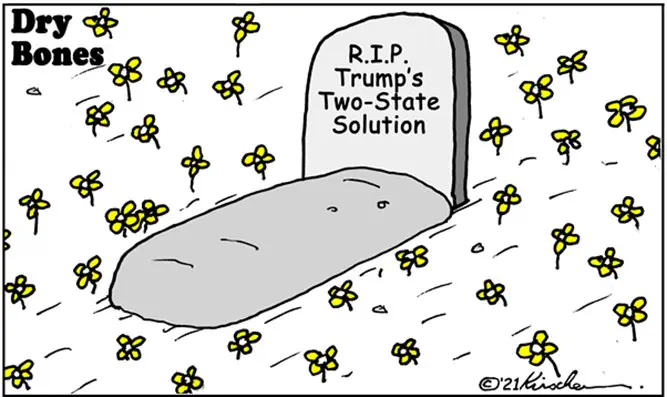
Dry Bones: Burying Trump's peace plan

Dry Bones: Burying Trump’s peace plan

Y. Kirschen

A possible attempt by the outgoing US Ambassador to Israel – David Friedman – to preserve the specific two-state solution proposed in former President Trump’s Vision for Peace (Vision) – lasted about two hours – before being shredded in the garbage bin of history by the newly-elected President Biden.

This is the only conclusion one can reasonably draw after a second U.S. Ambassador to Israel page – in French – headed “U.S. Ambassador to Israel, the West Bank and Gaza” – was published on Twitter at about the same time as President Biden’s swearing in ceremony was beginning (See images beow).


C:\Users\dsing\Pictures\Saved Pictures\Two Embassy websites (2).jfif


Republican Senator Rick Scott of Florida blamed the new Biden administration for the Embassy’s new Twitter page:

“The Biden Admin title change for the @USAmbIsrael shows the Democrats’ hostility to Israel”

Other comments similarly blamed the Biden administration.

These criticisms seem misplaced – given the timing of the second page’s appearance on Twitter.

The second page was not a forgery – as a spokesman for the American embassy told The Times of Israel:

“This is not a policy change or indication of future policy change.”

The spokesman was simultaneously confirming that Trump’s two-state solution was still America’s policy objective in the ‘West Bank’ and Gaza:

  • A Palestinian Arab State in Gaza and about 70% of the ‘West Bank’ – plus an area currently within Israel’s sovereign borders and
  • Israeli sovereignty being extended in the remaining 30% of the ‘West Bank’

That Friedman – not the incoming Biden administration – authorised this second Embassy Twitter page – is further supported by the fact that Friedman posted his final Tweet – as Ambassador – on both Embassy pages:

“Signing off now, moving to @DavidM_Friedman. Thank you President Trump for the honor of a lifetime. Thank you @MikePence,@MikePompeo,@SteveMnuchin1,Jared Kushner,@AviBerkow45,@Robertcobrienand @LighstoneA…”

The Jewish Chronicle also reported:

“In a further comment, the US Embassy said: “It was an inadvertent edit, and not reflective of a policy change.”

An “inadvertent edit” it certainly was not.

Someone in the Embassy had created the second Embassy page – pre-Biden – and someone in the new 2 hours-old Biden administration had apparently directed the Embassy – after Friedman had left – to de-activate that page. Representing Trump’s peace plan as American current policy going forward under the Biden administration had come to a crushing halt.

A Washington Post article in August 2020 summed up Biden and the Democrats position on Trump’s version of a two-state solution:

“The Democrats, led by presidential candidate Joe Biden, are determined to change course should they come to power. There are open discussions within the caucus about conditioning the billions in aid given to Israel on the basis of its actions. Biden and virtually every Democrat in Congress were vocal in their opposition to Israeli Prime Minister Benjamin Netanyahu’s now-stalled plans to start annexing parts of the West Bank.”

Any attempt by Israel to extend its sovereignty unilaterally into any part of Judea and Samaria (aka ‘West Bank’) – incorrectly termed “annexation” – will assuredly be opposed by President Biden.

Trump’s Vision acknowledged the historic and biblical right of the Jewish people to reconstitute the Jewish National Home in the ‘West Bank’ – recognized and legally authorized by the 1922 League of Nations Mandate for Palestine – and preserved under article 80 of the United Nations Charter.

A jointly-appointed US-Israel Mapping Committee – headed by Friedman – had failed – after 11 months – to produce a detailed subdivision of the ‘West Bank’ embracing the concept of a two-state solution proposed by Trump – before Friedman’s retirement as Ambassador.

Closing the Embassy’s second Twitter page signals such a map will never be released under President Biden’s administration.

Biden has effectively declared Trump’s peace plan dead and buried.


Author’s note: The cartoon – commissioned exclusively by the author —is by Yaakov Kirschen aka “Dry Bones”- one of Israel’s foremost political and social commentators – whose cartoons have graced the columns of Israeli and international media publications for decades. His cartoons can be viewed at Drybonesblog

https://www.israelnationalnews.com/News/News.aspx/295763


In further step away from 2015 deal, Tehran spokesperson says limitations to be placed from next month on UN short-notice inspections of suspect sites


US President Joe Biden signs an executive order in the Oval Office of the White House, in Washington, January 25, 2021. (Evan Vucci/AP)

US President Joe Biden signs an executive order in the Oval Office of the White House, in Washington, January 25, 2021. (Evan Vucci/AP)

TEHRAN, Iran (AP) — Iran warned the Biden administration on Tuesday that it will not have an indefinite time period on its disposal to rejoin the 2015 nuclear deal between Tehran and world powers.

Iran also said it expects Washington to swiftly lift crippling economic sanctions that former US president Donald Trump imposed on the country after pulling America out of the atomic accord in 2018, as part of what he called maximum pressure against Iran.

Trump cited Iran’s ballistic missile program among other issues in withdrawing from the accord. And when the Trump administration increased sanctions, Iran gradually and publicly abandoned the deal’s limits on its nuclear development.

The remarks Tuesday by Iran’s Cabinet spokesman Ali Rabiei are part of pressure that Tehran is trying to exert on the US as it seeks to increase its leverage and get the Biden administration to quickly return to the deal.

US President Joe Biden has moved swiftly to dismantle Trump’s legacy by signing a series of executive actions that reverse course on a wide range of issues, including climate change and immigration.

Though Biden has pledged to return to the nuclear deal, Rabiei said there has yet to be any communication between Iran and Biden on the subject.

“The US will not have all the time in the world,” Rabiei said. “We are waiting for the official announcement of their stance as well as the lifting of sanctions.”

In the meantime, he added that Iran would take a step further away from the nuclear deal by imposing a “restriction” on short-notice inspections by the UN nuclear watchdog in late February. The first step to limit those inspections would be taken from the week of February 19, he said.

In December, Iran’s parliament approved a law under which part of the inspections that the deal had provided for would be suspended in February if European signatories to the 2015 nuclear deal do not offer relief from oil and banking sanctions.

Tensions between Tehran and Washington have steadily increased. During Trump’s final days as president, Tehran seized a South Korean oil tanker and begun enriching uranium closer to weapons-grade levels, while the US has sent B-52 bombers, the USS Nimitz aircraft carrier and a nuclear submarine into the region.

Iran has also increased its military drills, including firing cruise missiles as part of a naval drill in the Gulf of Oman this month.

Iran has missile capability of up to 2,000 kilometers (1,250 miles), far enough to reach Israel as well as US military bases in the region. Last January, after the US killed a top Iranian general in Baghdad, Tehran retaliated by firing a barrage of ballistic missiles at two Iraqi bases housing US troops, resulting in brain concussion injuries to dozens of American soldiers.


sael threatens to attack Iran if US eases sanctions,rejoins 2015 nuke deal

JANUARY 26, 2021 

Israeli officials warned they will attack Iran if President Joe Biden eases U.S. sanctions on Iran and rejoins the 2015 Joint Comprehensive Plan of Action (JCPOA), also known as the Iran nuclear deal.

Two weeks ago, Tzachi Hanegbi, a cabinet member and top advisor to Israeli Prime Minister Benjamin Netanyahu, threatened that Israel will take action, as it did against Iraq in the 1980s and against Syria in 2007, to prevent Iran from advancing its nuclear program.

Habegbi said, “If the United States government rejoins the nuclear deal — and that seems to be the stated policy as of now — the practical result will be that Israel will again be alone against Iran. . . This of course we will not allow. We’ve already twice done what needed to be done, in 1981 against the Iraqi nuclear program and in 2007 against the Syrian nuclear program,” as The Times of Israel reported.

Hanegbi’s comments referred to strikes by Israel on Iraq and Syria’s nuclear reactors.

On Monday, an Israeli source told Breaking Defense that Israel could go so far as to set a Biden administration decision to ease sanctions on Iran as a redline before Israel launches a strike.

“Israel needs to know — and fast — whether Washington plans to stop Iran’s race to the bomb or take some action to do this,” the source told Breaking Defense.

Since President Donald Trump withdrew the U.S. from the Iran deal in 2018, the U.S. has increasingly sanctioned Iran under a “maximum pressure” campaign. Iran has in turn violated its own commitments to the nuclear deal and has been stockpiling and enriching uranium beyond levels allowed under the deal.

The Breaking Defense source said Israeli intelligence is closely monitoring Iran’s nuclear facilities and “The people who need to know are updated by the hour.”

Israel has already allegedly taken action to counter Iran’s nuclear program. On Thursday, Israel allegedly attacked an Iranian target in Syria. Iran has been assisting Syrian leader Bashar Al-Assad’s regime throughout the Syrian civil war in recent years.

“This pressure will continue and grow, as a preparation for a direct attack on targets in Iran,” the source said, addressing Thursday’s alleged Israeli attack.

Iran also accused Israel of carrying out the November roadside ambush that killed a leading Iranian nuclear scientist, Mohsen Fakhrizadeh.

Biden has repeatedly suggested bringing the U.S. back into the 2015 Iran nuclear deal, and his campaign website said he “would re-enter the agreement, using hard-nosed diplomacy and support from our allies to strengthen and extend it, while more effectively pushing back against Iran’s other destabilizing activities.”

Mordechai Kedar, an Israeli analyst on Iran and the Arab world, told Breaking Defense he believes the new U.S. administration will ignore Israel’s requests. Kedar said, “The new administration will do everything to bring Iran back into the family of nations, without really understanding their real goals.”

Previewing his expectations for the Biden administration in December, Iranian President Hassan Rouhani predicted Biden would return to the Iran deal and the U.S. sanctions “will be broken.”

By contrast, Biden’s secretary of state nominee Antony Blinken said during a Senate confirmation hearing last week, that a return to the Iran deal is still a “long way” off. Blinken said, “We would have to see, once the president is in office, what steps Iran actually takes” and evaluate whether “they’re coming back into compliance with their obligations” and said a return to the 2015 agreement would serve as a platform for a “longer and stronger agreement” to address Iran’s missile program and its sponsorship of terrorism and other malign activities.
