
Unlike after his election victory, Israeli leaders waste no time in welcoming new US president; PM also tweets thanks to Trump ‘for all the great things you have done for Israel’


Prime Minister Benjamin Netanyahu congratulates US President Joe Biden and Vice President Kamala Harris following their inauguration, January 20, 2021 (video screenshot)

Prime Minister Benjamin Netanyahu and President Reuven Rivlin congratulated Joe Biden on his inauguration as the 46th US president on Wednesday and urged him to build on the series of peace deals the Trump administration brokered between the Jewish state and its Arab neighbors.

Netanyahu, in a video message, also highlighted an area on which the leaders appear to be headed for confrontation, urging the new president to work with Israel to confront “the threat posed by Iran.” Biden has said he intends to reenter the 2015 Iran deal, which Netanyahu bitterly opposed and successfully lobbied president Donald Trump to abandon.

“President Biden, you and I have had a warm personal friendship going back many decades,” Netanyahu said in the English-language video statement issued moments after Biden took the oath of office. “I look forward to working with you to further strengthen the US-Israel alliance, to continue expanding peace between Israel and the Arab world and to confront common challenges — chief among them the threat posed by Iran.”

In his congratulatory message, Rivlin said that the US has no better friend than Israel and that the ties between the two countries go beyond political parties and are based on shared values.

“Our region is changing quickly. Many of the changes are positive. The recent peace deals between Israel and our neighbors brought new hope with them and I expect to work with you to help build further bridges in the region, including with our Palestinian neighbors,” Rivlin said.

Volume 90%


Biden has praised the normalization deals Israel reached with the UAE, Bahrain, Sudan and Morocco, and his aides have expressed interest in building on them. However, his nominee for secretary of state Antony Blinken warned Tuesday that he would take a “hard look” at some of the apparent side agreements involved, such as the sale of F-35s to Abu Dhabi. That purchase was officially signed on Wednesday.

Biden’s election also represents a return to US support for a more traditional two-state solution to the Israeli-Palestinian conflict. Trump released a peace plan based on that same concept, but it envisioned Israel annexing every one of its West Bank settlements. Biden, on the other hand, has been a vocal critic of the settlement movement and of Netanyahu’s efforts to annex large parts of the West Bank.

The speedy messages of congratulations, particularly from Netanyahu, were a contrast from those issued after major TV networks called the election for Biden on November 7 — when the premier was one of the last major world leaders to recognize Biden’s win. Netanyahu over the past four years has become one of Trump’s closest backers, and Israel, which has benefited from a slew of moves by the former president, is one of the only countries where the deeply controversial leader enjoyed positive polling.

Netanyahu has also been accused by critics of mortgaging his relations with the Democratic party due to his bare-hug embrace of Trump, following several years of very public breaks with the Democratic Obama administration over its promotion of the Iran nuclear deal.

Then-US Vice President Joe Biden, right, and Israeli President Reuven Rivlin meet at the President’s Residence in Jerusalem, March 9, 2016. (Mark Neyman/GPO)

That is once again expected to be an issue of contention between the countries as Biden has pledged to reenter the accord, vacated by Trump, so long as Iran returns to strict compliance with it. Netanyahu has already publicly warned Biden that such a strategy would be a mistake.

And while he was quick to congratulate Biden, Netanyahu followed it up with one last goodbye to Trump.

“President Trump, thank you for all the great things you have done for Israel, especially your historic recognition of Jerusalem as Israel’s capital and bringing four peace agreements between Israel and the Arab world,” his office tweeted.

Israeli UN Ambassador Gilad Erdan in his New York office on October 13, 2020. (Israeli Mission to the UN)

Israel ambassador to the UN Gilad Erdan, who will take on the additional role of envoy to the US on Thursday, was in Washington for the inauguration. In his own video statement, he noted that “relations between Israel and the United States have been deep and strong for many years.”

“As the incoming ambassador, I look forward to working with the new administration and strengthen relations even further. President Biden and Vice President Harris, Israeli citizens look forward to your visit to Jerusalem,” he said.

Politicians from across the political spectrum joined Netanyahu and Rivlin in welcoming the new US president and Vice President Kamala Harris.

“This is a special moment for America, and for the entire world,” said Defense Minister Benny Gantz.

“There are so many challenges that face us all: containing Iranian regional aggression and nuclear aspirations, fighting terror groups and destabilizing forces, expanding normalization, and reaching a resolution to the Israeli- Palestinian conflict,” said the Blue and White leader.

“I look forward to working with the Biden administration, and with my friends at the Pentagon, in taking on these challenges together.”

Foreign Minister Gabi Ashkenazi tweeted: “I am confident that under your leadership, the relationship between Israel and the US, our greatest ally and friend, will continue to flourish. I wish you much success throughout your presidency.”

In his own video message, New Hope party chairman Gideon Sa’ar, Netanyahu’s top rival in the upcoming Israeli election, told Biden, “All through your career, you have championed the unbreakable bond between the US and Israel.

“I look forward to working with you to strengthen the US-Israel alliance and bipartisan support for Israel.”

Opposition chairman and Yesh Atid leader Yair Lapid tweeted that he was “looking forward to working with you over the coming years to strengthen the special relationship between our two countries and advance our shared values.”

Nitzan Horowitz, chairman of the left-wing Meretz party, tweeted simply: “May it happen for us soon too,” a reference to his desire to see Netanyahu ousted from his post.

In a separate post, Horowitz wrote: “As an Israeli, as a Jew and as a person in this world, I am full of joy over Biden’s victory. A decent man, experienced and considerate, with a good heart.”

“This is a major repair after the disgrace of Trump,” he said.

https://www.timesofisrael.com/congratulating-biden-netanyahu-urges-him-to-build-on-peace-deals-confront-iran/
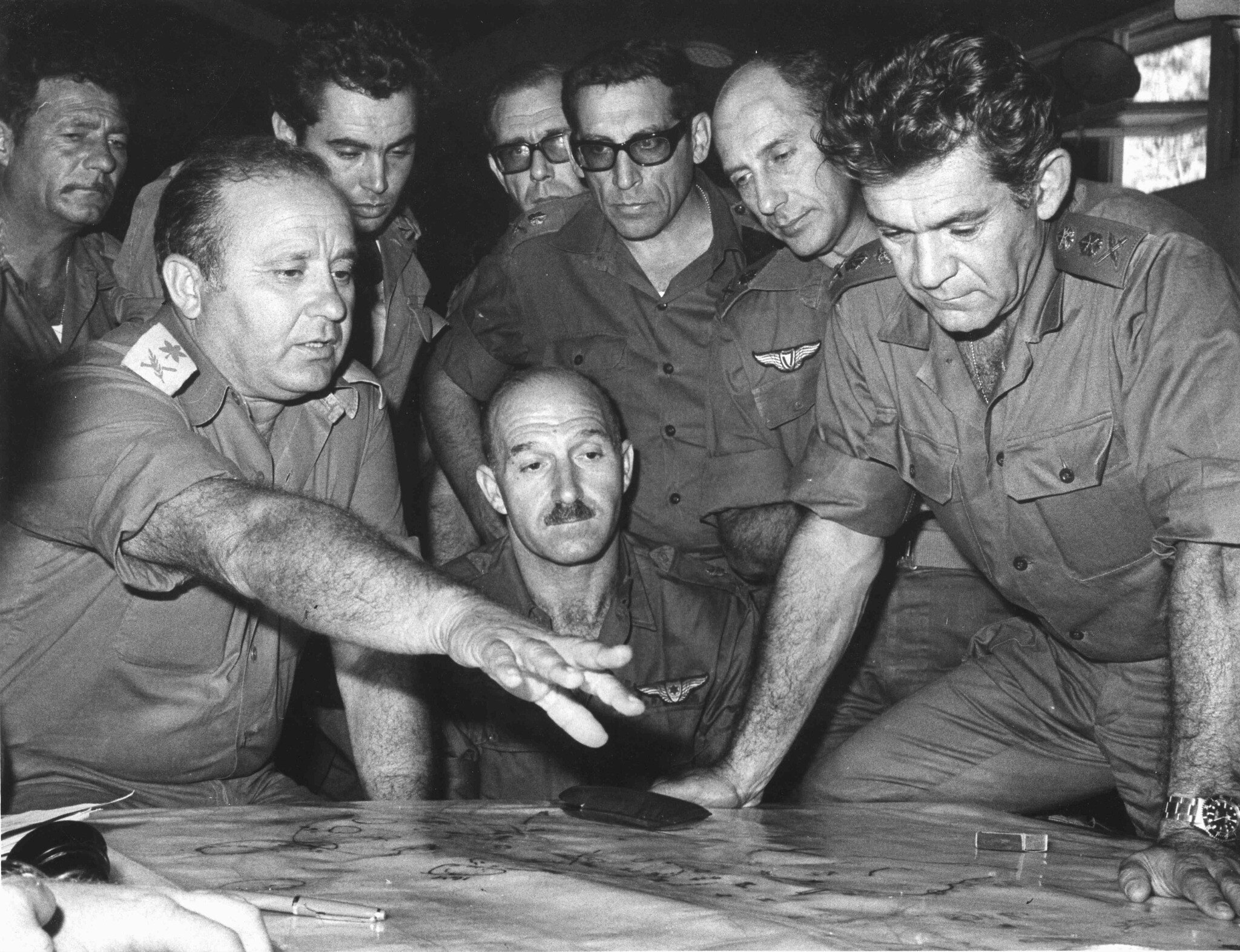

Defense Ministry releases transcripts of government meetings during 1973 conflict, showing the leadership’s uncertainty and concerns in the first few days of fighting


Then-head of the IDF Northern Command Maj. Gen. Yizhak Hofi, left, speaks to then-IDF chief of staff David Elazar, right, and other IDF top officers during the 1973 Yom Kippur War, in an undated photograph. (Defense Ministry Archive)

Then-head of the IDF Northern Command Maj. Gen. Yizhak Hofi, left, speaks to then-IDF chief of staff David Elazar, right, and other IDF top officers during the 1973 Yom Kippur War, in an undated photograph. (Defense Ministry Archive)

The Israeli government and military feared during the early days of the 1973 Yom Kippur War that without a decisive victory on at least one front, the world would no longer believe the Jewish state could defend itself, according to transcripts of previously classified cabinet meetings and top-level security discussions that were released by the Defense Ministry on Thursday.

“I have been living — since the beginning of the campaign — with the feeling that we cannot leave [the war] in a situation that the world says: That’s it. What we thought about Israel and the [Israel Defense Forces]: That’s it,” then-prime minister Golda Meir said during one such meeting on the night of October 10, the fifth day of the war.

That sentiment was echoed by the IDF chief of staff at the time, Lt. Gen. David Elazar, who said Israel needed to make a major offensive push into Syria to demonstrate the country’s military strength and to force Damascus’s ally Egypt to accept an armistice along the 1967 ceasefire lines.

“We are ready to go back but the Egyptians aren’t totally ready to go back, but they’d be ready for a ceasefire for the following reason: That tomorrow we are bombing all of Syria, including the cities there, and that we are advancing into Syria, and the world will believe that we are strong. No one in the world recognizes our weakness, not in Israel, not in America, not the Arabs and not the Russians. Tomorrow they’ll believe it more, that we are preparing for this, that we are going to Damascus,” Elazar said during that meeting.

The transcripts of the discussions were cleared for publication on Thursday, though in some cases words and sentences were redacted from the text, despite nearly half a century having passed since the conflict. The release of the documents was apparently spurred by the popularity of a new television miniseries on the Yom Kippur War, titled “Valley of Tears” in English, or “Sha’at Neila” in Hebrew, referencing the prayer service said at the end of the Yom Kippur holiday.

The 1973 conflict marked one of the most significant intelligence failures in Israel’s history, with critical information failing to reach Meir and other decisionmakers in time due apparently to haughtiness and hubris following the IDF’s resounding victory six years prior in the 1967 Six Day War. On October 6, 1973, the Jewish holy day of Yom Kippur, the militaries of Syria and Egypt attacked military positions on the Golan Heights and Sinai Peninsula, respectively, catching the relatively small number of Israeli troops stationed there off-guard.

Then-IDF chief of staff David Elazar, center, and other IDF top officers visit the Sinai Peninsula during the 1973 Yom Kippur War, in an undated photograph. (IDF Spokesperson’s Unit/Defense Ministry Archive)

“We had a night that was not good. Compared to yesterday, on the [Suez] canal, it was a bit better. We succeeded in blocking them. But on the other hand, on the Golan, they broke through our lines in one shot with large quantities of tanks,” Elazar said on the morning of October 7, adding: “As of now, we have 81 killed, but that doesn’t include the Golan outpost (which had been overrun by the Syrian military).”

As a result, the government considered taking drastic action.

“Maybe we should bomb Damascus?” then-deputy prime minister Yigal Allon asked during the meeting that morning.

The IDF chief of staff dismissed the recommendation by Allon, who had served as a major general in the 1948 Independence War, arguing that such an attack on a Syrian city would likely draw a similar retaliation against the Israeli home front.

Then-IDF chief of staff David Elazar visits the Egyptian front during the 1973 Yom Kippur War, as seen in footage released from the IDF archives on October 6, 2020. (Defense Ministry)

“Technically there’s no difficulty for us to bomb [Damascus]. But practically they aren’t attacking cities, and I don’t want to start that,” Elazar told the minister.

Ultimately, the IDF would indeed bomb a number of times in Damascus, beginning with a major bombardment of the Syrian military’s General Staff headquarters in the capital on October 9. However, those airstrikes were retaliatory, coming in response to a Syrian missile barrage that hit the Israeli Air Force’s Ramat David base, killing one pilot and injuring several airmen, as well as several nearby civilian communities.

Following a few days of dogged fighting, the IDF regained control of the Golan Heights, largely beating back the Syrian military and launching a counteroffensive into the Syrian homeland. The battle with Egypt was far more difficult, with Egyptian forces managing to penetrate deep into the Israeli-controlled Sinai.

IDF deputy chief of staff Yisrael Tal said he agreed with Elazar that without a resounding victory, additional Arab countries would consider attacking Israel.

“I agree with the chief of staff that our credibility is going to run out. If there’s not a turning point, then our friends and enemies will reach the conclusion that the State of Israel is weak. Once there is that conclusion, there’s no doubt that the Arabs will want it all and won’t settle for a small amount,” Tal said.

Then-defense minister Moshe Dayan makes s speech during the 1973 Yom Kippur War, in an undated photograph. (IDF Spokesperson’s Unit/Defense Ministry Archive)

However, Tal differed with his commander, and with defense minister Moshe Dayan and prime minister Meir, affirming that the way to win the war was by focusing on dealing a decisive blow to Syria with the hope that that would force its ally Egypt into accepting a ceasefire. Thus, Tal called for the military to divert its resources from the Syrian front, which was under control, to the Sinai.

“We’re facing two fronts. On the Syrian front, there is no immediate military risk to us after the blows that they’ve taken. They can’t launch an offensive against us tomorrow and tip the scales. There is an immediate military risk on the Egyptian front,” he said.

Tal was largely alone in that view.

“We need them to shout that we’re approaching Damascus,” Dayan said during a meeting earlier that day.

“It’s essential for bargaining. It’s essential for breaking [them],” Meir agreed.

Then-prime minister Golda Meir speaks at a press conference during the 1973 Yom Kippur War, in an undated photograph. (IDF Spokesperson’s Unit/Defense Ministry Archive)

The premier signed off on the IDF pushing into Syria in a counteroffensive to “smash” the Syrian military’s divisions and knock it out of the war, but not yet to capture Damascus.

In the end, the IDF would get within a few dozen kilometers of the Syrian capital, close enough to shell it with artillery, but never conquered it.

On October 10, the government and military became focused on concerns that a ceasefire would be ordered by the United Nations Security Council, potentially halting the gains that the IDF was making. The two main options on the table were a ceasefire along the 1967 lines or one “as it is,” with each military maintaining its gains or losses. Though this latter option was acceptable to Israel on the Syrian front, it was less desirable in the fight against Egypt, which still had troops east of the Suez canal.

“I have a forecast that a decision will be made with a majority of the Security Council to call for a withdrawal to the 1967 [lines]. There will be an American veto for that,” Meir told senior leadership on October 10.

Dayan said he understood from then-US secretary of state Henry Kissinger that Israel had to improve its positioning.

“We have a problem not just with equipment, but also with pilots, etc. We have a quantitative problem. We could take the canal tomorrow, but it would cost us dearly in human lives,” he said.

Israeli troops cross the Suez Canal during the Yom Kippur War, October 6, 1973. (AFP)

“Kissinger thinks it’s dangerous to have an ‘as it is’ ceasefire with them on our side. We need to be in a position that if there is an ‘as it is’ ceasefire we are in a much better state, or there will be a veto,” Dayan told the prime minister and IDF top brass.

Ultimately, no ceasefire was immediately ordered by the UN Security Council. The fighting continued for almost another two weeks — enough time for Israel to significantly improve its position on the Sinai front. A ceasefire was declared on October 22, but it was almost immediately broken by both sides.

Within three days, the IDF had further improved its situation, surrounding Egypt’s Third Army and effectively halting Cairo’s ability to launch further attacks. A new ceasefire was negotiated on October 25, though fighting continued on and off for months.

In total, over 2,500 Israeli soldiers died and thousands more were injured in the fighting, along with thousands of Egyptian and Syrian troops.


US B-52 Bombers Fly Over Middle East in Show of Force

January 18, 2021 Updated: January 19, 2021
US Air Force B-52 Stratofortress after refuelling during a mission over the Middle East on Sunday. (US Air Force)

B-52H Stratofortress bombers flew over the Middle East on Sunday in the midst of tensions with Iran, according to U.S. officials.

U.S. Central Command wrote that B-52H crews have conducted their “second Middle East presence patrol of 2021 as key part of CENTCOM’s defensive posture.”

The agency, which oversees military operations in the Middle East, included photos of the nuclear-capable bombers flying over the region.

It is the fifth time that U.S. Air Force planes have been flown over the Middle East in recent months, according to Central Command.

Gen. Frank McKenzie, Central Command’s commander, told news outlets that the missions are designed to demonstrate the United States’ commitment to the region.

“Short-term deployments of strategic assets are an important part of our defensive posture in the region,” he said in a statement. “The training opportunity and continued integration with regional partners improves readiness and delivers a clear and consistent message in the operational environment to both friends and potential adversaries, alike.”


Iran’s Revolutionary Guard carried out a drill on Saturday, launching anti-warship missiles at a target in the Indian Ocean, according to state-run media outlets cited by The Associated Press. The regime also fired cruise missiles in the Gulf of Oman, according to state media.

A top Iranian commander downplayed the B-52H bomber flyover.

“Asked by reporters about the US Central Command’s move to fly B-52 bombers in the region, Major General Mohammad Hossein Baqeri said on the sidelines of a Monday conference in Tehran that those flights have no operational value,” according to state-backed Tasnim News.

Tehran also recently seized a South Korean oil tanker and started enriching uranium. Other than B-52 patrols, the United States sent the USS Nimitz aircraft carrier and a nuclear submarine to the region, AP reported.

In 2018, President Donald Trump withdrew the United States from Iran’s nuclear deal to the chagrin of Tehran. Trump cited Iran’s ballistic missile programs.

Tensions have also risen over the killing of Iranian nuclear scientist Mohsen Fakhrizadeh in Tehran in November. Iranian leaders have accused Israeli spies of being behind his death. And more than a year ago, U.S. forces killed top Iranian commander Qassem Soleimani near the Baghdad airport before Iran launched a barrage of missiles at U.S. bases.
